
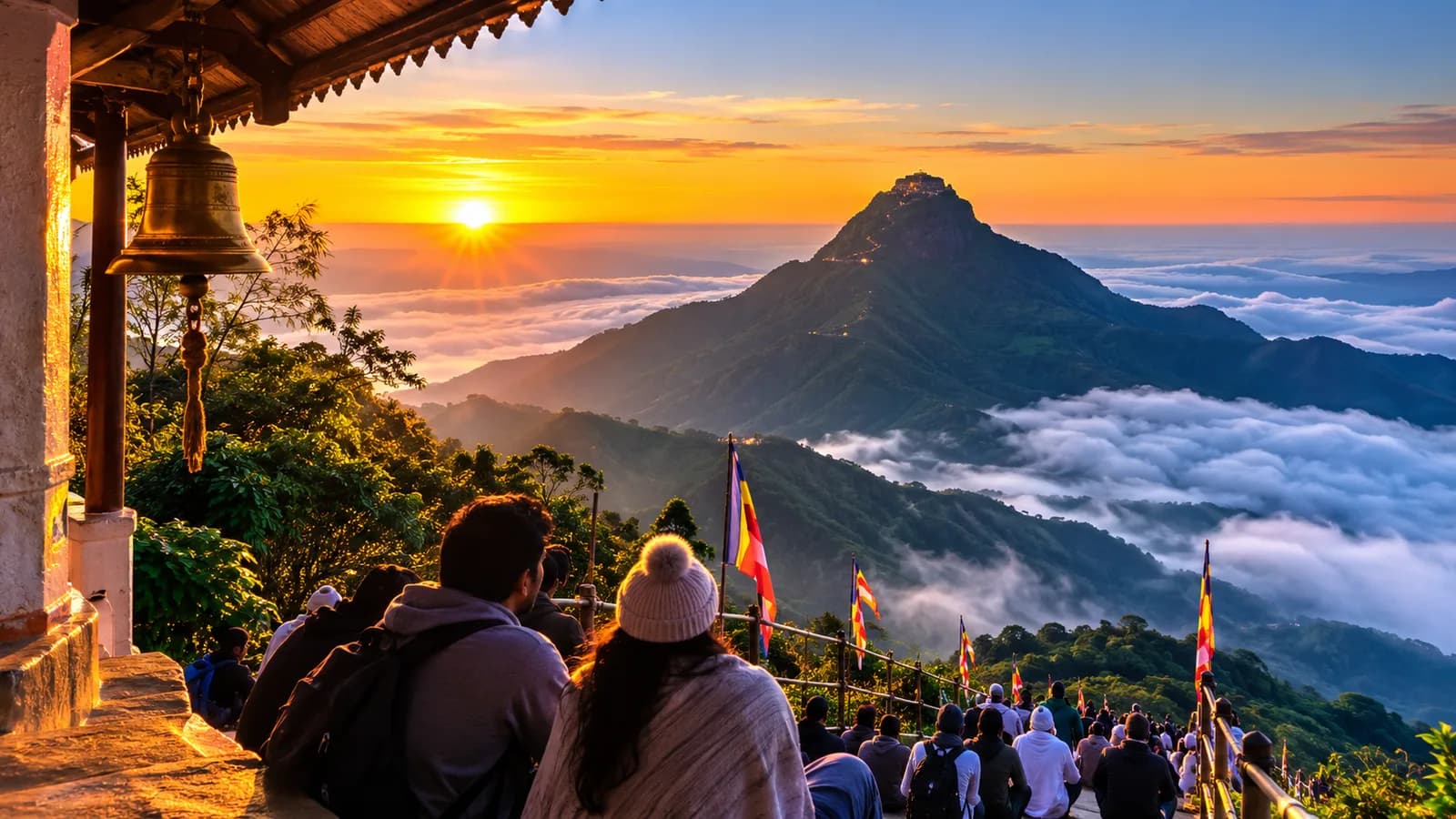
Few climbs in Sri Lanka carry the weight that Adam's Peak does. Known locally as Sri Pada, meaning sacred footprint, the mountain has drawn pilgrims for over a thousand years, and it remains one of the very few hikes in the country still treated first as an act of worship and only second as a tourist activity.
Buddhists believe the rock formation at the summit is the footprint of the Buddha. Hindus associate it with Shiva, Muslims and some Christians with Adam after his fall from Eden. That shared reverence across four faiths is part of what makes the mountain unusual among Sri Lanka's landmarks.
For travelers, the appeal is more physical and immediate: a demanding overnight staircase climb through cool highland forest, a lantern-lit trail crowded with pilgrims during the season, and a sunrise at the summit that, on a clear morning, casts the mountain's perfect triangular shadow across the clouds below.
This guide covers what matters most for planning the climb well in 2026: the pilgrimage season and its Poya calendar, the route options, what the climb actually involves, where to stay beforehand, and how to do it safely and respectfully.
Quick Summary
- Adam's Peak is a 2,243-metre sacred mountain in Sri Lanka's Central Highlands, climbed overnight to reach the summit by sunrise
- The official pilgrimage season runs from the December full moon (Unduwap Poya) to the May full moon (Vesak Poya)
- The Dalhousie (Nallathanniya) route is the most popular, best-lit, and most beginner-friendly of five possible routes
- The climb involves roughly 5,000 steps and typically takes 3 to 5 hours up, 2 to 4 hours down
- Outside the pilgrimage season the path is unlit, unmaintained in places, and best left to experienced hikers
- The famous triangular shadow phenomenon and the sunrise are the main reward for climbers who time the ascent correctly