
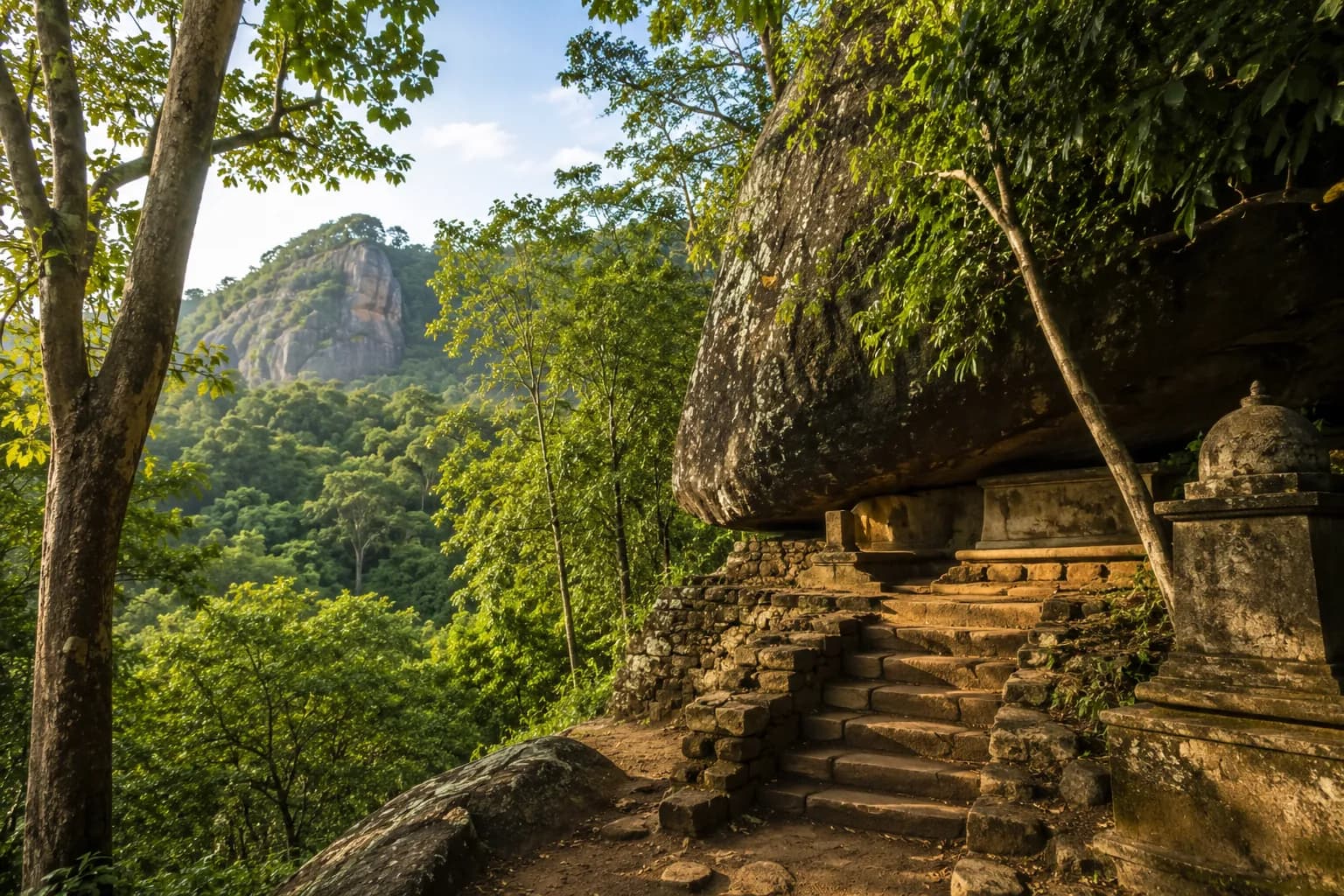
Most travelers who make it to Sri Lanka's Cultural Triangle spend their time between Sigiriya's rock fortress, Dambulla's painted caves, and the ancient capitals of Anuradhapura and Polonnaruwa. Ritigala rarely makes the list, and that is exactly its appeal.
Rising from the dry plains north of Habarana, Ritigala is an ancient forest monastery built into the slopes of the highest mountain in Sri Lanka's north-central region. Monks are believed to have lived here as early as the 3rd century BC, and by the 9th century the site had grown into a substantial monastic complex with dozens of buildings.
Unlike Sigiriya, Ritigala was never a palace or a symbol of royal power. It was a forest hermitage, built for monks who deliberately chose isolation, silence, and a life close to nature over the comforts of a city monastery. Walking its stone paths today still carries some of that same quiet.
This guide covers Ritigala's history, what you will actually see on site, how to visit responsibly given its status as a strict nature reserve, and how to fit it into a Cultural Triangle itinerary.
Quick Summary
- Ritigala is an ancient forest monastery on a mountain in Sri Lanka's Cultural Triangle, close to Habarana and Sigiriya
- It was established as a monastic site as early as the 3rd century BC and expanded significantly by King Sena I in the 9th century AD
- The site is far less visited than Sigiriya, Dambulla, or Anuradhapura, making it a genuinely quiet ruin to explore
- Highlights include the Banda Pokuna reservoir, stone stairways, ruined hermitages, and dense semi-evergreen forest
- The reserve is home to wild elephants, leopards, and sloth bears, so a guide is strongly recommended
- Ritigala sits about 21 km from Habarana and 32 km from Sigiriya, making it an easy half-day add-on
- Entrance fees are low compared with Sigiriya or the Ancient Cities ticket