
LankaTrip 见解

12 分钟阅读

Anuradhapura and Polonnaruwa: A Complete Guide to Sri Lanka's Ancient Capitals

Long before Kandy or Colombo, Sri Lanka's story was written in Anuradhapura and Polonnaruwa. Here is a complete guide to visiting the island's two great ancient capitals.

返回博客
Anuradhapura and Polonnaruwa: A Complete Guide to Sri Lanka's Ancient Capitals

Most first-time visitors to Sri Lanka head straight for Sigiriya's rock fortress, but the island's deeper story begins further north, in two cities that once ruled the entire country.

Anuradhapura and Polonnaruwa were successive royal capitals, together spanning more than 1,500 years of Sinhalese civilization, engineering, and Buddhist devotion.

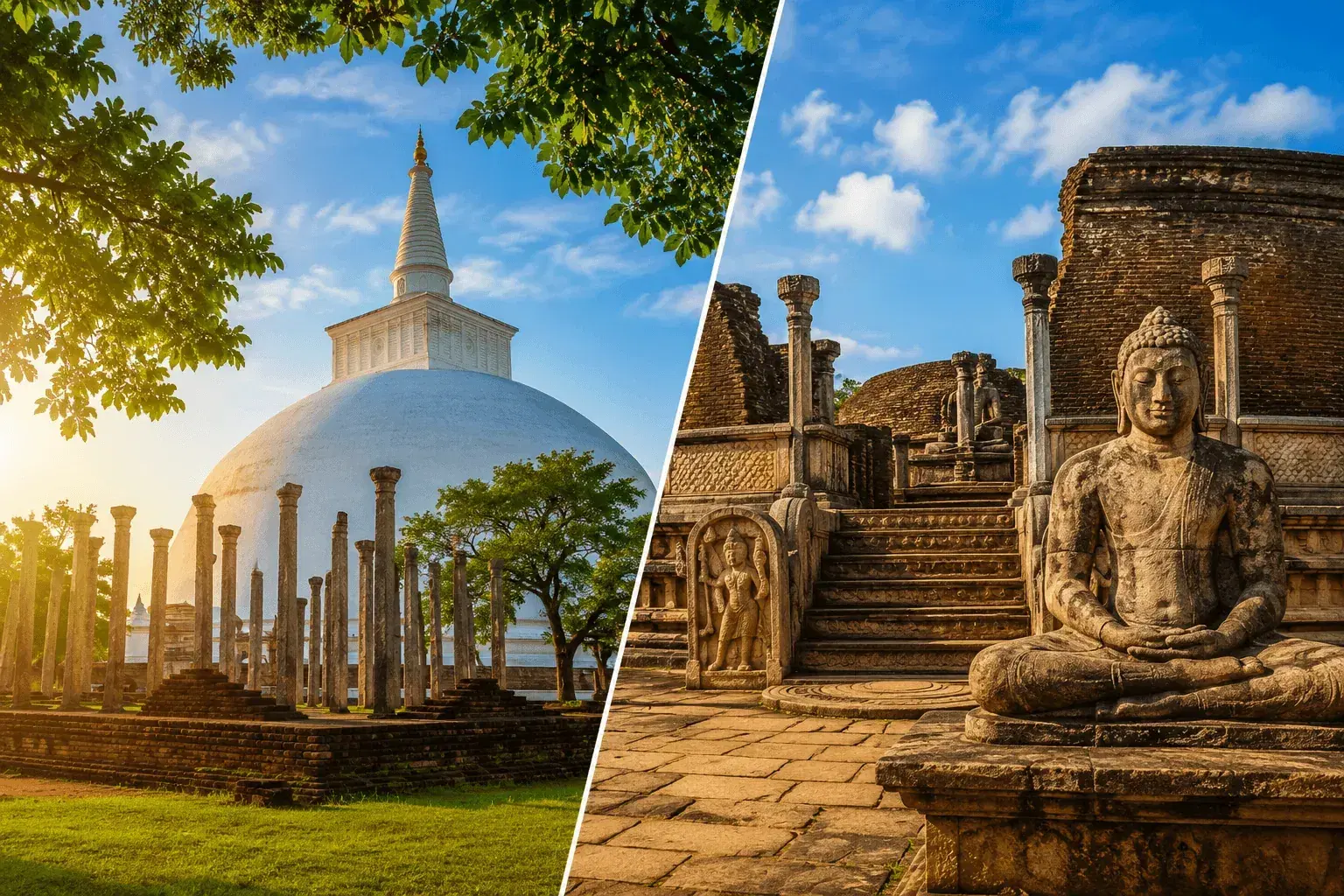
Anuradhapura came first, rising from around the 4th century BC into a sprawling sacred city of towering stupas, ancient monasteries, and ingenious irrigation works.

When Anuradhapura fell to invasion in the 10th century, power shifted east to Polonnaruwa, a more compact medieval capital famous for its finely carved stone art and grand reservoir.

Visiting either city, or both, offers a very different experience from the crowds and climbs of Sigiriya. These are places for slow cycling, quiet temples, ancient trees, and a genuine sense of stepping into Sri Lanka's deep past.

快速摘要

  • Anuradhapura was Sri Lanka's first great capital, founded more than 2,000 years ago
  • Polonnaruwa succeeded it as the island's second capital in the 11th century
  • Together with Sigiriya, Dambulla, and Kandy, they form Sri Lanka's Cultural Triangle
  • Anuradhapura is vast and spiritual; Polonnaruwa is compact and artistically rich
  • Both sites are UNESCO World Heritage Sites and require separate entrance tickets
  • Cycling is the most popular way to explore either city
  • Nearby Mihintale and Minneriya add easy extensions to a Cultural Triangle trip

Why Visit Sri Lanka's Ancient Capitals

Anuradhapura and Polonnaruwa are the historical anchors of Sri Lanka's Cultural Triangle, the region bounded roughly by Anuradhapura, Polonnaruwa, and Kandy that holds the island's greatest concentration of ancient monuments.

Where Sigiriya offers one dramatic rock and Dambulla offers painted caves, these two cities offer entire lost worlds: streets, palaces, monasteries, hospitals, and reservoirs that once supported thriving populations.

For travelers interested in Buddhism, archaeology, or simply quieter, greener sightseeing than a busy rock climb, both cities reward unhurried exploration.

They are also less physically demanding than Sigiriya. Most sites are reached on flat ground by bicycle, tuk-tuk, or car, making them accessible to a wide range of travelers, including families and older visitors.

Because the two cities differ so much in character, many travelers choose to visit both rather than pick one over the other.

Two UNESCO World Heritage citiesDeep Buddhist and royal historyFlat, cycling-friendly sitesQuieter than SigiriyaAnchors of the Cultural Triangle

Anuradhapura: The Sacred First Capital

Anuradhapura served as Sri Lanka's capital for roughly 1,300 years, from around the 4th century BC until the city's decline in the 10th century AD.

It grew into one of the ancient world's great urban centres, with sophisticated tank and canal systems that irrigated the surrounding dry-zone plains, some of which still function today.

The city is also considered one of the most sacred places in the Buddhist world, closely tied to the arrival of Buddhism in Sri Lanka in the 3rd century BC.

Unlike Polonnaruwa's compact core, Anuradhapura's heritage site spreads across a wide area of more than 40 square kilometres, mixing open plains, dense jungle, working monasteries, and rice paddies.

Because of this scale, a single rushed visit can feel overwhelming. Many travelers find that hiring a guide or driver, and pacing the day with rest breaks, leads to a far more enjoyable experience.

1,300 years as Sri Lanka's capitalOne of Buddhism's most sacred citiesSpread across 40+ square kilometresAncient tank and canal engineeringBest explored slowly with a guide

What to See in Anuradhapura

The Sri Maha Bodhi is one of the most revered sites in the city, believed to have grown from a cutting of the original Bodhi tree under which the Buddha attained enlightenment in India.

Ruwanwelisaya is a gleaming white dagoba considered one of the most important stupas in the Buddhist world, drawing pilgrims dressed in white who circle its base in quiet devotion.

Jetavanaramaya is a colossal brick stupa that was once among the tallest structures in the ancient world, and its scale is still striking even in its weathered state today.

The Abhayagiri Monastery complex holds some of the city's oldest ruins, including monastic buildings, bathing ponds, and stone carvings dating back roughly 2,000 years.

Kuttam Pokuna, or the Twin Ponds, showcases the refined stone bathing pools once used by resident monks, while Samadhi Buddha is a serene seated Buddha statue admired for its craftsmanship.

Given the number of major sites, most visitors select four or five highlights rather than attempting to see everything in one visit.

Sri Maha Bodhi sacred treeRuwanwelisaya dagobaJetavanaramaya stupaAbhayagiri MonasteryKuttam Pokuna twin pondsSamadhi Buddha statue

Add a Visit to Mihintale

Mihintale, located a short drive from Anuradhapura, is widely regarded as the place where Buddhism was formally introduced to Sri Lanka in the 3rd century BC.

A long stone stairway climbs through the forested hillside past shrines, caves, and ruins to a stupa at the summit, where panoramic views open across the surrounding plains.

The site combines pilgrimage, history, and light hiking, making it a popular half-day extension for travelers already based in Anuradhapura.

Because the climb involves several hundred steps, comfortable shoes and an early or late start are recommended to avoid the strongest heat of the day.

Many guides consider Mihintale one of the most atmospheric stops in the entire Cultural Triangle, particularly around sunset.

Birthplace of Buddhism in Sri LankaLong forested stairwayPanoramic summit viewsGood half-day extensionBest at sunrise or sunset

Polonnaruwa: The Medieval Second Capital

After Anuradhapura's decline following repeated invasions, power shifted east to Polonnaruwa, which became Sri Lanka's capital from around the 11th to 13th centuries.

The city reached its peak under King Parakramabahu I, a ruler remembered for transforming Polonnaruwa into a prosperous centre of art, religion, and hydraulic engineering.

His most famous legacy is the Parakrama Samudra, a vast man-made reservoir built on the principle that not a single drop of rainwater should be wasted.

Compared with Anuradhapura, Polonnaruwa's ruins are more compact, more architecturally intact, and generally easier to cover in a single day.

This combination of accessibility and artistic quality makes Polonnaruwa a favourite for travelers with limited time in the Cultural Triangle.

Sri Lanka's capital for roughly three centuriesPeak under King Parakramabahu IParakrama Samudra reservoirCompact and well-preservedEasier to cover in one day than Anuradhapura

What to See in Polonnaruwa

The Royal Palace Group includes the remains of King Parakramabahu's multi-storey palace and audience hall, with thick brick walls hinting at its original grandeur.

The Quadrangle, a raised platform enclosed by a wall, gathers several of Polonnaruwa's finest structures in one compact area, including the circular Vatadage relic house and the Thuparama image house.

Gal Vihara is the site's undisputed highlight, where four Buddha statues, including a reclining figure, are carved directly into a single granite rock face with remarkable precision.

Rankoth Vehera, the largest surviving stupa in Polonnaruwa, rises impressively from the flat surrounding grounds and remains an active place of worship.

The Parakrama Samudra reservoir borders the western edge of the ancient city and offers a scenic, breezy contrast to the stone ruins, especially toward late afternoon.

Because the site is relatively compact, cycling between these highlights typically takes a half day to a full day, depending on pace.

Royal Palace GroupThe Quadrangle and VatadageGal Vihara rock-carved BuddhasRankoth Vehera stupaParakrama Samudra reservoir

Anuradhapura or Polonnaruwa: Which to Choose

Travelers with limited time often ask whether to visit Anuradhapura or Polonnaruwa if only one is possible.

Polonnaruwa tends to suit travelers who want well-preserved, artistically striking ruins that can be covered comfortably in a single day, and it combines easily with a day trip from Sigiriya or Dambulla.

Anuradhapura suits travelers with a deeper interest in Buddhist pilgrimage, ancient engineering, and a slower, more contemplative pace, though it requires more time and tolerance for heat and distance.

Many visitors find that the two cities complement rather than duplicate each other, since Anuradhapura's atmosphere is spiritual and expansive while Polonnaruwa's is compact and sculptural.

Where the itinerary allows, spending one day at each site, ideally with an overnight stop nearby, gives the most complete picture of Sri Lanka's ancient capitals.

Polonnaruwa: compact and well preservedAnuradhapura: spiritual and expansiveBoth pair well with Sigiriya or DambullaConsider time, heat tolerance, and interestsTwo days covers both comfortably

Getting Around Both Sites

Cycling is the most popular and practical way to explore both cities, and bicycles can usually be hired near the entrance or arranged through a hotel or guesthouse.

Polonnaruwa's compact layout makes cycling especially rewarding, allowing visitors to move easily between clusters of ruins along shaded paths.

Anuradhapura's greater distances mean cycling can be tiring in the heat, so some travelers prefer a tuk-tuk or car with a driver for at least part of the visit.

A knowledgeable guide adds significant value at both sites, since many ruins have limited on-site signage and rich historical context that is easy to miss without explanation.

Both sites open early in the morning and close in the late afternoon, so plan arrival times accordingly to avoid rushing through the final hour.

Bicycles widely available near entrancesPolonnaruwa suits cycling wellAnuradhapura may need a driver or tuk-tukGuides add historical contextArrive early to allow enough time

Tickets, Fees, and Practical Planning

Both Anuradhapura and Polonnaruwa require separate entrance tickets, generally purchased at a museum or ticket counter near the main entrance before entering the archaeological areas.

Entrance fees for foreign visitors are considerably higher than for local visitors, reflecting the ongoing cost of conserving these large heritage sites.

Travelers planning to visit Sigiriya, Polonnaruwa, and Anuradhapura in one trip should budget accordingly, since combined costs across the Cultural Triangle can add up quickly.

Tickets and opening hours can change, so confirming current prices locally or through an official tourism source before travel is recommended.

Carrying identification, sun protection, water, and comfortable walking shoes is essential, since much of the walking happens in open, exposed areas.

Separate tickets for each cityHigher rates for foreign visitorsBudget for multiple Cultural Triangle sitesConfirm current prices locallyBring water, sun protection, and good shoes

Combining With the Rest of the Cultural Triangle

Anuradhapura and Polonnaruwa sit within easy reach of Sri Lanka's other major Cultural Triangle attractions, making a multi-day loop a popular way to explore the region.

Sigiriya's rock fortress and Dambulla's cave temples are both a manageable drive from either ancient city, allowing travelers to combine several UNESCO sites within a few days.

Nature lovers can add Minneriya or Kaudulla National Park for an elephant safari, particularly rewarding during the seasonal elephant gathering in the drier months.

Some travelers base themselves centrally, in or around Sigiriya, Dambulla, or Habarana, and take day trips out to Anuradhapura and Polonnaruwa rather than changing accommodation for each stop.

Planning routes in a loop, rather than backtracking, generally saves time and makes the most of a Cultural Triangle itinerary.

Close to Sigiriya and DambullaElephant safaris at Minneriya or KaudullaHabarana is a convenient central basePlan routes as a loopMulti-day Cultural Triangle itineraries work well

Best Time to Visit

The North Central Province, where both cities sit, generally experiences a drier climate than the hill country, with May to September often bringing sunnier, drier conditions.

The region can also be visited comfortably outside this window, though rain and humidity are more likely between the inter-monsoon and monsoon months.

Because much of the walking happens across open, exposed ground with little shade, early morning visits help avoid the strongest heat of the day.

Late afternoon light can also be rewarding for photography, particularly around Polonnaruwa's Parakrama Samudra and Anuradhapura's larger stupas.

Regardless of season, sun protection, a hat, and plenty of drinking water are essential for a comfortable visit.

May to September often drierVisitable year-round with rain possibleEarly morning avoids peak heatLate afternoon light for photographySun protection is essential

Visiting Respectfully

Both cities remain active places of worship as well as archaeological sites, so modest dress covering shoulders and knees is expected, and shoes and hats must be removed at sacred structures.

Visitors should move quietly around monks, pilgrims, and worshippers, and avoid climbing on stupas, statues, or ancient walls.

Photography is usually welcome, but posing with one's back to a Buddha statue, or in disrespectful positions near sacred images, should be avoided.

Both sites are home to resident monkeys and other wildlife. Visitors should not feed or approach animals, and should keep food secured.

Supporting local guides, cycle-hire operators, and small cafés around both cities helps ensure tourism benefits the surrounding communities that maintain these heritage sites.

Cover shoulders and kneesRemove shoes and hats at sacred sitesAvoid climbing on ruins or statuesPhotograph respectfullySupport local guides and small businesses

旅行贴士

  • Buy separate tickets for Anuradhapura and Polonnaruwa in advance where possible
  • Start early to avoid the strongest midday heat
  • Hire a bicycle for the most enjoyable way to explore either site
  • Bring water, sun protection, and a hat
  • Wear clothing that covers shoulders and knees
  • Carry a spare pair of socks since shoes must be removed at sacred sites
  • Hire a guide for richer historical context, especially in Anuradhapura
  • Do not climb on stupas, statues, or ancient walls
  • Keep a safe distance from monkeys and other wildlife
  • Confirm current entrance fees and opening hours locally
  • Plan Cultural Triangle stops as a loop to save travel time
  • Allow extra time at Anuradhapura given its larger scale

常见问题

What is the difference between Anuradhapura and Polonnaruwa?

Anuradhapura was Sri Lanka's first capital and is a vast, spiritually significant sacred city spread across a wide area. Polonnaruwa was the second capital, and its ruins are more compact and artistically well preserved, making it easier to cover in a single day.

Can I visit both cities in one trip?

Yes. Many travelers visit both, often basing themselves centrally near Sigiriya, Dambulla, or Habarana and taking day trips, or spending a night near Anuradhapura before continuing to Polonnaruwa.

How much time do I need for each site?

Polonnaruwa can be covered well in half a day to a full day, while Anuradhapura's larger scale often benefits from a full day or more, especially if paired with Mihintale.

Is cycling the best way to explore these sites?

Cycling is popular and enjoyable at both sites, and especially suited to Polonnaruwa's compact layout. Anuradhapura's greater distances mean some travelers prefer a tuk-tuk or car for part of the visit.

Do I need a guide?

A guide is not required but is strongly recommended, particularly at Anuradhapura, since on-site signage is limited and the historical context greatly enriches the visit.

What should I wear when visiting?

Modest clothing covering shoulders and knees is expected, and shoes and hats must be removed at sacred structures such as stupas and image houses.

What is Gal Vihara?

Gal Vihara is a rock shrine in Polonnaruwa featuring four Buddha statues, including a large reclining figure, carved directly into a single granite rock face. It is considered one of the finest examples of ancient Sri Lankan stone sculpture.

Can these ancient cities be combined with a safari?

Yes. Minneriya and Kaudulla National Parks are both within reach of Polonnaruwa and are well known for elephant sightings, particularly during the seasonal elephant gathering.

Is Mihintale worth visiting?

Yes. Mihintale is regarded as the site where Buddhism was introduced to Sri Lanka and offers a scenic climb, historic shrines, and panoramic views, making it a worthwhile half-day extension from Anuradhapura.

读者笔记

参与讨论

分享你对这篇指南的问题、建议或旅行经历。

评论

0 条评论

加载中...

准备把灵感变成斯里兰卡之旅了吗?

使用 LankaTrip 规划行程、联系本地向导,把这份行程变为现实。

需要规划帮助?

规划你的斯里兰卡之旅

规划我的旅程