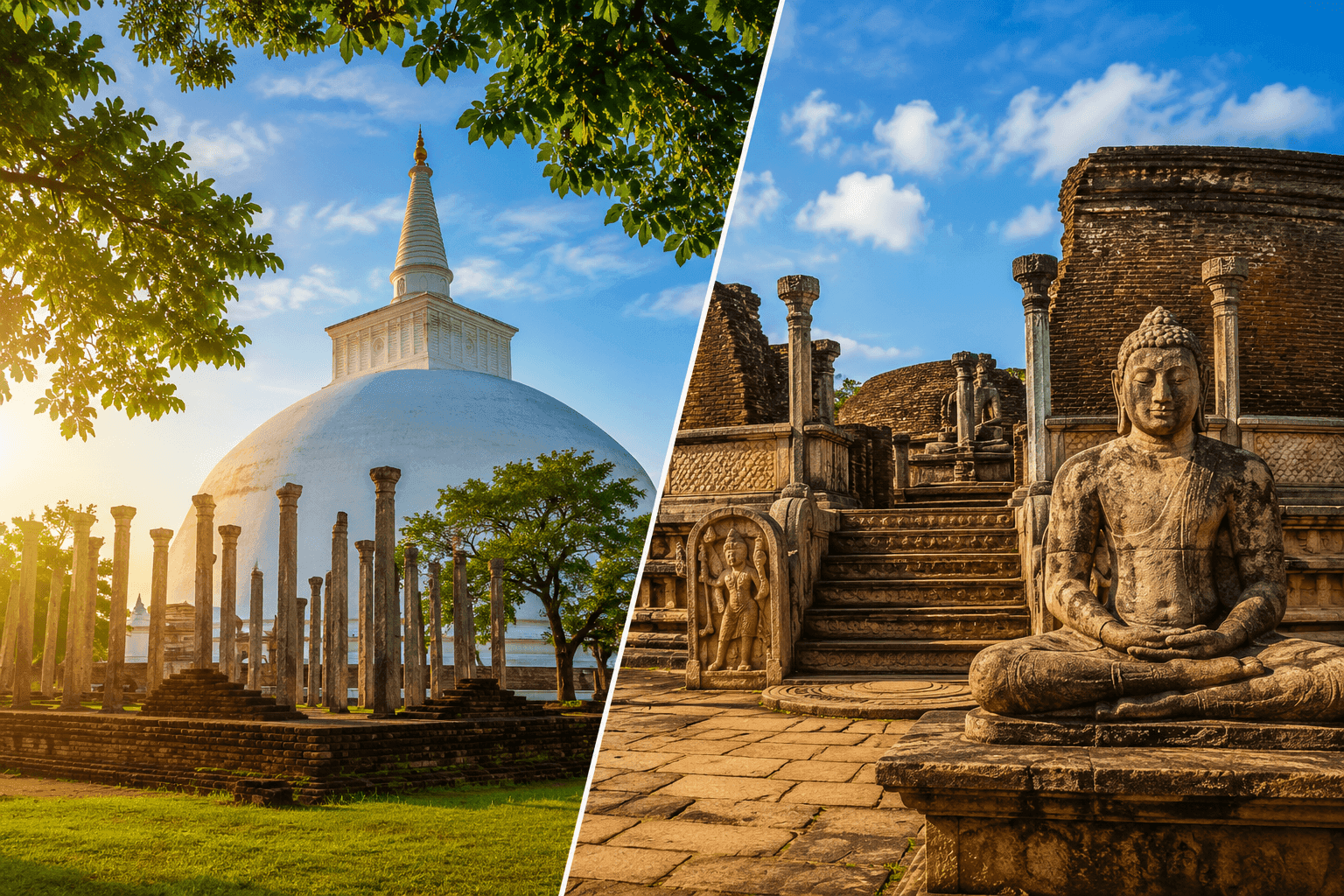
Most first-time visitors to Sri Lanka head straight for Sigiriya's rock fortress, but the island's deeper story begins further north, in two cities that once ruled the entire country.
Anuradhapura and Polonnaruwa were successive royal capitals, together spanning more than 1,500 years of Sinhalese civilization, engineering, and Buddhist devotion.
Anuradhapura came first, rising from around the 4th century BC into a sprawling sacred city of towering stupas, ancient monasteries, and ingenious irrigation works.
When Anuradhapura fell to invasion in the 10th century, power shifted east to Polonnaruwa, a more compact medieval capital famous for its finely carved stone art and grand reservoir.
Visiting either city, or both, offers a very different experience from the crowds and climbs of Sigiriya. These are places for slow cycling, quiet temples, ancient trees, and a genuine sense of stepping into Sri Lanka's deep past.
त्वरित सारांश
- Anuradhapura was Sri Lanka's first great capital, founded more than 2,000 years ago
- Polonnaruwa succeeded it as the island's second capital in the 11th century
- Together with Sigiriya, Dambulla, and Kandy, they form Sri Lanka's Cultural Triangle
- Anuradhapura is vast and spiritual; Polonnaruwa is compact and artistically rich
- Both sites are UNESCO World Heritage Sites and require separate entrance tickets
- Cycling is the most popular way to explore either city
- Nearby Mihintale and Minneriya add easy extensions to a Cultural Triangle trip