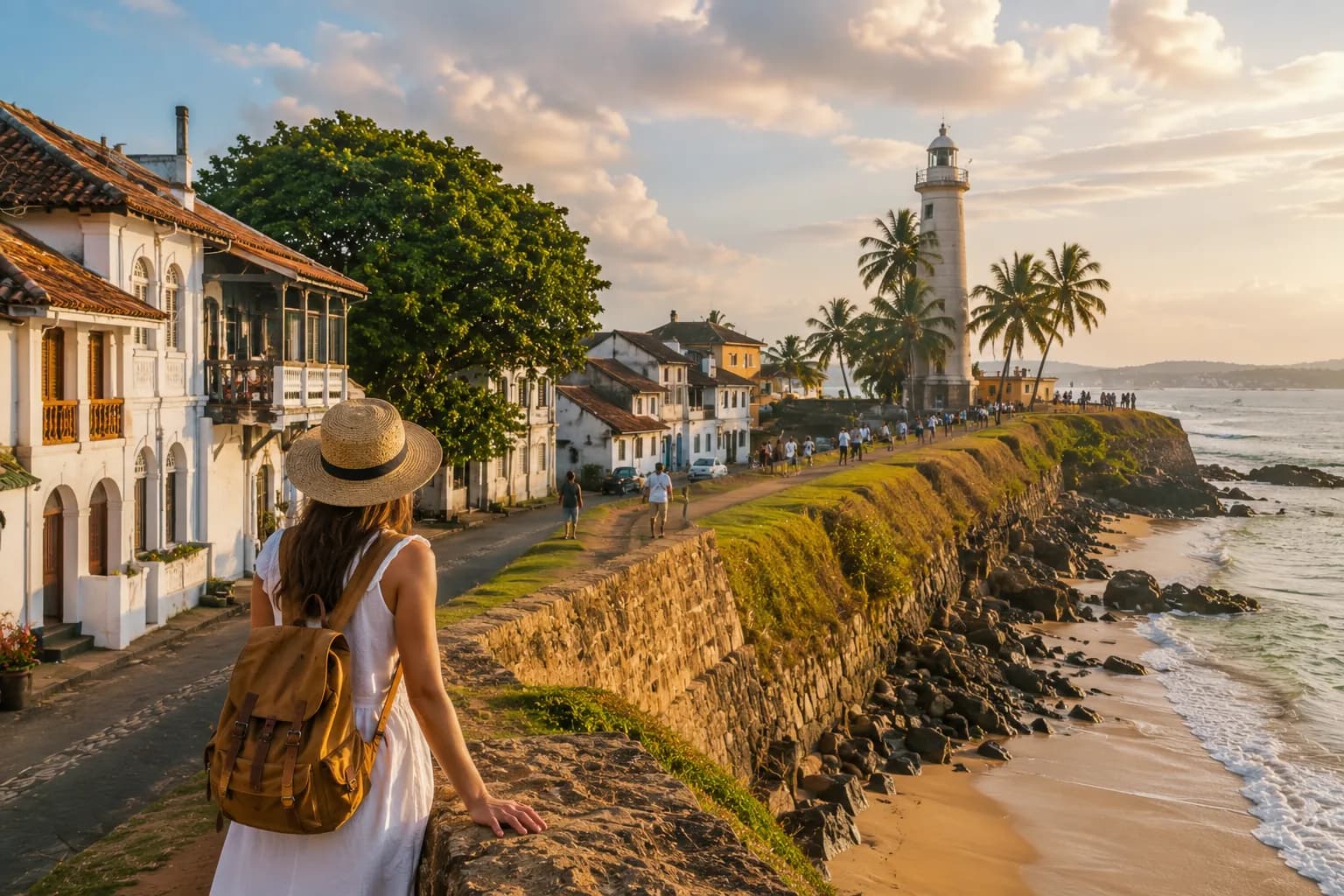
Few places in Sri Lanka compress this much history into so small a space. Galle Fort sits on a rocky promontory at the southern tip of Galle city, enclosed by ramparts that have stood since the 17th century, and it remains one of the best-preserved examples of a European-built fortified town anywhere in South Asia.
Walk through its main gate and the atmosphere changes almost immediately. Traffic noise fades, the streets narrow, and colonial-era villas painted in faded pastels give way to courtyard cafés, jewellery ateliers, and centuries-old churches that still hold regular services.
Galle Fort was never abandoned or turned into a purely commercial attraction. Families have lived inside its walls for generations, which is part of why UNESCO inscribed it as a World Heritage Site in 1988 and why it still feels like a real town rather than a recreation of one.
This guide covers what to see and do inside the fort, how to plan your time, where to stay and eat, the best day trips nearby, and the practical details that make a visit smoother, from the best time to go to how to behave respectfully in a neighbourhood people call home.
त्वरित सारांश
- Galle Fort is a UNESCO-listed fortified town on Sri Lanka's south coast, built by the Portuguese and expanded by the Dutch
- Its 17th-century ramparts, bastions, and lighthouse remain remarkably intact and are free to explore on foot
- Highlights include the lighthouse, the rampart walk, the Dutch Reformed Church, the Old Dutch Hospital, and the Maritime Museum
- The fort survived the 2004 tsunami largely thanks to its original Dutch-built sea walls
- It works well as a full-day stop or as a base for exploring Unawatuna, Jungle Beach, and the wider south coast
- Galle is easily reached from Colombo by train, private driver, or the Southern Expressway in about 2 to 3 hours