LankaTrip जानकारी

21 मिनट पढ़ें

Learning to Surf in Sri Lanka in 2026: The Complete Beginner's Guide

Warm water, soft sandy-bottom waves, and lessons from around 20 US dollars make Sri Lanka one of the easiest places on earth to learn to surf. This 2026 guide covers where beginners should go, what to expect from your first lesson, camp costs, and how to pick a safe, legitimate surf school.

ब्लॉग पर वापस
Learning to Surf in Sri Lanka in 2026: The Complete Beginner's Guide

Most people who dream of learning to surf imagine two obstacles: cold water and expensive lessons. Sri Lanka removes both.

The sea here stays around 27 to 29 degrees Celsius all year, warm enough that a wetsuit is never part of the conversation. A 90-minute group lesson with a board, rash guard, and instructor costs about what a single coffee-shop breakfast does in Sydney or London. And the island's signature learning wave, the long, soft, sandy-bottom roller of Weligama Bay, is about as gentle an introduction to the sport as the ocean offers anywhere.

That combination is why Sri Lanka has quietly become one of the world's great learn-to-surf destinations, drawing complete beginners from Europe, Australia, and increasingly North America to a string of laid-back coastal villages where the daily rhythm is surf, eat, nap, repeat.

This guide is written for the traveler who has never stood on a surfboard, or who has had one wobbly lesson on holiday and wants to actually learn. It covers where to go in 2026 depending on your dates, what lessons and camps genuinely cost, how to choose a school you can trust, what your first week in the water will really feel like, and the safety and etiquette basics that keep the experience fun.

If you are already an intermediate or advanced surfer researching reef breaks and swell windows, our general Sri Lanka surfing guide covers the full spot map. This one is for first waves.

त्वरित सारांश

  • Sri Lanka is one of the cheapest and most forgiving places in the world to learn to surf, with group lessons from roughly 18 to 25 US dollars
  • Total beginners learn fastest on the south coast from November to April, and at the east coast's gentler bays from May to September
  • Weligama is the island's beginner nursery: a huge sandy-bottom bay where almost everyone stands up in their first lesson
  • Surf camps bundle accommodation, daily lessons, and breakfast from roughly 300 to 700 euros per week; individual lessons suit shorter trips
  • Five to seven days of daily surfing is the realistic minimum to go from never-surfed to catching small green waves
  • Choose schools with certified instructors, small student ratios, soft beginner boards, and clear safety briefings

Why Sri Lanka Is One of the Best Places on Earth to Learn

Plenty of countries have surf schools. A few things make Sri Lanka unusually kind to beginners.

The waves themselves are the biggest factor. Swells travel a long way before reaching the island and are softened further by outlying reefs, so Sri Lankan waves are famously fatter and slower than their Indonesian cousins. For an experienced surfer chasing barrels, that is a compromise. For someone learning to pop up, it is a gift: the wave gives you time.

The learning beaches are mostly sandy-bottomed. Falling, which you will do constantly in week one, means splashing into warm water over sand rather than scraping across reef.

Costs stay low at every level. Group lessons run roughly 18 to 25 US dollars for about 90 minutes including the board and rash guard, private lessons from around 25 to 40 dollars, and daily board rental just a few dollars once you can manage on your own. A week at a surf camp with accommodation, daily lessons, and breakfast typically lands between 300 and 700 euros, which undercuts comparable packages in Portugal, Costa Rica, or Australia significantly.

The dual-coast seasons mean there is a beginner-friendly wave somewhere on the island every month of the year, something very few surf destinations can claim.

Finally, the scene is sociable and unintimidating. The beginner bays are full of other people at exactly your level, instructors push you into waves with cheerful patience, and the village atmosphere in places like Weligama, Ahangama, and Arugam Bay is built around new surfers rather than merely tolerating them.

Soft, slow waves that give beginners timeWarm water year-round, no wetsuitGroup lessons from about 18 to 25 USDSandy-bottom learning beachesA beginner wave somewhere every month

When to Come and Which Coast to Choose

Sri Lanka's two monsoons split the surfing year between opposite coasts, and beginners should follow the season rather than fight it.

From roughly November to April, the south and southwest coast is in its dry season and its learning bays are at their best. This is when Weligama, Ahangama, Midigama, Hiriketiya, and Hikkaduwa hum with surf schools and camps, and it is the right window for most first-time visitors combining surfing with the classic island itinerary.

From roughly May to September, the pattern flips. The south gets rain and wind-chopped seas while the east coast enjoys sunshine and clean, organised swell. Arugam Bay is the hub, and while its famous main point suits experienced surfers, the gentler beaches nearby give beginners a proper east-coast season. July and August, right now as this guide is published, are the heart of it.

October and April are transition months: surfable, quieter, and cheaper, but with less predictable conditions on both coasts.

One honest warning that saves beginners disappointment: do not plan to surf both coasts on one short trip. The drive between the south coast and Arugam Bay takes the better part of a day, and the coast you are leaving will be out of season anyway. Pick the coast that matches your dates and stay put; progress comes from surfing the same forgiving wave daily, not from collecting spots.

Whichever window you choose, mornings are almost always the best time to learn, before the wind rises and while the light is soft.

November to April: south coast seasonMay to September: Arugam Bay and the eastSurf mornings before the wind risesDo not try both coasts in one short tripTransition months are quiet and cheap

Weligama: The Island's Learning Nursery

If one beach explains Sri Lanka's rise as a learn-to-surf destination, it is Weligama.

The name means sandy village, and the bay lives up to it: a broad, gently curving stretch of sand more than a kilometre long, where slow whitewater rollers reform again and again all the way to the beach. The bottom is sand, the water is waist to chest deep across a huge area, and on a normal day there is enough room for every surf school in town to operate without crowding each other.

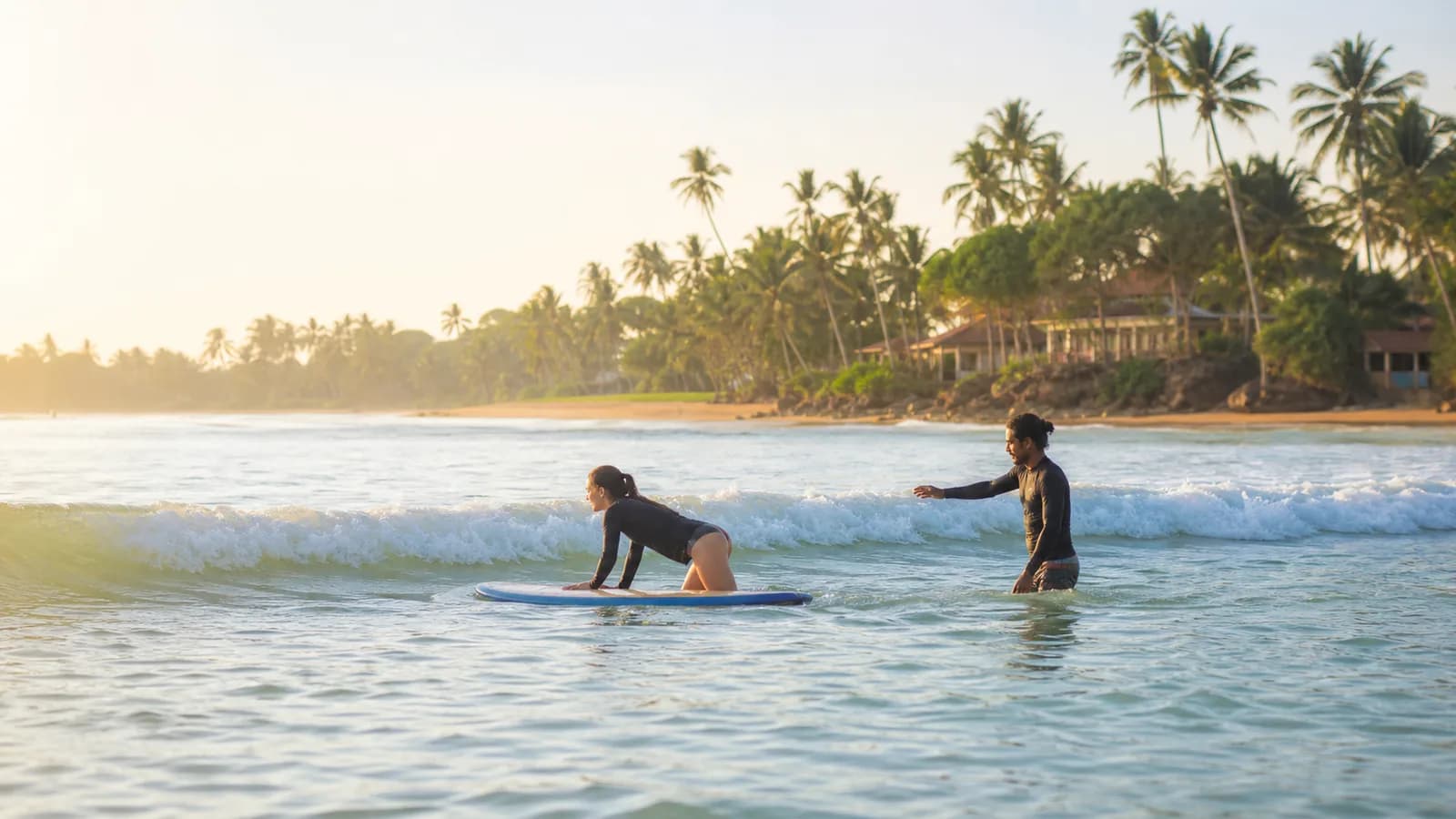
This is where most people stand up for the first time, usually within their very first lesson. Instructors wade beside you, pick your wave, steady the tail of the board, and push you into the moving whitewater while shouting the pop-up count you practised on the sand. The wave then does most of the work.

Weligama's other advantage is infrastructure. The town is dense with surf schools, camps, board-rental stands, cafés, and guesthouses at every budget, and it sits on the coastal rail line and main road, an easy connection from Galle, Mirissa, and the rest of the southern circuit covered in our itinerary guide.

Its weakness is the flip side of its strength: in high season the whitewater zone gets busy with other learners, and the bay's sheer gentleness means that once you can catch unbroken waves you will outgrow it. That is exactly the moment to move down the coast.

Nearby, Hiriketiya's pretty horseshoe bay and the small beaches around Ahangama and Midigama offer the next step: mellow green waves for improving beginners, in quieter and more boutique surroundings, with Hikkaduwa further west providing a livelier old-school surf-town alternative.

Kilometre-long sandy-bottom bayMost people stand up in lesson oneDense with schools, camps, and cafésEasy transport links on the south coastGraduate to Ahangama or Hiriketiya

Arugam Bay for Beginners: The East Coast Season

Arugam Bay's reputation was built on a long right-hand point break that is genuinely world class, and genuinely not a beginner wave. But the surrounding coastline hides some of the friendliest learning waves in the country, which is why the village fills with first-timers every east-coast season.

The pattern in Arugam Bay is that schools drive students a short distance to whichever nearby beach suits the day's conditions and the group's level. Several spots within a tuk-tuk ride of the village offer soft, sandy-bottomed peelers that play the same role Weligama does in the south, while the famous points wait for the day your skills catch up.

The village itself is a single laid-back strip of surf camps, restaurants, and juice bars with a distinctly backpacker energy: younger and more nightlife-flavoured than the south coast's boutique scene, and extremely easy to arrive at alone and leave with friends.

Getting there is the honest trade-off. Arugam Bay sits on the far side of the island, roughly seven to eight hours by road from Colombo, and is best reached as the finale of an inland route through the hill country and the Cultural Triangle rather than as a quick hop from the airport.

For a May-to-September traveler, that structure is ideal: run the classic inland loop first, then reward yourself with a week of morning lessons and hammock afternoons on the east coast while the south sits in its monsoon.

Learner beaches a tuk-tuk ride from the villageSeason runs May to SeptemberSociable backpacker village energySeven to eight hours by road from ColomboPerfect finale to an inland itinerary

Surf Camp or Individual Lessons: Which Should You Book?

Beginners in Sri Lanka choose between two models, and the right one depends mostly on trip length and travel style.

Individual lessons are the flexible option. You book session by session with a school on the beach, typically 90 minutes in a small group for roughly 18 to 25 US dollars, or privately for about 25 to 40. Most schools sell discounted packs of five or ten lessons. This suits travelers weaving a few surf days into a wider itinerary, families testing whether the kids take to it, and anyone who prefers choosing their own accommodation and daily rhythm.

Surf camps bundle the whole experience: a room, daily breakfast, one or two coached sessions each day, boards, and usually extras such as video analysis, yoga classes, and social dinners. Weekly prices in 2026 broadly run from around 300 euros for simple shared setups to 700 euros or more for boutique camps with pools and private ensuite rooms. Per session, camps often work out cheaper than à la carte lessons, and the structure removes every decision except showing up.

The camp model has a second, underrated benefit for solo travelers: an instant social circle. Meals, sessions, and sunset gatherings are shared, and many people book a week alone and describe the group as the best part of the trip.

The honest downsides: camps lock you into one location and schedule, quality varies widely behind similar-looking websites, and some operate week-to-week cycles that suit fixed Saturday-to-Saturday flights better than flexible wandering.

A sensible hybrid for a two-week trip: one structured camp week to build the foundation, then a second week of independent surfing with occasional private lessons at the next beach along the coast.

Lessons: flexible, roughly 18 to 25 USD per group sessionCamps: 300 to 700 euros per week bundledCamps suit solo travelers sociallyLesson packs suit mixed itinerariesHybrid: camp week, then independent week

How to Choose a Surf School You Can Trust

Surf schools in Sri Lanka range from excellent, professionally run operations to a man with foam boards and no training, and the price difference between them can be just a few dollars. Since we never recommend specific businesses, here is the checklist that separates the good ones wherever you are on the coast.

Ask about instructor qualifications. Look for internationally recognised surf-instructor certification and, crucially, lifesaving or water-rescue training. A confident local surfer is not automatically a competent instructor.

Check the student-to-instructor ratio. For true beginners, three or four students per instructor is the acceptable ceiling; some schools push eight or more into the water with one coach, which is both slower for learning and meaningfully less safe.

Look at the equipment. Beginners belong on large soft-top foam boards with leashes in good condition, and every student should be offered a rash guard. Battered fibreglass boards handed to first-timers are a warning sign.

Expect a proper land briefing. A legitimate first lesson spends 15 to 20 minutes on the sand covering safety, how to fall, how to carry and control the board, and the pop-up technique before anyone touches the water. A school that skips straight to pushing you into waves is skipping the part that protects you.

Read recent reviews on major platforms, weighting the ones that mention safety, patience, and small groups over the ones that only mention fun photos. Video analysis, included photos, and structured multi-day progression plans are all signs of a school that takes teaching seriously.

Finally, trust the beach test: watch a school teach for ten minutes before booking. You will see immediately whether instructors are in the water engaged with students or chatting on the sand.

Certified instructors with rescue trainingMaximum three to four beginners per coachSoft-top boards and rash guards providedProper land briefing before entering waterWatch a school teach before you book

What Your First Week in the Water Actually Looks Like

Knowing the normal learning curve saves you from the two classic beginner emotions: false confidence on day one and false despair on day three.

Day one is usually a triumph. In whitewater with an instructor pushing you into waves, most reasonably fit people stand up several times in their first 90-minute session. You will leave the beach convinced surfing is easy.

Days two and three are the humbling. Your arms ache from paddling, the pop-up that worked yesterday deserts you, and you swallow more of the Indian Ocean than seems fair. This is universal. Paddling strength and timing simply take a few days to build, and every surfer on the beach went through it.

Days four and five are where it clicks. You start catching whitewater without a push, your pop-up becomes one motion instead of three, and your instructor begins talking about the unbroken green waves further out.

By days six and seven, most committed learners catch their first small green wave, the moment the ocean lifts you and the board accelerates down a smooth face rather than churning foam. It is the sensation people cross the world for, and it typically arrives at the end of week one, not the start.

Practical rhythms that speed this up: surf every day rather than every other day, favour early-morning sessions when winds are light and your energy is fresh, limit sessions to around two hours before technique collapses with fatigue, and spend afternoons resting rather than booking a second exhausting activity. Stretch, hydrate, and use far more sunscreen than feels reasonable; the tropical sun off the water burns even on cloudy days.

Two weeks of this, and you will paddle out at a mellow point on your own. That is the realistic, genuinely achievable promise of learning in Sri Lanka.

Day one: standing up in whitewaterDays two to three: the universal humblingDays six to seven: first green waveSurf daily, mornings, two hours maximumTwo weeks to independent surfing

Staying Safe and Surfing Politely

Surfing in Sri Lanka is very safe for beginners who follow a few non-negotiable rules, and unnecessarily risky for those who ignore them.

Never take your first sessions alone. Currents, sandbanks, and rips are invisible to the untrained eye, and instructors position you where the water is safe as much as where the waves are good. Once independent, always ask a local school or lifeguard about conditions and hazards before paddling out at an unfamiliar beach, and stay well away from river mouths after heavy rain.

Protect your head when you fall: fall flat or feet-first, never dive, and surface with your arms over your head, because the board snapping back on its leash causes more beginner injuries than the seabed does.

Respect the beginner zones. Learning areas and the lineups at proper breaks are kept separate for good reason; a runaway foam board in a crowd of surfers is dangerous, so stay in the whitewater zones until an instructor confirms you are ready to move out.

Learn the two etiquette rules that matter from day one: the surfer closest to the breaking part of the wave has priority, so do not paddle for a wave someone is already riding, and never ditch your board and dive under an oncoming wave when other people are behind you.

Respect the ocean's schedule and your own limits: if the waves look bigger than yesterday, they are, and there is no prize for paddling out tired, hungover, or scared. The waves return every morning.

Finally, respect the place. The surf economy supports entire villages here. Learn a few words of Sinhala or Tamil, keep beaches clean, dress modestly away from the sand, and remember that the friendly crew pushing you into waves are professionals at work, for whom an end-of-week tip is genuinely meaningful.

First sessions always with an instructorCover your head when you fallStay in beginner zones until clearedPriority rule: one surfer per waveAsk locals about currents at new beaches

What a Learn-to-Surf Trip Costs in 2026

Surfing is the cheap part of a Sri Lanka trip, which surprises travelers used to European or Australian surf pricing.

Budget the surfing itself first. Group lessons run roughly 18 to 25 US dollars, private lessons about 25 to 40, and five-lesson packs bring the per-session price down further. Once independent, soft-top rental costs only a few dollars per session or by the day. A camp week, as covered above, bundles everything from around 300 to 700 euros.

Living costs in the surf villages stay gentle: local rice-and-curry lunches for a few dollars, Western café breakfasts for five to eight, guesthouse rooms from budget backpacker rates to boutique beachfront, and tuk-tuk hops between beaches for small change. A realistic all-in week for an independent learner, with mid-range guesthouse, daily group lessons, and mixed local and café eating, lands around 400 to 600 US dollars excluding flights, and dedicated budget travelers do it for less.

Cash matters more than cards in the surf villages. Many schools, beach rental stands, small cafés, and tuk-tuks are cash-only, so arrive with rupees; our money and connectivity guide covers ATMs, fees, and SIMs in detail.

Two spending tips that pay for themselves: buy or bring high-SPF reef-safe sunscreen and zinc, because quality sunscreen is expensive and patchy locally, and consider a simple long-sleeve rash guard or surf leggings, which prevent both sunburn and board rash better than sunscreen alone.

Check that your travel insurance covers surfing. Most standard policies do at beginner level, but confirm rather than assume, and note any clause about surfing outside instructed sessions.

Lessons: 18 to 40 USD depending on formatIndependent week: roughly 400 to 600 USD all-inCash-only culture in surf villagesBring reef-safe sunscreen and a rash guardConfirm insurance covers surfing

What to Pack (and What to Leave at Home)

Beginners routinely overpack for surf trips. Everything technical is available or rentable on the coast, so travel light and buy the gaps locally.

Bring: two swimsuits or boardshorts that stay put in whitewater, a long-sleeve rash guard, reef-safe high-SPF sunscreen and face zinc, a wide-brim hat and sunglasses for the beach, flip-flops, a quick-dry towel, basic first-aid tape and antiseptic for the inevitable scrapes, motion-friendly travel insurance documents, and any personal medication.

Do not bring a surfboard. Beginner soft-tops are everywhere for a few dollars a day, airlines charge painful board fees, and you will not know what board suits you until you have surfed for a couple of weeks anyway. The same logic applies to wetsuits, which you will never wear here.

Useful extras if you have space: a reusable water bottle, since sessions are dehydrating and refill stations are spreading through the surf towns, a dry bag for beach days, and a small padlock for camp lockers.

For women, a well-fitting one-piece or sports bikini under surf leggings is the practical combination most female instructors themselves wear; whitewater is ruthless with delicate swimwear.

Leave valuables at your accommodation. The beach culture is honest, but an unattended phone on a busy learner beach is a temptation nowhere needs, and salt water ends more electronics than theft does.

Rent boards; never fly them in as a beginnerLong-sleeve rash guard beats sunscreen aloneReef-safe sunscreen from homeNo wetsuit, everLeave valuables off the beach

Beyond the Lessons: Building a Trip Around Learning to Surf

A learn-to-surf week has a shape that leaves half of every day free, and Sri Lanka is unusually good at filling that half.

On the south coast, the surf villages sit within easy reach of the region's other headline experiences: seasonal whale watching from Mirissa in the November-to-April window, the lanes and ramparts of Galle Fort, gentle lagoon and river trips, and the beaches east toward Tangalle for a rest day without a board. All of it connects by short tuk-tuk and train hops.

On the east coast, Arugam Bay pairs naturally with an evening wildlife drive toward the lagoons and the fringes of the nearby national parks, where elephants are a regular roadside sight in season.

Surf-and-yoga is the classic combination, and most camps and villages offer daily classes; the stretching genuinely helps the week-one shoulder ache. Ayurvedic massage, covered honestly in our Ayurveda guide, is the other traditional recovery ritual worth trying at a legitimate centre.

If you are building the surf week into a longer route, the itinerary logic is simple: put the surf block at the end. Learning is physical, and a week that finishes with slow beach mornings sends you home rested rather than rushed. Our full 7, 10, and 14-day itinerary guide shows exactly where a south-coast or east-coast surf stay slots into the classic loops.

However you structure it, the honest promise of learning to surf here is bigger than the sport: a week of mornings in warm water, a skill that stays with you for life, and a very good answer the next time someone asks what you did on holiday.

Whale watching and Galle Fort from the south villagesWildlife evenings near Arugam BayYoga genuinely helps week-one achesPut the surf block at the end of your routeA skill that stays for life

यात्रा सुझाव

  • Book your first lessons for early morning before the wind rises
  • Surf consecutive days rather than spacing sessions out
  • Watch a school teach for ten minutes before booking with them
  • Insist on a land safety briefing in your first lesson
  • Wear a long-sleeve rash guard and reapply sunscreen after every session
  • Carry cash: schools, rentals, and beach cafés are often cash-only
  • Cover your head with your arms every time you surface after a fall
  • Stay in the whitewater learner zones until your instructor clears you
  • Limit sessions to about two hours before fatigue ruins technique
  • Confirm your travel insurance explicitly covers surfing
  • Do not try to surf both coasts on one short trip
  • Tip your instructor at the end of the week; it is customary and earned

अक्सर पूछे जाने वाले प्रश्न

Where is the best place to learn to surf in Sri Lanka?

Weligama on the south coast is the island's classic learning beach, with a long sandy-bottom bay of gentle whitewater and dozens of schools, at its best from November to April. From May to September, the beginner-friendly beaches around Arugam Bay on the east coast take over.

How much do surf lessons cost in Sri Lanka in 2026?

Group lessons of about 90 minutes typically cost 18 to 25 US dollars including the board and rash guard, private lessons roughly 25 to 40 dollars, and multi-lesson packs bring prices down further. Board rental for independent practice costs just a few dollars per session.

How much does a surf camp in Sri Lanka cost?

Weekly camp packages bundling accommodation, breakfast, daily lessons, and boards broadly run from around 300 euros for simple setups to 700 euros or more for boutique camps with pools and private rooms, which is significantly cheaper than comparable camps in Europe or Australia.

When is the surf season in Sri Lanka?

There are two: the south and southwest coast works from roughly November to April, and the east coast around Arugam Bay from May to September. Beginners should simply choose the coast that is in season for their travel dates.

How long does it take to learn to surf?

Most beginners stand up in whitewater during their first lesson, catch their first unbroken green wave around days six to seven of daily surfing, and can paddle out independently at gentle spots after about two weeks. Five to seven consecutive days is the realistic minimum for genuine progress.

Do I need a wetsuit in Sri Lanka?

No. Water temperatures stay around 27 to 29 degrees Celsius all year. A long-sleeve rash guard for sun protection is the only extra layer beginners need.

Is Sri Lanka safe for beginner surfers?

Yes, provided beginners take their first sessions with instructors, stay in designated learner zones, protect their heads when falling, and ask locals about currents before surfing unfamiliar beaches independently. The learning bays are sandy-bottomed and generally forgiving.

Can I learn to surf in Sri Lanka as a solo traveler?

Sri Lanka is one of the easiest places in the world to do exactly that. Group lessons and surf camps create instant social circles, and villages like Weligama and Arugam Bay are full of solo learners, including many solo women.

Should I bring my own surfboard?

Not as a beginner. Soft-top learner boards rent for a few dollars a day everywhere, airline board fees are steep, and you will not know what board suits you until you have been surfing for a few weeks.

Can children learn to surf in Sri Lanka?

Yes. The gentle, waist-deep whitewater at beaches like Weligama suits children well, and many schools teach kids with dedicated instructors and small boards. Parents should confirm instructor ratios, lifesaving training, and calm conditions before booking.

पाठक टिप्पणियां

बातचीत में शामिल हों

इस गाइड के लिए अपना प्रश्न, सुझाव या यात्रा अनुभव साझा करें.

टिप्पणियां

0 टिप्पणियां

लोड हो रहा है...

प्रेरणा को श्रीलंका यात्रा में बदलने के लिए तैयार हैं?

अपनी यात्रा की योजना बनाने, स्थानीय गाइड से जुड़ने और इस यात्रा कार्यक्रम को साकार करने के लिए LankaTrip का उपयोग करें.

योजना में मदद चाहिए?

अपनी श्रीलंका यात्रा की योजना बनाएं

मेरी यात्रा बनाएं