
LankaTrip जानकारी

18 मिनट पढ़ें

Nine Arches Bridge, Ella: The Complete 2026 Visitor's Guide

The Nine Arches Bridge is Sri Lanka's most photographed piece of railway, but most visitors arrive at the wrong time, stand in the wrong spot, or trust an outdated train timetable. This 2026 guide covers exactly how to plan the visit, where to watch from, and the century-old story behind the bridge in the sky.

ब्लॉग पर वापस
Nine Arches Bridge, Ella: The Complete 2026 Visitor's Guide

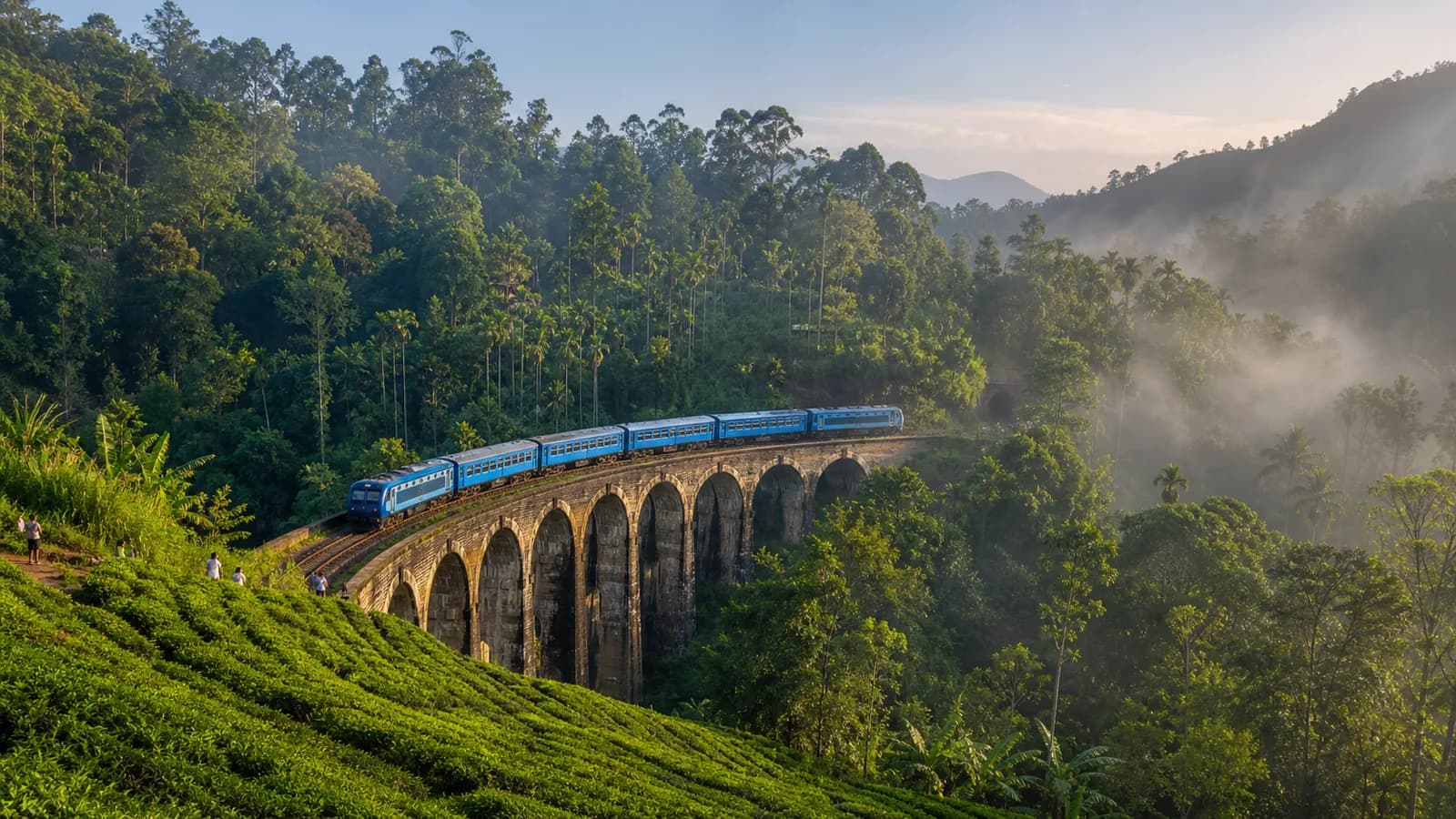
Every country has one image that launches a thousand trips. For Sri Lanka in the social media era, it is a blue train easing across nine stone arches above a green ravine outside Ella.

The Nine Arches Bridge has become the most photographed few hundred metres of railway in South Asia, and unlike many viral locations, it does not disappoint in person. The bridge is genuinely beautiful, the setting of tea terraces and jungle is genuinely dramatic, and the slow crossing of a train, horn echoing off the hills, is genuinely worth waiting for.

What disappoints visitors is almost always the planning. People arrive at midday to a packed hillside, trust a train timetable from a three-year-old blog post, wait an hour for a crossing that already happened, or spend their visit standing somewhere with a worse view than the café fifty metres behind them.

This guide fixes that. It covers how to reach the bridge on foot or by tuk-tuk, how the train crossings actually work in 2026 and how to check them reliably, where the best viewpoints really are, the safety rules of visiting a working railway, and the remarkable story of how a hundred-year-old bridge of stone, brick, and cement came to carry trains across this ravine in the first place.

It also shows how the bridge fits into a larger Ella morning, because the smartest visitors never treat it as a standalone stop.

त्वरित सारांश

  • The Nine Arches Bridge is a 91-metre, nine-arched railway viaduct completed in 1921, spanning a jungle ravine between Ella and Demodara
  • Roughly six trains cross in each direction daily, but times shift frequently; verify locally the evening before rather than trusting online timetables
  • Early morning is the best visit: soft light, cooler walking, fewer crowds, and closely spaced train crossings
  • You can walk from Ella town in 30 to 60 minutes or take a tuk-tuk to within a short downhill path of the bridge
  • The classic photo comes from the tea-field slopes above the bridge's curve, not from the bridge deck itself
  • It combines naturally with Little Adam's Peak into one classic Ella morning, with the Demodara Loop as an add-on for rail enthusiasts

What Exactly Is the Nine Arches Bridge?

Officially the Demodara Nine Arch Bridge, and poetically the Bridge in the Sky, the viaduct carries the upcountry railway line across a deep ravine between Ella and Demodara stations, at around a thousand metres above sea level.

The structure is about 91 metres long and rises roughly 24 metres above the valley floor, its nine arches built from stone, brick, and cement rather than the steel typical of railway bridges of its era. That material choice is central to its story, covered below, and to its beauty: the warm masonry curves through the green landscape rather than cutting across it.

The bridge sits on a bend, which is what makes the photographs work. A train crossing straight track is a line; a train crossing the Nine Arches curve reveals its whole length against the arches, framed by tea bushes on the slopes and jungle pressing in on both sides.

Completed in 1921 under British colonial administration as part of extending the upcountry line, the bridge has carried trains for over a century and remains a fully working piece of Sri Lanka Railways infrastructure, not a preserved monument. That working status is exactly its charm, and exactly why the safety section of this guide matters.

There is no entrance fee and no gate: the bridge and the paths around it are open at all hours, though visiting in darkness is neither safe nor rewarding.

91 metres long, about 24 metres highNine arches of stone, brick, and cementCompleted in 1921, still in daily useBuilt on a curve, which makes the photosFree to visit, no gates or tickets

The Story Behind the Bridge in the Sky

The Nine Arches Bridge comes with one of Sri Lankan railway lore's favourite stories, and like most good lore it blends documented fact with well-worn legend.

The documented part: the bridge was built as the upcountry railway extension pushed from Ella toward Badulla in the late 1910s, a project of British colonial engineering that relied heavily on Sri Lankan labour, materials, and construction skill. It opened to traffic in 1921, and the engineering challenge was real: spanning a deep ravine on a curve and a gradient, in wet, unstable hill country.

The legend, told by every guide in Ella: with steel in short supply because of the First World War, the bridge's planned steel was diverted to the war effort, and local builders, with a Sri Lankan craftsman named P. K. Appuhami celebrated as the central figure, proposed building the viaduct entirely from stone, brick, and cement instead. The story goes that confidence in the unorthodox structure was so high that its builders stood beneath the arches as the first train crossed.

Historians debate how much of that account is literal, and the full engineering records tell a more conventional collaborative story. But the physical fact nobody disputes is the remarkable one: a masonry viaduct built in the 1910s, without modern machinery, has now carried more than a century of trains through landslide-prone mountains, including the seismic shocks of cyclones and floods, and still stands in daily service.

Knowing the story changes how the bridge reads when you stand under it. The arches stop being a photo backdrop and become what they are: one of the finest surviving pieces of early twentieth-century railway craftsmanship in Asia, made largely by hand.

Opened to traffic in 1921Built during First World War steel shortagesLocal craftsmanship central to the storyP. K. Appuhami celebrated in local legendOver a century of continuous service

How to Get to the Nine Arches Bridge

The bridge sits a couple of kilometres northeast of Ella town, and the journey there is half the experience if you choose the walking route.

Walking from Ella town is the classic approach and takes 30 to 60 minutes depending on route and legs. The most popular path leaves the main road near Ella's town end and follows a mix of lanes, forest track, and a stretch beside the railway itself toward the bridge. It is well-trodden, sociable, and mostly shaded, with a final descent to the viewpoints. Expect uneven ground, some mud after rain, and enough gradient to count as gentle exercise rather than a stroll.

A second walking option follows the railway tracks from Ella station in the direction of Demodara. It is flat and impossible to get lost on, but it means sharing an active railway with trains for the whole distance, which demands constant attention; walk single file, stay off the rails, and step well aside early whenever you hear a horn. Families with small children should choose the road-and-trail route instead.

By tuk-tuk, drivers from Ella town will take you to a parking area above the bridge in about ten to fifteen minutes, from which a short, steep path drops down to the viewpoints. This is the right choice in rain, in midday heat, for anyone with limited mobility, or when racing to beat a train time. Agree the fare before setting off, and consider paying the driver to wait, as finding a return tuk-tuk at the parking area is usually easy but not guaranteed.

However you arrive, wear proper footwear rather than flip-flops. And in wet months, take the local advice about leeches seriously on the jungle paths: closed shoes, socks, and a quick check of your ankles at the bridge cost nothing, and repellent applied to shoes helps.

30 to 60 minute walk from Ella townTrack-side route: flat but demands attentionTuk-tuk to within a short downhill pathClosed shoes, not flip-flopsLeech precautions in wet months

Train Crossing Times in 2026, and Why You Must Verify Locally

Seeing a train cross is the moment everyone comes for, and it is also where outdated information ruins the most visits, so here is the honest 2026 picture.

Roughly six trains a day pass over the bridge in each direction, spread between early morning and evening, with crossings loosely clustered in the early-to-mid morning and again in the afternoon. On a typical current pattern, the first crossings come around dawn to mid-morning, which is one more reason the morning visit wins.

But precise times cannot be responsibly printed in a guide like this, for three reasons. Sri Lanka Railways adjusts hill-country schedules periodically, and timetables have been in flux since the post-cyclone repairs reshaped services on the main line. Trains on this stretch also run late as a matter of routine, sometimes by minutes, occasionally by hours. And the bridge lies between stations, so published station departure times only approximate the moment a train actually reaches the arches.

The reliable method used by everyone who gets the shot: ask your guesthouse or hotel the evening before, since Ella accommodations track the current crossing times as a daily professional courtesy, or ask at Ella railway station directly. Locals also use Sri Lanka Railways' official information and popular local train-tracking apps that show live running status, which are far more useful than any static timetable.

Then apply the golden rule: arrive at least thirty minutes before the expected crossing, and treat the wait as the experience rather than a delay. The hillside cafés exist precisely for this, and a train announcing itself with a distant horn after a forty-minute wait is more satisfying than punctuality could ever be.

If a crossing genuinely matters to your photography, target the morning cluster: if one train runs late, another follows relatively soon, doubling your chances in a single visit.

About six crossings each way dailyTimes shift; never trust old blog timetablesAsk your guesthouse the evening beforeArrive thirty minutes early minimumMorning cluster doubles your chances

The Best Viewpoints, and Where Not to Stand

The bridge offers half a dozen distinct vantage points, and choosing between them is choosing what kind of memory you take home.

The classic elevated view comes from the tea-planted slopes on the Ella side of the ravine, looking along the bridge's curve. This is the postcard: the full sweep of the arches, the train revealed along its whole length, tea rows in the foreground. Arrive early and you can pick your terrace; arrive at midday in season and you will share it with a crowd.

The clifftop cafés above the bridge occupy some of the best sightlines of all, and buying a fresh juice or coffee for the price of the view is one of Ella's better bargains. For families, older visitors, or anyone waiting out a long delay, a café table beats standing on a muddy slope in the sun by a wide margin.

From below, a path drops to the base of the arches, where the masonry towers overhead and the scale of the 1921 achievement lands properly. Photographers underrate this angle; it is also the quietest spot when the upper slopes are busy.

On the bridge deck itself, walking across between trains is part of the tradition, and the view down the ravine from the parapet is lovely. But treat the deck as what it is: an active railway. Cross promptly rather than picnicking on the sleepers, keep constant awareness of both directions, and clear the deck entirely, well before a train arrives, the moment anyone signals or a horn sounds. The train photo you want is taken from the slopes, never from the tracks in front of an approaching engine.

Drone pilots should note that regulations apply to drone use in Sri Lanka, and flying over an operating railway and crowds carries obvious risks; check current Civil Aviation Authority rules and obtain any required approvals before packing one.

Tea-slope curve view: the classic postcardClifftop cafés: best value seats in EllaBase of the arches: underrated and quietBridge deck: cross briskly, never lingerDrone use requires checking current regulations

When to Visit: Time of Day and Time of Year

Time of day shapes this visit more than almost any other decision.

Early morning, from first light to around nine, is the connoisseur's window: soft light on the arches, mist sometimes pooling in the ravine, cool walking temperatures, thin crowds, and the day's most closely spaced train crossings. Photographers, and anyone who has seen the midday scene, consider this non-negotiable.

Midday in high season is the bridge at its busiest, when tour groups, day-trippers, and the whole of Ella's guesthouse population seem to converge. The bridge is still beautiful; the experience is simply shared with hundreds rather than dozens.

Late afternoon offers a second good window, with warm light from the west and crowds thinning as day-trippers leave, though train crossings become sparser toward evening and a delayed final train can mean waiting into dusk.

Seasonally, the bridge is a year-round sight, and Ella's weather is famously changeable in every month. The January-to-April window brings the most reliably dry trails; the inter-monsoon and monsoon-influenced months bring greener slopes, dramatic mist, occasional downpours, muddier paths, and livelier leeches. Rain rarely lasts all day, and a misty crossing, with the train emerging from cloud onto the arches, is for some photographers the best version of the shot.

Whatever the forecast, build slack into the plan. The bridge rewards the visitor with ninety spare minutes and punishes the one with a taxi waiting and a train to catch elsewhere.

Early morning: light, mist, space, trainsMidday: beautiful but crowdedLate afternoon: warm light, fewer peopleJanuary to April for driest trailsMist can make the photo, not ruin it

Photographing the Bridge Like You Mean It

A phone at the right moment beats a camera bag at the wrong one, but a few technique choices lift Nine Arches photos from record shots to keepers.

Scout before the train comes. Use the waiting time to walk the slope and frame the empty bridge from several spots, so that when the horn sounds you are standing in a chosen composition rather than scrambling for one.

Shoot the curve. Compositions that show the bridge bending through the frame, with the train's carriages articulated along it, outperform head-on angles every time. The tea terraces make natural leading lines toward the arches.

For the train itself, continuous burst mode is your friend: crossings take well under a minute, and the best frame usually has the engine emerging past the third or fourth arch with most of the train visible behind it. A modest telephoto compresses the arches beautifully from the far slope; a wide angle from the base of the viaduct exaggerates its height.

People make the scale. A figure on the far end of the deck, or pickers in the tea rows below, gives the bridge its true size in a way empty frames never do. As everywhere in Sri Lanka, ask before photographing tea workers closely; a smile and a gesture at the camera is usually all it takes, and the courtesy is noticed.

Morning mist, when it comes, is a gift: expose for the highlights and let the ravine fall into soft grey. And when the train finally arrives, take your burst, then lower the camera for the second half of the crossing. Some part of the visit belongs to your eyes.

Scout compositions during the waitShoot the curve, not head-onBurst mode for the crossingInclude people for scale, with courtesyWatch the second half without a lens

Safety and Etiquette on a Working Railway

Nothing about the Nine Arches Bridge is dangerous to a sensible visitor, and everything about it can be dangerous to a careless one, because the essential fact never changes: this is a live railway, not a film set.

The rules that matter are few and absolute. Never walk the deck or the approach tracks with headphones in. Look and listen both ways constantly; trains here are quiet on the downgrade until surprisingly close, and the curve limits sightlines in both directions. Clear the tracks completely, onto solid ground beyond the rails, as soon as a horn sounds or others begin moving, and never gamble that a train is on the other track or moving slowly enough to outwait.

Keep children physically in hand on the deck and near the edges; the parapets are low by modern standards and the drop is over twenty metres. The slope paths, café stairs, and track ballast are all ankle-turning territory in bad footwear, and genuinely slick after rain.

Selfie positioning causes more close calls here than anything else. No photograph justifies standing on the tracks as a train approaches, sitting with legs over the parapet, or climbing the arch faces. The people you see doing it are not proof it is safe; they are the reason the horn keeps sounding.

Etiquette is simpler: this is a neighbourhood as well as a landmark. The paths cross village land and working tea slopes, so stay on the trodden routes, do not trample tea rows for an angle, carry your litter out, and support the small cafés and stalls whose owners keep the area welcoming. Vendors around the bridge are generally low-pressure; a polite no is always enough.

Treat the bridge as its builders would want, a working monument shared on its own terms, and it repays the respect with one of the island's finest hours.

Live railway: eyes and ears always onClear the tracks at the first hornChildren in hand on the deckNo photo is worth the tracksStay on paths, out of the tea rows

Combining the Bridge With the Rest of Ella

The Nine Arches Bridge is a ninety-minute experience inside a town built for slow days, and the classic combinations are classics for a reason.

The definitive Ella morning pairs Little Adam's Peak with the bridge: climb the peak for sunrise, an easy forty-five-minute ascent with an enormous payoff, then walk down and across to the bridge in time for the mid-morning train cluster, finishing with a late breakfast at a café above the arches. It is arguably the single best half-day in the Sri Lankan hill country, and it is entirely walkable.

Rail enthusiasts should add the Demodara Loop, a short ride or drive beyond the bridge, where the line famously spirals around a hill and passes under itself at Demodara station, another piece of the same 1920s engineering campaign and far less visited than the bridge it partners.

Arriving in Ella by the celebrated hill-country train, currently boarded at Nanu Oya while post-cyclone repairs continue on the stretch beyond Kandy, you will actually cross the Nine Arches Bridge on the way in if continuing past Ella toward Demodara and Badulla; riding over the arches you photographed the day before is a satisfying full-circle moment worth planning.

The bridge also slots naturally into the full Ella menu of Ella Rock, waterfalls, tea factory visits, and café evenings, all covered in our dedicated Ella guide, and into the wider hill-country leg of any island route; our 7, 10, and 14-day itineraries show exactly where the Ella days fall.

However you assemble the day, keep the bridge in the morning slot. Everything else in Ella improves in the afternoon; the bridge does not.

Little Adam's Peak sunrise, then the bridgeDemodara Loop for rail enthusiastsRide across the arches toward BadullaBridge in the morning, everything else afterEntirely walkable from Ella town

यात्रा सुझाव

  • Ask your guesthouse for current train-crossing times the evening before
  • Arrive at least thirty minutes before the expected crossing
  • Visit in the early morning for light, mist, space, and clustered trains
  • Wear closed shoes; the paths are uneven and flip-flops fail here
  • Take leech precautions on jungle paths in wet months
  • Agree tuk-tuk fares before riding, and consider paying the driver to wait
  • Buy a drink at a clifftop café; it is the best seat in the house
  • Keep children physically in hand on the bridge deck
  • Clear the tracks completely the moment you hear a horn
  • Carry water, sunscreen, and small cash for cafés and stalls
  • Stay on trodden paths and out of the tea rows
  • Pair the visit with Little Adam's Peak for Ella's best half-day

अक्सर पूछे जाने वाले प्रश्न

Where is the Nine Arches Bridge?

The bridge spans a ravine on the railway line between Ella and Demodara stations in Sri Lanka's Uva Province, about two kilometres northeast of Ella town, at roughly a thousand metres above sea level.

What time do trains cross the Nine Arches Bridge in 2026?

Roughly six trains cross in each direction daily, clustered in the morning and again in the afternoon, but exact times change periodically and trains routinely run late. Ask your Ella guesthouse or the railway station the evening before your visit, and arrive at least thirty minutes before the expected crossing.

How do I get to the Nine Arches Bridge from Ella?

Walk from Ella town in 30 to 60 minutes via the popular trail route or along the railway tracks, or take a ten-to-fifteen-minute tuk-tuk to a parking area above the bridge, from which a short, steep path descends to the viewpoints.

Is there an entrance fee for the Nine Arches Bridge?

No. The bridge and surrounding paths are free and open at all hours, with no tickets or gates. The only costs are optional: tuk-tuk fares and café purchases.

Why is the Nine Arches Bridge famous?

It combines striking colonial-era engineering, a viaduct of nine masonry arches completed in 1921, with a spectacular jungle-and-tea-field setting and the photogenic spectacle of trains crossing its curve. Local legend adds that wartime steel shortages led builders to construct it entirely from stone, brick, and cement.

Can you walk across the Nine Arches Bridge?

Yes, walking the deck between trains is a long-standing tradition, but it is an active railway: cross promptly, stay alert in both directions, keep children in hand, and clear the tracks entirely the moment a horn sounds or a train appears.

What is the best time of day to visit?

Early morning, from first light to around nine, offers soft light, possible mist, cool temperatures, the fewest crowds, and the day's most closely spaced train crossings. Late afternoon is a good second choice; midday in high season is the busiest window.

How long should I spend at the Nine Arches Bridge?

Allow ninety minutes to three hours including the walk and at least one train crossing. Photographers and anyone combining the visit with Little Adam's Peak should budget a full morning.

Is the Nine Arches Bridge suitable for children and older visitors?

Yes, with the tuk-tuk-and-café approach. Families can ride to the parking area, take the short path down, and watch crossings from a café terrace, avoiding the longer trails. On the bridge deck itself, children should be kept physically in hand.

Can I visit the Nine Arches Bridge and Little Adam's Peak in one morning?

Yes, and it is the classic Ella half-day: climb Little Adam's Peak for sunrise, then walk across to the bridge for the mid-morning train crossings, finishing with breakfast at a café above the arches.

पाठक टिप्पणियां

बातचीत में शामिल हों

इस गाइड के लिए अपना प्रश्न, सुझाव या यात्रा अनुभव साझा करें.

टिप्पणियां

0 टिप्पणियां

लोड हो रहा है...

प्रेरणा को श्रीलंका यात्रा में बदलने के लिए तैयार हैं?

अपनी यात्रा की योजना बनाने, स्थानीय गाइड से जुड़ने और इस यात्रा कार्यक्रम को साकार करने के लिए LankaTrip का उपयोग करें.

योजना में मदद चाहिए?

अपनी श्रीलंका यात्रा की योजना बनाएं

मेरी यात्रा बनाएं