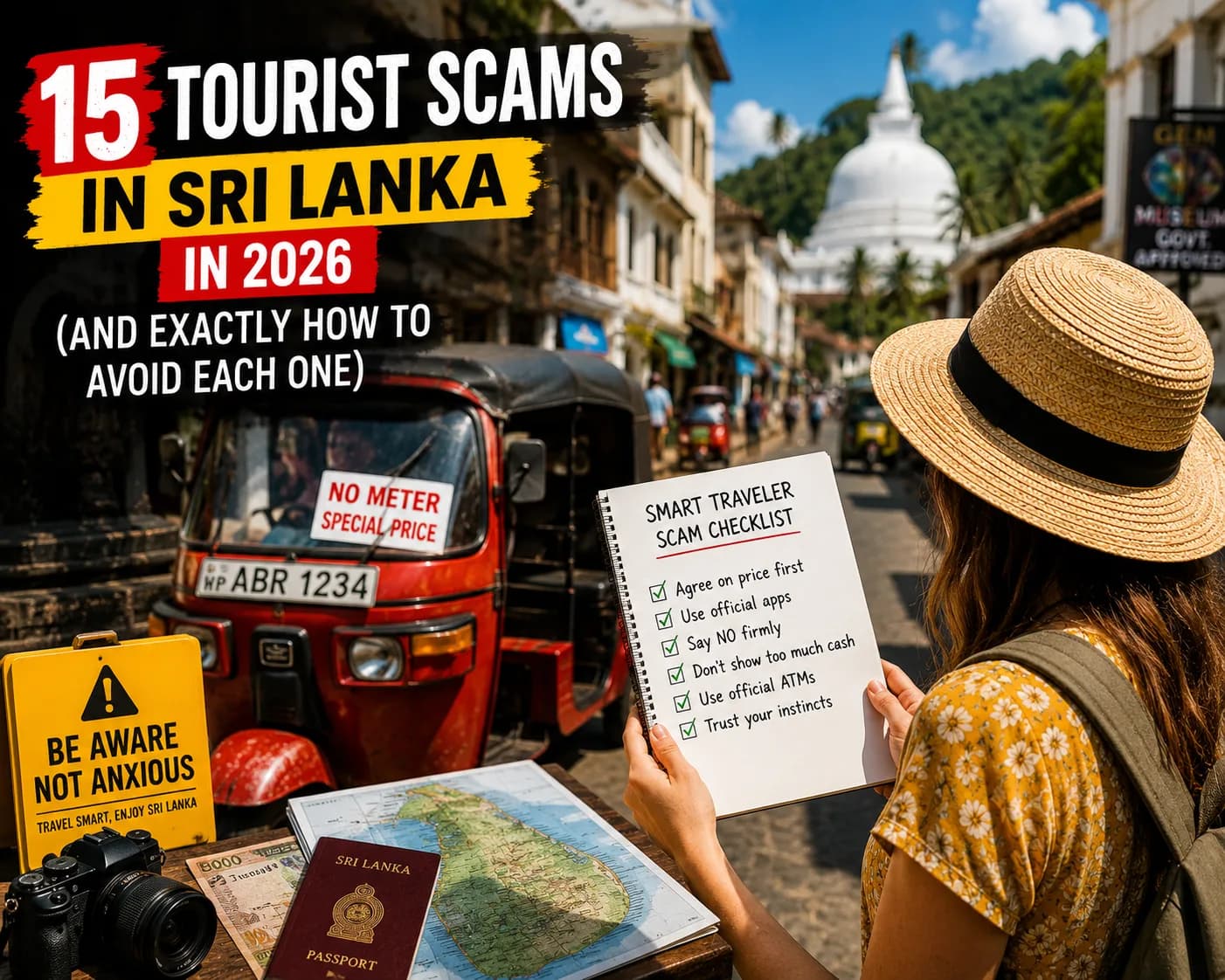
Sri Lanka has very low rates of violent crime against tourists, but like almost every popular destination, it has a small, repeating set of scams built around pressure, distraction, or a friendly-seeming setup.
The frustrating part for most travelers is not the scams themselves, which are usually low-stakes, but not knowing what a scam looks like in the moment, which can make an otherwise relaxed trip feel more guarded than it needs to be.
This guide is different from a general safety overview. It goes scam by scam, explains exactly how each one is set up, where it tends to happen, and gives you the specific habit or line that shuts it down.
Read it once before you go, and you will likely never think about most of these again once you are actually on the ground, because the patterns become obvious almost immediately.
त्वरित सारांश
- Almost every Sri Lanka scam targets your money through pressure or distraction, not through violence
- Tuk-tuk fare tricks and gem shop pressure sales are the two most common issues by far
- Fake monks, staged animal photos, and 'secret temple' invitations follow very recognizable scripts once you know them
- Card skimming and currency exchange tricks are a growing, quieter risk worth a few simple precautions
- A firm, polite 'no thank you' and walking away ends nearly every scam attempt before it starts
- None of this should make you anxious. Once you know the dozen or so patterns, the rest of Sri Lanka is refreshingly easy
1. The Tuk-Tuk 'Broken Meter' or No-Meter Fare
How it works: a driver claims the meter is broken, quotes a flat rate well above the going price, or agrees to a fare and then asks for more at the destination, sometimes claiming they misunderstood the distance.
A close variant uses a fare-calculation app on the driver's phone that is quietly rigged to run high, with the display slipping out of view near the end of the ride.
Where it happens: airports, tourist zones, and anywhere a driver approaches you rather than the other way around.
How to avoid it: agree on the exact fare in words, out loud, before getting in, or use a metered ride-hailing app such as PickMe, which removes the negotiation entirely. If a driver claims a broken meter, thank them and choose another tuk-tuk instead.
Agree the fare before you get in, alwaysUse a ride-hailing app where possibleA 'broken meter' is your cue to pick a different tuk-tukCommon at airports and tourist zones
2. The Gem Shop 'Investment' Pitch
How it works: a friendly stranger, driver, or guide steers you toward a shop selling gemstones, often with a story about buying low and reselling for profit back home. The stones are frequently fake, low-quality, or accompanied by fabricated authenticity certificates, and prices are set well above real value.
Where it happens: most commonly reported around Galle, Kandy, and Colombo.
How to avoid it: never buy gems with the intention of reselling them. If you genuinely want a gemstone, buy only from an established, licensed dealer you found independently, not one suggested by a driver or new acquaintance, and have any significant purchase independently appraised before paying.
Never buy gems as an 'investment'Avoid shops recommended by drivers or strangersCommon in Galle, Kandy, and ColomboUse an independent, licensed dealer if buying
3. The 'Special Festival' or 'Secret Temple' Invitation
How it works: an overly friendly stranger mentions a festival, ceremony, or temple that is supposedly open only today, then flags down a tuk-tuk that conveniently appears already waiting. The route sometimes leads to a commission-paying shop, or in rarer, more serious cases, to an isolated location.
Where it happens: streets and public spaces near major tourist areas, often started with casual small talk about where you're from.
How to avoid it: treat any unsolicited invitation to a one-day-only event with polite skepticism, and never accept a ride that appears immediately and conveniently after the invitation. If a temple or attraction is genuinely worth visiting, it will still be there tomorrow, and your hotel or a licensed guide can confirm.
Be skeptical of 'today only' invitationsNever take a ride that appears suspiciously fastVerify events through your hotel, not a strangerOften starts with friendly small talk
4. The Dropped Camera Trick
How it works: someone asks you to take their photo, hands you their camera or phone, and when you return it, deliberately drops it and blames you, demanding payment for the 'damage'.
Where it happens: reported most often in Colombo, in crowded public areas.
How to avoid it: it is fine to politely decline requests to take a stranger's photo with their device, particularly from someone you don't know in a crowded area. If you do help and this happens anyway, firmly decline to pay and walk toward a public, well-lit area or staff member rather than negotiating on the spot.
Be cautious about handling strangers' cameras or phonesReported mainly in ColomboDecline to pay if this happensMove toward staff or a public area if pressured
5. The Fake Monk or 'Blessing' Donation
How it works: someone dressed as a monk, or simply a local near a temple entrance, offers a flower, wristband, or medallion as a 'blessing', then asks for a donation immediately afterward, sometimes naming a surprisingly large specific amount.
Where it happens: entrances and grounds of busy, tourist-heavy temples.
How to avoid it: politely decline unsolicited offerings of flowers, bracelets, or blessings from anyone approaching you rather than the other way around. If you want to make a donation, use the official, clearly marked collection boxes inside the temple instead.
Decline unsolicited 'blessings' or braceletsCommon at busy temple entrancesDonate only at official collection boxesA specific dollar figure is a strong warning sign
6. Staged Animal Photos and Street Performances
How it works: performers with snakes, monkeys, or other animals invite you to watch or take photos, then demand payment afterward, sometimes aggressively if you decline. Sri Lanka's famous stilt fishermen are, in many well-known spots, now largely staged for tourist photos rather than active fishing.
Where it happens: near major tourist attractions and popular coastal photo spots.
How to avoid it: if someone invites you to photograph an animal act or a 'traditional' scene, assume a payment will be expected and decide in advance whether you're comfortable with that, both financially and ethically, since animal performances in particular often involve poor treatment of the animals. It is completely fine to decline and walk on.
Assume a fee is expected for staged photo opportunitiesStilt fishing at popular spots is often staged, not activeAnimal performances raise real welfare concernsDeclining and walking on is always an option
7. The 'New Friend' Bar Bill
How it works: a friendly local strikes up conversation and invites you for a drink, orders freely, then disappears before the bill arrives, either to the bathroom or claiming to fetch forgotten money, leaving you with a heavily inflated tab.
Where it happens: bars and nightlife areas, particularly in cities.
How to avoid it: be cautious about accepting drink invitations from someone you just met, and if you do go along, keep an eye on the order and the running bill rather than letting a new companion order freely on your behalf.
Be cautious with drink invitations from new acquaintancesWatch the bill as it builds, not just at the endCommon in city bars and nightlife areasA sudden disappearance before the bill is the tell
8. Unofficial 'Guides' and Commission Touts
How it works: someone presents themselves as a guide near a temple, market, or bus station, offers help, and either demands an exorbitant fee afterward or steers you toward shops and tours that pay them a commission.
Where it happens: entrances to popular attractions, bus and train stations.
How to avoid it: book guides in advance through your hotel or a known operator rather than accepting an offer on the street, and politely but firmly decline unsolicited help, even when it's offered warmly.
Book guides through your hotel or a known operatorCommon near attractions, bus and train stationsPolitely decline unsolicited street offersA warm approach doesn't guarantee good intent
9. Fake Charity Collectors
How it works: someone with official-looking paperwork or a laminated ID approaches with an emotional appeal for a school, orphanage, or community project, collecting cash donations that never reach any real cause.
Where it happens: streets and beaches near tourist areas.
How to avoid it: if you want to support a local cause, choose an established, verifiable charity in advance rather than donating to someone who approaches you directly on the street with paperwork you cannot verify.
Verify any charity independently before donatingBe cautious of street-based emotional appealsLaminated ID cards are easy to fakeCommon near tourist streets and beaches
10. ATM Skimming and Card Fraud
ATM fraud, including card skimming, has been flagged by more than one country's foreign travel advisory as a real, if not dominant, risk in Sri Lanka, where devices are sometimes attached to machines to capture card data and PINs.
How to avoid it: use ATMs attached to banks or inside hotels rather than free-standing street machines where possible, check for anything loose, unusual, or added-looking around the card slot and keypad, and always cover the keypad with your other hand while entering your PIN.
For card payments generally, watch the terminal as your card is processed rather than handing it over and looking away, and check your bank statements periodically during and after your trip.
Prefer bank- or hotel-attached ATMsCheck for loose or unusual attachmentsAlways cover the keypad when entering your PINWatch your card during any transaction
11. Dynamic Currency Conversion and Card Overcharging
How it works: a merchant offers, or automatically applies, a charge in your home currency instead of Sri Lankan rupees, at a significantly worse exchange rate than your own bank would give you. In some cases, staff simply enter the wrong, higher amount and hope it goes unnoticed.
Where it happens: card payments at restaurants, shops, and hotels, particularly where totals are shown in more than one currency.
How to avoid it: always ask to be charged in Sri Lankan rupees, not your home currency, and check the total on the screen before authorizing any payment.
Always ask to be charged in LKR, not your home currencyCheck the total before authorizing paymentWatch for dual-currency displaysA simple habit that prevents most card overcharging
12. Street Currency Exchange Tricks
How it works: someone on the street offers to change money at an appealing rate, then either shortchanges the count, applies a much worse rate than quoted, or simply disappears with the cash mid-transaction.
Where it happens: near tourist areas in major cities, especially where legitimate exchange counters are also nearby, making the informal offer look like a normal option.
How to avoid it: exchange currency only at banks, hotels, or licensed exchange counters, check the day's official rate before you go, and count any cash received before walking away from the counter.
Use banks, hotels, or licensed counters onlyCheck the official rate before exchangingCount cash before leaving the counterAvoid informal street exchange offers entirely
13. Resold or Fake Train Tickets
How it works: popular scenic routes, especially Kandy to Ella, sell out reservations well in advance, so unofficial vendors sometimes resell tickets at inflated prices, occasionally for seats that turn out not to be valid.
Where it happens: around Kandy, Ella, and Nanu Oya stations, particularly during peak season.
How to avoid it: book reserved seats directly through Sri Lanka Railways or a reputable travel platform well in advance, and treat any offer to sell you a ticket in person near the station with caution, verifying it matches your name and the train details before paying.
Book reserved seats well in advance officiallyCommon around Kandy, Ella, and Nanu Oya stationsVerify any resold ticket matches your details exactlyUnreserved third-class seats are usually available as a backup
14. Surfboard and Rental Equipment 'Damage' Claims
How it works: after renting a surfboard, bike, or other equipment, the renter claims you damaged it and demands a high repair fee, sometimes for damage that was already there.
Where it happens: surf towns and rental shops in beach areas.
How to avoid it: photograph or video the equipment's condition, including any existing scratches or dings, before you take it, and do the same when you return it, so you have clear evidence either way.
Photograph rental equipment before and after useCommon at surf shops in beach townsClear photos resolve most disputes instantlyApply the same habit to bike and scooter rentals
15. Airport 'Helper' and Visa Fee Scams
How it works: someone presenting themselves as an official or helpful assistant at the airport offers to sort out your visa, ETA, or currency exchange for an inflated fee, targeting travelers who didn't prepare their documents in advance.
Where it happens: arrival areas at Bandaranaike International Airport.
How to avoid it: apply for your ETA online in advance through the official eta.gov.lk portal before you fly, so there is nothing left to 'help' with on arrival, and use official airport currency counters or your hotel for money changing rather than an approaching stranger.
Apply for your ETA online before you flyIgnore unsolicited 'helpers' at arrivalsUse official counters for currency exchangePreparation removes almost all of this risk
यात्रा सुझाव
- Agree tuk-tuk fares out loud before every ride, or use a metered app
- Never buy gems as an investment, and avoid shops suggested by strangers or drivers
- Decline unsolicited 'blessings', photo requests, or 'secret' invitations from strangers
- Cover the keypad at every ATM and prefer bank- or hotel-attached machines
- Always ask to be charged in Sri Lankan rupees, never your home currency
- Exchange money only at banks, hotels, or licensed counters
- Book scenic train tickets officially and in advance
- Photograph rental equipment before and after use
- Book guides and tours through your hotel or a known operator
- A polite, firm 'no thank you' followed by walking away ends almost every scam attempt
अक्सर पूछे जाने वाले प्रश्न
What is the most common scam in Sri Lanka?
Tuk-tuk fare overcharging is the single most common issue, followed closely by gem shop pressure sales. Both are easily avoided by agreeing fares in advance and never buying gems as an investment.
Is Sri Lanka dangerous because of these scams?
No. Almost all common Sri Lanka scams target money through pressure or distraction rather than violence, and are avoidable once you recognize the pattern. Violent crime against tourists remains rare.
How do I avoid the fake monk or blessing scam?
Politely decline any unsolicited flower, bracelet, or blessing offered by someone approaching you at a temple, and make donations only at official, clearly marked collection boxes.
Is it safe to use ATMs in Sri Lanka?
Generally yes, but card skimming has been flagged as a risk. Use ATMs attached to banks or hotels where possible, check for tampering, and always cover the keypad when entering your PIN.
Should I buy gemstones in Sri Lanka?
Only from an established, licensed dealer you find independently, never one recommended by a driver or new acquaintance, and never with the intention of reselling for profit. Fake or overpriced gems are a common scam.
How do I avoid tuk-tuk overcharging?
Agree on the exact fare out loud before getting in, or use a metered ride-hailing app such as PickMe. If a driver claims a broken meter, choose a different tuk-tuk.
What should I do if I've been scammed in Sri Lanka?
Contact the Tourist Police hotline at 1912, which specifically handles visitor-related issues, rather than a standard local police station.