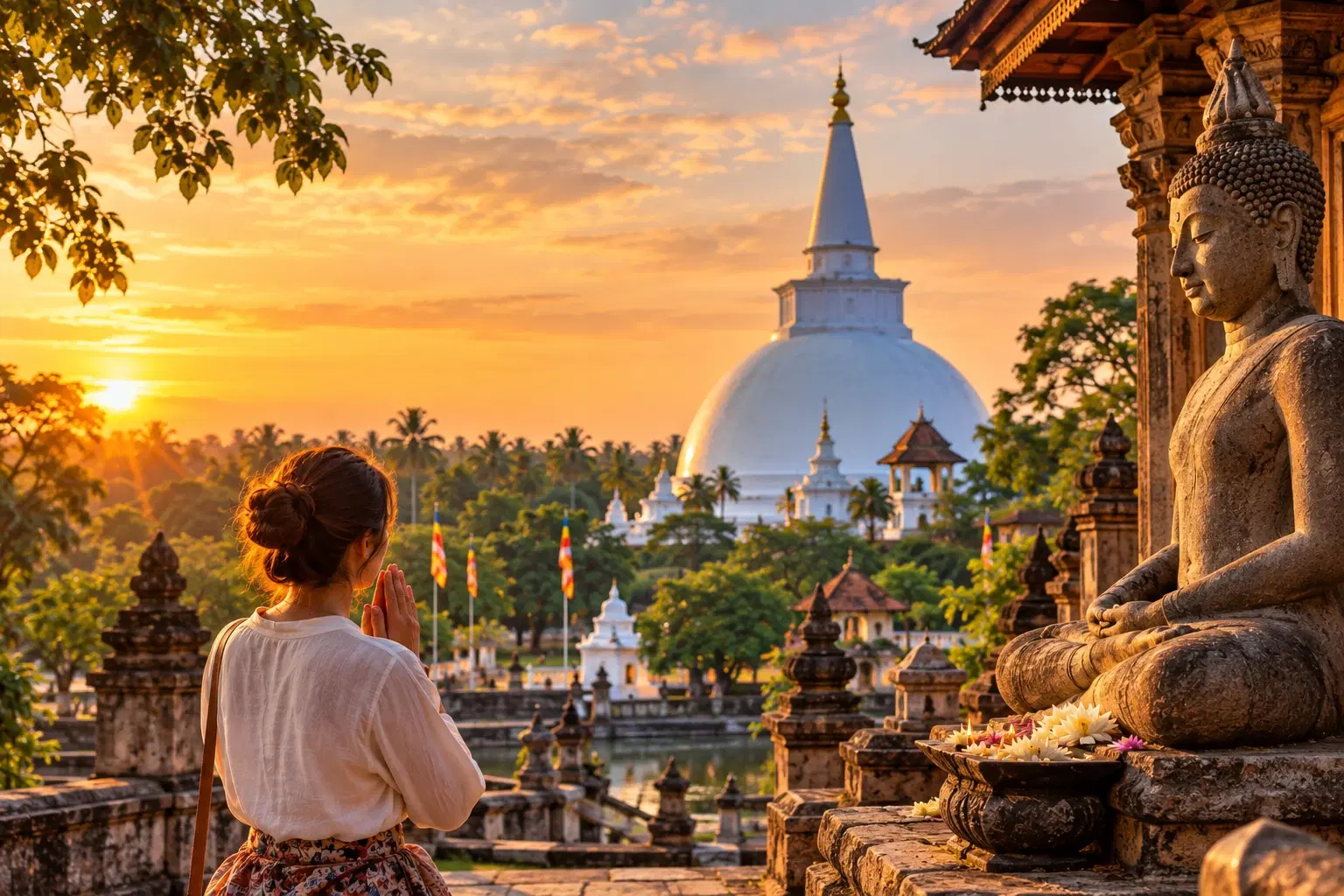
Many travellers come to Sri Lanka for its temples, and leave having seen a lot of them without quite understanding what they were looking at. That is a shame, because Sri Lanka offers something rarer than beautiful ruins: one of the oldest continuous Buddhist cultures in the world, still practised every day by the people you meet.
Theravada Buddhism has been central to life on the island since, according to tradition, the monk Mahinda brought it here in the third century BCE. Around 70 per cent of Sri Lankans are Buddhist, and the constitution gives Buddhism the foremost place. You will see it in white-clad families walking to the temple on full moon days, in the lanterns of Vesak, in the Bodhi trees on every village junction, and in the way people behave around a Buddha image.
That living quality is exactly why it rewards some preparation. A visitor who understands what a Poya day is, why the Bodhi tree matters, how to walk around a stupa and what not to do in front of a Buddha statue will have a completely different experience from one who treats temples as backdrops. And a small number of visitors each year discover, often unpleasantly, that Sri Lankans take respect for Buddhist images very seriously indeed.
This guide is written for travellers of any faith or none. It covers how to behave at temples, what the law and the courts have actually said about Buddha images and tattoos, the full moon calendar with the gazetted 2027 dates, the major festivals and pilgrimage sites, how to take part in offerings and meditation without overstepping, and how to put it all into an itinerary.
On dates: Poya days follow the lunar calendar, and Sri Lanka's public holidays are fixed by government gazette. The 2027 list was published in Gazette Extraordinary No. 2493/05 dated 16 June 2026. We have used dates reported from that gazette and say clearly where we could only confirm them second-hand.
Кратко
- Buddhism in Sri Lanka is a living religion, practised daily by most of the population — visit temples as a guest at a place of worship
- Cover shoulders and knees, remove shoes and hats, and never pose with your back to a Buddha image
- There is no law banning Buddha tattoos, and the Supreme Court ruled a 2014 arrest over one unlawful — but cover them anyway
- Every full moon is a Poya holiday; remaining 2026 Poya days are 25 October, 24 November and 23 December
- Vesak 2027 falls on 19 May, with 20 May also a holiday, according to the 2027 holiday gazette as reported in July 2026
- Poson, commemorating the arrival of Buddhism, draws huge crowds to Mihintale and Anuradhapura
- The 2026-27 Adam's Peak pilgrimage season runs from Unduvap Poya on 23 December 2026 to Vesak on 19 May 2027
- The Temple of the Tooth charges foreign visitors LKR 3,000, or LKR 2,500 for SAARC, Thai and Myanmar nationals
- You can take part respectfully — offering flowers, lighting a lamp, joining a Bodhi puja — without pretending to be a Buddhist
- Do not buy antiques, and think twice before buying a Buddha head as home décor