
LankaTrip 见解

21 分钟阅读

Jaffna and Northern Sri Lanka in 2026: The Complete Guide to the Island's Least-Visited Region

Most Sri Lanka itineraries stop at Anuradhapura. Four hours further north sits a peninsula with its own language, cuisine, architecture, religion and history — reachable on a single morning train and still receiving a fraction of the island's visitors. Here is how to travel it properly in 2026.

返回博客
Jaffna and Northern Sri Lanka in 2026: The Complete Guide to the Island's Least-Visited Region

There is a point on almost every Sri Lanka itinerary where the map simply stops. Travelers loop from Colombo through the Cultural Triangle, down the hill country, along the south coast and back. Above Anuradhapura, the plan thins out and then disappears.

What lies above that line is a peninsula that feels like a different country. The language on the shopfronts changes to Tamil. The temples change from white dagobas to towering, brightly painted Dravidian gopurams. The landscape flattens into limestone, lagoon and palmyra palm. The food changes so completely that Jaffna cuisine is treated as its own tradition rather than a regional variation.

For decades this was inaccessible. The A9 highway and the northern rail line were closed for much of the civil conflict, and Jaffna was effectively cut off from the rest of the island. The war ended in 2009, the railway was rebuilt and reopened, and the road north has been fully usable for years.

And yet visitor numbers remain a small fraction of what the south and hill country receive. That has an obvious upside — you will not queue, and prices are among the lowest on the island — and a less obvious one, which is that the north is still a place where being a foreign visitor is unusual enough that people talk to you.

This guide covers the practical mechanics of getting there and moving around, what is genuinely worth your time across the peninsula and the offshore islands, what the food is actually like, and how to travel respectfully in a region where the recent past is not yet history.

快速摘要

  • Jaffna sits roughly 400km north of Colombo, about 6 to 7 hours by road or around 7 hours on the Yal Devi express train
  • The peninsula is flat, compact and easy to cover by bicycle in town and tuk-tuk further out
  • Two full days is the practical minimum; three to four days lets you add the ferry islands
  • Nallur Kandaswamy Temple enforces a strict dress code including shirt removal for men
  • The 2026 Nallur festival runs from 16 August to 12 September
  • Jaffna has its own cuisine, distinct from southern Sri Lankan food, and its own dialect of Tamil

Why Northern Sri Lanka Belongs on Your Itinerary

The case for Jaffna is not that it is an undiscovered paradise. It is a working provincial capital, hot, flat and functional, and it will not compete with Ella for scenery or Mirissa for beaches.

The case is that it is the single biggest cultural shift available on the island without leaving it. Sri Lanka is often described as a country of layered cultures, but in practice most itineraries stay within one of those layers. Jaffna gives you the other.

Once the capital of the independent Jaffna Kingdom before falling to Portuguese forces in 1619, the city carries a distinct history that runs largely parallel to the Sinhalese kingdoms most visitors learn about at Anuradhapura and Polonnaruwa. The Dutch fort, the Hindu temple architecture, the colonial-era Christian churches and the Tamil literary tradition all belong to a different narrative thread.

Practically, it is also the cheapest region in the country to travel in. Budget accommodation commonly runs around LKR 2,000 to 5,000 per night, meals from a few hundred rupees, and a full day of tuk-tuk hire around LKR 3,000 to 5,000.

There is a further reason that matters more than it should have to. Tourism income in the Northern Province reaches communities that received very little of it for a generation. Visiting the north is one of the more directly useful things a traveler can do with an extra three days in Sri Lanka.

The island's most complete cultural change of sceneFormer capital of the Jaffna Kingdom until 1619The cheapest region in Sri Lanka to travelVery few foreign visitors compared to the southTourism income reaches communities that need it

Getting to Jaffna: Train, Road and Air

The journey itself is a significant part of the experience, and there are three realistic options.

The train is the best of them. Express services on the northern line, including the Yal Devi, run from Colombo Fort to Jaffna in roughly 7 hours, with some services quoted at up to 9 or 10 hours depending on the timetable and stopping pattern. Departures are typically early morning, around 6.00am. Second-class reserved fares generally fall between LKR 1,200 and 2,500, with first-class air-conditioned seats higher. This is not the famous hill-country train — it crosses the dry northern plains rather than tea terraces — but the reopened northern line is historically significant in its own right and far more comfortable than the road.

Reserved seats sell out, particularly around festivals and long weekends. Book through Sri Lanka Railways or an agent well in advance. Unreserved travel is possible but unpleasant over seven hours.

By road, the A9 highway covers roughly 400km from Colombo in 6 to 7 hours. Public buses run the route for around LKR 1,500 to 2,000 and are cheap but tiring, with hard seats on some services. A private minibus or car with driver from Colombo typically costs in the region of USD 60 to 80 for the vehicle, which becomes reasonable value for a group and lets you break the journey at Anuradhapura or Vavuniya.

Domestic flights operate to Jaffna's airport at Palaly from Colombo, with limited schedules and one-way fares that have been quoted from around LKR 22,000. This is the fastest option and the one that skips the entire experience of arriving overland.

A practical routing tip: rather than backtracking, many travelers now run Colombo to Anuradhapura, Anuradhapura to Jaffna, then Jaffna back down the east coast towards Trincomalee. It turns a there-and-back detour into a loop.

Yal Devi express: around 7 hours from Colombo FortSecond-class reserved roughly LKR 1,200 to 2,500A9 highway: 400km, 6 to 7 hours by roadDomestic flights available with limited schedulesConsider looping onward to Trincomalee instead of backtracking

Nallur Kandaswamy Temple and Its Rules

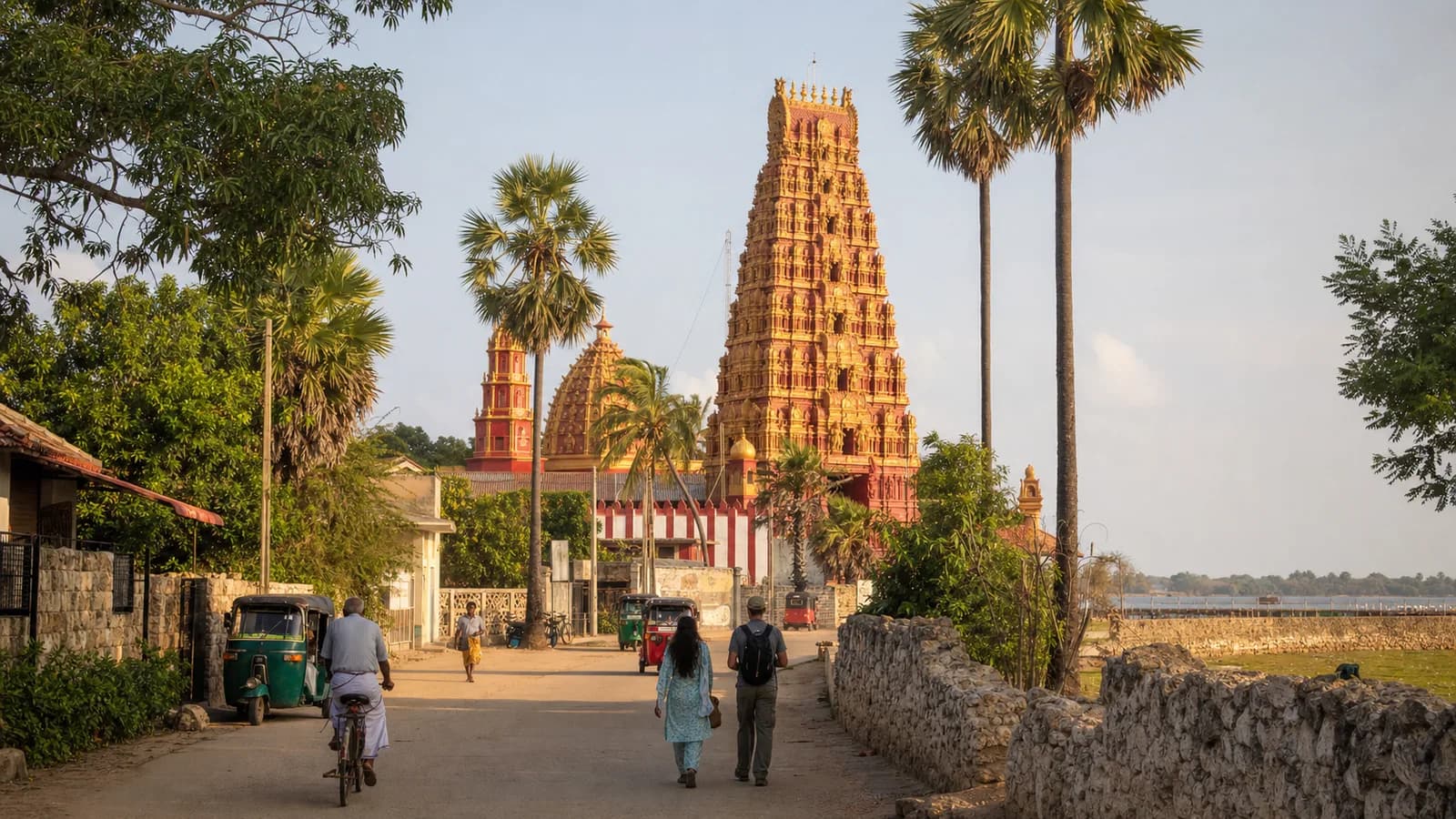
Nallur Kandaswamy Kovil is the spiritual centre of the peninsula and the single site that most defines a visit to Jaffna. Dedicated to Lord Murugan, its history is traced back to around 948 AD, with the present structure a reconstruction built after the original was destroyed during the Portuguese period.

Visually it is extraordinary: a golden gopuram and flag mast visible from a distance across the flat peninsula, red-and-white striped walls, and a scale of daily ritual that has no real equivalent in the south.

It is also an active place of worship with dress rules that are enforced without exception, and this is where visitors most often go wrong. Men must remove their shirt before entering the temple complex — not drape it over a shoulder, but carry it or tie it at the waist. A verti or dhoti is preferred but trousers are accepted. Women must cover shoulders and legs, and hair should be tied rather than worn loose. Footwear is removed by everyone before entering the premises.

Enforcement is at the gate. Visitors who arrive in shorts or vest tops are turned away, and there is no negotiation. Bring or buy a sarong.

Photography rules vary by area and by ceremony. Ask before photographing anything, and never photograph worshippers mid-ritual. A foreigner's entrance fee applies at some northern sites; expect to pay in cash.

Time your visit for a puja if you can. The temple is known for its punctuality and for a striking discipline during ceremonies — several visitors describe the silence during puja as the most memorable thing about the north.

Golden gopuram visible across the peninsulaMen must remove shirts to enter the complexWomen cover shoulders and legs, hair tiedDress rules enforced strictly at the gateTime your visit for a scheduled puja

The Nallur Festival: 2026 Dates and What to Expect

For 25 days each year the temple becomes the centre of Tamil religious life across Sri Lanka and the global diaspora. The Nallur festival draws hundreds of thousands of devotees, with families returning from London, Toronto, Paris and Colombo specifically for it.

The 2026 festival runs from 16 August to 12 September, with the flag hoisting ceremony, or Kodiyetram, on 17 August marking the official opening. The dates follow the Tamil lunar calendar, falling shortly after the Aadi Amavasai new moon.

The two days most visitors want to see are the grand chariot festival, or Ther Thiruvizha, expected in the second week of September, when the deity is drawn through the streets on an enormous carved wooden chariot by thousands of devotees; and the water-cutting or Theertham ceremony that concludes the festival the following day.

Practically, festival period changes everything about a Jaffna trip. Accommodation across the peninsula books out months ahead and prices rise sharply. Streets around the temple close for extended periods with designated entry and exit routes. Footwear must be removed before entering temple premises, and the temple authorities publish route instructions that visitors are expected to follow strictly.

This is a religious observance, not a performance. Kavadi offerings, fasting and acts of penance are acts of devotion by individuals, and photographing them without permission is intrusive. If you attend, attend as a guest: dress correctly, follow instructions, stay out of processional paths, and put the camera away during rituals.

If you would rather avoid crowds entirely, plan your Jaffna visit outside the mid-August to mid-September window.

2026 festival: 16 August to 12 SeptemberFlag hoisting on 17 August opens the festivalChariot procession is the climax in early SeptemberBook accommodation months in advanceAttend as a respectful guest, not a spectator

Jaffna Town: Fort, Library and the Streets Between

The town itself is compact, flat and genuinely pleasant to explore by bicycle, which most guesthouses rent for a few dollars a day.

Jaffna Fort, begun by the Portuguese in 1618 and greatly expanded by the Dutch, occupies a commanding position on the lagoon at the western edge of town. It is a vast star-shaped structure, heavily damaged during the conflict and partially restored since. Walking the ramparts at sunset, with the lagoon on one side and the town on the other, is the best hour of the day in Jaffna.

The Jaffna Public Library is a building that carries more weight than its architecture suggests. Once one of the largest libraries in Asia and a centre of Tamil scholarship, it was burned in 1981 in an event that remains one of the most painful in the region's modern memory. Its rebuilt white facade is now a symbol of recovery. Visit it, and understand what you are looking at.

Nearby sit the clock tower, the Jaffna Archaeological Museum, and Manthiri Manai, the crumbling remains of a building traditionally associated with a minister of the old Jaffna Kingdom. St Mary's Cathedral reflects the strong Catholic presence across the peninsula, a legacy of the Portuguese period.

The market district is where the town is most itself: palmyra products, dried fish, Jaffna mangoes in season, and a general commercial energy that has returned strongly over the past decade.

Give the town a full day. The temptation is to treat Jaffna as a base for the islands and skip the streets, which is a mistake.

Dutch star fort with lagoon views at sunsetThe rebuilt Public Library and its historyArchaeological museum and colonial-era churchesExcellent town for cycling, flat and compactAllow a full day rather than passing through

The Ferry Islands: Nainativu and Delft

The islands off the western tip of the peninsula are the reason to give Jaffna more than two days, and they are unlike anywhere else in Sri Lanka.

Access is by causeway then boat. Two long causeways run first to Kayts and then to Punkudutivu, where the Kurikadduwan jetty serves both island routes. The jetty is roughly an hour from Jaffna town by tuk-tuk. Ferries are navy-operated, cheap — commonly quoted around LKR 300 to 500 per person — and reliable, but they do not run to a schedule you can plan a day around. Morning departures are the safest bet and the calmest crossings.

Nainativu, known as Nagadeepa in Sinhala, is the closer island and takes around 15 minutes to reach. It holds two significant sites almost side by side: the Nagapooshani Amman Temple, a major Hindu pilgrimage destination, and Nagadeepa Purana Viharaya, a Buddhist temple marking a site traditionally associated with a visit by the Buddha. Seeing Hindu and Buddhist pilgrims sharing one small island is one of the more quietly striking things you will encounter in Sri Lanka. Allow around three hours for both.

Delft, or Neduntheevu, is the further and stranger island, roughly an hour by boat. It is arid, windswept and largely empty, with field boundaries built from coral stone, baobab trees, the ruins of a Portuguese-Dutch fort, a Dutch-era dovecote, the remains of colonial stables, and herds of wild ponies descended from horses introduced in the colonial period. There are no cars for visitors; local transport meets the boat. Budget most of a day including the crossings.

Practical notes: bring cash, as there are no ATMs on the islands. Bring water and sun protection, since shade is minimal on Delft. Check return sailing times on arrival rather than assuming, and do not leave the last crossing to chance.

Ferries from Kurikadduwan jetty, roughly LKR 300 to 500Nainativu: Hindu and Buddhist sites side by sideDelft: wild ponies, coral walls and baobabsMorning crossings are calmest and most reliableCarry cash, water and sun protection

The Northern Coast: Keerimalai, Point Pedro and Kankesanthurai

North of Jaffna town, the peninsula opens into a coastline of shallow seas, temples and long, largely empty beaches.

Keerimalai Springs are freshwater bathing pools set right against the sea, long held to have healing properties and still used daily by local bathers. There are separate bathing areas, and visitors should treat them as active religious and community sites rather than a swimming spot. Adjacent stands Naguleswaram Temple, one of the oldest Saivite sites on the island.

Kankesanthurai, usually shortened to KKS, is the northern port area with a broad beach. It has been the intermittent Sri Lankan terminal for passenger ferry services to southern India, which have operated on and off in recent years subject to weather and commercial conditions. If a Sri Lanka to India crossing interests you, check current status close to your travel dates rather than relying on older reports.

Point Pedro sits at the northeastern tip, about a 45-minute drive from Jaffna, and the nearby Sakkotai Cape marks the northernmost point of Sri Lanka with a simple concrete marker and a colonial-era lighthouse. There is not a great deal to see, and that is rather the point — this is the end of the island, with the Indian coast around 60km away across open sea and occasionally visible on a clear day.

Also on the northern peninsula is Kadurugoda, or Kandarodai, a compact archaeological site of miniature stupas roughly 2,000 years old, which sits interestingly alongside the region's dominant Hindu heritage. Dambakolapatuna, north of Jaffna, marks the traditional landing place of the Buddhist mission that arrived in ancient Sri Lanka.

Some areas of the northern coast remain near military installations. Signage is generally clear, but do not photograph installations or checkpoints, and follow any instruction to divert.

Keerimalai freshwater springs beside the seaPoint Pedro and Sri Lanka's northernmost capeKankesanthurai port and its intermittent India ferryKadurugoda's ancient miniature stupasNever photograph military installations

Jaffna Food: The Island's Most Distinctive Cuisine

If you eat well in only one region of Sri Lanka, make it this one. Jaffna Tamil cooking is meaningfully different from southern Sri Lankan food, not a variation on it.

Jaffna crab curry is the dish that has escaped the region's borders, and it deserves the reputation. Made with the distinctive Jaffna curry powder — darker, hotter and more heavily roasted than southern blends — it is one of the great regional dishes of South Asia and genuinely difficult to find at this standard elsewhere in the country.

Beyond crab, look for odiyal kool, a thick seafood broth thickened with palmyra root flour, which is the north's signature communal dish. Kottu appears here as it does everywhere, but northern versions differ. Pittu, idiyappam and dosa feature heavily. Seafood generally is excellent and cheap, given the peninsula's position.

The palmyra palm underpins a whole category of local products: palmyra jaggery, odiyal flour, sweets, and toddy. Palmyra-based sweets and preserves make far better souvenirs than anything in a tourist shop.

Jaffna mangoes, in season around the middle of the year, are treated across Sri Lanka as the best on the island, and locals will tell you so within about ten minutes of your arrival.

A practical tip that consistently produces better results than guidebooks: ask where local people eat rather than where visitors eat. The north has relatively little tourist-oriented dining, which means the gap between the two is smaller here than almost anywhere else in Sri Lanka — but it still exists.

Jaffna crab curry with distinctive dark curry powderOdiyal kool, the north's palmyra-thickened seafood brothExcellent, inexpensive seafood throughoutPalmyra products make genuine local souvenirsJaffna mangoes in mid-year season

Getting Around the Peninsula

Jaffna is one of the easiest places in Sri Lanka to move around, largely because it is flat and distances are short.

Within the town, bicycles are the ideal choice. Rental typically runs a few dollars per day and many guesthouses supply them. There are no hills, the main sites cluster within a few kilometres, and cycling makes the market and residential streets accessible in a way a vehicle does not.

For excursions across the peninsula, hire a tuk-tuk by the day. Rates commonly fall around LKR 3,000 to 5,000 for a full day, and a driver who knows the peninsula will save you significant time on the island jetty runs and the northern coast loop.

Self-drive is possible but adds little given how cheap hired transport is. If you do drive, note that northern roads are patrolled and speed limits are enforced.

Buses connect the main towns and cost very little, but coverage to specific sites is patchy and timetables are difficult for visitors to work with.

Cash is essential outside Jaffna town. ATMs exist in the town itself, but the ferry jetties, the islands, Point Pedro and smaller villages will need cash, ideally in smaller denominations. Card acceptance is limited even in town.

Heat is the main practical constraint. The peninsula is hot and largely shadeless. Plan outdoor sites for early morning and late afternoon, carry more water than you think you need, and use the middle of the day for lunch and the museum.

Bicycles are ideal within flat, compact Jaffna townFull-day tuk-tuk hire around LKR 3,000 to 5,000Carry cash; card acceptance is limitedSpeed limits are enforced on northern roadsPlan outdoor sightseeing around the midday heat

When to Visit Northern Sri Lanka

The north runs on a different weather cycle to the south and hill country, which is exactly why it is useful in a longer itinerary.

Roughly May to September is the most reliable window. Seas are calmer, which matters directly for the island ferries, and rainfall is generally low. This is also when the southwest of the island is at its wettest, so the north is a genuine alternative rather than a compromise.

October to December brings the northeast monsoon. Roads can flood, ferry crossings become unreliable, and outdoor sightseeing is compromised. This is the period to avoid if the islands are a priority.

January to March is generally dry and pleasant, and pairs well with a south-coast trip in the same period.

Two calendar considerations override the weather. The Nallur festival from 16 August to 12 September 2026 fills the peninsula and transforms both the experience and the accommodation market. And weekends see noticeably heavier domestic visitor traffic at Nallur temple and the main sites, so start early or plan midweek.

Whatever the season, the heat is constant. The peninsula does not have a cool period in the way the hill country does.

May to September: calm seas, reliable ferriesOctober to December: northeast monsoon, avoidJanuary to March: dry and comfortableNallur festival dominates mid-August to mid-SeptemberWeekends are busier at major sites

Travelling Sensitively in a Post-Conflict Region

This section matters more than any packing tip in this guide.

Sri Lanka's civil conflict ended in 2009, and the Northern Province was its epicentre. Nearly every person you meet in Jaffna has direct experience of displacement, loss or both. Reconstruction is visible everywhere, but so is the damage.

The practical implications are simple. Do not treat the conflict as a conversation opener. If someone chooses to tell you their story, listen properly; if they do not, do not go looking for it. Avoid asking people which side they were on, what they lost, or how many family members they have left.

Do not photograph military installations, checkpoints, or personnel. This is not a cultural nicety — it can create real problems for you and greater ones for anyone nearby. Signage is generally clear, and if you are told to move on, move on.

Be thoughtful about war-related sites. Some memorials and former conflict locations attract visitors. Approach them as you would any memorial to mass death: quietly, without selfies, and with an awareness that people who lost family may be present.

On the positive side, spend locally and spend widely. Stay in locally owned guesthouses, eat in local restaurants, hire local drivers and guides, and buy palmyra products directly from producers. The economic argument for visiting the north is real, and it only works if the money lands locally.

Finally, learn a few words of Tamil rather than Sinhala here. Vanakkam as a greeting and nandri for thank you will be received warmly, and the gesture is noticed.

The conflict ended in 2009 and remains personalLet people raise their own history, or notNever photograph military sites or personnelTreat memorial sites as places of mourningLearn a few words of Tamil, not Sinhala

旅行贴士

  • Book reserved train seats well in advance, especially around the Nallur festival
  • Carry a sarong for temple visits; men will need to remove shirts at Nallur
  • Bring cash in small denominations, as the islands and villages have no ATMs
  • Take the earliest possible ferry to Delft and confirm return times on arrival
  • Rent a bicycle for the town and hire a tuk-tuk by the day for the peninsula
  • Plan outdoor sightseeing for early morning and late afternoon because of the heat
  • Never photograph military installations, checkpoints or personnel
  • Learn a few words of Tamil rather than Sinhala for the north
  • Try odiyal kool as well as the more famous crab curry
  • Avoid October to December if the ferry islands are a priority
  • Book accommodation months ahead if travelling during the Nallur festival
  • Let local people raise the subject of the conflict rather than asking about it

常见问题

Is Jaffna safe to visit in 2026?

Yes. Jaffna and the wider Northern Province are safe for visitors, with routine tourism infrastructure, low crime and a strongly welcoming attitude towards foreign travelers. The main practical cautions are heat, unreliable ferry schedules during the northeast monsoon, and the requirement not to photograph military installations. The recent conflict history calls for social sensitivity rather than security concern.

How do I get from Colombo to Jaffna?

The most comfortable option is an express train from Colombo Fort, including the Yal Devi, taking roughly 7 hours with early morning departures and second-class reserved fares generally between LKR 1,200 and 2,500. By road, the A9 covers about 400km in 6 to 7 hours by bus or private vehicle. Domestic flights to Palaly operate on limited schedules.

How many days do I need in Jaffna?

Two full days is the practical minimum: one for the fort, town and Nallur Temple, and one for a single island. Three to four days lets you visit both Nainativu and Delft plus the northern coast, and five days allows a genuinely relaxed pace including Point Pedro and Keerimalai.

When is the Nallur festival in 2026?

The 2026 Nallur Kandaswamy Temple festival runs from 16 August to 12 September, with the flag hoisting ceremony on 17 August. The grand chariot procession falls in the second week of September, followed by the concluding water-cutting ceremony. Accommodation across the peninsula books out months ahead for this period.

What is the dress code for Nallur Temple?

It is strict and enforced at the gate. Men must remove their shirt before entering the complex, carrying it or tying it at the waist rather than draping it over a shoulder. Women must cover shoulders and legs and tie their hair rather than wearing it loose. Everyone removes footwear. Visitors in shorts or vest tops are turned away.

How do I get to Delft Island?

Take a tuk-tuk or vehicle roughly an hour from Jaffna town across the causeways to Kurikadduwan jetty on Punkudutivu, then a navy-operated ferry of about an hour to Delft. Fares are commonly around LKR 300 to 500 per person. Take the earliest crossing, carry cash and water, and confirm return sailing times when you arrive.

What is the best time of year to visit northern Sri Lanka?

Roughly May to September offers calm seas, reliable island ferries and low rainfall, and coincides with the wettest period in the southwest, making the north a genuine alternative. October to December brings the northeast monsoon with flooding and unreliable crossings. January to March is generally dry and comfortable.

Is Jaffna expensive?

It is among the cheapest regions in Sri Lanka. Budget accommodation commonly runs LKR 2,000 to 5,000 per night, meals from a few hundred rupees, full-day tuk-tuk hire around LKR 3,000 to 5,000, and island ferries a few hundred rupees. The main costs are getting there and any site entrance fees.

Is the ferry between Jaffna and India running?

Passenger ferry services between Kankesanthurai and southern India have operated intermittently in recent years, subject to weather, demand and commercial conditions. Because the service has started and paused more than once, check the current status close to your travel dates rather than relying on older reports or third-party listings.

Do people speak English in Jaffna?

English is widely understood in tourism-facing businesses, guesthouses and among younger residents, and Jaffna has a strong educational tradition. Tamil is the everyday language rather than Sinhala. Learning vanakkam for hello and nandri for thank you is genuinely appreciated in the north.

读者笔记

参与讨论

分享你对这篇指南的问题、建议或旅行经历。

评论

0 条评论

加载中...

准备把灵感变成斯里兰卡之旅了吗?

使用 LankaTrip 规划行程、联系本地向导,把这份行程变为现实。

需要规划帮助?

规划你的斯里兰卡之旅

规划我的旅程