
LankaTrip Insights

26 min read

Anuradhapura and Polonnaruwa in 2026 and 2027: The Real Ticket Prices, What They Do Not Cover, and Which City to Choose

Both ancient cities cost USD 30 for a non-SAARC adult, not the USD 25 repeated across the internet. The Anuradhapura ticket also does not cover everything inside Anuradhapura, and sources contradict each other on exactly what it excludes. Here is the verified position, and the honest answer to which city to visit if you only have time for one.

Back to blog
Anuradhapura and Polonnaruwa in 2026 and 2027: The Real Ticket Prices, What They Do Not Cover, and Which City to Choose

There are two ancient capitals in Sri Lanka's Cultural Triangle, and the internet is remarkably confused about both of them.

We checked the Central Cultural Fund's own published price table, which is updated regularly and carries a timestamp and the exchange rate used. As of the most recent update we could see, Anuradhapura and Polonnaruwa are each USD 30 for a foreign adult and USD 15 on the half ticket, quoted alongside a rupee equivalent calculated at that day's rate.

Almost nothing published elsewhere matches that. In the course of researching this article we found Polonnaruwa listed at USD 25, at USD 30, at USD 35, at LKR 3,750 and at LKR 4,500 — five different figures for one entrance fee, several of them on pages carrying 2026 dates. We found guides still selling the USD 50 combined Cultural Triangle round ticket, which no longer exists. We found opening hours given as 7:00 to 5:00, 7:00 to 5:30, 7:00 to 6:00, 7:00 to 6:30 and 8:00 to 5:00.

This matters more than a few dollars. It matters because a family of four arriving with USD 100 budgeted for Anuradhapura discovers it costs USD 120 before anyone has bought water, and because travellers who read that their ticket covers everything arrive at a temple gate and are asked for money they were not expecting and assume they are being cheated.

The second problem is subtler and specific to Anuradhapura. The ticket does not cover the whole of Anuradhapura, several of the most famous things in the city sit outside it, and the sources disagree about which ones. We are going to lay out what we could verify, what we could not, and how to handle the gap in practice.

And then the question most people actually have, which is whether they need both cities at all. The honest answer is that most travellers do not, that the two are far less similar than their shared billing suggests, and that choosing badly costs you a day you could have spent somewhere better.

Quick Summary

  • Both Anuradhapura and Polonnaruwa cost USD 30 for a non-SAARC adult, USD 15 on the half ticket, per the Central Cultural Fund's live price table
  • The USD 25 figure repeated across travel articles is out of date, and we found published figures ranging from USD 25 to USD 35 for the same site
  • The old USD 50 two-month combined Cultural Triangle round ticket no longer exists — sites are ticketed individually
  • Tickets are valid for a single entry on one day only. You cannot split Anuradhapura across two days on one ticket
  • The Anuradhapura ticket does not cover everything in Anuradhapura, and sources contradict each other on the exclusions
  • Mihintale is not a Central Cultural Fund site and is ticketed separately
  • Polonnaruwa is compact and comprehensible; Anuradhapura is vast, dispersed and harder to read without a guide
  • If you can only do one, Polonnaruwa is the better first visit and Anuradhapura is the more moving one
  • Carry cash. Card machines at the ticket counters are unreliable
  • Ticket counters operate from 7:00am to 5:00pm, and arriving at opening changes the experience completely

What They Actually Cost

The Central Cultural Fund manages heritage ticketing for around thirty major archaeological sites including Sigiriya, Anuradhapura and Polonnaruwa, and it publishes a live price table with a timestamp and the exchange rate applied. That table is the authoritative source, and it is the one we are quoting.

Anuradhapura: USD 30 full ticket, USD 15 half ticket. Polonnaruwa: USD 30 full, USD 15 half. For comparison, Sigiriya is USD 35 full and USD 20 half.

Prices are quoted in US dollars and payable in rupees at the exchange rate published on the day. At a rate of 333 rupees to the dollar, the USD 30 sites work out at LKR 9,990 and the half ticket at LKR 4,995. Because the rate is applied daily, the rupee figure moves — treat any rupee amount in any article, including this one, as an illustration rather than a price.

The half ticket is defined by the Central Cultural Fund as applying to children aged six to twelve. Relief tickets, which is the term the Fund uses, are available to SAARC nationals, to residence visa holders serving the Sri Lankan government or an embassy, and to students holding a valid Green Card or International Student Card. A valid passport must be produced at the counter to obtain one. Sri Lankan nationals enter the sacred areas without a ticket.

The combined Cultural Triangle round ticket, priced at USD 50 for two months and widely described in older guidebooks and forum threads, is no longer sold. Each site is ticketed individually. If a source is offering you a round ticket, that source is out of date and everything else on the page should be treated with the same suspicion.

Tickets can be ordered in advance through the Central Cultural Fund's e-ticketing service. The order is valid for ninety days, but the order is not the ticket — you still collect the physical ticket at the site counter and must produce the order receipt number to do it. Payment is not refundable. The practical benefit is avoiding a queue rather than avoiding the counter.

One hard constraint that surprises people: the ticket is valid for a single entry on the relevant day. It is not a multi-day pass. If you want two days at Anuradhapura, that is two full-price tickets.

Buy at official counters only. At Polonnaruwa the counter is at the Archaeological Museum complex near the main entrance; at Anuradhapura there are counters near the Archaeological Museum and at several approach points including the junction near the Twin Ponds. Tickets offered by drivers and touts outside these counters are not official. And carry cash — travellers consistently report card payment failing at the counters, and a declined card at 7am with a driver waiting is a poor start to the day.

Anuradhapura USD 30 full, USD 15 halfPolonnaruwa USD 30 full, USD 15 halfThe USD 50 combined round ticket no longer existsSingle entry, one day only — not a multi-day passCarry cash; card machines are unreliable

What the Anuradhapura Ticket Does Not Cover, and Where the Sources Disagree

This is the part that generates the most confusion and the most arguments at temple gates, so we are going to be precise about what is settled and what is not.

Settled: Isurumuniya Viharaya is not covered by the sacred city ticket. Every source we checked agrees on this. It charges its own small fee for foreign visitors, reported variously at LKR 200 and LKR 500. We could not establish which is current, so budget the higher figure.

Settled: Mihintale is not covered. It is a separate site with its own ticket, and it does not appear on the Central Cultural Fund's price table at all, which is consistent with it being administered separately. The fee is commonly reported at around LKR 1,000.

Settled: the ticket covers the great monastic complexes — Jetavanaramaya, Abhayagiri, Thuparamaya, Lankaramaya, the Twin Ponds, the Samadhi Buddha and the Abhayagiri moonstone among them. These are what you are paying for, and they are the majority of the archaeological city by area.

Not settled: Sri Maha Bodhi. Some sources state it is included in the sacred city ticket. Others state it is excluded and charges LKR 500 for foreign visitors. Others state it is free to enter but that a donation is expected. We could not resolve this from primary sources.

Not settled: Ruwanwelisaya. Most sources treat it as covered by the ticket; at least one describes it as sitting outside the paid archaeological zone and free to enter. Similar ambiguity attaches to Mirisavatiya.

Not settled: the museums. One detailed account holds that the Anuradhapura Archaeological Museum and the site museums at Jetavanaramaya and Abhayagiri each require separate entry. Another holds that the Jetavana and Abhayagiri museums are included in the ticket. These cannot both be right.

How to handle this in practice, given that it cannot be resolved in advance: buy the sacred city ticket, keep it accessible because it is checked at roving checkpoints rather than at one gate, and carry roughly LKR 2,000 in small notes for the sites that ask separately. That covers every combination of the above. If you are asked for money at a temple gate, you are almost certainly not being scammed — the sacred city ticket genuinely does not cover everything, and the people collecting at Isurumuniya and Sri Maha Bodhi are doing so legitimately.

There is a budget route worth mentioning honestly, because travellers use it. A significant part of the Anuradhapura experience — Sri Maha Bodhi, Ruwanwelisaya, the Brazen Palace, Thuparamaya, the atmosphere of the Mahavihara complex on a Poya evening — is reachable without the USD 30 ticket, paying only the small individual temple fees. What you lose is Jetavanaramaya, Abhayagiri, the Twin Ponds and the Samadhi Buddha, which is a real loss archaeologically. We mention it because it exists, not because we recommend it; if you have come this far, pay for the whole city.

Isurumuniya is definitely excludedMihintale is a separate site with a separate ticketSri Maha Bodhi's status is genuinely disputed between sourcesMuseum coverage is contradictory across sourcesCarry around LKR 2,000 in small notes to cover every case

Anuradhapura or Polonnaruwa: Which One, If You Only Have Time for One

These two cities get bundled together as interchangeable stops on a Cultural Triangle circuit, and they are not interchangeable at all. They differ in period, in scale, in how legible they are to a visitor, and in what they feel like.

Anuradhapura was the capital for roughly 1,300 years, from around the fourth century BC. Polonnaruwa succeeded it and lasted a little over a century, from the eleventh to the thirteenth. That difference in duration shows in everything.

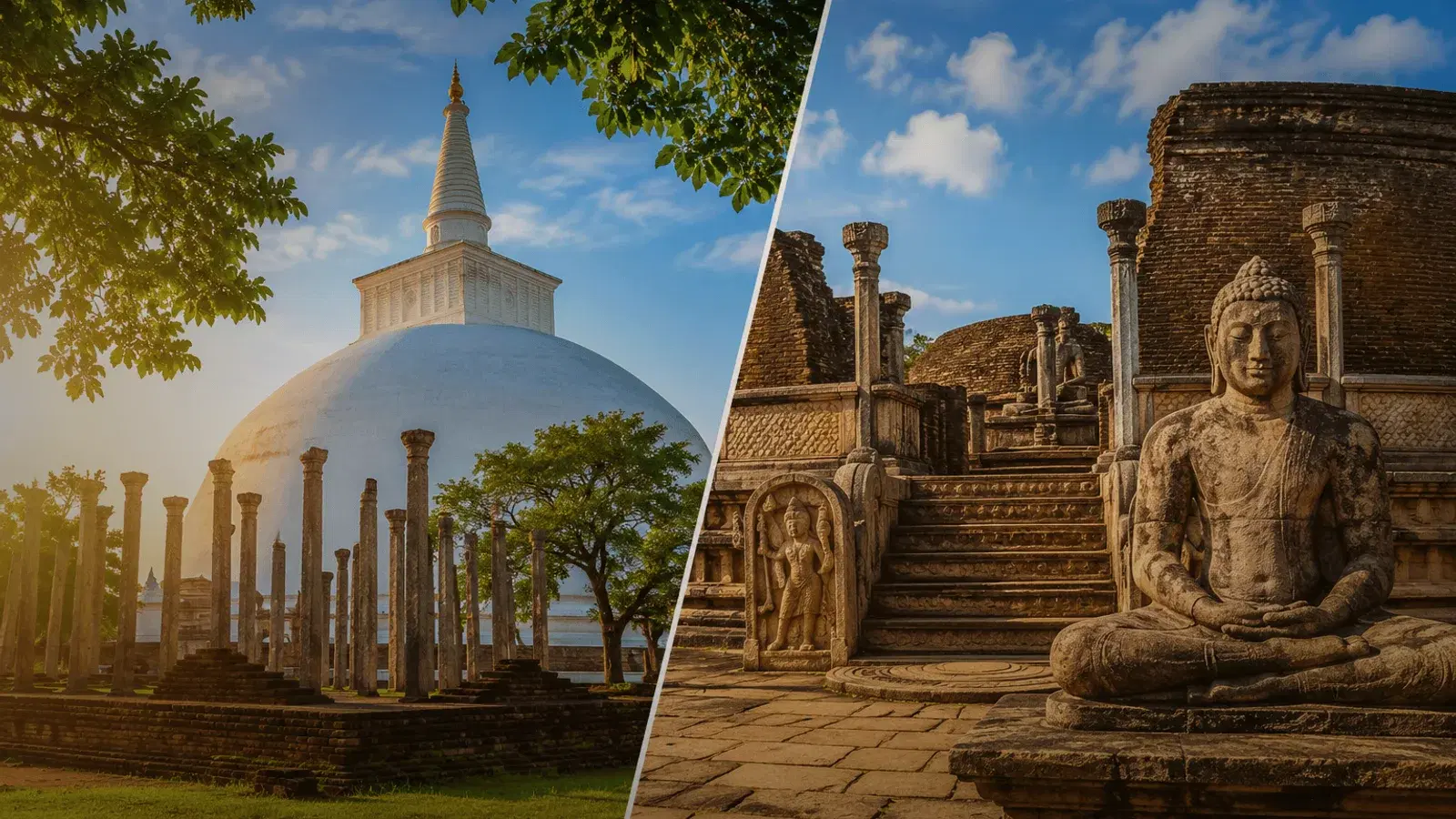
Polonnaruwa is compact, coherent and readable. It was built quickly, largely by a small number of kings with a plan, and it survives as a comprehensible medieval city — a royal palace complex, a walled sacred quadrangle, a sequence of temples and stupas, all within about four kilometres end to end. You can cycle it, you can see how the pieces relate, and you can understand what you are looking at without much prior knowledge. Its centrepiece, Gal Vihara, is four colossal Buddha figures carved from a single granite face, and it is among the finest sculpture in Asia.

Anuradhapura is enormous, dispersed and much harder to read. Monuments sit kilometres apart across scrubland, reservoirs and modern roads, accumulated over more than a millennium with no single plan. Jetavanaramaya was once among the tallest structures on earth. Sri Maha Bodhi has been tended continuously for over two thousand years and is one of the oldest documented trees in the world. But you will not grasp Anuradhapura by wandering it, and a visitor without a guide or serious reading often leaves with an impression of large white domes and long hot distances.

So: if this is your first ancient city in Sri Lanka, if you have young children, if you have half a day rather than a full one, or if you want to understand rather than absorb, choose Polonnaruwa. It gives more per hour and asks less of you.

If you have a real interest in Buddhism or in archaeology, if you want the living devotional atmosphere rather than the ruins, or if the idea of standing in front of a tree planted in the third century BC means something to you, choose Anuradhapura. It is the more significant place and the more moving one, and with a good guide it is the better day.

If you have time for both, do Polonnaruwa first. It builds the vocabulary — stupa, vatadage, moonstone, guardstone, image house — that makes Anuradhapura legible when you get there. Doing them in the other order wastes some of Anuradhapura on you.

One practical note on combining them: they are roughly 100 km apart on reasonable roads. Doing both in a single day is possible and is sold as a day trip, but it means several hours in a vehicle and roughly two hours at each site in the worst heat of the day. It is a poor use of the money you have just spent on two USD 30 tickets.

Polonnaruwa: compact, coherent, easier to understandAnuradhapura: vast, dispersed, more significant, harder to readFirst-timers and families should choose PolonnaruwaDo Polonnaruwa first if doing bothBoth in one day is possible and not worth it

Polonnaruwa: How to Do It Properly

Polonnaruwa is one of the few major sites in Sri Lanka that is genuinely best explored by bicycle, and this is not a novelty recommendation. The site is flat, the internal roads are tarmac and quiet, and the monument groups sit far enough apart to make walking tiring and close enough to make a vehicle feel absurd.

Bicycles are hired at the museum car park and near the main entrance for roughly LKR 400 to 600 per day. They are simple single-speed machines with no helmets provided, which is acceptable given the speeds and the traffic, though anyone uncomfortable with that should take a tuk-tuk instead. Official guides and guided tuk-tuk drivers can also be arranged at the museum.

The efficient route runs south to north. Start at the Royal Palace complex and the Audience Hall, move to the Sacred Quadrangle for the Vatadage and its cluster of temples, continue north past Rankot Vihara and Lankatilaka, and finish at Gal Vihara. That is around four kilometres of riding with as many stops as you want. Finishing at Gal Vihara is deliberate — it is the best thing at the site and works well as an ending.

The southern group around Potgul Vihara and the Parakramabahu statue sits apart from the main axis and takes about half an hour. Include it if you have a full day, skip it if you do not.

Time needed: two to three hours for the highlights, four to six for a thorough visit, and the museum adds another forty-five minutes to an hour. Do not skip the museum. Its scale models of the buildings as they originally stood are what turn a field of brick foundations into something you can picture, and seeing it before you ride rather than after makes a noticeable difference.

Timings: the Central Cultural Fund states that heritage site ticket counters operate from 7:00am to 5:00pm. Published site closing times vary considerably between sources, so plan your visit around the morning rather than around a closing time you have read somewhere. Being at the counter at 7:00am is the single best decision available to you here — it is cool, empty, the light on Gal Vihara is at its best, and the tour buses have not arrived.

Shoes come off at the sacred areas, and the stone gets extremely hot from mid-morning. Socks are a genuinely useful thing to have in your bag. So is water, more than you think, because there is very little shade at the northern end of the site.

Hire a bicycle: LKR 400–600 per dayRide south to north, finish at Gal ViharaVisit the museum before you ride, not afterTicket counters from 7:00am; be there at openingCarry socks — the stone burns by mid-morning

Anuradhapura: How to Do It Without Wasting the Day

Anuradhapura defeats people through distance. The archaeological zone is spread across a very large area, and travellers who arrive expecting a Polonnaruwa-scale site and set off on foot generally see two monuments and give up.

Cycling is possible and popular, and the terrain is flat, but the distances are considerably greater than at Polonnaruwa and there is very little shade. It works well from 7:00am to about 10:00am and becomes punishing after that. A tuk-tuk hired for a half or full day is the more realistic choice for most visitors, particularly families, and lets you cover the outlying complexes without arriving at each one exhausted.

A workable sequence, roughly grouped by geography: begin in the south with Isurumuniya, beautifully set against the Tissa Wewa reservoir and worth its separate small fee for the rock-cut sculpture alone, and neighbouring Vessagiriya. Move north to the Mahavihara core — Sri Maha Bodhi, the Brazen Palace, Ruwanwelisaya and Thuparamaya, which sit close together and are the devotional heart of the city. Then head to the northern complexes: Jetavanaramaya, Abhayagiri, the Twin Ponds, the Samadhi Buddha and the Abhayagiri moonstone, which are the archaeological heart.

That is a full day at a reasonable pace. Two days lets you do it properly with an unhurried morning at each cluster, but remember that two days means two tickets.

The case for a guide is much stronger here than at Polonnaruwa. Anuradhapura does not explain itself. A licensed guide who can tell you why the Samadhi Buddha's expression is considered the finest in Sri Lankan sculpture, what a moonstone's concentric bands represent, and why Jetavanaramaya's brickwork was an engineering achievement is the difference between a memorable day and a hot one.

Dress and conduct matter more at Anuradhapura than almost anywhere else in the country, because this is an active pilgrimage site rather than an archaeological park with worshippers in it. Cover shoulders and knees. White clothing is customary for worshippers and always appropriate. Shoes and hats come off at the sacred precincts. Do not turn your back on a Buddha image to photograph yourself, do not climb on any structure, and do not point your feet toward an image while sitting.

If your timing allows it, visit the Mahavihara area in the late afternoon or on a Poya day. Ruwanwelisaya lit at dusk with families making offerings and oil lamps along the terrace is the thing people remember about Anuradhapura, and it is nothing to do with archaeology.

Distances are the main obstacle — take a tuk-tuk unless you start earlyWork south to north: Isurumuniya, Mahavihara core, northern complexesTwo days means two full-price ticketsA guide changes this site more than any other in the TriangleRuwanwelisaya at dusk is the memory people keep

Mihintale: The Half Day That Completes Anuradhapura

Mihintale sits about 13 km east of Anuradhapura and it is where Buddhism arrived in Sri Lanka. By tradition, the monk Mahinda, son of the Emperor Ashoka, met King Devanampiyatissa here in the third century BC and converted him, an encounter that redirected the entire subsequent history of the island.

It is not covered by the Anuradhapura ticket and does not appear on the Central Cultural Fund's price table. It is ticketed separately, at a fee commonly reported at around LKR 1,000 for foreign visitors.

The site is a hill with a long granite stairway of roughly 1,840 steps rising through a series of terraces — though the steps are broad and shallow rather than steep, and the climb is far gentler than the number suggests. At the top are the Ambasthala Dagoba where the meeting is said to have taken place, the Mahaseya Dagoba, and Aradhana Gala, a bare rock outcrop with a long view across the plain toward Anuradhapura's great stupas on a clear day.

Allow two to three hours including the climb. Go early or late; the granite is exposed and there is almost no shade, and shoes must come off at the upper terraces where the stone becomes genuinely painful in the middle of the day.

Mihintale is at its most extraordinary on Poson Poya in June, which commemorates the arrival of Buddhism and draws enormous crowds of white-clad pilgrims to this specific hill. It is one of the most significant days in the Sri Lankan religious calendar. If your trip coincides with it, the experience is remarkable — and the practical reality is very large crowds, restricted vehicle access and no possibility of a quiet visit. Decide which you want.

Is it worth adding? If you are spending two days at Anuradhapura, yes, without hesitation — it is the origin point of everything the city was built to express, and a morning there makes the rest make sense. If you have one rushed day, skip it rather than compressing Anuradhapura to fit it in.

Where Buddhism arrived in Sri LankaSeparate ticket, around LKR 1,000Roughly 1,840 broad, shallow steps — easier than it soundsTwo to three hours; go early or latePoson Poya in June is extraordinary and extremely crowded

Getting There in 2026 and 2027

Anuradhapura is on the northern railway line, which was restored following Cyclone Ditwah damage with international assistance and is operating. Trains run from Colombo Fort, and the journey is long but straightforward. Anuradhapura has two stations, and services vary in speed considerably — an express is a very different proposition from an all-stops train.

Polonnaruwa is on the Batticaloa line, reached via Maho and Gal Oya junctions, and the connection from Colombo is slow enough that most visitors arrive by road instead.

By road, both cities are typically visited from a base at Sigiriya, Dambulla or Habarana, which sit between them. Polonnaruwa is around 35 km from Habarana and roughly 215 km from Colombo. Anuradhapura is around 60 km from Habarana. Basing at Habarana or Sigiriya and doing each city as a day trip is the most common structure and generally the best one, because it lets you leave at dawn.

Note that the hill-country railway remains disrupted at the time of writing, so travellers combining the Cultural Triangle with Kandy and Ella should check the current position rather than assuming rail connections that existed before November 2025 are running. Our October guide covers the current rail picture in more detail.

Whichever you choose, the single most important logistical decision is what time you leave. Both sites transform between 7:00am and 10:00am — in temperature, in crowd levels, in light, and in whether the stone is walkable barefoot. A driver who agrees to a 6:15am departure is worth more than one who charges less.

Anuradhapura is on the restored northern linePolonnaruwa is on the slow Batticaloa line; most arrive by roadBase at Habarana, Sigiriya or Dambulla and do day tripsCheck the hill-country rail position separatelyLeaving at dawn matters more than anything else

Photography, Drones and the Rules That Are Actually Enforced

Ordinary photography is permitted at both sites and is included in the ticket. The rules that get travellers into trouble are about subject and posture rather than about cameras.

Do not photograph yourself with your back to a Buddha image. This is the one that causes real problems. It is regarded as deeply disrespectful in Sri Lanka, it is enforced, and foreign visitors have been detained and deported over it. The same applies to posing beside, touching, climbing on or sitting on any Buddha image.

Buddha tattoos are a related and genuinely serious issue. Visible tattoos of the Buddha have led to travellers being refused entry to the country and deported. If you have one, cover it.

Drones require prior written approval from the Central Cultural Fund. Flying without it at a heritage site is prohibited, and the same applies to commercial filming. This is stated plainly in the Fund's own ticket terms.

Photographing worshippers is a matter of ordinary courtesy — ask, and accept a refusal. At Sri Maha Bodhi in particular, people are engaged in significant devotional acts and it is not a photo opportunity.

Damaging archaeological structures, flora or fauna at a World Heritage site is a criminal offence in Sri Lanka, which is worth knowing before someone in your group decides to take a brick home.

Never photograph yourself with your back to a Buddha imageCover Buddha tattoos — deportations have resultedDrones need prior written CCF approvalAsk before photographing worshippersDamaging structures is a criminal offence

What a Realistic Day Costs

Working from the verified ticket prices, here is what two adults should actually budget, so nobody is surprised at a counter.

Polonnaruwa, two adults: USD 60 in tickets, roughly LKR 1,000 for two bicycles, plus transport from your base. Add food and water. There are no significant hidden extras at Polonnaruwa — the ticket genuinely covers the site and the museum is included at the ticket office.

Anuradhapura, two adults: USD 60 in tickets, plus roughly LKR 1,000 to 2,000 for the separately-ticketed temples depending on which you visit and which of the disputed fees turn out to apply, plus a tuk-tuk for the day, plus transport from your base. Budget the extras rather than being caught out by them.

Mihintale, two adults: around LKR 2,000 in tickets plus transport.

A family of four with two children aged six to twelve pays USD 90 per site, not USD 120, because of the half ticket. Children under six enter free. Carry passports if you intend to claim SAARC or student relief tickets, because they will be checked.

The comparison people usually want: Sigiriya is USD 35 and takes a couple of hours; Polonnaruwa is USD 30 and takes half a day; Anuradhapura is USD 30 and takes a full day. On a cost-per-hour basis the ancient cities are considerably better value than the rock, whatever their relative fame suggests.

One planning note that saves money: because tickets are single-entry and single-day, there is no benefit whatsoever in buying early or in trying to spread a visit. Buy on the day, at the counter, at 7:00am.

Polonnaruwa for two adults: USD 60 plus bicyclesAnuradhapura for two adults: USD 60 plus LKR 1,000–2,000 in extrasChildren 6–12 are half price; under 6 freeCarry passports for SAARC or student relief ticketsNo advantage to buying ahead — tickets are single-day

Visiting Responsibly

Both cities are sacred to a great many people, and the difference between a visitor and a tourist is mostly a matter of how you carry yourself in them.

Dress properly rather than minimally. Shoulders and knees covered is the requirement; loose, light, modest clothing is what actually works in the heat. A sarong or scarf in your bag solves most problems.

Remove shoes and hats at sacred precincts, and do it before you are asked. Leave them at the designated racks rather than carrying them into the terrace.

Keep your voice down near active worship. At Sri Maha Bodhi and Ruwanwelisaya you will often be within a few metres of people in the middle of something meaningful to them.

Do not tip the shoe-minders extortionately or refuse them entirely — a small note is normal and expected, and this is a legitimate service.

Hire licensed guides. A licensed guide has been trained and examined, and the difference in what you learn is substantial. Guiding is also a livelihood that has had a difficult few years; the money goes somewhere useful.

Buy your water, food and souvenirs at the small stalls around the sites rather than bringing everything from a hotel. The margins are thin and the visitor season is short.

Finally, resist the urge to make the ruins into a backdrop. Both cities have had a difficult relationship with visitor behaviour in recent years, and the difference between a place being welcoming and a place being defensive about outsiders is made up of thousands of small individual decisions, including yours.

Cover shoulders and knees; carry a scarf or sarongShoes and hats off before being askedKeep quiet near active worshipHire licensed guidesBuy from the stalls around the sites

Travel Tips

  • Check the Central Cultural Fund's live price page on the day — prices are quoted in USD and converted at that day's rate
  • Carry cash; card machines at ticket counters frequently fail
  • Buy only at official counters, never from drivers or touts
  • Keep your ticket accessible — it is checked at roving checkpoints, not one gate
  • Carry around LKR 2,000 in small notes for separately-ticketed temples at Anuradhapura
  • Be at the counter at 7:00am; this matters more than any other decision
  • Carry socks — stone terraces become too hot to walk on barefoot by mid-morning
  • Cover shoulders and knees, and bring a scarf or sarong
  • Never photograph yourself with your back to a Buddha image
  • Cover any Buddha tattoo before arriving in Sri Lanka
  • Drones require prior written approval from the Central Cultural Fund
  • Take passports if claiming SAARC, student or diplomatic relief tickets
  • Do the Polonnaruwa museum before cycling, not after
  • Hire a licensed guide at Anuradhapura — it does not explain itself
  • Carry more water than you think, especially at northern Anuradhapura
  • Do not attempt both cities in one day

Frequently Asked Questions

How much does it cost to enter Anuradhapura in 2026?

USD 30 for a foreign adult and USD 15 on the half ticket, according to the Central Cultural Fund's live published price table. Payment is made in rupees at the exchange rate applied on the day. The USD 25 figure that appears in many travel articles is out of date.

How much does Polonnaruwa cost?

The same as Anuradhapura: USD 30 full and USD 15 half, per the Central Cultural Fund. We found published figures ranging from USD 25 to USD 35 elsewhere, none of which match the Fund's own table.

Is there still a combined Cultural Triangle ticket?

No. The USD 50 two-month round ticket described in older guidebooks and forum threads is no longer sold. Sites are ticketed individually.

Can I use one Anuradhapura ticket over two days?

No. The Central Cultural Fund states that tickets are valid for a single entry on the relevant day only. Two days at Anuradhapura means two full-price tickets.

What does the Anuradhapura ticket not cover?

Isurumuniya is definitely excluded and charges its own fee, reported at between LKR 200 and LKR 500. Mihintale is a separate site entirely. Beyond that, sources contradict each other on whether Sri Maha Bodhi, Ruwanwelisaya and the site museums are included. Carry around LKR 2,000 in small notes and you will be covered whichever applies.

Is Mihintale included in the Anuradhapura ticket?

No. It is not a Central Cultural Fund site and does not appear on the Fund's price table. It is ticketed separately, at a fee commonly reported at around LKR 1,000 for foreign visitors.

Anuradhapura or Polonnaruwa — which should I choose?

Polonnaruwa if it is your first ancient city here, if you have children, if you have half a day, or if you want to understand what you are looking at without a guide. Anuradhapura if you have a real interest in Buddhism or archaeology, or want the living devotional atmosphere rather than the ruins. If doing both, do Polonnaruwa first.

Can I visit both in one day?

Physically yes, sensibly no. They are around 100 km apart, and a combined day means hours in a vehicle and about two hours at each site in the worst heat, after paying USD 60 in tickets. Give each its own day.

How long do I need at each site?

Polonnaruwa takes two to three hours for the highlights and four to six for a thorough visit, plus about an hour for the museum. Anuradhapura takes a full day at a reasonable pace, and two days to do properly.

Should I cycle or take a tuk-tuk?

Cycle at Polonnaruwa — it is flat, compact and genuinely the best way to see it, with hire at around LKR 400 to 600 per day. At Anuradhapura the distances are much greater with very little shade, so a tuk-tuk for the day is the more realistic choice unless you start at 7am and finish by mid-morning.

Can I buy tickets online in advance?

You can place an order through the Central Cultural Fund's e-ticketing service, valid for 90 days, but the order is not the ticket. You still collect the physical ticket at the site counter and must produce your order receipt number. Payments are non-refundable. Since tickets are single-day anyway, there is little advantage over buying at the counter.

What should I wear?

Shoulders and knees covered, in loose, light, modest clothing. White is customary and always appropriate at Anuradhapura. Shoes and hats come off at sacred precincts, so carry socks because the stone becomes too hot to walk on barefoot from mid-morning.

Can I fly a drone at the ancient cities?

Not without prior written approval from the Central Cultural Fund. Drone filming at heritage sites is prohibited without it, and this is stated explicitly in the Fund's own ticket terms.

Can I get to Anuradhapura by train?

Yes. Anuradhapura is on the northern line, which has been restored and is operating. Polonnaruwa is on the Batticaloa line and the connection is slow, so most visitors reach it by road from a base at Habarana, Sigiriya or Dambulla.

Reader notes

Join the conversation

Share your question, tip, or travel experience for this guide.

Comments

0 comments

Loading...

Ready to turn inspiration into a Sri Lanka trip?

Use LankaTrip to plan your journey, connect with local guides, and make this itinerary a reality.

Need help planning?

Plan your Sri Lanka adventure

Plan my trip