LankaTrip Insights

28 min read

Ayurveda, Yoga and Spas in Sri Lanka in 2026 and 2027: What Is Regulated, What Is Not, and How to Check Before You Lie Down

Sri Lanka's tourism regulations say a spa treatment room must not lock from the inside, an Ayurvedic hotel must display its physician's registration certificate, and a yoga retreat must not claim to cure all illnesses. Almost no wellness article mentions any of this. Here is how to use those rules to choose well.

Back to blog
Ayurveda, Yoga and Spas in Sri Lanka in 2026 and 2027: What Is Regulated, What Is Not, and How to Check Before You Lie Down

Wellness is one of the most searched reasons to visit Sri Lanka, and one of the least carefully written about. Most articles are lists of attractive resorts with sunrise yoga decks. Very few explain what Ayurveda actually is here, who is allowed to practise it, or how a traveller can tell a registered treatment centre from a roadside room with a massage bed.

That gap matters, because Sri Lanka is unusual. Ayurveda is not an imported trend here; it is a state-recognised medical system with its own government department, a statutory medical council, public hospitals and university degrees. At the same time, the word 'Ayurveda' on a signboard is not protected in the way travellers might assume, and a share of the premises using it are not what they claim to be.

The good news is that Sri Lanka's government has published detailed standards for Ayurvedic hotels, spas, and yoga and meditation centres. They are written for operators, buried in PDFs on the Sri Lanka Tourism Development Authority's website, and almost never quoted in travel writing. Read as a traveller, they amount to a very practical checklist: what should be on the wall, what the treatment room should look like, what you should be asked before anything starts, and what nobody should promise you.

This guide uses those documents, the Ayurveda Act and the Ayurvedic Medical Council's public register, together with the published evidence on herbal medicine safety, to explain Ayurveda, spas, yoga and meditation in Sri Lanka as they are in 2026 and 2027. We do not name or rank private resorts or studios. The aim is to give you the tools to judge any place yourself.

One point before anything else. We are a travel publication, not a medical one. Nothing here is medical advice. If you have a health condition, are pregnant, or take regular medication, talk to your own doctor before booking a treatment programme, and tell the Sri Lankan physician everything when you arrive.

Quick Summary

  • Ayurveda, spas and yoga are three different things in Sri Lanka, with different rules and different regulators
  • Ayurvedic practitioners must be registered with the Ayurvedic Medical Council under the Ayurveda Act No. 31 of 1961; practising for gain without registration is an offence
  • You can check a practitioner against the council's public register before booking
  • SLTDA regulations require an Ayurvedic hotel to have at least one registered Ayurvedic physician and to display the certificate
  • SLTDA spa guidelines say treatment rooms must not lock from the inside and must be visible when the door opens
  • SLTDA criteria for yoga and meditation retreats ban 'cure-all' claims and require written consent and a price list
  • Panchakarma includes induced vomiting, purgation, enemas and, in some programmes, bloodletting — these are medical procedures, not pampering
  • Some Ayurvedic products sold internationally have tested positive for lead, mercury or arsenic; ask what you are taking and do not carry unlabelled medicines home
  • Police in Colombo and elsewhere have repeatedly raided unregistered 'Ayurveda' and 'spa' premises operating as brothels; stick to registered places
  • Two or three days of treatments is relaxation; a genuine panchakarma programme usually takes weeks

Ayurveda, Spa and Yoga: Three Different Things

Travellers tend to use these words interchangeably. In Sri Lanka they describe three different kinds of service, and each is governed differently.

Ayurveda is a traditional medical system. In Sri Lanka the term in law also covers Siddha, Unani and the island's own indigenous medicine, Desiya Chikitsa. A proper Ayurvedic treatment begins with a consultation with a registered physician, who assesses you and prescribes treatments, diet and sometimes internal medicines. The therapists who carry out the treatments work under that physician.

A spa is a relaxation and wellbeing service. It may use Ayurvedic oils and techniques, but also Thai, Balinese, Swedish or aromatherapy methods. A spa massage does not require a doctor, and it is not a medical treatment. Many good hotel spas are exactly this, and there is nothing wrong with that as long as you know which one you are getting.

Yoga and meditation sit in a third category. In Sri Lanka they are offered as drop-in classes, multi-day retreats, teacher trainings, and in the case of meditation, at Buddhist monasteries and forest hermitages. They are not medical services and are not delivered by Ayurvedic physicians, although many Ayurveda resorts include them in their daily programme.

The practical point is simple: before you book anything, work out which of the three you are buying. A 'three-day Ayurveda detox' with no consultation and no physician is a spa package with an Ayurvedic name. A 'spa' that offers to prescribe herbal medicines without a registered physician is overstepping. And a yoga retreat that promises to cure a medical condition is making a claim Sri Lanka's own tourism criteria prohibit.

Ayurveda: a registered medical systemSpa: relaxation, may use Ayurvedic oilsYoga and meditation: practice, not medicineEach is regulated differentlyWork out which one you are buying

How Sri Lanka Regulates Ayurveda, Spas and Wellness Centres

The Ayurveda Act No. 31 of 1961, amended most recently in 2023, establishes the Department of Ayurveda and the Ayurvedic Medical Council. The council registers Ayurvedic practitioners, pharmacists, nurses and massage therapists and deals with their professional conduct. Under the Act, pretending to be a registered Ayurvedic practitioner, or practising for gain as one without registration, is an offence.

Separately, the Tourism Act No. 38 of 2005 requires tourist services to be registered with the Sri Lanka Tourism Development Authority, known as SLTDA. Providing an unregistered tourist service is an offence under the same Act.

For Ayurvedic hotels, SLTDA's Tourism (Registration of Ayurvedic Hotel) Regulations No. 2 of 2019, published in Gazette Extraordinary No. 2149/20 on 14 November 2019, set out minimum requirements. They include at least one Ayurvedic physician certified by the Department of Ayurveda or the Ayurvedic Medical Council, the physician's certificate displayed in the waiting area or consultation room, separate treatment rooms for male and female guests, therapists with at least six months of training approved by the Department of Ayurveda, medicines purchased from manufacturers registered with the Department, patient records of what was prescribed and by whom, emergency and hospital transfer arrangements, and public liability insurance.

For spas and wellness centres, SLTDA publishes separate registration guidelines covering building standards, hygiene, staff training, product labelling and the design of treatment rooms.

For yoga, meditation and other non-Ayurvedic wellness services, SLTDA has published registration criteria for what it calls the Mindful and Spiritual segment of wellness tourism, covering both stand-alone centres and residential retreats. These criteria state that any provider offering services under the name 'Ayurveda' falls outside them and must first obtain approval from the Department of Ayurveda.

None of this guarantees quality. Standards on paper and practice on the ground are not the same thing, and we cannot inspect individual premises. But these documents tell you what a registered place is supposed to look like, and that is far more useful than a star rating.

Ayurveda Act No. 31 of 1961, amended 2023Ayurvedic Medical Council registers practitionersTourism Act No. 38 of 2005 requires SLTDA registrationAyurvedic Hotel Regulations No. 2 of 2019Separate SLTDA spa guidelinesNew criteria for yoga and meditation centres

How to Check a Centre, a Physician and a Spa Before You Book

Ask for the physician's name and registration number. A genuine Ayurveda centre will give you both without hesitation. The Ayurvedic Medical Council publishes a register of doctors, and the Ministry of Indigenous Medicine points the public to a searchable directory of registered practitioners. Check the name before you arrive, not after.

Look for the certificates on the wall. Under the Ayurvedic hotel regulations, the physician's registration certificate should be displayed in the waiting area or consultation room. SLTDA's spa guidelines and its criteria for wellness centres both require the operating licence to be displayed in a conspicuous place. If you cannot see either, ask.

Check the SLTDA list. Sri Lanka Tourism publishes a list of registered spa and wellness centres on its official travel website. It is not always complete or up to date, so absence is a reason to ask questions rather than proof of wrongdoing, but presence is a reasonable sign.

Expect a consultation first. At an Ayurveda centre, a physician should see you before any treatment and ask about your health, medication and goals. SLTDA's wellness criteria also require a consultation before treatments, clear information about what will be done, and your written consent.

Ask for the menu. SLTDA's wellness criteria require a displayed menu of services with detailed pricing, any supplementary charges, treatment duration and a cancellation policy. Sessions are supposed to last the full stated time.

Be wary of claims. The same criteria tell providers to avoid exaggerated or misleading claims, specifically including suggestions that a treatment can cure all illnesses. A place that promises to cure diabetes, cancer, infertility or chronic pain in a week is telling you something important about itself.

Book directly or through a registered agent. SLTDA publishes a list of registered travel agents. Wellness packages sold through social media accounts with no registered business behind them leave you with very little recourse if something goes wrong.

Ask for the physician's name and registration numberCheck the Ayurvedic Medical Council registerLook for the displayed certificate and SLTDA licenceCheck the official SLTDA spa listExpect a consultation and written consentTreat 'cure-all' claims as a red flag

What the Treatment Room Should Look Like

SLTDA's spa registration guidelines are unusually specific about treatment rooms, and those details are worth knowing because they exist to protect you.

Treatment rooms must not have locking devices on the inside. They must be kept clear of screens or other objects so that there is a clear view of the room when the door is opened. SLTDA's criteria for yoga and wellness centres say the same thing in different words: treatment rooms must maintain privacy but must not be hidden, and must have doors that cannot be locked.

Fresh linen should be provided for each guest, and disposable underwear should be offered. Products used should be properly labelled with the manufacturer and basic ingredients. An emergency exit path should be displayed inside the door.

At Ayurvedic hotels, the regulations require separate treatment rooms for male and female guests and both male and female therapists. Asking for a therapist of the same gender is normal and should never be treated as unusual.

SLTDA's wellness criteria also say that practices involving touch must follow ethical boundaries, with the client's consent, and be gender sensitive. You can ask what a treatment involves before it starts, decline any part of it, and stop at any time.

If a room locks from the inside, is hidden behind a curtained corridor with no visibility, or the staff are evasive about what is included, leave. That is not the setup of a registered spa or treatment centre.

No locks on the inside of treatment roomsClear view of the room when the door opensFresh linen and disposable underwearLabelled productsSame-gender therapist on requestYou can stop at any time

Ayurvedic Treatments Explained

The Ayurvedic hotel regulations list the types of treatment a registered Ayurvedic health care unit is expected to provide. They are a useful guide to what the terms on a menu actually mean.

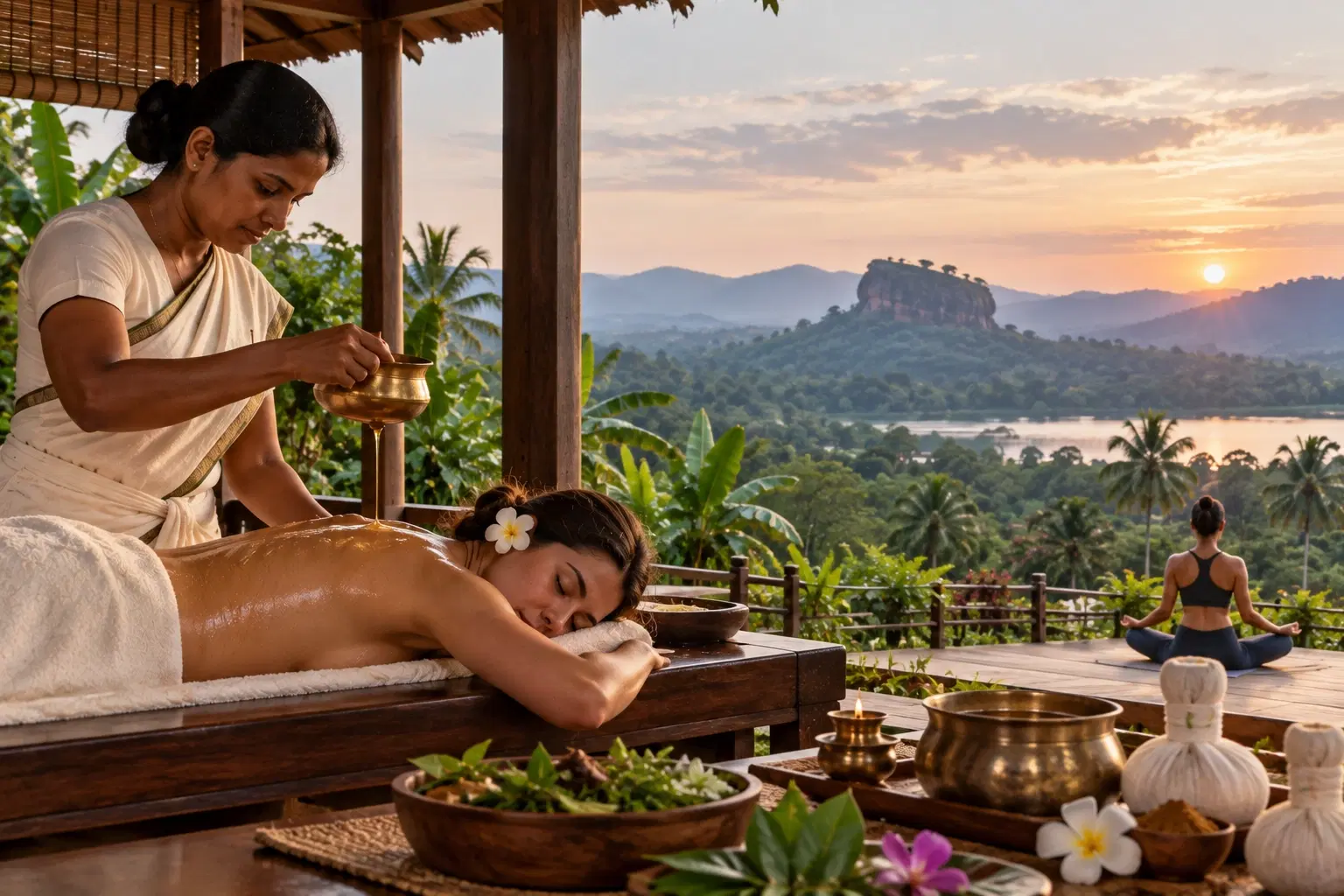
Preparatory treatments, known as poorva karma, are what most visitors experience. They include abhyanga, a full-body massage with warm medicated oil; shirodhara, a steady stream of warm oil poured across the forehead; herbal steam baths, traditionally taken in a wooden steam box; and pinda sweda, in which warm cloth bundles filled with herbs are pressed over the body. These are generally gentle, deeply relaxing and suitable for most healthy adults.

The main cleansing procedures, pradhana karma or panchakarma, are a different matter. The regulations list vamana, therapeutic induced vomiting; virechana, therapeutic purgation; nasya, the administration of medicated substances through the nose; vasti, medicated enemas; and raktha mokshana, bloodletting. These are medical procedures. They should only be done after a physician's assessment, with proper supervision, and they are not appropriate for everyone.

Smaller treatments, kshudra karma, include oil pulling and gargling, and treatments for the eyes. Shamana karma covers internal medicines and dietary measures designed to settle the body.

Diet is part of treatment, not an add-on. A serious Ayurveda centre will adjust what you eat to your assessment, which usually means simple vegetarian food, no alcohol and regular mealtimes. If that sounds unappealing, a spa package is probably a better fit than an Ayurveda programme.

You will be very oily. Hair and skin stay coated after many treatments, and centres commonly advise avoiding strong sun, swimming or cold immediately afterwards. Pack clothes you do not mind staining.

Abhyanga: warm oil massageShirodhara: warm oil on the foreheadHerbal steam and herbal bundlesPanchakarma: medical cleansing proceduresDiet is part of treatmentExpect oil everywhere

Panchakarma, Detox Claims and How Long You Really Need

Panchakarma is the treatment most associated with Ayurveda holidays, and the one most often sold in a form that bears little resemblance to what the word means.

A genuine panchakarma programme includes preparation, one or more of the main procedures described above, and a recovery phase with a controlled diet. Physicians commonly recommend programmes of two weeks or more for this reason. Two or three days of oil massages and steam can be wonderful, but it is not panchakarma, whatever the package is called.

The word 'detox' deserves particular care. Your liver and kidneys remove waste continuously. Ayurveda has its own framework for cleansing, which many people find meaningful, but claims that a short package removes 'toxins' in a measurable medical sense are not supported by evidence that we are aware of. The US National Center for Complementary and Integrative Health notes that scientific evidence for Ayurvedic treatments is limited and advises people not to use Ayurveda to delay seeing a conventional health care provider about a medical problem.

None of this means the experience is without value. Many people find a structured period of rest, early nights, simple food, no alcohol, daily treatments, yoga and quiet genuinely restorative. That is a legitimate reason to go. It is simply a different claim from 'curing' anything.

When comparing programmes, ask what the physician will actually do on each day, which of the main procedures are included, what the minimum stay is, and what happens if you feel unwell during treatment.

Real panchakarma usually takes weeksTwo or three days is relaxation, not panchakarma'Detox' is a marketing word, not a diagnosisEvidence for Ayurvedic treatments is limitedRest, routine and quiet have real valueAsk what happens on each day

Health, Herbal Medicines and Safety

Tell the physician everything. Every medication, every supplement, every health condition, any pregnancy or chance of pregnancy, and any allergies. Some herbal preparations interact with prescription drugs, and some procedures are unsuitable with heart conditions, high or low blood pressure, recent surgery or pregnancy.

Do not stop prescribed medicines because a wellness programme suggests it. Discuss any change with your own doctor first.

Be careful with internal medicines. The US National Center for Complementary and Integrative Health reports that some Ayurvedic preparations can contain lead, mercury or arsenic in amounts that may be toxic. A 2008 study in the Journal of the American Medical Association found that about one in five Ayurvedic medicines bought online, made in both the United States and India, contained detectable lead, mercury or arsenic, with metal-based preparations more likely to be affected. These studies were not of Sri Lankan products specifically, and we are not suggesting Sri Lankan physicians use such preparations. But they are a good reason to know what you are taking.

In Sri Lanka, registered Ayurvedic hotels are required to buy manufactured medicines from producers registered with the Department of Ayurveda and to keep a record of what was prescribed. Ask for the name of any medicine you are given, and for a written list at the end of your stay.

Do not carry large quantities of unlabelled powders, pastes or pills home. Many countries restrict the import of herbal medicines, and an unlabelled product gives your own doctor nothing to work with if a problem arises.

Pregnant travellers and children should not take internal Ayurvedic medicines without specific advice from their own doctor.

In an emergency, Sri Lanka's free Suwasariya ambulance service can be reached on 1990.

Disclose all medication and conditionsNever stop prescribed medicine without your doctorSome Ayurvedic products abroad contained heavy metalsAsk the name of every medicine you takeDo not carry unlabelled medicines homeAmbulance: 1990

Roadside 'Ayurveda' Signs and Why Registration Matters

Walk along Galle Road in Colombo or the main road through almost any beach town and you will see signs for Ayurveda massage. Some of these are genuine, modest treatment rooms staffed by trained therapists. Some are ordinary massage businesses using the word. And some are something else entirely.

Sri Lankan police have repeatedly raided premises operating as brothels under the name of Ayurvedic or massage centres. In December 2025 police in Colombo said they had intensified inspections of establishments registered as Ayurvedic or massage centres after a series of raids, including one on a premises on Galle Road in Kollupitiya. Further raids were reported in January and June 2026.

There is another side to this. In September 2026 an Ayurvedic physician publicly criticised the way some raids were being carried out, arguing that legitimate therapists were being wrongly arrested and that a respected medical tradition was being stigmatised. That criticism is fair to note: most people working in Ayurvedic massage are doing exactly what they say they do.

For a traveller, the practical conclusion is the same either way. A registered centre with a named physician, a displayed licence, a price list and a treatment room that meets the standards above is a better choice than an unmarked room above a shop, for your safety, your privacy and your recourse if something goes wrong.

If anyone offers 'extra services', leave. If you have a complaint about a tourist service, SLTDA operates an online complaints system and a tourism hotline on 1912.

Not every 'Ayurveda' sign is a treatment centrePolice raids on fronts reported in 2025 and 2026Most therapists are legitimateRegistered and visible beats cheap and hiddenComplaints: SLTDA online system or 1912

Hotel and Resort Spas: What to Expect

Most large hotels and many boutique properties in Sri Lanka have a spa. For many travellers, a spa treatment at the end of a long travel day is the most practical and enjoyable form of wellness on the island.

SLTDA's spa guidelines set minimum standards for registered spas, including purpose-designed buildings, a reception, a set number of therapy rooms, changing rooms and lockers, hot and cold water, trained staff with certificates in their specialisation, and a manager with suitable qualifications.

Where a spa has a jacuzzi or pool, the guidelines require a filtration system, a regular water-testing programme covering pH, chlorine and dissolved solids, monthly bacterial analysis, anti-entrapment covers on drains and suction ports, and displayed safety notices.

Hotel spas typically offer a mix of Ayurvedic-style treatments and international ones. An 'Ayurvedic massage' in a hotel spa is usually a relaxation massage with Ayurvedic oils. It is a good experience, but it is not a medical Ayurvedic treatment unless a physician has assessed you.

Ask about the oils before a facial or head treatment if you have sensitive skin or allergies. Registered spas are expected to use labelled products with listed ingredients.

Prices vary enormously between a guesthouse massage room and an international resort spa. We do not quote figures because they change frequently and depend on the property; the displayed menu is the only reliable source.

The most practical wellness option for most travellersSLTDA sets minimum spa standardsWater testing rules for jacuzzis and poolsHotel 'Ayurvedic massage' is usually relaxationAsk about oils if you have allergiesCheck the displayed menu for prices

Yoga Classes, Retreats and Teacher Trainings

Yoga in Sri Lanka ranges from a single drop-in class on a beach deck to residential retreats of a week or more and multi-week teacher trainings.

The largest concentration is on the south coast, particularly around Weligama, Mirissa, Hiriketiya and Tangalle, where yoga grew up alongside surfing. Arugam Bay on the east coast has a similar scene during its season. Ella and the hill country offer cooler practice with mountain views, and there are retreats inland and near the Cultural Triangle for those who want quiet.

There is no national licensing of yoga teachers in Sri Lanka. SLTDA's criteria for wellness centres require instructions to be delivered by qualified and experienced facilitators and say professional staff must hold relevant and verifiable certifications or experience, but those criteria apply to registered centres, and a class on a guesthouse roof may not be one.

So ask. Where did the teacher train, for how long, and how long have they taught? What style is the class, and is it suitable for beginners? For a retreat, what is the daily schedule, how many hours of practice are there, and what else is included?

Tell the teacher about injuries before class. Heat and humidity make muscles feel more flexible than they are, which is one reason travellers overstretch. Hydrate properly; SLTDA's criteria require hydration stations at registered centres for good reason.

For teacher trainings, check whether the certificate is recognised by the body you want it to count with at home. Sri Lankan registration of a centre is not the same as international recognition of a qualification.

SLTDA's criteria for residential retreats also require minimum stay requirements to be communicated in advance, a pre-arrival questionnaire, an orientation session and clear information on schedule and conduct. A retreat that cannot tell you these things before you pay is not well organised.

South coast is the main yoga hubArugam Bay in its season; Ella for cool morningsNo national yoga teacher licensingAsk about training and experienceMention injuries; heat makes you overstretchCheck how a teacher training is recognised

Meditation and Buddhist Practice

Meditation in Sri Lanka is rooted in Theravada Buddhism, and some of the most authentic opportunities are at monasteries and forest hermitages rather than at resorts.

A number of monasteries and meditation centres accept foreign visitors for short or longer stays, typically for guided meditation, Dhamma talks and a simple daily routine. Arrangements vary greatly, and many require you to contact them in advance.

Expect simplicity. Accommodation may be basic, meals are usually vegetarian and eaten before noon, silence may be kept for much of the day, and visitors are often asked to wear white or plain, modest clothing and to observe basic precepts such as no alcohol.

Many monastic centres do not charge a fixed fee and instead rely on donations, known as dana. Giving generously and respectfully is part of the arrangement, not an optional tip.

These are religious institutions, not wellness products. Treat them with the same respect you would any temple: covered shoulders and knees, shoes off where indicated, no photographs of monks without permission, and no expectation of hotel-style service.

Resort and retreat meditation sessions are more accessible for beginners and are often a good first step. SLTDA's wellness criteria require cultural and spiritual components to be conducted respectfully and, where relevant, in collaboration with local communities or spiritual institutions.

Rooted in Theravada BuddhismSome monasteries accept foreign meditatorsSimple food, silence, modest white clothingDonation-based: give generouslyReligious institutions, not wellness productsResort sessions are an easier start

Where to Go: Wellness by Region

West coast. The stretch from Wadduwa and Kalutara through Beruwala and Bentota has the longest-established concentration of Ayurveda resorts on the island, many of them catering to long-stay European guests. It is also convenient for the airport.

South coast. From Galle to Tangalle you find everything: resort Ayurveda, small treatment centres, yoga studios, surf-and-yoga camps and retreats. It is the easiest region to combine wellness with a beach holiday.

Hill country. Retreats around Kandy, Ella and the tea country offer cooler temperatures, forest walks and quiet. The weather can be wet and cold, and some programmes combine yoga with walking. Note that the Kandy to Nanu Oya railway is still closed; plan road transfers.

Cultural Triangle. A smaller number of Ayurveda and wellness properties sit near Sigiriya, Dambulla and the ancient cities. The area is hot and dry for much of the year, which suits some treatments and some travellers.

East coast. Arugam Bay and the Trincomalee area have yoga and small wellness offerings during their season, when the west and south are wet.

Kandy and its surroundings are also where you are most likely to encounter Buddhist meditation in a living religious context.

West coast: long-established Ayurveda resortsSouth coast: yoga, surf and Ayurveda togetherHill country: cool retreats, road transfersCultural Triangle: fewer, quieter propertiesEast coast: yoga in its own season

When to Go

Ayurvedic treatments are indoor and can be taken at any time of year. The season matters more for what you do between treatments.

The west and south coasts are generally at their best from December to April and wetter from May to September with the south-west monsoon. Beaches on those coasts can be dangerous for swimming in the wet months, which matters little on an Ayurveda programme but a lot on a yoga-and-beach holiday.

The east coast works the other way round, generally best from around May to September.

The hill country is coolest and clearest from January to April, and wettest around October and November, when landslide risk on mountain roads rises.

Some long-stay Ayurveda guests deliberately travel in the quieter, wetter months, when there are fewer visitors and prices at some properties are lower. Ask each property whether it runs its full programme year-round.

Poya full moon days are monthly public holidays on which alcohol sales are banned island-wide. On a genuine Ayurveda programme you will not be drinking anyway.

Treatments work year-roundWest and south: December to AprilEast: around May to SeptemberHill country: January to AprilQuieter months can mean lower prices

Costs, Packages and What to Ask Before Paying

We do not publish prices for private wellness providers. They vary from very modest to international luxury, change frequently, and are often quoted as all-inclusive packages that are hard to compare.

What drives the price: whether a registered physician is involved, how many treatments per day are included, whether internal medicines are included, the length of the minimum stay, the standard of accommodation and food, and whether yoga, meditation and excursions are part of the package.

Before paying, ask for a written breakdown: the number of consultations, treatments per day and their duration, which panchakarma procedures if any are included, whether medicines are included or charged separately, the minimum stay, meals, and the cancellation policy. SLTDA's wellness criteria expect providers to publish prices, supplementary charges and cancellation terms, so a reasonable provider should not find this difficult.

Check whether your travel insurance covers complementary treatments, and whether it covers you if you become unwell during one.

For stays of several weeks, check how long your visa or electronic travel authorisation allows you to stay, and whether you will need an extension from the Department of Immigration and Emigration. Rules change, so confirm on the official site before booking a long programme.

Prices vary widely; compare packages carefullyGet a written breakdown before payingAsk whether medicines are extraCheck your insuranceCheck visa length for long stays

Who a Wellness Trip Does Not Suit

Anyone looking for a cure. Ayurveda, yoga and meditation can support wellbeing, but no reputable Sri Lankan provider should promise to cure a serious illness, and SLTDA's own criteria prohibit that kind of claim.

Anyone with a serious or unstable medical condition who has not discussed the programme with their own doctor. That includes heart disease, uncontrolled blood pressure, recent surgery, and pregnancy.

Anyone wanting a normal holiday with a few treatments added. A real Ayurveda programme means early nights, a restricted diet, no alcohol and a lot of oil. If you want sightseeing, beach bars and seafood, book a hotel with a good spa instead.

Anyone expecting luxury at a monastery. Meditation centres attached to religious institutions are simple by design.

And anyone in a hurry. Wellness in Sri Lanka rewards slow travel. If you only have a few days, a couple of good spa treatments and a yoga class are a better use of them than a compressed 'detox'.

Not for anyone seeking a cureDiscuss medical conditions with your doctor firstReal Ayurveda means diet and early nightsMonasteries are simple by designShort trips: spa and yoga, not 'detox'

Travelling Well: Respect, Privacy and Recourse

Ayurveda is part of Sri Lanka's public health system and cultural heritage, not only a tourism product. Treat physicians as the medical professionals they are, and therapists as trained workers.

Keep your own record. Photograph the physician's certificate, note the names of medicines, and keep receipts. SLTDA's criteria require registered wellness providers to keep your health information confidential and to maintain records of treatment, which you are entitled to ask about.

Tip fairly where tipping is customary, and give dana properly at monasteries.

Do not photograph other guests in treatment areas, and respect silence in retreats and meditation spaces.

If something goes wrong, raise it with the manager first. For registered tourist services, SLTDA runs an online complaints system and a tourism hotline on 1912. For concerns about an Ayurvedic practitioner's conduct, the Ayurvedic Medical Council is the professional regulator.

Ayurveda is medicine and heritageKeep your own recordRespect silence and privacyGive dana properlySLTDA complaints and 1912 hotline

Travel Tips

  • Decide whether you want Ayurveda, a spa or yoga before you book
  • Ask for the physician's name and registration number and check it on the Ayurvedic Medical Council register
  • Look for the displayed physician certificate and SLTDA licence
  • Expect a consultation and written consent before treatments
  • Leave if a treatment room locks from the inside or is hidden from view
  • Ask for a same-gender therapist if you prefer; it is normal
  • Treat any promise of a cure as a red flag
  • Tell the physician about every medication, condition and pregnancy
  • Never stop prescribed medicine without your own doctor's advice
  • Ask the name of every medicine and get a written list
  • Do not carry unlabelled medicines home
  • Get a written package breakdown before paying
  • Allow two weeks or more for a genuine panchakarma programme
  • Pack old clothes for oil treatments
  • Tell yoga teachers about injuries and hydrate properly
  • Dress modestly and give dana at monasteries
  • Check visa length for long programmes
  • Complaints: SLTDA online system or tourism hotline 1912

Frequently Asked Questions

Is Ayurveda in Sri Lanka regulated?

Yes. Under the Ayurveda Act No. 31 of 1961, Ayurvedic practitioners must be registered with the Ayurvedic Medical Council, and practising for gain as an Ayurvedic practitioner without registration is an offence. Ayurvedic hotels that serve tourists must also be registered with the Sri Lanka Tourism Development Authority under regulations published in 2019.

How can I check that an Ayurvedic doctor is registered?

Ask for their full name and registration number and check it against the Ayurvedic Medical Council's register of doctors. The Ministry of Indigenous Medicine also directs the public to an online directory of registered practitioners. At a registered Ayurvedic hotel, the physician's certificate should be displayed in the waiting area or consultation room.

What is the difference between an Ayurvedic treatment and a spa massage?

An Ayurvedic treatment is prescribed by a registered physician after a consultation, as part of a medical system. A spa massage is a relaxation service that may use Ayurvedic oils but does not involve a physician. Both can be good; they are simply different things.

How long does panchakarma take?

A genuine programme includes preparation, the main procedures and a recovery period, which is why physicians commonly recommend two weeks or more. Short packages of two or three days are relaxation treatments, not panchakarma in the full sense.

Is Ayurvedic treatment safe?

External treatments such as oil massage and steam are generally gentle for healthy adults. Some panchakarma procedures and internal medicines carry real risks and are not suitable for everyone. Tell the physician about all medications and conditions, and discuss any programme with your own doctor first, particularly if you are pregnant or have a heart condition or high blood pressure.

Can Ayurvedic medicines contain heavy metals?

Some Ayurvedic products tested abroad have contained lead, mercury or arsenic, according to the US National Center for Complementary and Integrative Health and a 2008 JAMA study of products sold online. Those studies were not of Sri Lankan products specifically. Registered Sri Lankan Ayurvedic hotels must buy medicines from manufacturers registered with the Department of Ayurveda; ask what you are taking and keep a written list.

Are the roadside Ayurveda massage places safe?

Some are genuine and some are not. Police have raided a number of premises operating as brothels under the name of Ayurvedic or massage centres, including in Colombo in 2025 and 2026. A registered centre with a named physician, a displayed licence and a proper treatment room is the safer choice.

What should a spa treatment room look like?

According to SLTDA's spa guidelines, treatment rooms must not lock from the inside, must give a clear view of the room when the door opens, and should provide fresh linen and disposable underwear. Leave if a room does not meet these basics.

Can I ask for a therapist of the same gender?

Yes. SLTDA's Ayurvedic hotel regulations require separate treatment rooms for male and female guests and both male and female therapists. Requesting a same-gender therapist is normal.

Do yoga teachers in Sri Lanka need a licence?

There is no national licensing of yoga teachers. SLTDA's criteria for registered wellness centres require qualified and experienced facilitators with verifiable credentials, but not every class is run by a registered centre. Ask where your teacher trained and for how long.

Where is the best place in Sri Lanka for yoga?

The south coast around Weligama, Mirissa, Hiriketiya and Tangalle has the largest concentration of yoga studios and retreats. Arugam Bay is popular in its season, and the hill country around Ella offers cooler practice.

Where is the best place for an Ayurveda retreat?

The west coast between Wadduwa and Bentota has the longest-established concentration of Ayurveda resorts, and the south coast has many options as well. What matters more than location is whether the centre has a registered physician and meets the regulated standards.

Can I do a meditation retreat at a Sri Lankan monastery?

Some monasteries and meditation centres accept foreign visitors, usually by prior arrangement. Expect simple accommodation, vegetarian meals before noon, periods of silence, modest white or plain clothing and a donation-based arrangement.

What is the best time of year for a wellness trip?

Indoor treatments work year-round. For combining wellness with beaches, the west and south coasts are generally best from December to April and the east coast from around May to September. The hill country is clearest from January to April.

Where can I complain about a wellness provider?

Raise it with the manager first. For registered tourist services, the Sri Lanka Tourism Development Authority runs an online complaints system and a tourism hotline on 1912. Concerns about an Ayurvedic practitioner's professional conduct can be taken to the Ayurvedic Medical Council.

Reader notes

Join the conversation

Share your question, tip, or travel experience for this guide.

Comments

0 comments

Loading...

Ready to turn inspiration into a Sri Lanka trip?

Use LankaTrip to plan your journey, connect with local guides, and make this itinerary a reality.

Need help planning?

Plan your Sri Lanka adventure

Plan my trip