LankaTrip Insights

28 min read

A Day in Colombo in 2026 and 2027: The Open-Top Bus, the Tuk-Tuk Tour, or Doing It Yourself

Most visitors give Colombo a single day, usually at the start or end of a trip, and the three ways to spend it cost wildly different amounts for broadly similar coverage. This is an honest comparison of the open-top bus, the tuk-tuk city tour and a self-guided day, with verified prices where they exist and named uncertainty where they do not.

Back to blog
A Day in Colombo in 2026 and 2027: The Open-Top Bus, the Tuk-Tuk Tour, or Doing It Yourself

Colombo gets one day from most visitors, tacked onto the start or the end of a trip, and it is usually the day people put the least thought into.

That is a fair instinct in one sense. Colombo is not why anyone flies to Sri Lanka, and a first-time visitor choosing between another day in Colombo and another day in the hill country should choose the hill country.

But a day here is often unavoidable, because of flight times, and it is more interesting than its reputation suggests. It is a working port city with a Dutch and British colonial core, a chaotic market quarter, several genuinely beautiful religious buildings within a few kilometres of each other, and a seafront that fills up every evening with families, kite sellers and food carts.

There are three realistic ways to spend that day, and they cost dramatically different amounts for broadly similar coverage. The open-top double-decker bus, which is the red one you will have seen parked near Galle Face. A tuk-tuk city tour. Or doing it yourself.

This guide compares them honestly, including the parts the booking pages do not mention. We give verified prices where an official source publishes them, and we say so plainly where we could not verify a figure rather than repeating whatever number appears most often online.

Quick Summary

  • The red open-top double-decker is a single sightseeing service run in collaboration with the Sri Lanka Tourism Development Authority, operating twice daily
  • The same seat on the same bus is resold across booking platforms at prices ranging from roughly USD 20 to USD 60
  • Most guided Colombo tours, bus and tuk-tuk alike, include a shopping stop; this is a commission arrangement rather than an itinerary highlight
  • A tuk-tuk city tour is more flexible and usually cheaper, but you are more exposed to being taken to shops
  • Colombo is genuinely walkable in parts, and a self-guided Fort and Pettah morning costs nothing
  • The Lotus Tower publishes its own prices: USD 20 for foreign adults, USD 10 for children aged 3 to 10, free under 3
  • Colombo National Museum pricing could not be verified; reported figures range from LKR 500 to LKR 2,000 and we are not going to pick one
  • Galle Face Green, Independence Square and the Pettah streets are free
  • Traffic between roughly 4 and 7 pm will destroy any tightly scheduled afternoon plan

Is Colombo Worth a Day?

A straight answer first, because a lot of guides evade this one.

If you have ten days in Sri Lanka and you are choosing between a Colombo day and an extra day anywhere else, take the extra day elsewhere. Colombo is not the reason to come.

If you have a fixed day here because of flight timings, a layover, a cruise stop, or because you are collecting something from the city, it is a considerably better day than its reputation suggests, provided you do not try to treat it as a highlights checklist.

What Colombo does well: colonial architecture in a working setting rather than a preserved one, religious buildings of four faiths within a small radius, a market quarter that has not been tidied up for visitors, excellent and cheap food, and a seafront that is genuinely enjoyable in the evening.

What it does not do: beaches worth the name, dramatic scenery, or anything resembling a compact tourist old town. It is a city that is worked in, not a city arranged for visiting.

Set expectations accordingly and the day works. Arrive expecting Galle Fort with a bigger population and you will be disappointed.

Not the reason to visit Sri Lanka, and that is fineBetter than its reputation if you have the day anywayColonial architecture in a working cityFour faiths within a small radiusNot a compact tourist old town

The Open-Top Double-Decker: What It Actually Is

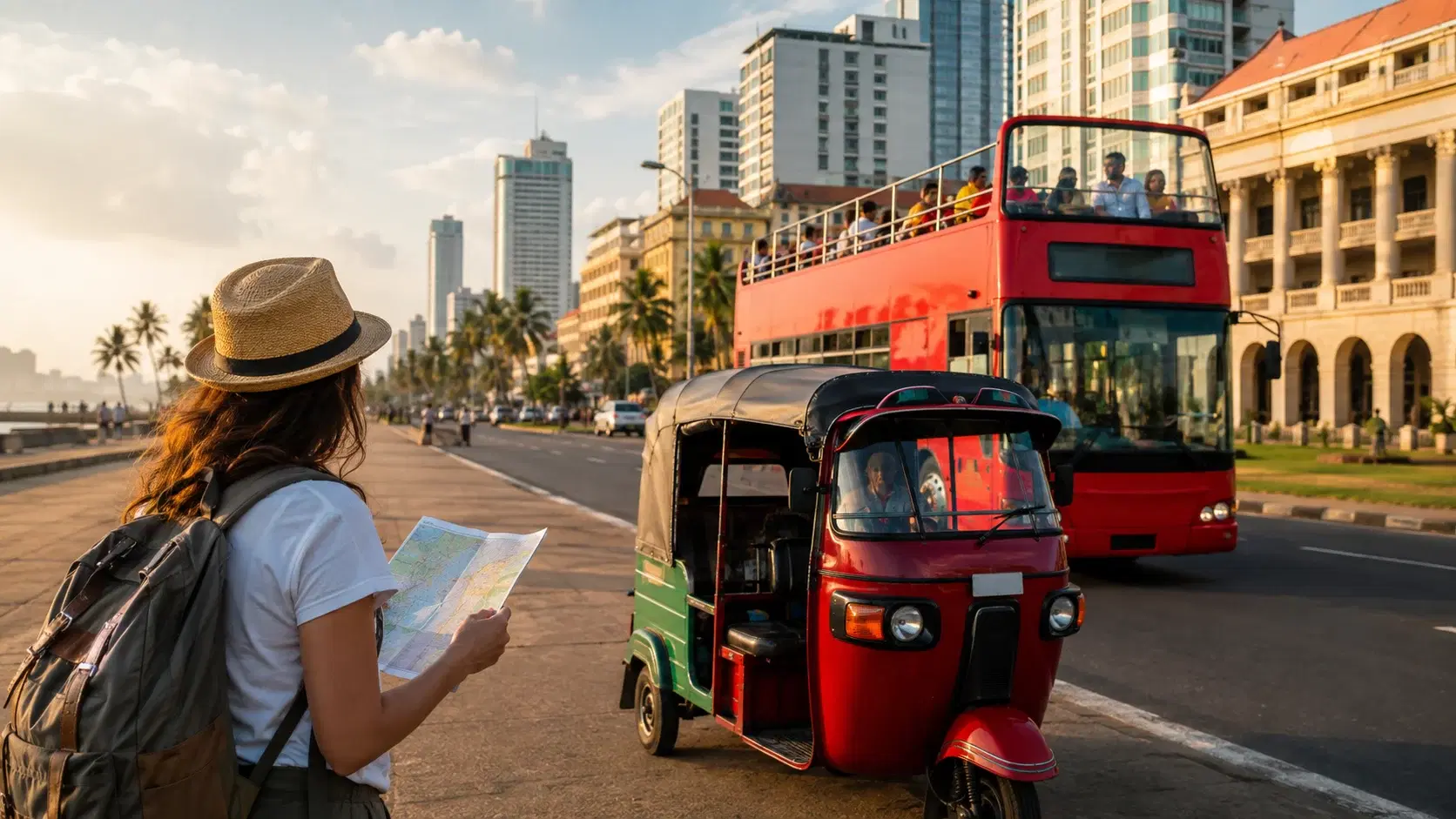
The red open-top double-decker you see around Galle Face and the Fort is a sightseeing service operated in collaboration with the Sri Lanka Tourism Development Authority. It is the only open-deck city sightseeing operation of its kind in Sri Lanka, which is why every listing you find is ultimately selling seats on the same vehicles.

The buses are converted London-style double-deckers with the top deck open. Tours run twice daily, seven days a week, with a morning departure typically in the region of 9 am and an afternoon one in the mid-afternoon. An evening version also operates.

The standard tour runs roughly two and a half to three and a half hours depending on which version you book. Hotel pickup within Colombo is generally included, and the service also picks up at the port for cruise passengers.

The route covers the Galle Face promenade with its display of old cannons, the Fort district, Pettah, the Old Parliament building, Town Hall, Independence Square, the Beira Lake area and the temple district. The bus stops and lets you off at several of these rather than simply driving past.

Live English commentary is provided by a guide on board. Bottled water and snacks are usually included, and entrance fees to some of the sites visited are sometimes included depending on the package.

One practical caveat from repeated visitor accounts: the public address system does not always work. On an open top deck in Colombo traffic, that matters more than it would elsewhere, and a guide speaking unamplified over engine noise is a genuinely different experience. Sit near the front if you can.

One operator, run with the tourism authorityTwice daily, seven days a week, plus an evening tourRoughly 2.5 to 3.5 hours with hotel pickupStops and disembarks at several sites, not a drive-pastThe PA system is not always working; sit near the front

Why the Same Bus Costs USD 20 to USD 60

This is the part worth reading before you book anything.

Because there is essentially one operator, every online listing is reselling the same product. And yet, checking across the major booking platforms and reseller sites, we found the Colombo open-deck bus tour listed at approximately USD 20, USD 27, USD 35, USD 40, USD 46, USD 50, USD 58 and USD 60.

Some of that spread is real. The morning tour, the afternoon excursion and the night tour are different lengths and are priced differently by the operator. Some packages include entrance fees to the sites visited and some do not. A three and a half hour evening tour is legitimately more than a two and a half hour morning one.

But it does not account for a factor of three on comparable products. Most of that gap is reseller margin, and it is invisible at the point of purchase because each site presents its figure as the price.

What to do about it. Compare at least three listings before booking, and compare them on duration and inclusions rather than on the headline figure alone. Check specifically whether entrance fees are included, because that is where the genuine difference between packages lies. And check whether you are booking the morning, afternoon or evening departure, because they are not the same product.

The general principle applies well beyond this one bus. Sri Lanka has a deep reseller layer between visitors and operators, and for any activity with a single provider, the price you are shown is frequently a markup on a markup.

We are not publishing a single recommended figure, because these prices move and a number published today would mislead you within months. What we can tell you is the shape of the problem and how to check.

One operator, many resellers, same seatsListings found from roughly USD 20 to USD 60Some spread is real: different tour lengths and inclusionsMost of it is reseller marginCompare three listings on duration and inclusions

The Shopping Stop Nobody Mentions on the Booking Page

Almost every guided city tour in Colombo, bus or tuk-tuk, includes a stop at a shop. Often a state-run handicraft store, sometimes a gem or jewellery showroom, sometimes both.

This is not a scandal and it is not unique to Sri Lanka. It is a standard commission arrangement across the region: the shop pays the operator or the driver for delivering customers, and that subsidy is part of why the tour price is what it is.

What you should know about it. The stop is an itinerary item, not an optional extra you were asked about. It will typically take twenty to forty minutes of a tour you are paying for by the hour. Prices at commission-paying shops are generally higher than at ordinary retail. You are under no obligation whatsoever to buy anything.

Gem showrooms deserve particular caution. Sri Lanka has a genuine and centuries-old gem industry, and it also has a well-established trade in selling overpriced or misrepresented stones to tourists who have no way to value them. Unless you know how to assess gemstones, do not buy them on a city tour. This is not a bargain you are stumbling upon.

How to handle it politely: say you are not shopping today, decline tea if you would rather not sit through a sales conversation, and wait outside or in the vehicle. Nobody will be offended. It happens constantly.

If you would rather avoid the stop entirely, say so when booking and again to your guide at the start. Some operators will accommodate it, particularly on private tours. Some will not, because the commission is built into the price you were quoted.

The honest summary: a shopping stop is not a reason to avoid a guided tour. It is a reason to know that thirty of the minutes you paid for are not sightseeing.

Nearly all guided Colombo tours include a shop stopIt is a commission arrangement, not an itinerary highlightExpect to lose 20 to 40 minutes of paid tour timeDo not buy gemstones on a city tourAsk to skip it at booking; some operators will agree

The Tuk-Tuk City Tour

The main alternative to the bus, and for a lot of travellers the better option.

A tuk-tuk city tour is a private hire: you, a driver, and a three-wheeler, for a fixed number of hours on a route you can influence. Most run three to five hours and cover much the same ground as the bus, plus places a double-decker physically cannot go.

The advantages are real. You can stop where you want and skip what bores you. You can get into the narrow streets of Pettah, which is where Colombo is most interesting and where the bus can only drive past. It is generally cheaper than the bus for two people. And it is a more conversational experience: a good tuk-tuk driver will tell you things a scripted commentary will not.

The disadvantages are equally real. There is no shade and no shelter, which matters in the middle of the day and matters more in the rain. It is noisier and dustier, and you are sitting in traffic at exhaust level. There is no safety comparison to be made with a bus, and there are no seatbelts. And the quality is entirely dependent on which driver you get, with no standard to fall back on.

Commission stops are, if anything, more of an issue on tuk-tuk tours than on the bus, because the driver's incentive is direct rather than institutional.

Agree the price and the duration before you set off, and be explicit about the route and about shops. A tuk-tuk tour that has been clearly framed at the start is usually excellent. One that has not can turn into three hours of shops.

For families with small children, the lack of restraints is worth weighing seriously.

Private, flexible, and usually cheaper for twoReaches Pettah streets a bus cannotNo shade, no shelter, no seatbeltsQuality depends entirely on the driverAgree price, duration, route and shops before setting off

Doing It Yourself, and Why It Often Wins

Colombo is more walkable than visitors expect, in specific areas, and the self-guided version of this day costs essentially nothing.

The reason it often works better than a tour is that the guided options are structured around covering ground, and Colombo does not reward covering ground. It rewards spending forty minutes in one market street.

The Fort district and Pettah are adjacent, compact, and best explored on foot. Galle Face Green is a twenty-minute walk from the Fort. The temple district around Beira Lake is a short tuk-tuk hop from there. Independence Square and the museum sit together in Cinnamon Gardens, a little further out.

That gives you a natural structure: walk the Fort and Pettah in the morning, take a metered tuk-tuk or a ride-hailing app between districts, and finish at Galle Face in the evening when the whole city turns up.

What you give up is commentary, and it is a genuine loss. Colombo's colonial buildings do not explain themselves and the Fort district in particular is much more interesting with context. If you are going self-guided, read about the Dutch and British periods beforehand, or hire a walking guide for the Fort section only.

What you gain is time, money, and the ability to stop for a plain tea when you feel like it.

The one thing to plan around is heat. Walk before 10.30 am or after 3.30 pm. The middle of the day in Colombo is not a walking proposition.

Fort and Pettah are compact and walkableColombo rewards depth, not coverageUse metered tuk-tuks or apps between districtsYou lose commentary; read beforehand or hire a guide for Fort onlyWalk before 10.30 am or after 3.30 pm

A Free Self-Guided Route

This is a suggested structure rather than a prescription, and it assumes a full day.

Start early in the Fort district. The old colonial commercial quarter has the Old Parliament, the clock tower lighthouse, the Dutch-era layout and a set of grand banking and trading buildings in varying states of repair. It is quiet in the early morning and busy by ten.

Walk into Pettah from there. This is the market quarter, organised loosely by street: one for hardware, one for textiles, one for electronics, one for spices and dried goods. It is loud, crowded and entirely unpretentious. Within it sit the striking red and white striped Jami Ul-Alfar mosque, a Hindu temple, and colonial-era churches, within a few hundred metres of each other. This concentration of faiths in one small quarter is the single most interesting thing about Colombo.

Break for the middle of the day. Eat properly, sit down, and get out of the sun.

Mid-afternoon, take a tuk-tuk to the Beira Lake temple area and Gangaramaya, then on to Independence Square and the museum precinct in Cinnamon Gardens if you want an indoor hour.

Finish at Galle Face Green from about five o'clock. This is when Colombo is at its best: the promenade fills with families, kite sellers and food carts, and the sunset over the Indian Ocean is genuinely good. The isso wade carts here are an institution.

Total cost: a few tuk-tuk fares, one or two entrance tickets if you want them, and whatever you eat.

Practical notes for the walking sections. Pavements are inconsistent and often occupied, so watch your footing rather than your phone. Pettah is busy rather than dangerous, but keep valuables secured as you would in any crowded market. Carry water.

Fort early, Pettah mid-morningFour faiths within a few hundred metres in PettahRest through the middle of the dayTemples and Cinnamon Gardens mid-afternoonGalle Face Green from about 5 pm

The Lotus Tower: Verified Pricing

The Lotus Tower, Nelum Kuluna in Sinhala, is a 350-metre communications tower beside Beira Lake and the tallest structure in South Asia. It has an observation deck, restaurants and a digital art installation.

It publishes its own prices, which makes it one of the few Colombo attractions you can budget for with confidence.

Foreign visitors: USD 20 for adults and children over 10, USD 10 for children aged 3 to 10, free for children under 3. Sri Lankan residents pay LKR 500 for an adult observation deck ticket, with lower rates for children and school students.

Opening hours are 9 am to 10 pm on weekdays and later at weekends, with ticket issue ending an hour or so before closing. Check the current times before travelling out, particularly for an evening visit.

One inconsistency worth flagging, on their own published page. The ticket table lists the USD 20 foreign adult rate as covering the observation deck plus the Pixel Bloom digital art experience, while the Tourist Pass description alongside it says the pass entitles the holder to a single visit to the observation deck. We could not reconcile the two. Ask at the counter what your ticket includes before paying, rather than assuming.

Is it worth USD 20? The view is good, particularly at dusk when the city lights come on and the ocean is still visible. It is a modern tower rather than a historic site, so what you are buying is the view and not much else. If you are only doing one paid attraction in Colombo and you like cities from above, it is a reasonable choice. If you would rather spend that on food and the museum, that is also a reasonable choice.

Go for sunset if you go at all. Daytime in haze is considerably less impressive.

USD 20 foreign adult, USD 10 children 3 to 10, free under 3Local adult rate LKR 500Open 9 am to 10 pm weekdays, later at weekendsPublished information conflicts on whether Pixel Bloom is includedGo at dusk; daytime haze reduces the view

Colombo National Museum: A Price We Could Not Verify

The National Museum is the largest in Sri Lanka, housed in an 1877 neo-Baroque building in Cinnamon Gardens. Its collection runs from prehistory through the Anuradhapura and Polonnaruwa periods to the colonial era, and the highlight for most visitors is the Kandyan royal throne and regalia.

It is a good use of two hours, particularly if the weather has turned or you need an indoor block in the middle of the day. It is also, honestly, a fairly traditional museum: cases and labels rather than interpretation.

On price, we are going to do something unusual and tell you we do not know.

Published figures for the foreign adult ticket include LKR 500, LKR 600, LKR 1,000, LKR 2,000 and USD 5, across sources that all present their number as current. Reported opening hours vary too, between 9 am to 5 pm daily and 9 am to 6 pm closed on Mondays. We could not locate an accessible official published price list to settle it.

Rather than pick the most commonly repeated figure and present it as fact, which is what most guides do, our advice is: budget around LKR 2,000 per adult, expect it may be less, and confirm at the ticket counter. A combined ticket with the adjacent Natural History Museum is generally available at a small premium.

Check the opening day before travelling out there. A closed Monday would be an annoying discovery after a tuk-tuk ride across the city.

If anyone reading this has current ticket information from the counter, we would genuinely like to hear it, and we will update the article.

Largest museum in Sri Lanka, strong Kandyan collectionTraditional presentation: cases and labelsPublished prices range from LKR 500 to LKR 2,000Opening hours also reported inconsistentlyBudget LKR 2,000, confirm at the counter, check the day

The Free Half of Colombo

A large share of what is worth seeing here costs nothing, which is not true of most of Sri Lanka's headline destinations.

Galle Face Green is a half-kilometre stretch of open lawn along the seafront, and it is the city's living room. Empty and hot at midday, packed and excellent from late afternoon. Kite sellers, food carts, families, couples, and a sunset over the ocean.

The Fort district costs nothing to walk. The Old Parliament, the clock tower, the colonial banking buildings and the port frontage are all street-level.

Pettah is free and is the most memorable part of the city for many visitors.

Independence Square and its surrounding colonnade are open and free. The memorial museum beneath it charges a small fee.

The Beira Lake waterfront, the Seema Malaka pavilions on the water, and the exteriors of the temple district are all viewable without a ticket, though the temples themselves may ask a donation or a small entry contribution.

Viharamahadevi Park, opposite the museum, is a genuine public park and a reasonable place to sit in shade.

Add all of that up and a Colombo day can cost you transport, food, and nothing else.

Galle Face Green: free, and best after 5 pmFort district is street-level and free to walkPettah costs nothing and is the most memorable partIndependence Square is open and freeA Colombo day can cost transport and food only

Visiting Colombo's Religious Sites Properly

Colombo's Buddhist, Hindu, Muslim and Christian sites are among the best things about it, and all of them are active places of worship rather than monuments.

The rules are consistent and not negotiable. Shoulders and knees covered, for everyone. Shoes removed before entering, and hats too at Buddhist sites. Carry a sarong or scarf; they weigh nothing and are sold everywhere.

At mosques, women should cover their hair, and visiting hours are restricted around prayer times. Ask before entering rather than walking in.

Never photograph yourself with your back to a Buddha image, and never climb on statues or stupas. Visitors have been arrested in Sri Lanka over exactly this, and it is treated far more seriously than most tourists expect.

Buddha tattoos are a genuine legal risk in Sri Lanka and people have been refused entry to the country over them. If you have one, cover it.

Photography inside shrine rooms may be restricted. Look for signage and ask if unsure.

Donations are appropriate rather than compulsory at most sites. Some will have a stated entry contribution for foreign visitors, which is normal.

Socks are useful. Stone courtyards get extremely hot by the middle of the day and you will be crossing them barefoot.

Shoulders and knees covered; shoes and hats offWomen cover hair at mosques; avoid prayer timesNever turn your back to a Buddha image for a photoCover Buddha tattoos; this is a real legal riskWear socks for hot stone courtyards

Getting Around Colombo

Ride-hailing apps operate in Colombo and cover both cars and tuk-tuks. For point-to-point journeys they are the simplest option, because the fare is set in advance and there is no negotiation.

Metered tuk-tuks exist and are common in Colombo, more so than elsewhere in the country. If a tuk-tuk has a working meter, ask for it to be used. If a driver refuses the meter, agree the fare before getting in, or find another; there is never a shortage.

Buses are extremely cheap and extremely crowded, and route information is largely in Sinhala. They are viable if you are confident and have time, and not the best use of a single day.

The coastal railway line running south from Fort station is a genuinely pleasant way to move along the coast, and Fort station itself is worth ten minutes.

Traffic is the real constraint. Between roughly 4 and 7 pm on weekdays, journeys that take fifteen minutes at other times can take fifty. Do not schedule anything tightly across the late afternoon, and if you have an evening flight, leave for the airport considerably earlier than the distance suggests.

The airport is roughly 35 km north of the city, with an expressway connection that makes it quick outside peak hours. It is still not a journey to leave to the last minute.

Ride-hailing apps fix the fare in advanceAsk for the meter; agree a fare if refusedBuses are cheap but not a good use of one dayAvoid tight scheduling between 4 and 7 pmLeave early for airport transfers regardless of distance

Eating Well in Colombo

Colombo has the widest range and the longest hours of anywhere in the country, and eating well here is easy and cheap if you know the rhythm.

The rhythm is the thing. Rice and curry from local eateries runs roughly 11 am to 2 pm and stops when the pots are empty. Bakery short eats fill the afternoon. Kottu griddles fire up from around 6 pm, and Colombo's Muslim-run night eateries run late.

Galle Face Green in the evening has isso wade, the lentil fritters topped with whole prawns, sold from carts. Buy from a cart frying to order rather than one with a stacked tray sitting in the sun.

Pettah has excellent and very cheap food, particularly around the market streets.

On price: local eateries generally sit below the VAT registration threshold, so the price on the board is what you pay. Tourist-facing restaurants add 18% VAT and often a 10% service charge, so budget around 30% above the menu figure there.

Our street food guide covers the timing, the safety grading system displayed in many eateries, and how to ask for less chilli, in far more detail than a city guide should attempt.

Widest range and longest hours in the countryRice and curry 11 to 2; kottu from 6 pmIsso wade at Galle Face in the eveningLocal eateries: board price is finalTourist restaurants: budget 30% above menu

So Which Should You Choose?

Our actual view, rather than a diplomatic non-answer.

Take the open-top bus if: you are on a cruise stop or a tight layover, you want commentary and no decisions, you are travelling with older relatives or anyone for whom heat and walking are a problem, or it is your first hours in Sri Lanka and you want an orientation before doing anything else. It is genuinely good at what it does, which is delivering a structured overview with someone explaining things. Compare listings before booking.

Take a tuk-tuk tour if: there are two of you, you want flexibility, you want to get into Pettah properly, and you are comfortable setting terms with a driver at the start. Agree price, hours, route and the shopping question up front.

Do it yourself if: you have a full day, you are reasonably confident in cities, and you would rather spend forty minutes in one market street than see nine things. This is the option we would personally choose, and it is also the cheapest by a wide margin.

Combine them if you have the day. The bus in the morning for orientation and commentary, then walk back into whichever district you want to see properly. That is a genuinely good use of a Colombo day and it is what we would suggest to a first-time visitor with the time.

What we would not do: book a full-day private car tour of Colombo. The city is too compact and too congested for it to be worth what it costs.

Bus: layovers, cruise stops, commentary, mobility needsTuk-tuk: two people, flexibility, proper Pettah accessSelf-guided: full day, cheapest, most rewardingBest combination is bus in the morning, walk in the afternoonA full-day private car tour is not worth it here

A Few Things That Make You a Better Visitor

Colombo is a working city and not a destination arranged for visitors, which changes what good behaviour looks like.

Ask before photographing people, particularly market traders and vendors. Someone working a stall in Pettah is doing a job, not providing a backdrop. Most will agree and many will enjoy it.

Do not haggle over food or over small purchases from street vendors. Bargaining is appropriate for craft markets and for a tuk-tuk fare agreed in advance, not for a bag of fruit.

Do not give money or sweets to children who approach you. It sustains the practice and keeps children out of school. If you want to contribute, buy from adults running businesses.

Carry a reusable water bottle and refuse bags and straws you do not need. Colombo has a significant waste problem and a day of tourism generates a lot of packaging.

Tip the tuk-tuk driver or guide who did a genuinely good job, in cash, directly. It is not expected in the way it is elsewhere, and it is appreciated.

And treat the city as somewhere people live. That sounds obvious, and yet the most common failure mode in Colombo is visitors treating the market quarter as a set.

Ask before photographing traders and vendorsDo not haggle over food or small purchasesDo not give money to children who approach youRefuse unnecessary plasticTip a good driver or guide directly in cash

Travel Tips

  • Compare at least three listings before booking the open-top bus; prices vary by a factor of three
  • Compare on duration and inclusions, not the headline figure
  • Check whether entrance fees are included in your bus package
  • Expect a commission shopping stop on any guided tour, and ask to skip it at booking
  • Never buy gemstones on a city tour
  • Agree price, hours, route and the shopping question with a tuk-tuk driver before setting off
  • Ask for the meter in Colombo tuk-tuks, or use a ride-hailing app for a fixed fare
  • Walk before 10.30 am or after 3.30 pm; the middle of the day is not walkable
  • Avoid tight scheduling between 4 and 7 pm because of traffic
  • Carry a sarong or scarf for temple and mosque visits
  • Wear socks; stone courtyards get very hot underfoot
  • Cover any Buddha tattoo, and never photograph yourself with your back to a Buddha image
  • Confirm the National Museum's opening day and current price before travelling out to it
  • Visit the Lotus Tower at dusk rather than in daytime haze
  • Leave for the airport far earlier than 35 km would suggest

Frequently Asked Questions

What is the red double-decker bus I keep seeing in Colombo?

It is the city's open-top sightseeing service, run in collaboration with the Sri Lanka Tourism Development Authority using converted London-style double-deckers with the top deck open. It operates twice daily, seven days a week, with an evening tour as well, and covers Galle Face, the Fort, Pettah, Independence Square and the Beira Lake temple area with live English commentary.

How much does the Colombo open-top bus tour cost?

That depends entirely on where you book it. Across booking platforms we found the same tour listed at roughly USD 20, 27, 35, 40, 46, 50, 58 and 60. Some of that spread is genuine, because the morning, afternoon and evening tours are different lengths and some packages include site entrance fees. Most of it is reseller margin. Compare at least three listings on duration and inclusions rather than on the headline price.

Is the Colombo bus tour worth it?

For a layover, a cruise stop, travellers with mobility or heat concerns, or as an orientation in your first hours in Sri Lanka, yes. It delivers a structured overview with someone explaining what you are looking at. If you have a full day and enjoy walking, a self-guided day covers the same ground more rewardingly and costs almost nothing.

Do Colombo tours include a shopping stop?

Almost always, whether by bus or tuk-tuk. It is a standard commission arrangement in which the shop pays the operator or driver for bringing customers, and it typically consumes twenty to forty minutes of a tour you are paying for by the hour. You are under no obligation to buy. Ask to skip it when booking and again at the start; some operators will agree. Avoid buying gemstones on a city tour under any circumstances.

Is a tuk-tuk tour better than the bus?

It is more flexible, usually cheaper for two people, and it reaches the narrow Pettah streets a double-decker cannot. Against that: no shade, no shelter in rain, no seatbelts, and quality depends entirely on which driver you get. Commission stops tend to be more of a problem because the incentive is direct. Agree price, duration, route and shops before setting off.

How much is the Lotus Tower ticket?

The tower publishes its own prices: USD 20 for foreign adults and children over 10, USD 10 for children aged 3 to 10, and free for under 3s. Sri Lankan residents pay LKR 500 for an adult observation deck ticket. One caveat: the published page is internally inconsistent about whether the USD 20 covers the Pixel Bloom digital art experience as well as the observation deck, so ask at the counter what your ticket includes.

How much is the Colombo National Museum?

We could not verify this. Published figures include LKR 500, LKR 600, LKR 1,000, LKR 2,000 and USD 5, all presented as current, and we could not locate an accessible official price list to settle it. Opening hours are also reported inconsistently, variously as 9 am to 5 pm daily and 9 am to 6 pm closed Mondays. Budget around LKR 2,000 per adult, expect it may be less, confirm at the counter, and check the opening day before travelling out.

Is Colombo worth visiting?

If you are choosing between a day in Colombo and an extra day elsewhere in Sri Lanka, take the day elsewhere. Colombo is not why people come. If you have the day anyway because of flights or a layover, it is considerably better than its reputation, provided you treat it as a city to spend time in rather than a checklist to complete.

Is Colombo walkable?

In parts, yes. The Fort district and Pettah are adjacent and compact, and Galle Face is a twenty-minute walk from the Fort. Between districts, use a metered tuk-tuk or a ride-hailing app. Pavements are inconsistent and often occupied, so watch your footing. Walk before 10.30 am or after 3.30 pm; the middle of the day is not a walking proposition.

What should I wear to Colombo's temples and mosques?

Shoulders and knees covered, for everyone. Shoes and hats removed before entering, and women should cover their hair at mosques. Carry a sarong or scarf. Socks are worth having because stone courtyards get extremely hot underfoot. Never photograph yourself with your back to a Buddha image, and cover any Buddha tattoo, which is a genuine legal risk in Sri Lanka.

How do I avoid being overcharged by tuk-tuks in Colombo?

Colombo has metered tuk-tuks more commonly than the rest of the country. Ask for the meter. If a driver refuses, agree the fare before getting in or simply take another, since there is never a shortage. Ride-hailing apps operate for both cars and tuk-tuks and fix the fare in advance, which removes the negotiation entirely.

How long before my flight should I leave Colombo?

Considerably earlier than 35 km suggests. The expressway connection is quick outside peak hours, but Colombo traffic between roughly 4 and 7 pm on weekdays can turn a fifteen-minute journey into fifty. Build a generous buffer, particularly for an evening departure.

What is the best free thing to do in Colombo?

Galle Face Green from about five o'clock. The seafront lawn fills with families, kite sellers and food carts, the sunset over the Indian Ocean is genuinely good, and it costs nothing. Walking the Fort district and Pettah is a close second and is the most memorable part of the city for many visitors.

Reader notes

Join the conversation

Share your question, tip, or travel experience for this guide.

Comments

0 comments

Loading...

Ready to turn inspiration into a Sri Lanka trip?

Use LankaTrip to plan your journey, connect with local guides, and make this itinerary a reality.

Need help planning?

Plan your Sri Lanka adventure

Plan my trip