
LankaTrip Insights

33 min read

Driving in Sri Lanka in 2026 and 2027: Why Your International Driving Permit Alone Is Not Legal Here

An International Driving Permit does not let you drive in Sri Lanka. You need a local recognition permit on top of it, and most visitors only discover this at a police checkpoint or when an insurance claim is refused.

Back to blog
Driving in Sri Lanka in 2026 and 2027: Why Your International Driving Permit Alone Is Not Legal Here

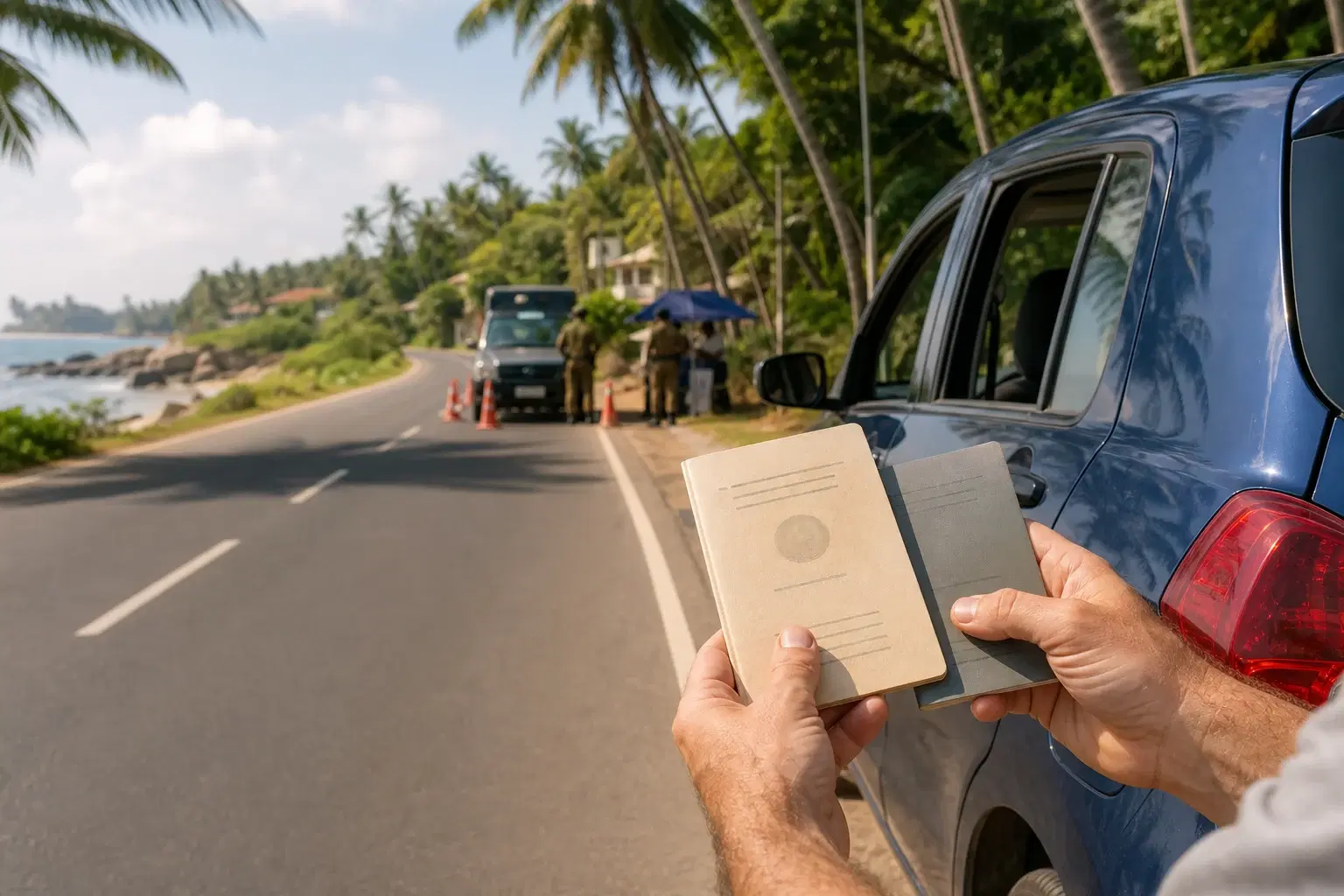
There is a specific moment that repeats itself in Sri Lanka several times a day, and it usually happens somewhere near Mirissa, Ella or Arugam Bay. A visitor is pulled over at a routine police checkpoint, hands over an International Driving Permit with quiet confidence, and is asked for something else entirely.

The something else is a locally issued permit. Depending on which office produced it and which year you are reading about, it is called a recognition permit, a covering permit or a temporary driving licence. The names are used loosely and interchangeably by rental companies, forums and even by some official-sounding websites, which is a large part of why so few visitors arrive holding one.

The rule underneath the confusion is not complicated. An International Driving Permit is a standardised multilingual translation of the licence your own country issued you. It proves what you are already entitled to drive. It does not, by itself, grant permission to drive on Sri Lankan roads. For that, Sri Lanka wants its own document, issued here, recognising your foreign entitlement.

Most travel articles on this subject fall into one of two failure modes. Either they state confidently that an IDP is sufficient, which is wrong, or they publish a single precise fee and a single office address, both of which have changed more than once in the past two years. In February 2026 the Department of Motor Traffic significantly expanded where these permits can be obtained, and almost nothing written for foreign visitors reflects that yet.

This guide sets out what the requirement actually is, the routes available to satisfy it, why the published fees disagree with each other so wildly, what the permit will and will not let you drive, and the far more expensive problem hiding behind the paperwork question, which is insurance. It also covers what driving here is genuinely like, and includes an honest section on who should not do it at all.

Quick Summary

  • An International Driving Permit is a translation of your home licence, not a licence in itself, and it does not authorise driving in Sri Lanka on its own
  • You need either a temporary driving licence or recognition permit issued locally, on top of your home licence
  • Since February 2026 the Department of Motor Traffic issues these at five regional offices as well as Werahera and the airport, which most guides have not updated
  • The counter in the arrivals hall at Bandaranaike International Airport is the simplest option for most arriving visitors
  • Published fees differ considerably between sources, and the issuing bodies do not publish a public fee schedule, so treat every figure online as an estimate
  • The permit will only cover categories you already hold at home, so a car licence does not let you ride a motorcycle or drive a tuk-tuk
  • The real cost of driving without the permit is not the fine, it is that your insurance cover may not respond to a claim
  • From 19 September 2026 police have announced strict enforcement of seat belts for every occupant on expressways, rear seats included
  • Lists of dramatically increased 2026 traffic fines circulating on social media were checked and found to be inaccurate
  • Distances in Sri Lanka are short and journey times are long, so plan roughly half the daily distance you would at home

The Core Misunderstanding: An IDP Is a Translation, Not a Licence

The International Driving Permit exists because of two international treaties, the 1949 Geneva Convention on Road Traffic and the 1968 Vienna Convention on Road Traffic. Each produced its own booklet format, and which one you need depends on the country that issued your licence and the country you intend to drive in.

Sri Lanka is a party to the 1949 Geneva Convention. That is the version of the IDP relevant here, and it is the version most national motoring associations issue to travellers heading this way.

What the treaty framework does not do is turn the IDP into a standalone licence anywhere. In every country that uses it, the IDP is carried alongside your original national licence and is worthless without it. It is a translation with a photograph, nothing more.

Sri Lanka goes one step further than many destinations by requiring that your foreign entitlement be formally recognised locally before you drive. That local recognition is a separate document, issued in Sri Lanka, and it is the piece almost every visitor is missing.

So the correct mental model is a stack of three things rather than one. Your home country licence sits at the bottom. The IDP sits on top of it as the translation layer. The Sri Lankan permit sits on top of both as the permission layer. Police checkpoints and rental companies expect to see the stack, not one item from it.

There is one useful nuance. If your home licence is printed in English, some offices will process your application without an IDP, working directly from the licence itself. If your licence is not in English, you will need either an IDP or a certified translation. Because practice varies between offices and staff, carrying an IDP regardless removes an entire category of argument at the counter.

IDP is a translation, not permissionSri Lanka follows the 1949 Geneva Convention formatA local permit is required on topAlways carry the original home licence tooAn English-language licence may be accepted without an IDP, but do not rely on it

Where You Can Get the Permit in 2026, Including the February Expansion

Until recently the honest answer to this question was discouraging. Foreign visitors could obtain a temporary driving licence at the Department of Motor Traffic head office at Werahera, on the southern edge of Colombo, or at the departmental counter in the arrivals area of Bandaranaike International Airport. That was the entire list, which meant anyone who skipped the airport counter faced a detour back toward Colombo.

On 2 February 2026 the Department of Motor Traffic announced that this facility had been extended to five regional offices, and the change was reported the following day. The offices named were Kurunegala, Hambantota, Gampaha, Anuradhapura and Jaffna. The Commissioner General noted that the service had previously been limited to Werahera and the Katunayake airport office.

That single announcement changes the practical planning picture more than anything else in this guide. A traveller landing at night and heading straight south, or one who decides mid-trip to rent a vehicle in the Cultural Triangle, now has options that did not exist before, without a dedicated trip to Colombo.

The same announcement drew a distinction worth noting. Anyone seeking a full Sri Lankan driving licence converted from a foreign licence, rather than a temporary permit, should still go to the Werahera licensing office. The regional expansion covers the temporary facility, not permanent conversion.

The airport counter remains the path of least resistance for most visitors. It sits in the arrivals area, it has been reported as operating around the clock, and dealing with the paperwork before you have collected a vehicle is far less stressful than dealing with it afterwards.

The Automobile Association of Ceylon in Colombo is the other long-standing route. It is a private membership organisation rather than a government department, it has issued recognition permits to foreign visitors for many years, and rental companies frequently arrange permits through it. Its office is on Sir Mohamed Macan Markar Mawatha near Galle Face in Colombo 3.

One observation that explains a great deal of the confusion online. The Automobile Association of Ceylon publishes no page on its own website describing a recognition permit for foreign visitors, and no fee schedule for one. Its published International Driving Permit page is written entirely for Sri Lankan licence holders travelling abroad. When the issuing body itself publishes nothing, every figure and procedure you find elsewhere is somebody's recollection or somebody's sales page.

Airport arrivals counter at Bandaranaike InternationalWerahera head office near ColomboRegional offices added February 2026: Kurunegala, Hambantota, Gampaha, Anuradhapura, JaffnaPermanent foreign licence conversion remains at Werahera onlyAutomobile Association of Ceylon in Colombo 3 as the alternative route

What It Costs, and Why Every Source Gives a Different Number

This is the part of the subject where we are going to decline to give you a single confident figure, and it is worth explaining why rather than simply publishing one and hoping.

For the government route, published accounts cluster around two figures. Some travellers report paying roughly one thousand rupees for a thirty-day permit at the Werahera counter. Other accounts, including several written for the airport counter, quote around two thousand rupees per month of validity. Both figures appear in reputable-looking write-ups, and both are plausible for different validity periods or different years.

For the Automobile Association route, the spread is far wider. Figures quoted publicly range from a couple of thousand rupees to figures more than five times that, sometimes bundled with a period of association membership, sometimes not. Some of the higher figures come from commercial services that arrange the permit on your behalf and are quoting their own total price rather than the underlying fee.

That last distinction matters. There is nothing improper about paying a rental company or an agent to handle the paperwork, and for travellers on a short trip it can be money well spent. But you are then buying a service, and the price of the service is not the price of the permit. Articles that conflate the two are the main reason the numbers online look chaotic.

Our position is the same one we take on every figure we cannot verify against a published official source. We are not going to print a precise number that may be wrong by a factor of five in either direction. Budget somewhere in the low thousands of rupees for the government route, treat anything substantially higher as including a service fee, and confirm the current amount at the counter itself.

Practical points that are more stable than the fee. Card payment has been reported as accepted at the airport counter, but foreign currency generally is not, so carry rupees. Permits are typically issued for thirty days with the option to extend, and extension is handled at the Department of Motor Traffic rather than at the airport.

If you want certainty before you fly, contact the Department of Motor Traffic directly and ask for the current fee for a temporary driving licence for a foreign licence holder, specifying your validity period. It is one email, and it replaces a great deal of guesswork.

No issuing body publishes a public fee scheduleGovernment route commonly reported in the low thousands of rupeesAgent and rental-arranged prices include a service feeCarry Sri Lankan rupees, not foreign currencyVerify the current fee directly before you travel

What to Bring to the Counter

The document list is short and consistent across accounts, which is a relief after the fee question.

Your passport, with the Sri Lankan entry stamp or visa clearly visible. Bring the physical passport rather than a copy, as your details are transcribed and verified from it.

Your original national driving licence. It must be a full licence. Provisional licences, learner permits, temporary licences and probationary documents are generally not accepted, and there is no route around that.

Your International Driving Permit, or a certified translation if your licence is not in English. Even where an English licence may be processed alone, having the IDP present removes the possibility of a disagreement.

Passport-sized photographs. Requirements have varied over time and some offices now capture the photograph on site, but two spare photographs weigh nothing and have saved a great many people a second trip.

Photocopies of your passport photograph page, your visa or entry stamp, and your licence. Leaving a government complex to find a photocopier is a genuinely common way to lose an hour.

One eligibility point that catches people out. Accounts of the process indicate the foreign licence should have meaningful remaining validity, with a year commonly cited as the threshold. If your licence expires soon after your trip, check this before you rely on being able to drive.

Expect biometric capture, a signature, document scanning and a payment step at the government offices, handled across a small number of counters. Reported processing times range from under twenty minutes on a quiet morning to a couple of hours when busy. Arrive early rather than late in the day.

Passport with visa or entry stampOriginal full home licence, not provisionalIDP or certified translationSpare passport photographs and photocopiesArrive early to avoid the queue

What the Permit Will and Will Not Let You Drive

This section resolves the single most common disappointment in the whole process, and it is better to absorb it now than at a rental counter in Ella.

A Sri Lankan permit recognises the entitlements you already hold. It does not create new ones. If your home licence covers cars only, your Sri Lankan permit will cover cars only.

That means a standard car licence does not authorise you to ride a motorcycle or scooter of any meaningful engine size. Effectively every scooter offered to visitors here falls into a category that requires a motorcycle entitlement at home. You cannot acquire that entitlement as a tourist, and no amount of goodwill at a rental shop changes the legal position.

Tuk-tuks are their own case. A three-wheeler falls under a distinct vehicle class in the Sri Lankan licensing system, and driving one legally requires that class to appear on your permit. Travellers who have done this properly describe checking, before leaving the counter, that the issued document actually shows the three-wheeler entitlement alongside car and dual-purpose vehicle. Accounts exist of people driving away and discovering the endorsement was missing.

Check the document before you leave the building. Read what categories are printed on it, ask if anything is unclear, and do not assume the counter has inferred what you intend to rent.

Any restrictions on your home licence transfer across as well. Corrective lenses, automatic transmission only, hearing aid requirements and similar conditions carry over to the Sri Lankan permit exactly as they appear at home.

There is a wider point behind all of this. Sri Lanka has a serious road casualty problem, and a large share of it involves motorcycles and three-wheelers. The licensing categories are not bureaucratic decoration. If you have never ridden a scooter before, a narrow coastal road shared with buses is not the place to find out whether you enjoy it.

The permit mirrors your existing entitlementsA car licence does not cover scooters or motorcyclesTuk-tuks need a specific three-wheeler classCheck the printed categories before leaving the counterHome licence restrictions carry across

The Real Cost Is Insurance, Not the Fine

Almost every discussion of this topic online eventually arrives at the same shrug. The fine is manageable, police rarely trouble tourists, plenty of people ride without paperwork and nothing happens. As a description of a typical uneventful day, that is not entirely untrue. As a basis for a decision, it is dangerous, because it measures the wrong risk.

The exposure that matters is not the roadside penalty. It is what happens when there is a collision.

Motor insurance responds to a legally authorised driver. If you were not lawfully permitted to drive the vehicle, an insurer has grounds to decline the claim, and that applies to the vehicle damage, to third-party damage and to injury to other people. On top of that, travel insurance policies commonly exclude claims arising from operating a vehicle you were not licensed to operate, which can reach your own medical treatment and evacuation cover.

The arithmetic is stark. A traffic fine is an inconvenience. Liability for a serious injury to another road user, uninsured, in a country where you are a visitor, is a different order of problem entirely.

This is also why rental operators who ask to see your permit are doing you a favour rather than creating friction. An operator who does not ask has quietly transferred a risk to you, and it is worth noticing which kind you are dealing with.

Whatever you rent, read what the insurance actually covers before you sign. Excess amounts, exclusions for single-vehicle accidents, theft cover and damage to the underside of a vehicle on rough roads are all worth asking about specifically. Basic third-party cover is mandatory on Sri Lankan roads, but mandatory minimum cover and adequate cover are not the same thing.

One more point that costs nothing. Photograph the vehicle from every angle before you take it, including existing scratches and tyre condition, and keep the rental agreement and permit with you rather than in a bag left in a room.

An unlicensed driver may void motor insuranceTravel insurance may exclude unlicensed drivingThird-party liability is the largest exposureOperators who check your permit are the safer choiceRead the excess and exclusions before signing

The Expressway Seat Belt Change Taking Effect in September 2026

This is a live rule change landing during the 2026 to 2027 season, and it is worth understanding properly because the reporting around it has been genuinely confusing.

Sri Lanka introduced a requirement for every occupant of a vehicle on an expressway to wear a seat belt, rear seats included. On ordinary roads the requirement applies to the driver and front-seat passenger. On expressways it applies to everyone in the vehicle.

A grace period was granted, and it originally ran to 19 June 2026. Enforcement of the wearing requirement began around that date, and it was widely reported as being in force from 20 June.

Separately, and this is the part that caused the confusion, the deadline for fitting seat belts to all passenger seats in vehicles that were not originally manufactured with them was extended by a further three months. That extension was made through an amendment to the Motor Traffic (Highways) Regulations, issued under an extraordinary gazette notification dated 17 June 2026, moving the deadline to 19 September 2026.

In August 2026 the Director of Traffic Control and Road Safety announced that the seat belt law for all drivers and passengers on expressways would be strictly enforced from 19 September 2026, as the grace period ends. The prescribed penalty announced was one thousand rupees, with provision for the vehicle owner, the driver and the passenger each to be held responsible. It was also stated to apply to passengers on buses operating on expressways.

For a visitor the practical implication is simple and applies whether you are driving yourself or sitting in the back of a hired car. On an expressway, everybody belts up. If you are hiring a vehicle with a driver and the rear seats have no functioning belts, that is now a question worth asking before the journey rather than at a police stop.

Because this rule has already been extended more than once, treat the September date as the current position rather than a permanent one, and check for updates close to your travel dates.

All expressway occupants must belt up, rear seats includedOrdinary roads: driver and front passengerFitting deadline extended to 19 September 2026 by gazetteStrict enforcement announced from 19 September 2026Announced penalty of one thousand rupees, owner, driver and passenger each liable

About Those Viral 2026 Traffic Fine Lists

During 2026 a table of Sri Lankan traffic fines circulated widely on social media, with figures dramatically higher than most drivers expected. A second version, presented as the definitive 2026 schedule, spread on its own afterwards. Both were shared as evidence of a recent increase.

A fact-checking review published in June 2026 examined whether any such revision had occurred and found no credible official confirmation of a recent increase, and no mainstream reporting of a change of that scale.

The framework that actually governs this is older and duller. Sri Lanka's principal legislation is the Motor Traffic Act No. 14 of 1951. The Motor Traffic (Amendment) Act No. 18 of 2017 expanded the spot fine system and revised the penalty structure, and a special gazette notification issued on 15 January 2018 set the fine amounts for a defined list of spot fine offences.

We mention this for two reasons. The first is that visitors sometimes arrive genuinely alarmed by figures that were never real. The second is more useful as a general habit. Screenshots of official-looking tables spread faster than corrections, and Sri Lankan traffic penalties are a recurring subject for this.

Figures for specific offences do appear across travel sites, including commonly quoted amounts for speeding and for driving without a valid licence. We are not reproducing a schedule here, because the figures circulating are inconsistent and we cannot verify them against a current published source.

The point that survives all of this is unchanged. Carry the correct documents, drive within the posted limits, and the fine schedule becomes an academic question. If you are stopped, remain polite, produce your documents, and ask for an official receipt for any payment. An officially receipted penalty is a normal part of the system, and asking for one is entirely reasonable.

Viral 2026 fine tables were checked and not substantiatedGoverning law remains the Motor Traffic Act of 1951The 2017 amendment expanded the spot fine systemSpot fine amounts were set by gazette in January 2018Always ask for an official receipt

The Road Rules That Actually Matter Here

Sri Lanka drives on the left. If you come from a right-hand-drive country this is one less adjustment. If you do not, budget a genuine adjustment period and be especially careful at junctions, at roundabouts and in the first minutes after any stop, which is when old habits reassert themselves.

Speed limits commonly cited are fifty kilometres per hour in built-up areas, seventy on open roads outside them, and one hundred on expressways, dropping to sixty on expressway entry and exit ramps. Posted signage overrides any general rule, and speed enforcement cameras operate on the expressway network.

Expressways are restricted. Tuk-tuks, bicycles and pedestrians are excluded outright. Sources differ on exactly where the motorcycle threshold sits, with some stating all motorcycles are excluded and others citing an engine capacity limit. If you are on two or three wheels, plan your route on the ordinary road network and check locally before assuming access.

Tolls on the expressway network are paid at booths. Cash in rupees is universally accepted and small denominations speed things up considerably. Some plazas accept electronic payment.

The horn is used differently here than in most of Europe or North America. A short note approaching a blind bend or when overtaking is information, not aggression, and it is expected. It also confers no right of way whatsoever.

Mobile phone use while driving is prohibited. Set your navigation before you move off or hand the phone to a passenger.

Helmets are mandatory for motorcycle riders and pillion passengers. This is enforced, and more importantly it is the single highest-value safety decision available to anyone on two wheels here.

Night driving deserves its own warning. Unlit vehicles, pedestrians in dark clothing, stray dogs, unmarked roadworks and oncoming full-beam headlights combine badly. Plan to arrive before dark, and treat that as a rule rather than an aspiration.

Left-hand trafficCommonly cited limits of 50, 70 and 100 km/hExpressways exclude tuk-tuks, bicycles and pedestriansCarry small rupee notes for tollsAvoid driving after dark

What Driving Here Is Actually Like

Sri Lanka looks small on a map and drives large. This is the mistake that ruins more self-drive itineraries than any other.

A hundred and fifty kilometres on an A road can take four hours. The same distance on an expressway can take under two. The variance is not a matter of traffic on any particular day, it is structural, and it depends entirely on which class of road your route uses.

Outside the expressway network, roads pass directly through the middle of every town on the way. There is no bypass culture. You will move at the pace of the market, the school gate and the bus in front of you.

Buses are the defining feature of Sri Lankan roads. Private buses in particular operate on incentives that reward speed, they overtake into gaps you would not consider, and they stop with little warning. The correct response is to yield space rather than contest it. This is not a road culture where standing on your rights is productive.

Add to the mix tuk-tuks changing direction without notice, motorcycles filtering on both sides, dogs sleeping in the warm centre of the road, cattle with absolute right of way in practice, and pedestrians walking on the carriageway because there is frequently nowhere else.

Hill-country roads bring their own character. The climbs above Kandy and around Nuwara Eliya are a sequence of tight hairpins on a narrow surface, frequently in mist, sometimes with a drop on one side and no barrier. First and second gear, engine braking on descents, and patience with the vehicle behind you.

In elephant country, particularly the roads bordering national parks in the southeast and around Habarana, wild elephants are on and beside the road at dusk and after dark. This is not a photo opportunity. Do not stop, do not approach, do not feed, and do not get between an elephant and the treeline.

The honest summary is that Sri Lanka is a rewarding country to drive and a demanding one. Drivers who enjoy it are those who accept its rhythm rather than trying to impose their own. Plan four to five hours of driving as a full day, and treat anything beyond that as a bad plan rather than a challenge.

Short distances, long journey timesRoads pass through the centre of every townYield to buses rather than contest themHairpins and mist in the hill countryElephants on rural roads at dusk

Why More Visitors Are Driving in 2026 Than Usual

There is a context to the current surge of interest in self-drive that is specific to this season, and it is worth stating plainly because it affects route planning.

Following Cyclone Ditwah, the main railway line from Colombo currently operates only as far as Rambukkana. The section from Rambukkana through Kandy to Nanu Oya is closed. The Nanu Oya to Ella and Badulla section is running normally, as are all other routes including the coastal line to Galle and Matara.

Reopening of the closed section is expected around January 2027, though that timeline should be treated as an expectation rather than a commitment.

The practical effect is that the classic rail approach to Kandy and the hill country is unavailable for part of this season, and road transport is filling the gap. That is a real reason to consider driving, and it is also a reason to expect more traffic than usual on the Colombo to Kandy corridor and the roads up to Nuwara Eliya.

If your plan involves reaching the hill country and picking up the Nanu Oya to Ella train from there, driving or hiring a car to Nanu Oya and taking the train onward is a workable combination that a great many people are using this season.

Check the current rail position before finalising anything. This situation has changed several times and will change again.

Main line currently runs only to RambukkanaRambukkana through Kandy to Nanu Oya is closedNanu Oya to Ella and Badulla operates normallyCoastal line unaffectedReopening expected around January 2027

Self-Drive or Hire a Driver? An Honest Comparison

Sri Lanka is one of the few countries where hiring a car with a driver is genuinely competitive with self-drive on cost, which makes this a real decision rather than a budget question with an obvious answer.

Self-drive suits travellers who want to stop where they like, who are staying in one region rather than crossing the island, who are comfortable in unfamiliar and assertive traffic, and who value independence highly enough to accept the workload.

A car with a driver suits travellers covering long distances, families with young children, anyone visiting during the heaviest monsoon weeks for their region, first-time visitors on a short trip, and anyone who would rather look out of the window than at the road. A good driver also solves parking, navigation, fuel stops and the entire permit question in one stroke.

There is a middle path that works well. Hire a driver for the long transfer days between regions, and rent something small for local exploring once you are based somewhere. This gives you independence where it is enjoyable and removes it where it is merely tiring.

If you go with a driver, agree in advance what is included. Fuel, tolls, the driver's accommodation and meals, waiting time and any commission arrangements at shops are all worth clarifying at the start rather than discovering later.

On that last point, be aware that unrequested detours to spice gardens, gem showrooms and batik workshops are a well-established part of the landscape. Saying at the outset that you would prefer to skip shopping stops is normal, is not rude, and generally settles the matter.

We do not recommend specific rental companies, drivers or agencies anywhere on this site. What we would suggest instead is a short list of things to check: whether the operator asks to see your permit, what the insurance excess is, whether the vehicle documents are in the vehicle, and whether you are given a contact number that a human being answers.

Hiring a driver is cost-competitive hereSelf-drive suits single-region tripsA driver suits long transfers and familiesCombining both often works bestClarify inclusions and shopping stops upfront

Scooters and Tuk-Tuks: The Realistic Picture

Renting a scooter in a coastal town or driving a tuk-tuk around the island are both genuinely popular, and both are surrounded by more misinformation than any other aspect of transport here.

The licensing position bears repeating because it is where people come unstuck. Riding a scooter requires a motorcycle entitlement on your home licence. Driving a tuk-tuk requires the three-wheeler class on your Sri Lankan permit. Neither can be conjured up locally if you do not already hold the underlying entitlement.

Many rental operators will not ask. That absence of a question is not permission, and it is a reliable indicator of how the operator will behave if something goes wrong.

If you do have the correct entitlements, a few practical points. Check brakes, tyres, lights and horn before accepting any vehicle. Insist on a helmet that fits and actually fastens. Take photographs of existing damage. Confirm what happens in a breakdown and whether there is a number to call.

Tuk-tuks are slow, which is part of their charm and also a safety consideration on fast A roads where you will be overtaken constantly. They are excluded from expressways entirely, so your routes will be longer than a car's.

Fuel is widely available and government regulated, with stations in every town and along main routes, though gaps between stations grow in the north and in remote rural areas. Keep the tank above half outside the main corridors and carry some cash, as not every rural station takes cards.

The honest caution: coastal roads look relaxed and are not. The stretch between Galle and Matara, the roads around Ella, and the approach to any beach town at sunset all combine tourist traffic, local traffic and buses. If you have limited riding experience, the freedom is not worth what it can cost.

Scooters need a motorcycle entitlement at homeTuk-tuks need the three-wheeler classAn operator who does not ask is a warning signCheck brakes, tyres and helmet before acceptingTuk-tuks cannot use expressways

Police Checkpoints: What to Expect

Routine checkpoints are a normal feature of Sri Lankan roads, particularly on approaches to towns and on main routes. Being stopped is not an accusation and is usually nothing more than a document check.

Keep your documents accessible rather than buried. Passport or a clear copy, home licence, IDP and the Sri Lankan permit, plus the rental agreement and vehicle documents. Having them in one place turns a five-minute stop into a one-minute stop.

Be polite, keep your hands visible, switch off the engine if asked and let the officer lead the conversation. English proficiency varies, so speak simply and slowly rather than at length.

If a penalty is issued, ask for the official receipt or spot fine notice. This is a standard part of the process and requesting it is entirely normal.

If something feels wrong, staying calm and asking for the officer's name and station, and for the written notice, is reasonable and generally resolves matters. Do not escalate at the roadside.

The overwhelming majority of visitors who carry correct documents describe checkpoints as brief and uneventful. The visitors with stories to tell are almost invariably the ones who did not have the paperwork.

Checkpoints are routine, not accusatoryKeep all documents in one accessible placeBe polite and let the officer leadAlways request an official receiptCorrect documents make stops brief

Who Should Not Drive in Sri Lanka

Most guides on this subject are written to encourage you. This one is not, entirely, because there are travellers for whom self-drive here is a poor decision and they deserve to be told so before they book.

Do not drive yourself if you have never driven on the left and your trip is short. The adjustment is real, and a week is not long enough to become comfortable while also navigating and sightseeing.

Do not ride a scooter if you have not ridden one before. Sri Lanka is not a place to learn. This is the single most common serious injury to visitors here and it is almost entirely preventable.

Reconsider if your itinerary crosses the island repeatedly. Long transfer days are exhausting here in a way the distances do not suggest, and a driver converts that time from work into rest.

Reconsider during the heaviest monsoon weeks for the region you are visiting. Standing water, reduced visibility, landslip risk on hill roads and flooded low-lying sections all raise the difficulty sharply.

Reconsider if anyone in the vehicle is a young child and you are covering long distances. Rear seat belt provision is variable outside newer vehicles, and this has become more consequential with the expressway rule described above.

And do not drive if the only reason you are considering it is that the paperwork felt like too much trouble. That is the worst reason of all, and it is the one that puts most people on the road without cover.

Not for first-time left-side drivers on short tripsNot the place to learn to ride a scooterLong cross-island transfers suit a driver betterHeavy monsoon weeks raise difficulty sharplyNever drive just to avoid the paperwork

What to Sort Out Before You Fly

Obtain your International Driving Permit at home. This must be done in your own country before departure, it usually takes minutes at a national motoring association, and it cannot be obtained here.

Check the categories printed on your home licence and confirm they cover what you intend to drive. Do this now, not at a rental counter.

Check your licence expiry date and make sure it has comfortable remaining validity beyond your trip.

Contact the Department of Motor Traffic to confirm the current fee, opening hours and document list for a temporary driving licence, and ask specifically about the office nearest your arrival plan.

Read your travel insurance policy wording on driving. Look for the exclusion relating to vehicles you are not licensed to operate, and check whether motorcycles are excluded entirely, which is common.

Download offline maps for the whole island. Mobile coverage is good on main routes and patchy in the hills and parts of the north and east.

Decide your route with realistic timings. Four to five hours of driving is a full day here. If your plan needs more than that on consecutive days, the plan is the problem.

Finally, check the current rail position, because it may change your route entirely and it has changed several times already this year.

Get the IDP at home before departureConfirm your licence categories nowVerify the current permit fee directlyRead the driving exclusions in your travel insuranceDownload offline maps

Travel Tips

  • Get your International Driving Permit at home before you fly, as you cannot obtain one here
  • Deal with the permit at the airport counter on arrival rather than after collecting a vehicle
  • Carry the original home licence, the IDP and the Sri Lankan permit together at all times
  • Read the categories printed on your permit before you leave the counter
  • Carry Sri Lankan rupees for the permit fee and for expressway tolls
  • Take photographs of any rental vehicle before driving away
  • Insist on a helmet that fits properly if you are on two wheels
  • Plan no more than four to five hours of driving in a day
  • Arrive at your destination before dark
  • Give way to buses rather than contesting space with them
  • Do not stop for wild elephants on rural roads at dusk
  • Download offline maps before leaving Colombo
  • Ask for an official receipt for any penalty
  • Check the current rail position before finalising your route

Frequently Asked Questions

Can I drive in Sri Lanka with just an International Driving Permit?

No. An International Driving Permit is a translation of your home licence, not a licence in itself. Sri Lanka requires foreign visitors to obtain a locally issued permit, variously called a recognition permit or temporary driving licence, before driving. You then carry your home licence, your IDP and the local permit together.

Where do I get the Sri Lankan driving permit?

The Department of Motor Traffic issues temporary driving licences at its head office at Werahera near Colombo and at a counter in the arrivals area of Bandaranaike International Airport. Since February 2026 the facility has also been available at regional offices in Kurunegala, Hambantota, Gampaha, Anuradhapura and Jaffna. The Automobile Association of Ceylon in Colombo 3 is a long-standing alternative route.

How much does the permit cost?

Published figures vary widely and neither issuing body publishes a public fee schedule, so we will not print a single number. Accounts of the government route commonly report amounts in the low thousands of rupees for a thirty-day permit. Substantially higher figures usually reflect a service fee charged by an agent or rental company on top of the permit itself. Confirm the current amount with the Department of Motor Traffic before you travel.

Can I rent a scooter in Sri Lanka with a car licence?

No. Your Sri Lankan permit reflects only the categories you already hold at home. Essentially every scooter offered to visitors requires a motorcycle entitlement, and you cannot acquire that entitlement as a tourist. Rental operators frequently do not ask, but that is not permission and it leaves you uninsured.

Can tourists drive a tuk-tuk in Sri Lanka?

Yes, but only if your permit carries the three-wheeler class, which is a distinct licensing category. Check the categories printed on the document before you leave the counter, as accounts exist of travellers discovering afterwards that the endorsement was missing.

What happens if I have an accident without the permit?

Motor insurance responds to a legally authorised driver, so an insurer may decline a claim if you were not lawfully permitted to drive. That can extend to vehicle damage, third-party damage and injury to other people. Travel insurance policies also commonly exclude claims arising from driving a vehicle you were not licensed to operate, which can affect your own medical cover. This risk is far more significant than any fine.

How long is the permit valid?

Temporary permits are typically issued for thirty days with the option to extend. Extension is handled by the Department of Motor Traffic rather than at the airport counter. Confirm the validity period and the extension procedure when you apply.

What documents do I need to apply?

Your passport with the entry stamp or visa, your original full home driving licence, your International Driving Permit or a certified translation if the licence is not in English, spare passport photographs and photocopies of the main documents. Provisional, learner and temporary licences are not accepted.

Is it safe to drive in Sri Lanka?

It is manageable for confident, experienced drivers who accept local road culture, and demanding for everyone else. The main hazards are buses, unpredictable overtaking, animals on the road and poor visibility at night. Distances are short but journey times are long. Two wheels carry considerably more risk than four.

Is it cheaper to drive myself or hire a driver?

In Sri Lanka the difference is smaller than most visitors expect, which makes it a genuine choice rather than a budget decision. Self-drive suits single-region trips and independent exploring. A driver suits long cross-island transfers, families and first-time visitors. Combining the two often works best.

Have Sri Lankan traffic fines increased in 2026?

Tables of dramatically increased fines circulated widely on social media during 2026. A fact-checking review published in June 2026 found no credible official confirmation of a recent increase. The governing framework remains the Motor Traffic Act of 1951, as amended in 2017, with spot fine amounts set by gazette in January 2018.

What is the new seat belt rule on expressways?

Every occupant of a vehicle on an expressway must wear a seat belt, rear seats included, while on ordinary roads the requirement covers the driver and front-seat passenger. The deadline for fitting belts to all passenger seats was extended by gazette in June 2026 to 19 September 2026, and police have announced strict enforcement from that date with an announced penalty of one thousand rupees. Because the date has already moved more than once, check the current position before you travel.

Can I still take the train to Kandy and the hill country?

Not on the full route at present. Following Cyclone Ditwah the main line from Colombo runs only as far as Rambukkana, and the section through Kandy to Nanu Oya is closed. The Nanu Oya to Ella and Badulla section operates normally, as does the coastal line. Reopening is expected around January 2027, which should be treated as an expectation rather than a guarantee.

Reader notes

Join the conversation

Share your question, tip, or travel experience for this guide.

Comments

0 comments

Loading...

Ready to turn inspiration into a Sri Lanka trip?

Use LankaTrip to plan your journey, connect with local guides, and make this itinerary a reality.

Need help planning?

Plan your Sri Lanka adventure

Plan my trip