LankaTrip Insights

16 min read

Getting Around Sri Lanka in 2026: Trains, Buses, Tuk-Tuks, PickMe, and Private Drivers Compared

Sri Lanka looks small on the map, but a 100 km journey can take four hours on winding roads. This 2026 transport guide compares every option — reserved trains, intercity buses, the PickMe app, tuk-tuks, private drivers, and domestic flights — with honest costs, booking steps, and current hill-country rail status.

Back to blog
Getting Around Sri Lanka in 2026: Trains, Buses, Tuk-Tuks, PickMe, and Private Drivers Compared

Transport decisions shape a Sri Lanka trip more than almost any other planning choice. Pick well and your journeys become highlights — tea fields sliding past an open train door, a breezy tuk-tuk ride along the coast. Pick badly and you lose whole days to slow roads and missed connections.

The island measures only about 435 kilometres from north to south, which tempts travelers into overambitious itineraries. In reality, winding mountain roads, town traffic, and railway schedules mean a 100-kilometre leg can easily take three or four hours, and the classic mistake of first-time visitors is planning distances as if they were European motorway drives.

The good news is that Sri Lanka offers a genuinely full menu of options: a charming and very cheap railway network, a dense web of local and intercity buses, the excellent PickMe ride-hailing app, tuk-tuks on every corner, affordable private drivers, expressways on key corridors, and even domestic flights for the longest hops.

One 2026-specific factor matters more than usual this year: Cyclone Ditwah's damage in late 2025 closed the middle of the famous upcountry railway. Trains from Colombo currently run as far as Rambukkana, the Nanu Oya to Ella and Badulla section operates normally in both directions, and the stretch in between — through Kandy — is still under repair, changing how travelers plan the classic hill-country journey. Every other line on the network is running fine.

This guide compares every option honestly — costs, booking steps, comfort, and safety — and finishes with sample transport plans for budget, mid-range, and comfort-first trips, so you can build an itinerary around how Sri Lanka actually moves rather than how it looks on the map.

Quick Summary

  • Distances deceive: the island is small, but 100 km can take three to four hours on winding roads
  • Trains are the scenic choice; reserved seats open for booking 30 days ahead and sell out fast on popular routes
  • In mid-2026, main-line trains from Colombo run as far as Rambukkana, and the Nanu Oya to Ella and Badulla section operates in both directions; the middle stretch through Kandy is bridged by road
  • Local buses are extraordinarily cheap — you can cross the island for under five US dollars
  • PickMe is the essential ride-hailing app, giving fixed fares for tuk-tuks, cars, and vans in cities and many tourist areas
  • Street tuk-tuks outside Colombo are unmetered; always agree the fare before setting off
  • A private driver is the most comfortable option for families and Cultural Triangle routes poorly served by rail
  • Self-driving requires an international driving permit endorsed for Sri Lanka and steady nerves

Trains: The Scenic Backbone

Sri Lanka's railway, first built in 1864 to carry coffee and later tea from the hills to Colombo's port, remains the most atmospheric way to cross the island, and the hill-country line through tea estates is routinely ranked among the world's most beautiful rail journeys.

The network's key tourist routes are the coastal line from Colombo south to Galle and beyond, the main line from Colombo to Kandy, and the upcountry continuation through Hatton, Nanu Oya, Pattipola — the island's highest station at 1,893 metres — and on to Ella and Badulla.

Trains carry three classes. First class, where available, offers reserved seats and sometimes observation cars; second class balances comfort and atmosphere with opening windows; third class is the cheapest and liveliest. Reserved carriages guarantee a seat, while unreserved second and third class tickets are sold only on the day at the station, sometimes from just an hour before departure.

Reserved seats open for booking 30 days in advance and sell out quickly on the famous stretches, especially in high season. Sri Lanka Railways operates an official online seat reservation system, and third-party platforms also book into the same system for a small fee with more familiar interfaces and payment options. Guesthouses in Kandy and Ella can often arrange tickets for a modest service charge as well.

Fares are remarkably cheap by global standards — long intercity journeys in second or third class typically cost the equivalent of just a few dollars, with air-conditioned and first-class options costing more where offered.

The essential 2026 caveat: after Cyclone Ditwah's landslides, main-line trains from Colombo currently run only as far as Rambukkana, and the section from Rambukkana through Kandy up to Nanu Oya remains closed for repairs. The Nanu Oya to Ella and Badulla stretch — arguably the most scenic part — reopened in June 2026 and runs normally in both directions, and every other route on the network, including the coastal line, is operating as usual. The popular workaround is to reach Kandy and Nuwara Eliya by road, then board at Nanu Oya for the glorious run to Ella. Check the current status with Sri Lanka Railways before locking in plans.

Reserved seats bookable 30 days aheadUnreserved tickets sold on the day onlyColombo trains currently run as far as RambukkanaNanu Oya to Ella and Badulla running both directionsRambukkana to Nanu Oya via Kandy still under repairLong journeys cost only a few dollars

Buses: The Cheapest Way Across the Island

Buses are how most Sri Lankans travel, and they reach virtually every town and village on the island with astonishing frequency and rock-bottom prices — budget travelers can genuinely cross the country for under five US dollars.

Two broad types operate side by side: government CTB buses and private buses, which run the same routes at similar prices, with private operators often adding faster intercity express and air-conditioned services on major corridors.

On expressway routes, air-conditioned intercity coaches between Colombo, the south coast, and other major cities are a comfortable and quick option, and seats on certain long-distance services can be reserved in advance.

Ordinary local buses are an experience in themselves: crowded, loud with music, decorated with devotion, and driven with enthusiasm. They are perfectly usable for short hops between nearby towns, and conductors will usually make sure a visitor gets off at the right stop.

The trade-offs are real. Buses can be very crowded at peak times, luggage space is limited, driving styles are assertive, and long journeys on ordinary services can be tiring. Keep your bag on your lap or at your feet, hold on when standing, and avoid the seats directly behind the driver if engine heat bothers you.

For comfort-conscious travelers, the sweet spot is to use buses for short daytime hops and expressway coaches for longer legs, while choosing trains or drivers for the routes where the journey itself is the attraction.

Cheapest transport on the islandCTB and private buses run everywhereAC intercity coaches on expressway routesCrowded at peak times with limited luggage spaceBest for short hops and budget travel

PickMe and Ride-Hailing: The App Every Traveler Should Download

If you install one app before landing, make it PickMe — Sri Lanka's homegrown equivalent of Uber or Grab, and by common consensus the single most useful tool for foreign travelers navigating cities and towns.

The app works like any modern ride-hailing service: enter pickup and drop-off points, see a fare estimate up front, choose between tuk-tuk, car, or van, and pay in cash or by card. The fixed pricing removes the negotiation entirely and doubles as a benchmark for what street rides should cost.

Coverage is strongest in Colombo and the surrounding Western Province and extends to many major towns and tourist areas, though availability thins out in rural regions, where street tuk-tuks and arranged drivers fill the gap.

Uber also operates in Sri Lanka but with more limited coverage concentrated in select cities, so most travelers find PickMe the more reliable choice island-wide.

You will need mobile data for the apps to work, which is one more reason to pick up a cheap local SIM or eSIM at the airport on arrival.

A practical pattern that works well: use PickMe for city rides, airport runs, and any journey after dark, and reserve street negotiation for places the apps do not reach.

Fixed fares with no negotiationTuk-tuk, car, and van optionsStrongest coverage in Colombo and major townsWorks as a price benchmark for street ridesRequires a local SIM or eSIM for data

Tuk-Tuks: Master Them and You Master Sri Lanka

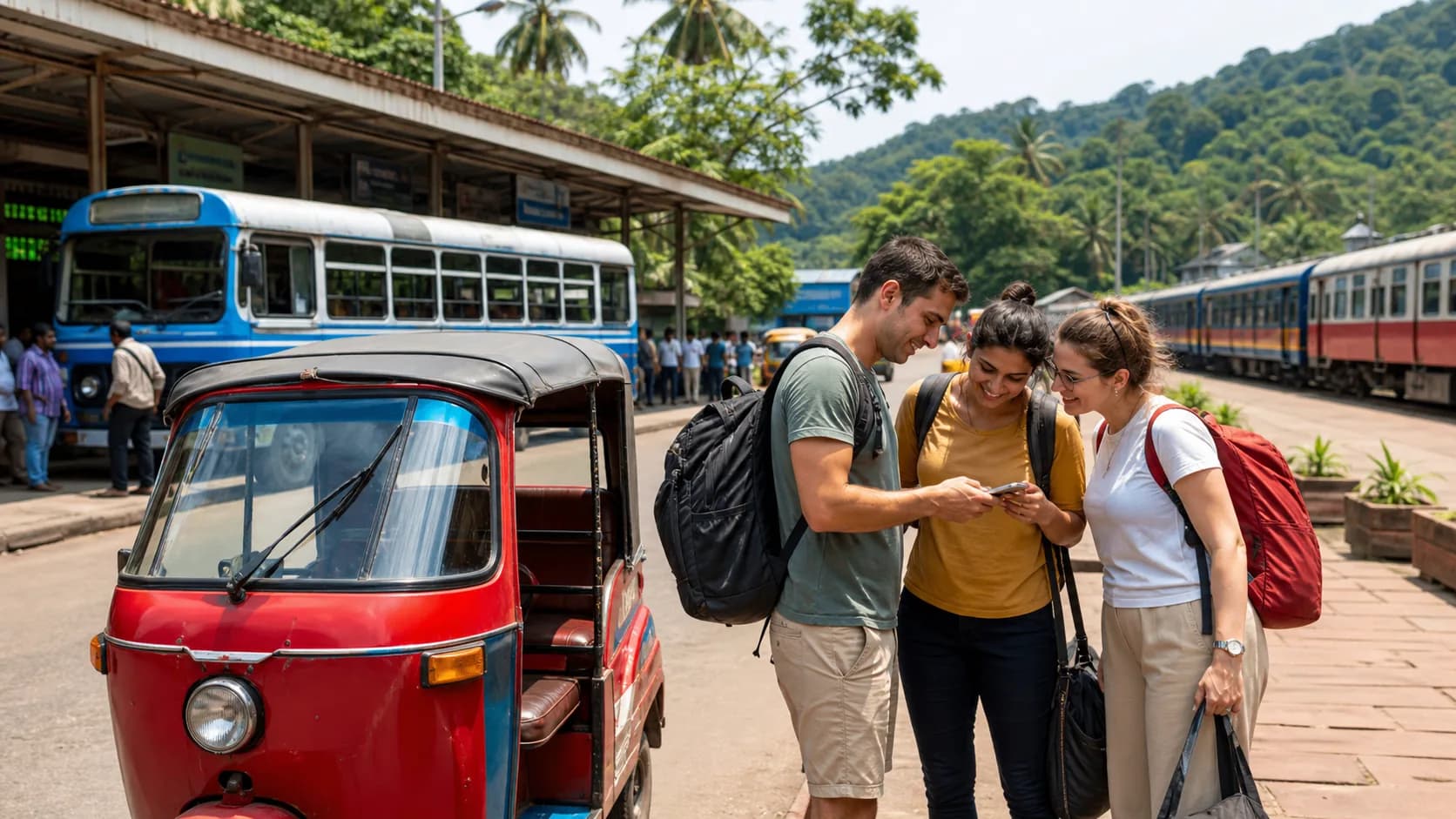
The three-wheeled tuk-tuk is the staple of short-distance travel everywhere on the island — simultaneously the most convenient and occasionally the most frustrating way to move.

Outside Colombo, most street tuk-tuks are unmetered, and the fare is whatever you agree with the driver, so the golden rule is simple and absolute: never set off without agreeing the price first.

The negotiation is part of the culture rather than a battle. Drivers open high for tourists; a friendly counter-offer, a smile, and a willingness to walk to the next tuk-tuk usually lands within a fair range. Checking the PickMe estimate for the same route gives you an instant sense of the fair local price.

Watch for the classic redirections: a driver who claims your destination is closed, pitches a special tour, or insists on a quick stop at a gem shop or spice garden is earning commission, and the correct response is a polite, firm no — or a new tuk-tuk.

Hiring a tuk-tuk with driver for a half or full day is a wonderful way to explore a local area, from Ella's viewpoints to the countryside around Sigiriya; agree the itinerary and total price clearly before starting.

Some travelers now rent self-drive tuk-tuks for their whole trip, which is legal with the correct licence endorsements arranged through rental companies — a memorable adventure, but one best suited to confident drivers who accept the chaos of local traffic.

Always agree the fare before departingUse PickMe estimates as your benchmarkRefuse gem shop and closed-attraction pitchesDay hire is great for exploring one areaSelf-drive rental possible with proper permits

Private Drivers: When They Are Worth Every Rupee

For many visitors — especially families, groups, and anyone on a tight schedule — a private car with driver is the option that transforms the trip, and by international standards it remains very affordable.

A driver removes every friction point at once: door-to-door travel, luggage handled, no timetables, air-conditioning, flexible photo stops, and a local navigator who knows where to eat and when to leave to beat the crowds.

Drivers are particularly valuable for the Cultural Triangle, where Sigiriya, Dambulla, Polonnaruwa, and Anuradhapura are spread across an area poorly served by rail, and for bridging the closed Rambukkana to Nanu Oya rail section via Kandy in 2026.

Costs vary with vehicle type, distance, and season, and multi-day hires conventionally include the driver's accommodation and meals, which many guesthouses provide for drivers at little or no charge. Agree in writing what is included — fuel, highway tolls, parking, driver expenses — before committing.

Choose licensed, reviewed drivers through reputable channels rather than airport touts, and be clear from the outset that you do not want shopping stops unless you ask for them.

A smart hybrid used by many travelers: hire a driver only for the legs that need one — the airport arrival, the Cultural Triangle loop, the rail gap — and enjoy trains, buses, and tuk-tuks for the rest.

Most comfortable option for families and groupsEssential for the Cultural TriangleBridges the 2026 hill-country rail gapAgree inclusions in writing beforehandHybrid driver-plus-train plans work brilliantly

Self-Driving, Scooters, and Domestic Flights

Self-driving in Sri Lanka is possible but honestly not recommended for most visitors. Roads are shared with pedestrians, cyclists, unpredictable buses, and stray dogs, road rules are interpreted loosely, and the mental load of driving steals attention from the scenery you came for.

If you are determined, you will need an international driving permit properly endorsed for use in Sri Lanka — arranged through the rental company or the relevant authority — and genuine experience with assertive Asian traffic.

Scooters and motorbikes are popular in beach towns for short local rides. Wear a helmet without exception, check the bike and brakes before accepting it, photograph existing damage, and confirm your travel insurance actually covers riding.

At the other end of the spectrum, domestic flights offer a superfast alternative for the longest journeys, with seaplane and small-aircraft services connecting Colombo with points around the island and delivering unforgettable aerial views along the way.

Flights make the most sense for travelers on very tight schedules covering long distances — for example reaching the east coast or the deep south quickly — and for those who simply want the scenic flight experience itself.

For everyone else, the ground-level mix of trains, buses, apps, and drivers covers the island perfectly well at a fraction of the cost.

Self-driving requires an endorsed international permitTraffic culture makes driving stressful for newcomersHelmets and insurance checks essential for scootersDomestic flights save time on the longest routesGround transport suits most itineraries

Airport Transfers and Your First Journey

Your first transport decision happens the moment you clear immigration at Bandaranaike International Airport, and it sets the tone for the trip.

The airport sits about 30 to 35 kilometres north of Colombo near Negombo, and the drive into the capital takes roughly an hour depending on traffic, with the Colombo-Katunayake Expressway speeding up the run considerably.

The smoothest options are a pre-arranged hotel transfer or a pre-booked airport pickup service, which means a named driver waiting in arrivals — worth the modest premium after a long-haul flight, especially for night arrivals.

Alternatively, official taxi counters in the arrivals area quote fixed prices to major destinations, and PickMe works from the airport once you have data on a local SIM, which you can buy from the counters in the arrivals hall.

Many travelers wisely spend their first night in nearby Negombo rather than pushing on: it is 15 to 20 minutes from the airport, has a full range of accommodation, and lets you start the real journey rested the next morning.

Budget travelers can also reach Colombo by bus from the airport for a tiny fare, though after a long flight with luggage, most people find the fixed-price taxi or app ride a worthwhile indulgence.

About an hour from CMB to ColomboPre-booked pickups are smoothest for night arrivalsOfficial taxi counters quote fixed pricesBuy a SIM in arrivals to unlock PickMeConsider a first night in nearby Negombo

The Right Transport Mix for Every Budget

Budget travelers spending under about 30 dollars a day can rely almost entirely on local buses and unreserved third-class trains for long distances, using street tuk-tuks with pre-agreed fares — benchmarked against PickMe — for short hops, and buying train tickets at station counters to avoid any booking fees.

Mid-range travelers with 30 to 80 dollars a day hit the comfort sweet spot by mixing reserved second-class train seats with air-conditioned intercity coaches, using PickMe cars for airport runs and longer town-to-town rides, and hiring a private driver only for the specific legs that need one, such as the Cultural Triangle.

Comfort-first travelers and families typically book a private car and driver for the whole itinerary, adding the reopened Nanu Oya to Ella train as a set-piece experience with the driver carrying the luggage to meet them at the far end — the best of both worlds.

Whatever the budget, two rules hold universally: never plan more than one long transport leg per day, and treat published journey times as optimistic minimums rather than promises.

Sri Lanka rewards travelers who slow down — the island's magic lives in the journeys as much as the destinations, and a schedule with breathing room turns transport from a chore into a highlight.

Under $30/day: buses and unreserved trains$30-80/day: reserved trains plus selective driver hireComfort-first: full driver with the scenic train as a set pieceOne long transport leg per day maximumTreat journey times as optimistic minimums

Travel Tips

  • Download PickMe and buy a local SIM or eSIM at the airport before anything else
  • Book reserved train seats as close to 30 days ahead as possible for popular routes
  • Verify the current hill-country rail status with Sri Lanka Railways before finalising plans
  • Never board a street tuk-tuk without agreeing the fare first
  • Sit on the left side facing forward for valley views on the Nanu Oya to Ella train
  • Plan a maximum of one long transport leg per day
  • Keep small notes handy so 'no change' never becomes an extra fee
  • Avoid overnight road journeys and long drives in heavy hill-country rain
  • Agree private-driver inclusions — fuel, tolls, meals, accommodation — in writing
  • Arrive early at stations for unreserved tickets and better boarding
  • Hold on near open train doors and never lean out for photos
  • Treat any driver's 'attraction is closed' claim as a red flag and verify yourself

Frequently Asked Questions

What is the best way to get around Sri Lanka?

Most travelers use a mix: scenic trains in the hill country, buses or expressway coaches for budget legs, PickMe and tuk-tuks in towns, and a private driver for routes with poor public transport such as the Cultural Triangle. There is no single best mode — the mix depends on budget and pace.

Is the Kandy to Ella train running in 2026?

Partially. After Cyclone Ditwah damaged the line in late 2025, main-line trains from Colombo run as far as Rambukkana, and the Nanu Oya to Ella and Badulla section reopened in June 2026 and runs in both directions. The middle stretch from Rambukkana through Kandy to Nanu Oya remains closed, so travelers cover it by road and join the train at Nanu Oya. All other routes run normally. Check the latest status before you travel.

How do I book train tickets in Sri Lanka?

Reserved seats open 30 days before departure and can be booked through the official Sri Lanka Railways online seat reservation system, at station reservation counters, or via third-party booking platforms for a small fee. Unreserved second and third class tickets are sold only on the day at the station.

What is PickMe and does it work for tourists?

PickMe is Sri Lanka's leading ride-hailing app, offering fixed-price tuk-tuk, car, and van rides. It works well for tourists in Colombo, major towns, and many tourist areas, and its fare estimates double as a benchmark when negotiating street tuk-tuks. You need mobile data, so buy a local SIM or eSIM on arrival.

How much does a private driver cost in Sri Lanka?

Costs vary with vehicle, distance, and season, but private drivers remain affordable by international standards, and multi-day hires conventionally include the driver's meals and accommodation. Always confirm in writing what the quote covers — fuel, tolls, parking, and driver expenses.

Are tuk-tuks metered in Sri Lanka?

Generally only in Colombo. Elsewhere, street tuk-tuks are unmetered and the fare is whatever you negotiate, so always agree the price before setting off, or book through PickMe for a fixed fare.

Can foreigners drive in Sri Lanka?

Yes, with an international driving permit properly endorsed for Sri Lanka, but self-driving is not recommended for most visitors due to assertive traffic culture and shared roads. Self-drive tuk-tuk rental is possible through companies that arrange the required permits.

How long does it take to get from Colombo airport to the city?

About an hour by road depending on traffic, using the Colombo-Katunayake Expressway. Many travelers instead spend their first night in Negombo, just 15 to 20 minutes from the airport.

Are buses in Sri Lanka safe for tourists?

Millions of Sri Lankans use them daily and tourists ride them routinely. They are crowded and driven assertively, so keep bags close, hold on when standing, and prefer daytime journeys. For long legs, air-conditioned intercity coaches on expressway routes are the more comfortable choice.

Reader notes

Join the conversation

Share your question, tip, or travel experience for this guide.

Comments

0 comments

Loading...

Ready to turn inspiration into a Sri Lanka trip?

Use LankaTrip to plan your journey, connect with local guides, and make this itinerary a reality.

Need help planning?

Plan your Sri Lanka adventure

Plan my trip