
LankaTrip Insights

29 min read

The Kandy Esala Perahera 2026: A Foreign Visitor's Honest Guide to the Grand Randoli Perahera and the Water-Cutting Ceremony

The Sri Dalada Perahera in Kandy builds across ten nights to a Grand Randoli Perahera and closes with the Diya Kepeema water-cutting ritual at dawn. This is a foreign visitor's guide to the two moments that matter most, including the date discrepancy in the official schedule and how to verify it before you travel.

Back to blog
The Kandy Esala Perahera 2026: A Foreign Visitor's Honest Guide to the Grand Randoli Perahera and the Water-Cutting Ceremony

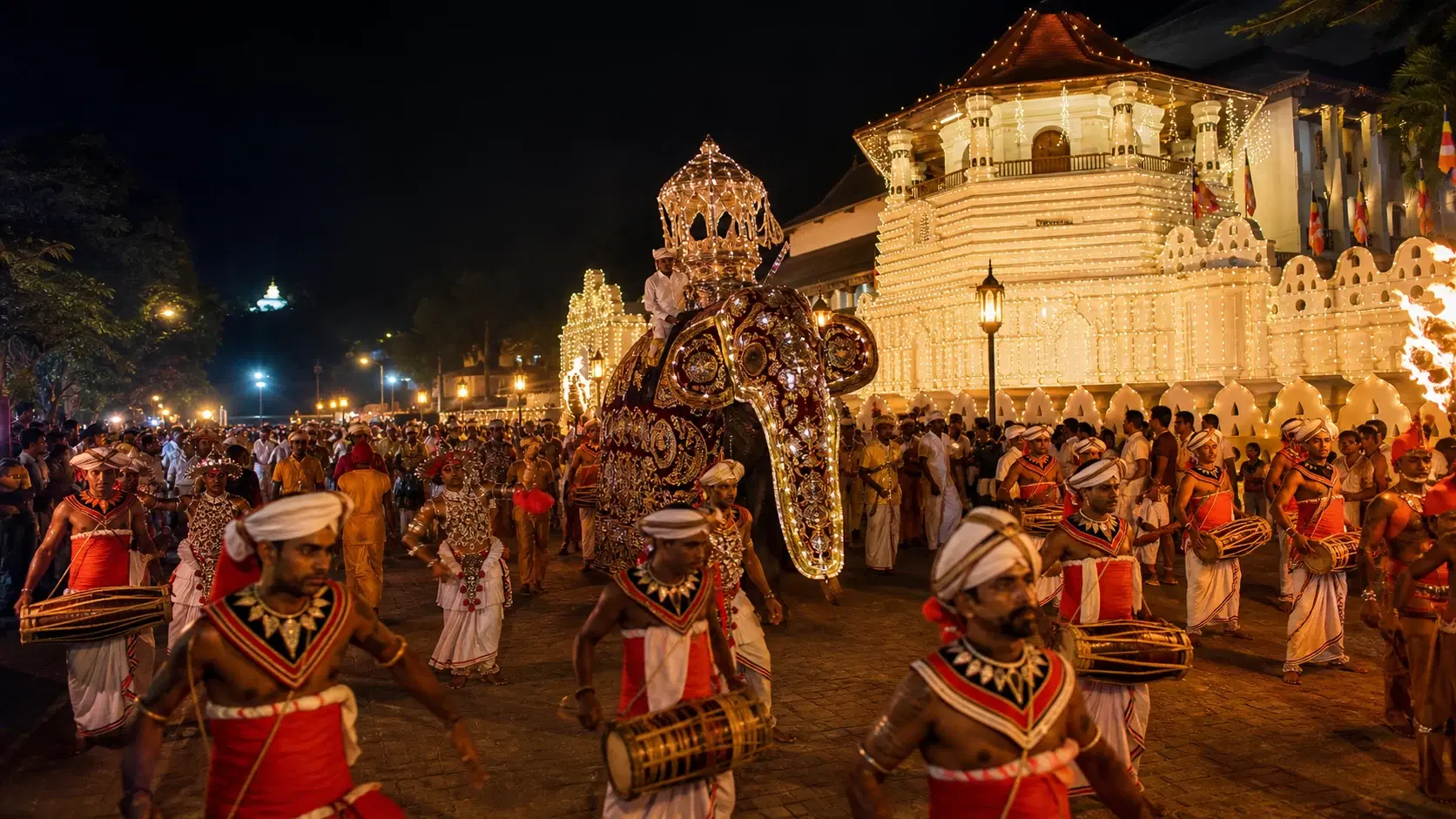
If you have seen one image of Sri Lanka that is not a beach or a tea field, it is probably this one: an elephant draped in illuminated cloth, moving through a night street lined with drummers and fire, carrying a golden casket on its back.

That is the Kandy Esala Perahera, and the night that image comes from is almost always the Grand Randoli Perahera, the climax of a ten-night festival that most foreign visitors know they should see and few understand.

This guide is written for those visitors. It is not a history essay, though it explains what you are looking at. It is a practical account of the two moments that matter most: the Grand Randoli night that everyone comes for, and the Diya Kepeema water-cutting ceremony that closes the festival at dawn and that almost nobody stays for.

We are going to be honest about several things other guides gloss over.

The first is the dates. The 2026 schedule was announced at a media briefing at the Sri Dalada Maligawa in early July, and the published reports of it do not fully agree on when the final Randoli and the Diya Kepeema fall. That matters a great deal if you are building a trip around a specific night, and we will not pretend to a certainty the sources themselves do not share.

The second is the elephants, which are the part of this festival most likely to give a thoughtful visitor pause, and which deserve a straight answer rather than silence.

The third is that this is a religious event. The pageantry is real and it is spectacular, but it is wrapped around an act of devotion to the most sacred object in Sri Lankan Buddhism, and attending well means understanding that rather than treating it as a show.

Kandy is busy, hot and crowded during festival week, and getting the practical details right is the difference between a night you remember for the right reasons and one you spend lost, uncomfortable and in the wrong place.

Quick Summary

  • The Kandy Esala Perahera, also called the Sri Dalada Perahera, honours the Sacred Tooth Relic of the Buddha and is among the oldest continuous processions in the world
  • It builds across ten nights: five nights of Kumbal Perahera, then the larger Randoli Perahera, ending with a Grand Randoli night
  • For 2026 the festival began around 18 August, with the Grand Randoli and the Diya Kepeema falling at the very end
  • Published sources disagree on the exact final dates, giving the Grand Randoli as either 26 or 27 August and the Diya Kepeema as 27 or 28 August
  • We are not resolving that discrepancy for you; verify directly with the Sri Dalada Maligawa before booking anything time-sensitive
  • The Grand Randoli Perahera is the most spectacular night and draws the largest crowds
  • The Diya Kepeema is a dawn water-cutting ritual at the Mahaweli River in Getambe, a few kilometres from Kandy
  • Kandy is currently road-access only because of the hill country rail closure, so plan transport accordingly

The 2026 Dates, and Why the Published Sources Disagree

The 2026 festival schedule was announced at a media briefing at the auditorium of the Sri Dalada Maligawa in early July, presided over by senior monks of the Asgiri Maha Vihara chapter, with the Diyawadana Nilame and other officials present. So there is an authoritative source. The problem is that the reports of it do not all say the same thing.

What every source agrees on: the festival opened in mid-August with the Kap Situveema tree-planting ceremony, followed by five nights of Kumbal Perahera from around 18 to 22 August, followed by the Randoli Perahera from around 23 August.

Where they diverge is the ending. Some reports give the final Grand Randoli Perahera as 26 August, with the Diya Kepeema water-cutting in the early hours of 27 August and the Day Perahera later that day. Other sources, including the temple's own material and several schedule aggregators, give the Grand Randoli as 27 August, with the Diya Kepeema and Day Perahera on 28 August.

That is a one-day discrepancy on the single most important night of the festival, and it appears in sources that should be reliable. We have found it stated both ways in reporting of the same briefing.

We are not going to pick one and present it as fact, because we cannot verify which is correct and doing so would be exactly the kind of false confidence that gets a visitor to Kandy on the wrong night.

There are a few plausible explanations for the divergence. Perahera timings depend on astrologically determined auspicious moments, which can be refined after an initial announcement. Reporting of the briefing may have contained errors that then propagated. And the distinction between the last Randoli night and the Grand Randoli, and between the pre-dawn Diya Kepeema and the Day Perahera that follows it, is easy to blur in a short news report.

What we can tell you is what to do about it. If you are building a trip around a specific night, confirm the date directly with the Sri Dalada Maligawa through its official channels close to your travel date, and treat any single blog's stated date, including anything you read here, as provisional.

The safe practical approach: if you can be in Kandy for the last three or four nights of the festival rather than one specific night, you remove the risk entirely. The processions on the final Randoli nights are all spectacular, and being present across several of them means you cannot miss the grand finale by a day.

The 2026 schedule was announced at a temple briefing in early JulySources agree on Kumbal from around 18 to 22 AugustSources disagree on the finale: Grand Randoli on 26 or 27 AugustDiya Kepeema is given as either 27 or 28 AugustVerify directly with the Sri Dalada Maligawa; be in Kandy for several final nights to be safe

What the Esala Perahera Actually Is

The Kandy Esala Perahera, also known as the Sri Dalada Perahera and as the Festival of the Tooth, is an annual procession held in Kandy to pay homage to the Sacred Tooth Relic of the Buddha, which is enshrined at the Sri Dalada Maligawa, the Temple of the Sacred Tooth Relic.

The word perahera means a procession of dancers, drummers, musicians, performers and caparisoned elephants moving through the streets in celebration of a religious event. The Sinhalese and Tamil communities both have deep connections to the traditions woven through it.

It is understood to be a fusion of two originally separate processions. One is the older Esala ritual, thought to date back many centuries, performed to invoke the blessings of the gods, historically associated with rain. The other is the Dalada procession, which began after the Sacred Tooth Relic arrived in Sri Lanka.

The relic itself carries enormous weight in Sri Lankan history and Buddhism. It is regarded as representing the living presence of the Buddha, which is why it receives daily, weekly and annual rituals at the temple. Tradition holds that it was brought to the island in the fourth century, hidden in the hair of a princess, during a period of conflict in India.

Possession of the relic became historically bound up with the right to rule Sri Lanka, which is part of why the festival has such political and cultural weight beyond its religious meaning.

The procession has been observed across successive Sri Lankan kingdoms for a very long time, and it continued even after the British ended the Kandyan Kingdom in 1815, conducted thereafter under the custody of a lay official called the Diyawadana Nilame. That continuity is a large part of why it matters: it is one of the oldest religious processions still performed anywhere in the world.

So when you watch it, you are not watching a show that was designed for tourists. You are watching a living ritual that predates the country's colonial history and has been performed, with interruptions rare enough to be notable, for many centuries.

Honours the Sacred Tooth Relic of the Buddha at the Temple of the ToothA fusion of an older Esala ritual and the Dalada processionThe relic is regarded as the living presence of the BuddhaHistorically tied to the right to rule Sri LankaContinued unbroken through and beyond the colonial era

How the Ten Nights Build: Kumbal, Randoli and the Grand Finale

The festival is not one event but a sequence that grows in scale night by night, and understanding the structure tells you which night to aim for.

It opens with the Kap Situveema, a ceremony in which a consecrated young jak tree is planted to mark the start of the festival. This is primarily religious and not a street spectacle.

Then come five nights of the Kumbal Perahera. These are the opening processions, smaller and more restrained, building steadily each evening as more elephants, dancers and performers join. Crowds are lighter and it is easier to find a spot. For a visitor who wants the atmosphere without the crush, an early Kumbal night is genuinely worth considering.

After the Kumbal nights come the Randoli Perahera nights. Randoli refers to the palanquins historically associated with the queens of the royal household. These processions are larger, longer and more elaborate, and the crowds grow with them.

The Randoli nights build toward the Grand Randoli Perahera, the final and largest procession, when the festival reaches its maximum scale with the most elephants and the most performers, and every section is at its most ornate. This is the night the iconic images come from and the night the largest crowds attend.

The festival then closes with the Diya Kepeema, the water-cutting ceremony, held in the early morning after the final Randoli night, followed by a Day Perahera, a daytime procession that marks the conclusion.

The practical takeaway: the Grand Randoli night is the spectacle, the Kumbal nights are the calmer alternative, and the Diya Kepeema is the sacred conclusion that most visitors miss because it happens at dawn and requires a separate trip out of the city.

If you only attend one night and you want maximum spectacle, aim for the Grand Randoli. If you want to actually see the procession without a two-hour wait in a dense crowd, an earlier night rewards you differently.

Opens with the Kap Situveema tree-planting ceremonyFive Kumbal nights: smaller, calmer, less crowdedRandoli nights: larger and more elaborateThe Grand Randoli is the biggest and most crowded nightThe Diya Kepeema closes the festival at dawn

The Grand Randoli Perahera: What You Actually See

The Grand Randoli Perahera is what most people mean when they say they want to see the Kandy Perahera, so it is worth describing what actually passes in front of you across the several hours it takes.

The procession is led by symbolic figures and officials, and it is organised into distinct sections. The Dalada Perahera, the procession of the Temple of the Tooth, is the central one, and it is accompanied by the processions of four devales, the shrines of guardian deities associated with the festival.

At the heart of it is the Maligawa Tusker, the principal elephant, who carries a golden casket on his back. The casket represents the Sacred Tooth Relic. It is worshipped by onlookers as it passes, and its passage is the most solemn and significant moment of the night.

Around and ahead of the relic move the performers that make the Perahera famous: Kandyan dancers in traditional costume, lines of drummers, whip-crackers whose cracks carry down the street, fire performers and torch-bearers, flag-bearers, and stilt-walkers.

The elephants are numerous on the grand night, many of them caparisoned in elaborately decorated cloth, some illuminated. The scale of the animal presence is part of what makes the images so striking and, as we discuss below, part of what a thoughtful visitor may want to think about.

The procession follows a route of roughly three kilometres through the historic centre, along Dalada Veediya, around Kandy Lake and back to the temple. It typically begins in the evening, commonly cited as starting around 7 to 8 pm on the grand nights, and can take three to four hours to pass a given point, with the whole event running toward or past midnight.

Because it is a procession rather than a staged performance, what you see depends entirely on where you sit. From a fixed point, the entire festival walks past you in sequence over several hours. You do not move; it does.

The sensory experience is intense: drumming that you feel as much as hear, the smell of torch smoke and elephants, dense crowds, and long stretches of anticipation punctuated by extraordinary passages. It is not a passive or comfortable evening, and it is unforgettable.

Led by officials and organised into temple and devale sectionsThe Maligawa Tusker carries a golden casket representing the relicKandyan dancers, drummers, whip-crackers, fire and torch bearersA roughly 3 km route past the temple and around Kandy LakeStarts in the evening and runs three to four hours or more

The Diya Kepeema: The Water-Cutting Ceremony Almost Nobody Sees

The Diya Kepeema is the ritual that formally closes the festival, and it is the part almost no foreign visitor experiences, partly because it happens at dawn and partly because it takes place outside the city.

After the final Randoli night, in the early hours of the following morning, the ceremony is held at the Mahaweli River at Getambe, a town a few kilometres from Kandy. The rituals are conducted by the monks and officials associated with the temple and the devales.

The ceremony itself is a water-cutting. A senior official, historically the kapurala or lay priest of the relevant devale, enters the river and cuts the water with a ceremonial sword, symbolically separating pure water from ordinary water. Water enclosed within the ceremonial circle is retained until the following year's festival, when it is returned to the river before the new cutting.

The symbolism is tied to the festival's ancient origins as a rain and fertility ritual. Cutting the water represents the renewal of the waters and the blessing of the coming season. It is a genuinely old piece of ritual, older in its roots than the Buddhist layer of the festival.

After the Diya Kepeema, a Day Perahera is held to mark the conclusion, a daytime procession that is smaller and different in character from the great night processions.

For a visitor, seeing the Diya Kepeema requires commitment. It means being awake and travelling out to Getambe in the pre-dawn hours after a late night at the Grand Randoli, into a ceremony that is sacred and comparatively intimate rather than a spectacle staged for onlookers.

We would gently suggest that this is not the part of the festival to attend casually or as a photo opportunity. If you go, go quietly, keep your distance from the ritual itself, follow the lead of local worshippers, and understand that you are a guest at a religious observance rather than an audience member.

For most visitors, the honest recommendation is to experience the Grand Randoli night fully and to understand the Diya Kepeema rather than attend it. But for those drawn to the deeper ritual layer of the festival, it is the true conclusion that the night processions build toward.

Held at dawn at the Mahaweli River in Getambe, near KandyA senior official cuts the river water with a ceremonial swordRooted in the festival's ancient rain and fertility originsFollowed by a daytime Day Perahera that closes the festivalSacred and intimate; attend quietly and respectfully if at all

Where to Watch: Seating, Standing and What It Costs

Where you experience the Perahera from shapes your entire night, and this is the practical decision most worth getting right.

There are broadly three options: paid grandstand or gallery seating, a spot in a hotel or restaurant along the route, and standing in the public crowd.

Paid seating is sold along the procession route, typically as tiered seats set up on the pavements and in temporary galleries. Prices rise steeply toward the Grand Randoli night, and the best-positioned seats near the temple sell out well in advance. These are usually arranged through agents, hotels or seat-selling operators rather than a single official box office, so quality and price vary considerably.

A word of caution on paid seats: because they are sold by many different operators, the experience is inconsistent. Some are well-positioned with a clear view; some are cramped, restricted or oversold. Book through a reputable operator, confirm exactly where the seat is on the route, and be clear about what time you need to be seated.

Hotels and restaurants along the route, particularly those facing the temple and the lake, offer views from balconies and upper floors. Properties directly on the route command a premium during festival week and book out early. If a comfortable, elevated view matters to you, this is the most reliable way to get one, and it is worth arranging months ahead.

Standing in the public crowd is free and it is how most Sri Lankans experience the Perahera. It is also demanding: you will need to arrive hours early for a good position on the grand nights, stand for a long time in a dense crowd, and manage without easy access to facilities. For a fit, prepared visitor it is the most authentic option and the one closest to the atmosphere of the festival.

Whichever you choose, timing is everything. For the grand nights, being seated two hours before the procession starts is commonly advised, and for the very final night even earlier. A great seat you reach too late is useless because the crowds and road closures will prevent you getting to it.

We do not recommend specific hotels, operators or seat-sellers on this site as a matter of policy. What we suggest instead is booking through a reputable, established operator, confirming the exact location of your seat, and being explicit about timing and what is included.

Three options: paid seating, a hotel or restaurant spot, or the public crowdPaid seats vary widely in quality; confirm the exact locationRoute-facing hotels book out months in advanceStanding is free, authentic and demandingBe in position well before the procession starts

How to Attend Respectfully

This is a religious observance, and the single most important thing a foreign visitor can do is behave as a guest at a sacred event rather than a spectator at entertainment. Most of the etiquette follows from that.

Dress modestly. Shoulders and knees covered is the baseline, as at any Buddhist site in Sri Lanka. This matters more, not less, at a festival honouring the Sacred Tooth Relic.

Stand when the Sacred Tooth Relic casket passes. When the Maligawa Tusker carrying the golden casket approaches, local onlookers rise and many worship. Follow their lead. Remaining seated and chatting while the relic passes is a genuine discomfort to those around you.

Keep noise and phone use down during the solemn parts. The Perahera has passages that are celebratory and passages that are reverent, and the difference is legible if you pay attention. Around the relic and during the Diya Kepeema especially, quiet is expected.

Do not turn your back on the relic or the procession to take selfies as it passes. This reads as disrespectful in a way that is easy to avoid.

Be thoughtful with photography. Photographs are generally fine from your position, but do not use flash near the elephants, do not push forward into the route for a shot, and do not photograph people at prayer as though they are part of the spectacle.

Never step into the procession route. Beyond being unsafe around the elephants, it disrupts a sacred procession. Stay behind the barriers and the line of the crowd.

Do not point the soles of your feet toward the relic, monks or shrines if you are seated on the ground, and do not point at the procession with a single finger, both of which are considered rude in Sri Lankan culture.

If you visit the Temple of the Tooth itself during festival week, expect heightened security and long queues, remove your shoes and hat, and dress as you would for any active place of worship.

The overarching principle is simple: you have been welcomed to witness something sacred and old. Behaving with the same respect the local worshippers show costs you nothing and honours what you have come to see.

Dress modestly; shoulders and knees coveredStand when the Sacred Tooth Relic casket passesKeep quiet during solemn passages and the Diya KepeemaDo not step into the route or use flash near elephantsBehave as a guest at a religious event, not an audience member

The Elephants: An Honest Word

The caparisoned elephants are central to the Perahera's imagery and they are also the aspect most likely to trouble a thoughtful visitor, so we are not going to avoid the subject.

Elephants have a deep and genuine place in this festival's tradition. The Maligawa Tusker carrying the relic casket is a role of real religious significance, and the animal that holds it is treated as an honoured participant. This is not a circus; the elephants are woven into a sacred ritual with centuries of history.

At the same time, the use of elephants in the Perahera has been the subject of ongoing debate, both internationally and within Sri Lanka. Concerns have been raised over the years about the welfare of festival elephants: the conditions in which some are kept, the effect of crowds, noise, fire and long nights on the animals, and the sourcing and treatment of captive elephants more broadly.

Sri Lanka has animal welfare laws and has introduced regulations concerning the treatment of captive elephants, including those used in processions, and welfare standards have been a live topic of reform and enforcement. The picture is genuinely mixed and it is contested, with committed people on multiple sides.

We are not going to tell you how to feel about this, and we are not going to pretend there is a clean consensus where there is not. What we will do is lay out the position honestly so you can make your own informed decision.

If the welfare question weighs on you, there are choices available. You can attend and observe without seeking out close contact with the animals. You can choose viewing positions and behaviour that minimise your contribution to crowding and noise around them. You can direct any elephant-related tourism spending elsewhere in Sri Lanka toward genuinely reputable conservation-focused operations rather than venues offering rides or performances, which are a separate issue from the Perahera itself.

And you can simply be an informed witness. Understanding that the animals in front of you are part of a contested picture, rather than uncritically consuming the spectacle, is itself a more responsible way to attend.

For some visitors, the welfare concerns will be a reason to experience the festival's human elements, the dancers, drummers and ritual, while feeling conflicted about the rest. That is a legitimate response, and we would rather name it than pretend the question does not exist.

Elephants have genuine, centuries-old religious significance hereTheir use in the Perahera is also a contested welfare topicSri Lanka has welfare laws and regulations that continue to evolveWe lay out the debate rather than resolving it for youInformed, low-impact attendance is a responsible middle path

Getting to Kandy in 2026, and Getting Around During the Festival

There is a significant 2026 complication that affects how you reach Kandy, and it is not in most Perahera guides because it is recent.

The classic way to reach Kandy has always been the train from Colombo. That is not currently possible. Cyclone Ditwah damaged the hill country Main Line in late 2025, and the Rambukkana to Nanu Oya section, which includes Kandy, remains closed for repairs, with reopening expected around January 2027.

Trains still run from Colombo as far as Rambukkana, and separately on the upper section from Nanu Oya to Ella and Badulla, but you cannot currently take a direct Colombo to Kandy train. Kandy is reached by road, roughly three to four hours from Colombo depending on traffic and the route.

During festival week this matters more than usual, because road traffic into and around Kandy is heavy and the town's road network is partly closed for the processions. Build in far more time than you think you need.

Within Kandy during the Perahera, expect road closures around the temple and the lake from the late afternoon on procession nights. Vehicles cannot get close to the route once it is sealed off, so your hotel's position relative to the route matters enormously.

If your accommodation is central and on or near the route, you can walk to your viewing position, which is a major advantage. If it is outside the centre, plan to arrive on foot in the closed zone well before the roads shut, and be prepared for a long walk back afterward amid large dispersing crowds.

Tuk-tuks are plentiful but will not be able to cross the closed route during the procession, and fares rise during festival week. Agree a price before you get in.

For the Diya Kepeema at Getambe, you need pre-dawn transport out of the city, which should be arranged in advance rather than hoped for on the night. This is another reason most visitors do not attend it.

Accommodation across Kandy fills quickly through August and especially around the final nights, so book early regardless of where you choose to stay.

Kandy is currently road-access only due to the Main Line closureAllow three to four hours by road from Colombo, more in festival trafficRoads around the route close from late afternoon on procession nightsA central, route-facing base lets you walk to your spotBook accommodation early; the final nights sell out

Practicalities for the Night Itself

A grand Perahera night is a long, crowded, physically demanding evening, and a little preparation makes an enormous difference to how much you enjoy it.

Arrive early. This cannot be overstated. Being in position two hours before the procession starts is standard advice for the grand nights, and for the final night earlier still. The crowds, the road closures and the security all conspire against a late arrival.

Eat before you settle in. Once you are in a seat or a crowd position, leaving and returning is difficult, and the procession runs for hours. Eat beforehand and carry water and a few snacks.

Use the bathroom before you take your position. Facilities near the route are limited and leaving your spot on a grand night often means losing it.

Dress for the evening. Kandy is cooler than the coast but a long night sitting still can get chilly, and modest dress is required regardless. Light layers work well.

Bring as little as possible. Large bags are awkward in crowds and may be subject to security checks. Carry the essentials: water, a light layer, a power bank, cash, and your phone.

Expect long stretches of waiting. The procession does not arrive all at once; it unfolds over hours, and there are gaps. This is normal. Patience is part of the experience.

Keep your belongings secure. Dense festival crowds anywhere in the world attract opportunistic theft, and Kandy on a grand night is very dense. Keep valuables close and zipped.

Mind the children and the elderly in your group. The crowds are intense and it is easy to become separated. Agree a meeting point in case anyone gets lost, because phone signal can struggle in the crush.

Plan your exit. When the procession ends, tens of thousands of people leave at once. Know roughly how you are getting back and be prepared for it to take time. A calm, central walk back beats a frustrating wait for a tuk-tuk that cannot reach you.

Arrive at least two hours early on the grand nightsEat, hydrate and use facilities before taking your positionCarry little; expect security checks and dense crowdsAgree a meeting point in case your group is separatedPlan your exit before the procession ends

Is the Perahera Right for Your Trip?

The Esala Perahera is one of the genuine highlights of the Sri Lankan calendar, but it is not the right fit for every traveller or every trip, and it is worth being honest about that.

It suits you if you are drawn to living cultural and religious tradition, if you can tolerate crowds and long evenings, and if you are willing to plan ahead for dates, seating and transport. For that visitor it is extraordinary and close to unmissable.

It suits photographers, though the best positions require planning and the low light and movement are technically demanding.

It suits travellers who are already going to be in the hill country in August and can build a Kandy stay around it, which is a natural fit given the festival's timing.

It is less suited to travellers who dislike crowds intensely, who are travelling with very young children who will struggle with late nights and dense throngs, or who have not planned ahead and arrive hoping to sort dates and seating on the day, which rarely works well during the grand nights.

It may not suit visitors for whom the elephant welfare question is a decisive concern, though as discussed above there are ways to engage thoughtfully rather than simply staying away.

And it is not the right choice if you want a quiet, contemplative encounter with Kandy. During festival week the town is at its busiest and most crowded, and the serene lakeside city many people picture is not what you will find. If tranquillity is your priority, visit Kandy outside festival season.

For the traveller it does suit, though, witnessing the Grand Randoli Perahera is one of those rare experiences that lives up to its reputation, and understanding the Diya Kepeema that follows it deepens the whole thing from a spectacle into an event with real meaning.

Plan the dates carefully, verify them directly, attend respectfully, and it will be among the most memorable nights of your time in Sri Lanka.

Best for travellers drawn to living tradition who plan aheadDemanding for those who dislike crowds or have very young childrenNot the visit for a quiet, contemplative KandyThe elephant question is a legitimate factor for someFor the right visitor, genuinely unmissable

Travel Tips

  • Verify the exact 2026 Grand Randoli and Diya Kepeema dates directly with the Sri Dalada Maligawa; published sources disagree
  • Being in Kandy for several final nights removes the risk of missing the grand finale by a day
  • Be in your position at least two hours before the procession starts on the grand nights
  • Dress modestly with shoulders and knees covered throughout the festival
  • Stand when the Sacred Tooth Relic casket passes, following local worshippers
  • Keep quiet and minimise phone use during solemn passages and the Diya Kepeema
  • Eat, hydrate and use facilities before you take your position for the night
  • Book route-facing accommodation months in advance; it sells out
  • Remember Kandy is currently road-access only because of the rail closure
  • Allow far more transport time than usual due to festival road closures
  • Arrange pre-dawn transport in advance if you intend to see the Diya Kepeema at Getambe
  • Keep valuables secure in the dense grand-night crowds
  • Agree a meeting point with your group in case you are separated and signal fails
  • Do not step into the procession route or use flash near the elephants
  • Confirm exactly where any paid seat is located on the route before booking

Frequently Asked Questions

What is the Kandy Esala Perahera?

It is an annual procession in Kandy, also called the Sri Dalada Perahera or Festival of the Tooth, held to honour the Sacred Tooth Relic of the Buddha enshrined at the Temple of the Sacred Tooth Relic. It features Kandyan dancers, drummers, fire performers and caparisoned elephants, and is among the oldest continuously observed religious processions in the world.

What are the 2026 dates?

The festival began around 18 August 2026 with five nights of Kumbal Perahera to around 22 August, followed by the Randoli Perahera from around 23 August. Published sources disagree on the finale, giving the Grand Randoli as either 26 or 27 August and the Diya Kepeema as either 27 or 28 August. Verify the exact dates directly with the Sri Dalada Maligawa before making fixed plans.

Why do the published dates disagree?

Reports of the same July temple briefing state the final dates differently, and we cannot verify which is correct. Perahera timings depend on astrologically determined auspicious moments that can be refined, and short news reports can blur the distinction between the last Randoli night, the Grand Randoli, the pre-dawn Diya Kepeema and the following Day Perahera. The safe approach is to verify directly and to be in Kandy for several final nights.

What is the Grand Randoli Perahera?

It is the final and largest night of the festival, when the procession reaches its maximum scale with the most elephants and performers and every section at its most elaborate. It is the night the iconic images come from and it draws the largest crowds. If you attend one night for spectacle, this is it.

What is the Diya Kepeema water-cutting ceremony?

It is the ritual that closes the festival, held at dawn at the Mahaweli River in Getambe, a few kilometres from Kandy. A senior official enters the river and cuts the water with a ceremonial sword, symbolically renewing the waters. It is rooted in the festival's ancient origins as a rain and fertility ritual and is followed by a daytime Day Perahera.

Should I try to see the Diya Kepeema?

It requires being awake and travelling out to Getambe in the pre-dawn hours after a late night, into a sacred and comparatively intimate ceremony. For most visitors, experiencing the Grand Randoli night fully and understanding the Diya Kepeema is the honest recommendation. Those drawn to the deeper ritual layer can attend, but should go quietly and respectfully rather than as spectators.

How do I get a seat for the Perahera?

There are three options: paid grandstand or gallery seating sold along the route, a spot in a route-facing hotel or restaurant, or standing in the free public crowd. Paid seats vary widely in quality and price, so confirm the exact location before booking. Route-facing hotels book out months ahead. Standing is authentic but demanding and requires arriving hours early on grand nights.

What should I wear?

Dress modestly with shoulders and knees covered, as at any Buddhist site in Sri Lanka. This matters especially at a festival honouring the Sacred Tooth Relic. Light layers are useful because a long night sitting still in Kandy can get cool.

How should I behave during the procession?

Treat it as a religious event, not entertainment. Stand when the Sacred Tooth Relic casket passes, keep quiet during solemn passages, do not step into the route, avoid flash near the elephants, and do not photograph worshippers as though they are part of the spectacle. Follow the lead of local attendees.

What about the elephants?

The caparisoned elephants have genuine, centuries-old religious significance in the festival, with the Maligawa Tusker carrying the relic casket. Their use is also a contested welfare topic, both internationally and within Sri Lanka, and welfare laws and regulations continue to evolve. We lay out the debate rather than resolving it, and suggest informed, low-impact attendance for visitors who feel conflicted.

How do I get to Kandy in 2026?

By road. Cyclone Ditwah damaged the hill country Main Line in late 2025 and the Rambukkana to Nanu Oya section, which includes Kandy, remains closed with reopening expected around January 2027. The classic Colombo to Kandy train is not currently running. Allow three to four hours by road from Colombo, and more during festival traffic.

How early should I arrive on the grand night?

Be in position at least two hours before the procession starts on the grand nights, and earlier for the very final night. Road closures, security and dense crowds make late arrival impractical, and a seat you cannot reach in time is useless.

Is the Perahera suitable for families?

It can be, but the grand nights involve late starts, long waits and very dense crowds that young children may find difficult. An earlier Kumbal night with lighter crowds is a gentler option for families, and agreeing a meeting point in case of separation is wise given how easily groups get split up.

Can I visit the Temple of the Tooth during the festival?

Yes, but expect heightened security and long queues during festival week. Remove shoes and hats, dress modestly, and behave as at any active place of worship. It is worth visiting to understand the relic at the centre of the whole festival.

Is it worth building a trip around?

For travellers drawn to living cultural and religious tradition who are willing to plan ahead, it is one of the genuine highlights of the Sri Lankan calendar and close to unmissable. It is less suited to those who strongly dislike crowds, want a quiet contemplative Kandy, or arrive hoping to sort dates and seating on the day.

Reader notes

Join the conversation

Share your question, tip, or travel experience for this guide.

Comments

0 comments

Loading...

Ready to turn inspiration into a Sri Lanka trip?

Use LankaTrip to plan your journey, connect with local guides, and make this itinerary a reality.

Need help planning?

Plan your Sri Lanka adventure

Plan my trip