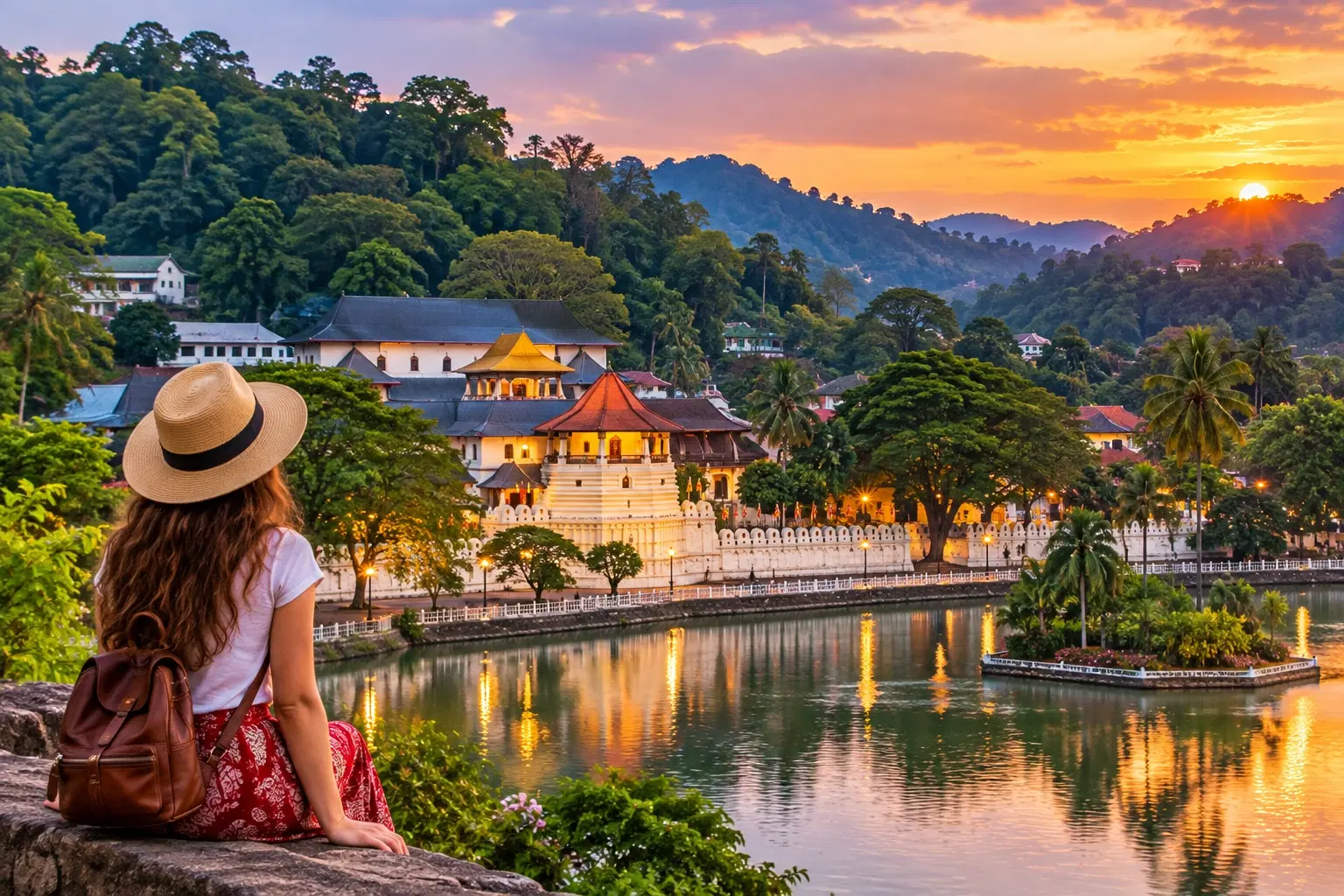
Kandy is the one stop almost every Sri Lanka itinerary shares. It was the last capital of the Sinhalese kings, it holds the relic that Sri Lankan Buddhists regard as the most sacred object in the country, and it sits on the natural route between the ancient cities of the north and the tea country to the south.
It is also a place where a surprising amount of what you will read online is out of date. The most common entrance price quoted for the Temple of the Tooth is LKR 2,000. The temple's own website now lists LKR 3,000 for most foreign visitors. Many guides tell you to buy separate tickets for the World Buddhist Museum and the royal palace museums; the temple ticket already covers four museums. And a large share of content still describes arriving by train from Colombo, which has not been possible since the cyclone in November 2025.
None of this makes Kandy less worth visiting. It makes it worth planning with current information, which is what this guide is for. We have checked ticket prices and visiting rules against the temple's and the Department of National Botanic Gardens' own published pages, and the rail position against statements from the Railway Department and the transport ministry reported in September 2026. Where sources disagree, we say so rather than picking a number.
We also want to be honest about what Kandy is. It is not a hill station and it is not a quiet mountain town. It is Sri Lanka's second great city in cultural terms: busy, congested at rush hour, noisy around the bus stands, and deeply alive. The lake, the temple, the forest behind it and the gardens at Peradeniya are genuinely beautiful. The traffic that connects them is not.
This guide covers everything a first-time visitor needs: what changed in 2026, how to visit the Temple of the Tooth properly, the other sights in and around the city, the Perahera, day trips worth taking and ones worth skipping, getting there and getting around while the railway is being rebuilt, where to stay, what to eat, when to come and how long to spend.
Quick Summary
- The Temple of the Tooth's own FAQ lists LKR 3,000 for most foreign visitors and LKR 2,500 for SAARC, Thai and Myanmar nationals — many live guides still say LKR 2,000
- That ticket already includes the Dalada Museum, World Buddhist Museum, Tusker Museum and Royal Elephant Stable
- Temple tickets are issued only by machines inside the temple; tickets sold by anyone else are not valid
- Daily services run at 5.30 to 7.00 am, 9.30 to 11.00 am and 6.30 to 8.00 pm; the temple is open 5.30 am to 8.00 pm
- Shorts, sleeveless tops and body-revealing clothing are refused at the entrance
- Peradeniya Botanic Gardens charges LKR 3,540 for foreign adults, with tickets sold until 5.00 pm
- Colombo to Kandy trains have not run since Cyclone Ditwah; a resumption was indicated for October 2026 but no timetable has been published
- There is still no expressway into Kandy; the road journey from Colombo takes around three to four hours
- The 2026 Esala Perahera ran 18 to 28 August; 2027 dates have not been announced
- Two nights suits most travellers; Kandy is a staging point, not a base for Sigiriya or Ella
What Kandy Is, and What It Is Not
Kandy grew as the capital of the Kandyan Kingdom, the last independent Sinhalese kingdom, which held out in the hills against the Portuguese and the Dutch before falling to the British in 1815. The relic of the Buddha's tooth, historically a symbol of the right to rule, was brought here and has remained here since, which is why the city carries a religious weight far beyond its size.
UNESCO inscribed the Sacred City of Kandy as a World Heritage Site in 1988. The listing covers the temple and the former royal palace complex around it rather than the modern city, and that distinction matters when you arrive: the heritage core is compact and walkable, while the city around it is a busy provincial capital with markets, schools, hospitals, offices and heavy traffic.
At around 500 metres, Kandy is noticeably cooler and fresher than Colombo, especially at night, but it is not highland. The tea terraces, cold evenings and misty ridges people associate with the hill country begin well to the south, beyond Gampola and Nawalapitiya. If you are expecting Nuwara Eliya, Kandy will surprise you.
Kandy's real role in most itineraries is as a hinge. It sits between the Cultural Triangle to the north and the hill country to the south, and it is the natural place to break that journey, see the temple, and absorb something of Sri Lanka's living Buddhist culture before moving on.
What it rewards is time at the right hours. The temple at dawn or during the evening service, the lake path in the early morning, Peradeniya before the midday heat and the forest in the late afternoon are all quite different experiences from the same places at noon.
Last royal capital of Sri LankaUNESCO World Heritage since 1988Around 500 metres — cooler, not highlandA busy city around a compact heritage coreThe hinge between the Cultural Triangle and the hill country
What Changed in 2026: The Numbers Most Guides Still Get Wrong
Temple of the Tooth ticket. The temple's official FAQ page currently lists LKR 3,000 for visitors from most countries and LKR 2,500 for visitors from SAARC countries, Thailand and Myanmar. A large number of live articles and aggregator pages still quote LKR 2,000 and LKR 1,500. One secondary source dates the increase to 1 July 2026; we could not confirm that date from the temple itself, but the current figure on the temple's own page is clear.
What the ticket covers. The same official page states that the ticket includes the Temple of the Tooth Relic, the Dalada Museum, the World Buddhist Museum, the Tusker Museum and the Royal Elephant Stable. Several guides still advise buying a separate World Buddhist Museum ticket. Check what your ticket says before paying anyone for anything else.
Where tickets come from. The temple states that tickets are issued automatically by machines installed within the temple, and that tickets or fees issued by other individuals or institutions are not valid. If someone outside offers to sell you a ticket, a fast-track pass or a guided entry that includes the ticket, decline.
Peradeniya Botanic Gardens. The Department of National Botanic Gardens lists LKR 3,540 for foreign adults over 12, LKR 2,360 for foreign students with proof, and LKR 1,770 for foreign children aged 5 to 12. Figures of LKR 1,500, 2,000 and 3,000 all still circulate online.
The train from Colombo. Colombo to Kandy rail services have been suspended since Cyclone Ditwah damaged the line at Balana and Kadugannawa in late November 2025. On 7 September 2026 the Deputy Minister of Transport said services between Colombo and Peradeniya were expected to resume in October 2026. As of late September no start date or timetable had been published. Treat the train as a possibility to check, not a plan to build on.
The expressway. The Central Expressway still does not reach Kandy. The Kadawatha to Mirigama section was reported as under construction during 2026 with completion targeted around 2028, and the section toward Kandy is not yet open. The road into Kandy remains the old A1 over the Kadugannawa pass, with its familiar bottlenecks.
Temple: LKR 3,000 most foreigners, LKR 2,500 SAARC, Thailand, MyanmarOne temple ticket covers four museumsMachine-issued tickets only — others are invalidPeradeniya: LKR 3,540 foreign adultColombo–Kandy train: October 2026 indicated, unconfirmedNo expressway into Kandy yet
The Temple of the Tooth: How to Visit It Properly
The Temple of the Sacred Tooth Relic, Sri Dalada Maligawa, stands beside Kandy Lake within the former royal palace complex. The octagonal Pattirippuwa tower overlooking the moat is the image most people know; the complex behind it includes shrine rooms, the inner relic chamber, a library, museums, and the royal buildings to the north.
The single most important thing to understand is that you will not see the tooth. The relic is kept inside a series of nested golden caskets in the inner chamber. During the daily services the doors of the chamber are opened and devotees, and visitors, file past to see the outer casket. That moment, with drums and horns playing and worshippers carrying lotus and jasmine, is what most people remember.
The temple publishes three daily services: an early morning service from 5.30 to 7.00 am, a mid-morning service from 9.30 to 11.00 am, and an evening service from 6.30 to 8.00 pm. The temple is open from 5.30 am to 8.00 pm every day. On Wednesdays at 9.30 am the Nanumura Mangallaya, a ritual bathing of the relic with a herbal preparation, takes place.
The early morning service is the least crowded and the most atmospheric. The evening service is the most popular with visitors and can be very busy, particularly on weekends, school holidays and Poya full moon days. The mid-morning service sits between the two.
Allow at least an hour and a half, and more if you want to see the museums properly. The World Buddhist Museum, housed in the former colonial court building, is often rushed or skipped and is one of the more interesting rooms in the city, with material from Buddhist traditions across Asia.
Special relic expositions are a different matter. In April 2025 a public exposition of the relic drew roughly 450,000 devotees in a single day, with queues reported at nearly ten kilometres and entry to the complex restricted. Such events are announced by the temple and can change normal visiting arrangements at short notice. If one coincides with your trip, it is a remarkable thing to witness from outside, but do not expect a normal tourist visit that day.
You see the casket, not the toothServices at 5.30 am, 9.30 am and 6.30 pmOpen 5.30 am to 8.00 pm dailyWednesday 9.30 am relic bathing ritualEarly morning is quietestAllow 90 minutes or more
Dress Code, Security and Entry Rules at the Temple
The temple's published guidelines are clear: visitors wearing shorts, sleeveless tops or body-revealing clothing are not permitted. Appropriate clothing can be obtained at the entrances, but it is simpler and more respectful to arrive dressed for it. Cover shoulders and knees, and bring a light layer or sarong if you are unsure.
All visitors are screened at the entrance, and belongings, including offerings, are checked with scanning equipment. This is not a formality. The temple was badly damaged in a truck bomb attack in 1998, and security is taken seriously. Carry as little as possible.
Footwear, bulky luggage and non-essential items are handed in at reception booths in exchange for a token. There are separate booths for local devotees and foreign visitors. You will walk barefoot on stone and tile; in the middle of the day the outdoor paving can be very hot, so socks are useful.
The temple asks visitors not to bring polythene or plastic bags or containers, including for offerings, and pets are strictly prohibited.
Remove hats. Do not pose with your back to a Buddha image, do not point your feet at images or monks, and keep your voice low in the shrine rooms. Photography rules can differ between areas of the complex, and the inner chamber area during services is not the place for a camera held above the crowd. Filming for commercial or media purposes requires prior approval from the temple.
For visitors with special needs, the temple states that assistance, including transport from the main entrance and use of a lift, can be arranged through its administration office. Call ahead rather than arriving unannounced.
No shorts, sleeveless or revealing clothingSecurity screening for everyoneShoes and bags handed in for a tokenNo plastic bags, no petsNo photos with your back to a Buddha imageAccessibility assistance available on request
The Royal Palace Complex and Kandy's Museums
The Temple of the Tooth is only one part of a wider royal complex. North of it stand the Audience Hall, the Magul Maduwa, with its carved wooden pillars, and the remains of the King's Palace and the Queen's Palace. The Audience Hall is where the Kandyan chiefs signed the convention of 1815 that ceded the kingdom to the British.
Within the temple ticket you have the Dalada Museum on the upper floors of the temple, the World Buddhist Museum, the Tusker Museum, which preserves the body of Raja, the temple's most famous ceremonial elephant, and the Royal Elephant Stable.
The Kandy National Museum, in the former Queen's Palace area, is run by the Department of National Museums and charges its own entrance fee. It is small and quiet, with Kandyan-period objects, weapons, jewellery and documents, and it is a useful counterweight to the crowds at the temple if you want historical context.
Just beyond the complex, the four devales, shrines to the guardian deities Natha, Vishnu, Kataragama and Pattini, are part of Kandy's religious landscape and take part in the Esala Perahera. The Natha Devale is among the oldest buildings in the city. These are active shrines; the same dress and behaviour expectations apply.
The British Garrison Cemetery, a short walk uphill from the temple, holds graves from the early colonial period, many of them of young soldiers and their families. It is small and quiet, and a reminder that the period after 1815 was not peaceful.
Audience Hall and royal palace remainsFour museums on the temple ticketKandy National Museum charges separatelyThe four devales of the guardian deitiesBritish Garrison Cemetery nearby
Kandy Lake and the City Walk
Kandy Lake was created in the early nineteenth century by the last king, Sri Wickrama Rajasinghe, and it defines the shape of the city centre. A path runs around most of its circumference, and a full loop takes around an hour at an easy pace.
The best time to walk it is early in the morning, when the air is cool, the traffic is lighter and the light across the water toward the temple is soft. Late afternoon into dusk is the other good window, particularly on the way to the evening service.
Expect monkeys, water monitors, cormorants, egrets and fruit bats around the lake. Do not feed the monkeys and keep food out of sight; they are bold and quick.
Swimming and boating on the lake are not visitor activities. The lake is part of the sacred setting of the temple and is treated accordingly.
From the lake, the walk into the central market area, along Dalada Veediya and the streets around the clock tower, gives you the working city: fabric shops, pharmacies, bakeries, jewellers and crowds. It is worth doing once, with an eye on traffic, which rarely yields to pedestrians.
Built by the last king of KandyAround an hour for a full loopBest early morning or at duskMonkeys, monitors and waterbirdsNo swimming or boating
Royal Botanic Gardens, Peradeniya
The Royal Botanic Gardens at Peradeniya lie about 5.5 kilometres west of Kandy on the Colombo road, in a loop of the Mahaweli, Sri Lanka's longest river. The garden was established in its current form in 1821 on land that had been a royal garden long before, and it covers 147 acres with more than 4,000 plant species.
Highlights include the Royal Palm Avenue, the Cabbage Palm Avenue along the river drive, the great Java fig on the Great Lawn, whose canopy spreads like a living umbrella, the orchid house, the spice garden with nutmeg trees planted in 1840, the giant bamboo collection, and the suspension bridge over the Mahaweli.
The Department of National Botanic Gardens lists opening hours of 7.30 am to 6.00 pm every day of the year, with tickets sold until 5.00 pm. Foreign adults pay LKR 3,540, foreign students with proof LKR 2,360, and foreign children aged 5 to 12 LKR 1,770.
Go early. The garden is large, much of it is open lawn, and by late morning it can be hot. Weekends and public holidays bring large numbers of local families and school groups, which is part of the charm but changes the atmosphere.
Allow two to three hours. The garden is essentially flat and suitable for most visitors, though distances add up. Buggy transport inside the garden has been offered at an additional charge; confirm current arrangements at the entrance.
Peradeniya is easily combined with the three temples to the west of Kandy, or visited on the way in or out of the city if you are travelling to or from Colombo.
147 acres, more than 4,000 speciesForeign adult LKR 3,540Open 7.30 am to 6.00 pm, tickets until 5.00 pmOrchid house, spice garden, Java figGo early; allow two to three hours
Udawattakele: A Rainforest Behind the Temple
Directly behind the Temple of the Tooth rises Udawattakele, a forested ridge of around 104 hectares that was a royal preserve in the Kandyan period, declared a forest reserve in 1856 and a sanctuary in 1938. It is one of the easiest ways to get into genuine forest in Sri Lanka without leaving a city.
The visitor entrance is on the western side, around fifteen to twenty minutes on foot from the temple. Well-maintained paths loop through tall trees, past a pond and forest hermitages used by Buddhist monks. Birdwatchers value it highly, and monkeys, giant squirrels and a range of forest birds are commonly seen.
We found the foreign entrance fee reported at figures ranging from around LKR 570 to LKR 930 across recent sources, with one visitor account citing LKR 900. We could not find a current official figure. Expect a fee under LKR 1,000 and confirm at the gate. Several sources report that ticket sales end in the mid-afternoon, so arrive by 3.00 pm to be safe.
In wet weather leeches are active on the paths. Wear closed shoes and long trousers, and consider leech socks if it has been raining.
The forest contains active monastic hermitages. Keep your voice down near them, do not photograph monks meditating, and stay on the marked paths. Sources also report that unmarried couples may be refused entry; whether or how that is applied to foreign visitors is not something we could verify.
Royal forest, sanctuary since 193815 to 20 minutes' walk from the templeExcellent for birdwatchingFee reported between LKR 570 and 930 — confirm at gateLeeches after rainActive monastic hermitages
Kandy's Viewpoints: The City from Above
Kandy sits in a bowl, and the best way to understand its shape is from one of the ridges around it.
The viewpoint on the road above the southern side of the lake, often called Arthur's Seat, gives the classic view across the lake to the temple and the city. It is a short tuk-tuk ride or a steep walk from the lake, and it is best in the early morning or late afternoon.
The large white Buddha statue at Bahirawakanda Vihara looks down on the city from a hill to the west and is visible from much of Kandy. The temple is an active place of worship, the climb or ride up is steep, and the view back over the city is wide. Dress as you would for any temple; a small entrance fee may be charged.
For a longer view, the Hanthana range south of the city rises to over 1,000 metres and offers ridge walks with views over Kandy and toward the Knuckles on a clear day. These routes cross estate and forest land and are best done with someone who knows them.
Viewpoint conditions depend heavily on haze and cloud. Morning is usually clearest.
Arthur's Seat for the classic lake viewBahirawakanda Buddha over the cityHanthana ridge walks with a guideMornings are usually clearest
Kandyan Dance and Drumming Shows
Kandyan dance is one of Sri Lanka's classical dance forms, originally tied to ritual and to the royal court, and today central to the Esala Perahera. Several halls near the lake stage evening performances for visitors, typically timed so you can walk to the temple's evening service afterwards.
A show usually runs for around an hour and includes drumming, several dance forms including masked dances, and often a fire-walking finale. Ticket prices are set by the venues; recent visitor reports suggest figures in the LKR 3,000 to 3,500 range, but this is not a regulated price and we have not verified it. Confirm at the door.
Honest assessment: the shows are staged for tourists, the halls can be crowded and hot, and the quality varies. They are also the only realistic way most visitors will see Kandyan dance performed by trained dancers outside the Perahera season, and many travellers enjoy them.
If your visit coincides with the Esala Perahera, you will see Kandyan dancers in their real ceremonial context, and a staged show becomes optional.
Classical dance with royal and ritual rootsAround one hour, early eveningPrices not regulated — confirm at the doorTourist-staged but a genuine art formEasy to combine with the evening puja
The Kandy Esala Perahera: When It Happens and What It Takes
The Kandy Esala Perahera is a series of processions honouring the Sacred Tooth Relic, held each year around the Esala full moon in July or August. It combines the procession of the Temple of the Tooth with those of the four devales, with drummers, dancers, whip-crackers, torch-bearers and ceremonial elephants, led on the grandest nights by the Maligawa tusker carrying the relic casket's replica.
The 2026 Perahera, as published by the temple, ran from 18 to 28 August: five nights of Kumbal Perahera from 18 to 22 August, five nights of Randoli Perahera from 23 to 27 August, the water-cutting ceremony in the early hours of 28 August, and the Dahawal day procession that afternoon.
The 2027 dates have not been announced. The festival follows the lunar calendar and the temple publishes the schedule, with auspicious start times, in the months before. Do not trust any specific 2027 dates you see until they appear on the temple's own website.
What the Perahera means for your trip: Kandy's accommodation fills months ahead for the Randoli nights and prices rise sharply. Roads around the route close from the afternoon. Reserved seating along the route is sold through hotels and operators at prices that vary widely, and the free standing space along the barriers fills from mid-afternoon on the busiest nights.
If you are not specifically coming for the Perahera, the weeks around it are the most expensive and most crowded time to be in Kandy. If you are, commit to at least two nights, book early, and treat the procession as the religious observance it is rather than a parade laid on for spectators.
Two other Esala processions are worth knowing about: the Devinuwara Perahera in the far south, which is freer and far less mediated, and smaller devale processions elsewhere. Our separate Devinuwara guide covers the contrast.
Held around the Esala full moon, July or August2026: 18 to 28 August2027 dates not yet announcedBook accommodation months aheadRoad closures from the afternoonA religious observance, not a show
Day Trips from Kandy: Worth It, and Not
The three temples west of Kandy. Gadaladeniya, Lankatilaka and Embekke Devale lie within about 30 minutes of the city and together make an excellent half-day. Gadaladeniya and Lankatilaka date from the fourteenth century Gampola period and sit on rock outcrops with rural views; Embekke is famous for its carved wooden pillars. Each charges a modest fee. Combine them with Peradeniya for a full day.
The Knuckles range. North-east of Kandy, the Knuckles Conservation Forest is part of the UNESCO-listed Central Highlands and offers some of the best walking in the country, from half-day trails to multi-day routes, with cloud forest, streams and villages. It needs a guide and an early start. Our rainforest and nature guide covers it in detail.
Ambuluwawa. About an hour south, near Gampola, a hilltop multi-religious complex topped by a spiral tower gives huge views on a clear day. The upper stairs of the tower are narrow and exposed and not suitable for anyone uncomfortable with heights. It is busy at weekends.
Sigiriya and Dambulla as a day trip. Possible, but we do not recommend it. Both are around two and a half to three hours each way on mountain and plains roads, which means five to six hours in a vehicle for two sites that are best experienced at dawn or late afternoon. Stay a night or two in the Cultural Triangle instead.
Pinnawala. Many Kandy day tours include Pinnawala on the way from Colombo. The facility has long been the subject of criticism from animal welfare organisations over the conditions in which elephants are kept and handled. We are not in a position to inspect current conditions, so we would simply say: if seeing elephants matters to you, seeing them in the wild at Minneriya, Kaudulla, Udawalawe or elsewhere is a better experience for you and for the animals.
Nuwara Eliya and Ella. These are not day trips from Kandy. With the Kandy to Nanu Oya railway still closed, the road to Nanu Oya alone takes three and a half to five hours. Move on to the hill country rather than trying to return the same day.
Three temples loop: an easy half-dayKnuckles: best walking nearby, guide neededAmbuluwawa: big views, exposed stairsSigiriya as a day trip: not recommendedPinnawala: welfare concerns, see wild elephants insteadNuwara Eliya and Ella: move on, do not day-trip
Getting to Kandy While the Railway Is Being Rebuilt
By train. The Colombo to Kandy line, one of the most scenic climbs on the network, has not carried passenger trains through to Kandy since Cyclone Ditwah damaged it in late November 2025. The worst damage was on the steep section between Rambukkana and Kadugannawa. In July 2026 the transport minister said the line would be restored within the year, and on 7 September 2026 the Deputy Minister of Transport said Colombo to Peradeniya services were expected to resume in October 2026. As of the end of September, no firm date or timetable had been published. Check Sri Lanka Railways directly before relying on it, and be very wary of anyone selling Colombo to Kandy train tickets before an official timetable exists.
By road from Colombo. Kandy is roughly 115 kilometres from Colombo. The journey takes around three to four hours depending on traffic, and longer at weekends and on the eve of public holidays. There is no expressway into Kandy; the final approach uses the A1 over the Kadugannawa pass.
By road from the airport. From Bandaranaike International Airport, travellers usually go directly by car rather than through Colombo. Allow three to four hours, and do not schedule a Kandy to airport transfer for the morning of an early flight without generous margin.
By bus. Intercity buses run frequently from Colombo, including from the renovated Central Bus Stand in Pettah, which reopened in April 2026. They are cheap and fast by local standards but have little luggage space. Buses also connect Kandy with Dambulla, Kurunegala, Nuwara Eliya and most other regional towns.
From the Cultural Triangle. Kandy is around two and a half to three hours from Sigiriya or Dambulla by road. From Dambulla, frequent buses make the trip.
Onward to the hill country. With the Kandy to Nanu Oya railway section still closed, the standard route is by road from Kandy to Nanu Oya, three and a half to five hours, then the train from Nanu Oya to Ella and beyond. Our hill country guide covers the current position in detail.
No Colombo–Kandy trains since November 2025October 2026 resumption indicated, not confirmedColombo by road: 3 to 4 hoursNo expressway into KandyFrequent buses from Colombo and DambullaHill country: road to Nanu Oya, then train
Getting Around Kandy
On foot. The heritage core — the temple, the lake, the palace complex, the museums, the Udawattakele entrance and the central streets — is compact enough to walk. Pavements are uneven and narrow in places and the traffic is relentless, but walking is often faster than driving in the centre.
By tuk-tuk. Tuk-tuks are everywhere and are the easiest way to reach viewpoints, hill hotels and Peradeniya. Agree the fare before you get in, or use a ride-hailing app, which is now widely available in Kandy and removes most of the negotiation.
By car and driver. The best option for day trips to the three temples, the Knuckles or Ambuluwawa, and for onward travel. A driver who knows the city will also know which routes to avoid at school closing time.
Traffic. Kandy's traffic is among the worst in the country for a city of its size. The centre is built in a narrow valley with limited routes in and out, and congestion peaks in the morning, at school closing time in the early afternoon, and in the evening. Build this into your plans, particularly if you are catching a bus or leaving for the airport.
A practical rule: do the things in the centre on foot early and late, and use vehicles in the middle of the day for things outside it.
Heritage core is walkableAgree tuk-tuk fares or use an appCar and driver for day tripsHeavy congestion at peak hoursWalk the centre early and late
Where to Stay in Kandy
Around the lake and the centre. The most convenient base for first-time visitors, walkable to the temple, lake and restaurants. Rooms range from simple guesthouses to large hotels. It is also the noisiest area and the most affected by traffic, and the most expensive and hardest to book during the Perahera.
In the hills above the lake. Guesthouses and hotels on the ridges around the lake and toward Hanthana offer quieter nights, cooler air and views, in exchange for a steep walk or a short tuk-tuk ride into town. This is our general preference for a two-night stay outside Perahera season.
Toward Peradeniya and along the river. Properties west of the city and along the Mahaweli are calmer and closer to the gardens and the three temples, but further from the temple and the evening scene. Good if you have a car and driver.
Outside Kandy entirely. Hotels in the countryside around Kandy, including toward the Knuckles and Victoria reservoir, trade convenience for setting. They suit travellers who want a rural stay and plan to visit the city only once.
Before booking anywhere, check the exact location on a map, the gradient of the access road if you will be walking, whether the room has air-conditioning or a fan, and whether the property is on the Perahera route if you are travelling in July or August.
Lake and centre: most convenient, noisiestHills above the lake: quieter, cooler, viewsPeradeniya side: calm, better with a carCountryside: setting over convenienceBook months ahead for the Perahera
What to Eat in Kandy
Kandy is a good place to eat Sri Lankan rice and curry the way it is eaten locally: a mound of rice with several vegetable curries, dhal, a sambol, papadam and a fish, chicken or egg curry, at lunchtime, in a busy local restaurant. Lunch is the main meal and the best time to find variety.
Short eats — patties, rolls, cutlets, vadai — fill the bakery counters around the centre and are the cheapest way to eat well on the move. Kottu, string hoppers and hoppers are widely available in the evening.
Kandyan sweets such as kavum and kokis are traditionally associated with the Sinhala and Tamil New Year in April but can be found year-round in some shops.
For vegetarians: Maldive fish, dried and cured tuna, is commonly used in sambols and many vegetable curries and is invisible once mixed. If you do not eat fish, say so explicitly and ask specifically. Our cooking classes and food guide explains this in more detail.
Water: drink bottled or filtered water, and be cautious with ice in very small places. Kandy's larger restaurants generally handle this well.
Rice and curry is a lunchtime mealShort eats from bakery countersKottu and hoppers in the eveningAsk about Maldive fish if vegetarianBottled or filtered water
When to Visit Kandy
January to April is generally the most settled period in Kandy, with less rain and clearer mornings. It is also the busiest foreign tourist season, and April brings the Sinhala and Tamil New Year, when many local businesses close for a few days and domestic travel surges.
May to September is mixed. Kandy sits on the inland side of the south-west monsoon and gets showers rather than the heavy, sustained rain of the south-west coast, though wet spells happen. July and August bring the Esala Perahera and the highest accommodation prices of the year.
October and November are generally the wettest months across the island, and Kandy and the surrounding hills are no exception. Heavy rain raises landslide risk on hill roads, which is exactly what closed the railway in 2025. December is transitional.
Poya full moon days, every month, bring large numbers of devotees to the Temple of the Tooth. The atmosphere is special, but the temple is much busier and alcohol sales are prohibited island-wide on Poya days.
Whatever the month, mornings are usually the clearest and coolest part of the day, and short heavy showers in the afternoon are common.
January to April: most settledJuly to August: Perahera, crowds, high pricesOctober to November: wettest, landslide riskPoya days: busy temple, no alcohol salesMornings clearest year-round
How Long to Stay, and Who Kandy Does Not Suit
For most travellers, two nights is right. That gives you an arrival afternoon and evening service, a full day for the temple complex at dawn, the lake, Peradeniya and Udawattakele, and a relaxed departure.
Three nights makes sense if you want a day trip to the three temples or a guided walk in the Knuckles, or if you want to see both the morning and evening services without rushing.
One night is possible if you are passing through between the Cultural Triangle and the hill country, but you will spend much of it in traffic and see the temple in a hurry.
Kandy does not suit travellers looking for quiet mountain scenery and cool nights; that is the hill country further south. It does not suit anyone expecting a relaxed small town; it is a busy city with noise and congestion. And it is a poor base for day trips to Sigiriya, Nuwara Eliya or Ella, all of which are too far to return from comfortably.
It does suit anyone interested in Buddhism, history and living religious culture, garden lovers, birdwatchers, and anyone who wants to understand why Sri Lanka's heritage is not only in ruins but in daily practice.
Two nights for most travellersThree nights with a day tripOne night is a rushNot for quiet mountain sceneryIdeal for culture, gardens and birds
Etiquette, Safety and Scams in Kandy
Buddhist imagery. Treat Buddha images with respect everywhere, not only in temples. Do not pose with your back to a statue, climb on religious structures, or wear clothing that uses the Buddha as decoration. Visible Buddha tattoos have led to foreign visitors being refused entry to the country or deported in past cases; cover them.
Monks. Give monks space and do not touch them. Women in particular should avoid physical contact, including handing items directly. On buses, certain seats are reserved for clergy.
Temple ticket touts. The temple states that only machine-issued tickets are valid. Ignore anyone outside offering tickets, shortcuts or entry packages.
Gem and spice pitches. Friendly approaches that lead to gem shops, with stories about buying stones to resell at home, are common around Kandy. Do not buy gems as an investment, and do not let a stranger or driver steer you to a shop. Roadside spice gardens on the approach roads are primarily sales outlets.
Monkeys. Around the lake, the temple and Udawattakele, monkeys will take food and grab bags. Keep food hidden and do not feed them.
Roads. Traffic is the most practical safety risk in Kandy. Cross carefully, assume drivers will not stop, and be extra careful after dark when pavements are poorly lit.
Generally, Kandy is a safe city for visitors, including solo and women travellers, with the usual care at night and in crowds. Our scams guide covers common patterns in more detail.
Respect Buddha images everywhereCover Buddha tattoosOnly machine-issued temple tickets are validAvoid gem investment pitchesGuard food and bags from monkeysTraffic is the main safety risk
What Kandy Costs: The Verified Tickets
We only list prices we could confirm on an official page. Everything else varies too much between providers and seasons to state honestly.
Temple of the Tooth: LKR 3,000 for visitors from most countries; LKR 2,500 for SAARC, Thai and Myanmar nationals. Includes four museums and the Royal Elephant Stable.
Royal Botanic Gardens, Peradeniya: LKR 3,540 foreign adult; LKR 2,360 foreign student with proof; LKR 1,770 foreign child aged 5 to 12.
Together, the two main sights come to LKR 6,540 for a foreign adult from outside South Asia. The three temples west of Kandy, Udawattakele, the Kandy National Museum and Bahirawakanda each add smaller fees, which we could not verify from official sources; expect each to be well below the two main tickets.
Accommodation, tuk-tuks, drivers and restaurants cover every range from very cheap to international luxury, and all of them rise sharply during the Esala Perahera. Carry cash in small notes for entrance booths, shoe booths, small shops and tuk-tuks.
Temple: LKR 3,000 or 2,500Peradeniya: LKR 3,540 foreign adultTwo main sights: LKR 6,540Other sites: smaller, unverified feesEverything rises during the PeraheraCarry small notes
Travel Tips
- Budget LKR 3,000 for the Temple of the Tooth, not LKR 2,000 — the price on older guides is out of date
- Buy temple tickets only from the machines inside the temple
- Do not pay separately for the World Buddhist Museum — it is on the temple ticket
- Cover shoulders and knees; shorts and sleeveless tops are refused
- Wear socks for hot stone paving after removing shoes
- Go to the 5.30 am service for the calmest visit
- Check Sri Lanka Railways before planning any Colombo to Kandy train
- Allow three to four hours by road from Colombo and more at weekends
- Do not plan Sigiriya, Nuwara Eliya or Ella as day trips from Kandy
- Arrive at Peradeniya early and before 5.00 pm at the latest
- Wear closed shoes and long trousers in Udawattakele after rain
- Keep food hidden from monkeys around the lake and forest
- Book months ahead if travelling during the Esala Perahera
- Confirm 2027 Perahera dates on the temple's website before booking
- Agree tuk-tuk fares first or use a ride-hailing app
- Avoid school closing time and evening rush hour for vehicle journeys
- Carry small notes for booths, shoe counters and tuk-tuks
- Cover any Buddha tattoos
Frequently Asked Questions
How much is the Temple of the Tooth entrance fee in 2026?
The temple's official FAQ lists LKR 3,000 for visitors from most countries and LKR 2,500 for visitors from SAARC countries, Thailand and Myanmar. Many websites still show LKR 2,000; that figure is out of date. Sri Lankan nationals enter free.
What does the Temple of the Tooth ticket include?
According to the temple, the ticket includes the Temple of the Tooth Relic, the Dalada Museum, the World Buddhist Museum, the Tusker Museum and the Royal Elephant Stable. You do not need a separate ticket for the World Buddhist Museum.
Can you actually see the Buddha's tooth?
No. The relic is kept inside nested golden caskets in the inner chamber. During the daily services the chamber doors open and visitors file past to see the outer casket.
What are the puja times at the Temple of the Tooth?
The temple publishes three daily services: 5.30 to 7.00 am, 9.30 to 11.00 am and 6.30 to 8.00 pm. The temple is open from 5.30 am to 8.00 pm. The early morning service is the least crowded.
What should I wear to the Temple of the Tooth?
Clothing that covers your shoulders and knees. The temple states that visitors in shorts, sleeveless tops or body-revealing clothing are not permitted. You will remove your shoes and hat; socks help on hot paving.
Is the Colombo to Kandy train running?
Not as of late September 2026. The line has been closed since Cyclone Ditwah in November 2025. On 7 September 2026 the Deputy Minister of Transport said services were expected to resume in October 2026, but no timetable had been published. Check with Sri Lanka Railways before planning around it.
How do I get from Colombo or the airport to Kandy?
By road, taking around three to four hours from either Colombo or the airport depending on traffic. There is no expressway into Kandy yet. Frequent intercity buses also run from Colombo.
Can I take the train from Kandy to Ella?
Not end to end. The Kandy to Nanu Oya section remains closed. The usual route is by road from Kandy to Nanu Oya, three and a half to five hours, then the train from Nanu Oya to Ella.
How many days do I need in Kandy?
Two nights suits most travellers. Three nights allows a day trip to the temples west of Kandy or the Knuckles. One night is possible if you are passing through but feels rushed.
How much is the Peradeniya Botanical Garden entrance fee?
The Department of National Botanic Gardens lists LKR 3,540 for foreign adults over 12, LKR 2,360 for foreign students with proof, and LKR 1,770 for foreign children aged 5 to 12. The garden is open 7.30 am to 6.00 pm, with tickets sold until 5.00 pm.
When is the Kandy Esala Perahera in 2027?
The 2027 dates have not been announced. The Perahera is held around the Esala full moon in July or August, and the temple publishes the schedule in advance. The 2026 Perahera ran from 18 to 28 August.
Can I do Sigiriya as a day trip from Kandy?
It is possible but not recommended. Sigiriya is around two and a half to three hours each way by road, which means most of the day in a vehicle for a site best seen at dawn or late afternoon. Stay in the Cultural Triangle instead.
Is Kandy worth visiting?
Yes, for the Temple of the Tooth, the living Buddhist culture, Peradeniya and the forest behind the temple. It is not a quiet hill town, and travellers looking for mountain scenery and cool nights should plan to continue into the hill country.
Is Kandy safe for tourists?
Generally yes, including for solo and women travellers. The main practical risks are traffic, monkeys taking food or bags, and sales pitches for gems. Buy temple tickets only from the official machines.
Where is the best area to stay in Kandy?
Near the lake for walkability, in the hills above the lake for quieter nights and views, or toward Peradeniya if you have a car. During the Perahera, book months ahead and check whether your hotel is on the procession route.