
LankaTrip Insights

24 min read

The Madhu Church Feast in 2026 and 2027: Inside Sri Lanka's Largest Pilgrimage

The Feast of Our Lady of Madhu on 15 August is one of the largest religious gatherings on the island and one of the very few places where Sinhalese and Tamil, Catholic and Buddhist and Hindu, have gathered together without interruption for centuries. It is also a working shrine rather than a tourist attraction, and that distinction shapes everything about how to visit.

Back to blog
The Madhu Church Feast in 2026 and 2027: Inside Sri Lanka's Largest Pilgrimage

There is a patch of dry forest in Mannar District, a couple of hours inland from the sea, where something unusual has happened continuously for more than three hundred and fifty years.

People have walked there. Tamil Catholics and Sinhalese Catholics, but also Hindus, Buddhists and Muslims. They walked there through Dutch persecution, through British rule, through independence, and through a twenty-six year civil war that made the surrounding district one of the most dangerous places on the island. The shelling reached the shrine itself. Refugee camps ringed the compound. At one point the statue at the centre of it all had to be taken away and hidden.

And every year they came back.

The Shrine of Our Lady of Madhu is Sri Lanka's most significant Catholic pilgrimage site, and its principal feast on 15 August is one of the largest religious gatherings the country holds. But describing it only in those terms misses what makes it remarkable. Madhu is one of the very few places in Sri Lanka where the divisions that have defined the country's modern history simply do not operate. A Buddhist family and a Tamil Catholic family will queue for the same blessing.

We should be direct about something at the outset, because most travel content about Madhu is not. This is not an attraction. It is a working shrine, and on 15 August it is the single most important day of the year for a great many Sri Lankan families, some of whom have saved for months and travelled for days to be there. The grounds prohibit alcohol and the kind of celebratory behaviour that fills a secular festival. People come to pray, and a substantial number come because they are ill, or grieving, or afraid.

That does not mean visitors are unwelcome. Madhu has received pilgrims of every background for centuries and the welcome is genuine. It does mean that how you visit matters more here than at almost any other site on the island, and it means that our honest recommendation for most foreign travellers is probably not the one you expect.

This guide covers the history, what actually happens during the feast, how to get there, the rules, the specific safety considerations of a former conflict zone, and a frank assessment of whether you should go on 15 August or on an ordinary Tuesday in March.

Quick Summary

  • The Shrine of Our Lady of Madhu is widely regarded as Sri Lanka's most important Catholic pilgrimage site
  • The principal feast falls on 15 August, the Feast of the Assumption, preceded by a nine-day novena beginning with a flag hoisting in early August
  • 2 July is the shrine's original and canonical feast day, and it remains significant even though August now draws far larger crowds
  • Attendance figures vary widely by year and source, commonly reported in the hundreds of thousands
  • The shrine is venerated by Buddhists, Hindus and Muslims as well as Catholics, and by both Tamil and Sinhalese communities
  • The statue was removed for safekeeping during the fighting in 2008 and returned after the war ended
  • Pope Francis visited Madhu in January 2015 and spoke there about reconciliation
  • For most foreign visitors, a quiet weekday outside the feast is the better and more respectful experience

How a Statue Ended Up in the Forest

The story begins with persecution, which is worth remembering when you stand in the quiet of the grounds.

Catholicism arrived in Sri Lanka's coastal regions with the Portuguese in the sixteenth century and took root among fishing and coastal communities, particularly in the north. When the Dutch took the coastal areas in the seventeenth century they promoted Protestantism and suppressed Catholic practice, closing churches and banning priests.

In 1670, after the Dutch took control of Mannar, a small group of Catholic families fled inland carrying a statue of the Virgin Mary with the infant Jesus. Accounts commonly put the number at around twenty families. They went into the forest, to a place then called Maruthamadu, which lay outside Dutch reach in territory associated with the Kandyan kingdom.

They were later joined by a much larger group, commonly given as around seven hundred Catholics who had fled Dutch persecution in the Jaffna peninsula. When the two communities met at Madhu, they installed the statue in a new shrine.

Saint Joseph Vaz, the Oratorian priest from Goa whose mission revived Catholicism on the island during this period, is associated with the area and is said to have taken refuge there.

The site itself may be considerably older than the Catholic story. There are accounts suggesting a pre-existing shrine at the location, and by the early twentieth century observers recorded that Buddhists and Hindus regarded the place as connected with the goddess Pattini, blending their own devotion with the Christian pilgrimage. Whether one reads that as syncretism, continuity, or simply the ordinary behaviour of religion in a shared landscape, it is part of why Madhu is what it is.

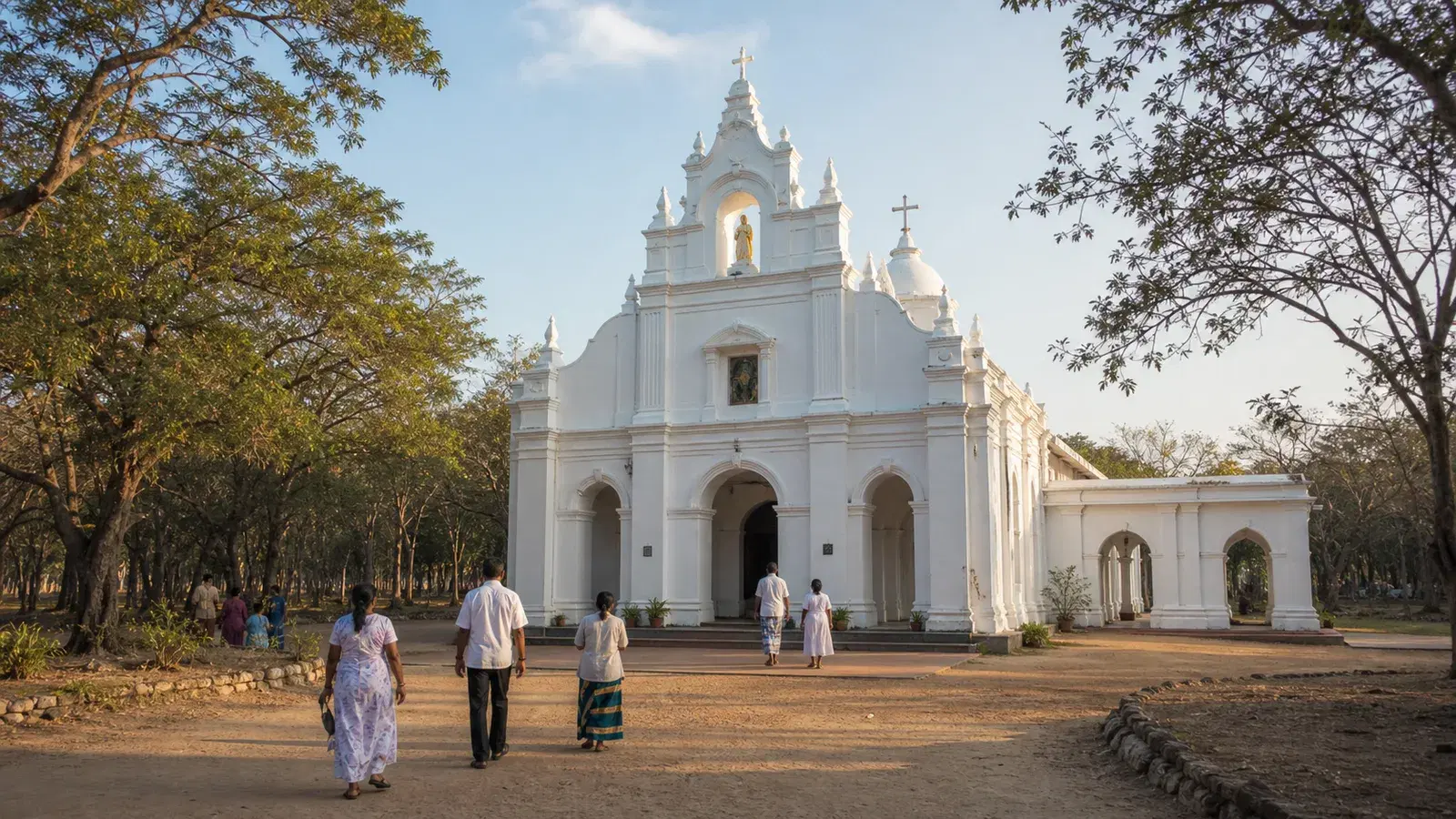
The church building most visitors see dates from 1872. Formal recognition followed: a papal decree authorising a canonical coronation of the statue was granted in the early 1920s, the coronation ceremony took place on 2 July 1924, and the church was formally consecrated in 1944.

One tradition runs through the whole history and is still visible today. Our Lady of Madhu is associated with protection from snakebite, a serious and practical concern in this forest country. Pilgrims have long taken away sand from the shrine grounds believing it carries that protection.

Statue carried into the forest in 1670Refugees from Mannar and Jaffna met at MadhuAssociated with Saint Joseph VazPresent church dates from 1872Canonical coronation on 2 July 1924

Why Madhu Matters Beyond Its Own Congregation

Sri Lanka's Catholic community is a minority, something in the region of six to seven percent of the population, and it is one of the few communities on the island that spans both the Sinhalese and Tamil populations. That single fact makes Catholic institutions unusual here, and it makes Madhu unusual even among them.

The shrine sits in a Tamil-speaking district within the Diocese of Mannar. Its congregation on any given feast day includes Tamil Catholics from the north and east and Sinhalese Catholics from the west coast, who in many cases were on opposite sides of a national conflict and who arrive at the same grounds to venerate the same statue.

It also crosses religious lines in a way that surprises visitors. Buddhists, Hindus and Muslims come to Madhu. This is not a token presence; it is a long-established pattern documented for well over a century. Mary is venerated in Islam, the site carries older associations for Hindu and Buddhist visitors, and the shrine's reputation for healing has never been confined to one community.

During the war this took on a heavier significance. The shrine functioned as a place of refuge, with camps for displaced people around the complex, and it sat in territory that changed hands. The claim that Madhu is a symbol of Sri Lankan unity is made often enough to have become a cliché, and it is nonetheless substantially true, in a country where such places are genuinely rare.

When Pope Francis visited in January 2015 during his apostolic journey to Sri Lanka, he chose to travel to Madhu specifically, in the Tamil north, and spoke there about reconciliation and about repentance as a precondition for it. For many Sri Lankans that visit carried political as well as religious weight.

We would encourage visitors to hold this context lightly rather than heavily. The people around you on the grounds are not there to demonstrate national reconciliation. They are there because they are asking for something, or giving thanks for something. The unity is a consequence of the devotion, not a performance of it.

Catholicism spans Sinhalese and Tamil communitiesBuddhists, Hindus and Muslims also venerate the siteA place of refuge during the civil warPope Francis visited in January 2015The unity follows from the devotion, not the reverse

The War Years, Told Carefully

This section exists because you cannot understand Madhu without it, and because visitors who arrive knowing nothing of it sometimes behave in ways that cause hurt.

The shrine lay within the conflict zone during Sri Lanka's civil war, which ran from 1983 to 2009. The surrounding area was contested and at various points fell under the control of different forces. The complex became a refuge for displaced civilians, and camps formed around it.

That status did not protect it. The shrine grounds were struck during the fighting, and civilians sheltering there were killed. Reported casualty figures for the incidents at and near Madhu differ between sources and we are not going to state a single number with false precision. What is not in dispute is that people who had come to a sanctuary died there, including children.

As fighting intensified in 2008, the statue itself was removed from the shrine for safekeeping. It was returned after the war ended in 2009. For many Sri Lankan Catholics, the departure and return of Our Lady of Madhu is one of the defining images of the whole conflict.

There is a piece of folklore that captures the atmosphere of those years better than any statistic. During the war, pilgrims are said to have watched the crown on the statue closely as it was carried in procession, because a crown that slipped was taken as an omen that the fighting would resume.

The war remains a live and painful subject in the north. Families in this district lost people, and some of those losses are unresolved. Two practical implications follow for visitors. First, do not raise the conflict conversationally with people you have just met, and if someone chooses to tell you their story, receive it rather than asking follow-up questions for detail. Second, be extremely careful with photography of individuals here for the same reason you would be at a funeral.

The Sri Lankan government has designated the shrine and its surroundings a sacred area, which reflects both its religious standing and its significance in the post-war period.

The shrine sheltered displaced civilians during the warThe grounds were struck and civilians were killedThe statue was removed in 2008 and returned in 2009The conflict remains painful and unresolved for many familiesDo not raise the war conversationally with strangers

What Actually Happens During the August Feast

The Madhu calendar is more complex than most guides suggest. The shrine holds a series of festivals across the year, commonly described as ten, rather than a single annual event.

Two dates matter most. The 2nd of July is the shrine's original and canonical feast day, the anniversary of the coronation of the statue in 1924. The 15th of August is the Feast of the Assumption of the Blessed Virgin Mary, a major date across the Catholic world, and it is the one that now draws by far the largest crowds at Madhu.

There is a practical reason for that shift as well as a devotional one. August falls during school holidays, which allows whole families to travel together, and for a pilgrimage that many households make as a unit, that matters enormously.

The August observance is not a single day. A flag hoisting in early August, commonly on the 6th, opens a nine-day preparatory period of novena prayers and services held morning, noon and night on the grounds. Pilgrims arrive progressively through this period, and many stay for several days rather than visiting for an afternoon.

Camping is an intrinsic part of the pilgrimage. Families set up makeshift shelters on and around the grounds and live there for the duration. There is accommodation for pilgrims at the complex, described in official northern tourism material as running to a few hundred rooms, but it is a fraction of what is needed at peak and it is not intended for casual visitors.

There is a long tradition of some coastal fishing communities travelling to Madhu by boat, arriving weeks in advance, which echoes the origins of the shrine itself.

On the feast day, a High Mass is celebrated in an outdoor pavilion because no building could hold the congregation. Senior clergy preside, and the occasion has historically drawn the country's political leadership as well. Afterwards the statue of Our Lady of Madhu is carried in procession around the church grounds, and this is the emotional centre of the whole event: candles, chanting, and a very large number of people petitioning for very personal things.

A communal meal, known as pitche choru, is another distinctive element, in which food is blessed and distributed to the gathered pilgrims.

Daily masses at the shrine are held in both Tamil and Sinhala, which is itself worth noticing.

Around ten festivals annually, not one2 July is the canonical feast; 15 August draws the crowdsFlag hoisting in early August opens a nine-day novenaOutdoor High Mass followed by a procession of the statueMasses are celebrated in both Tamil and Sinhala

How Many People Actually Attend

You will see numbers quoted for the Madhu feast ranging from tens of thousands to a million, and it is worth being clear about why.

Before the civil war, attendance at the August festival is reported to have approached a million people in some years. The war disrupted this severely, and for long periods pilgrimage was dangerous or impossible.

Since the war ended, attendance has recovered substantially. Figures reported in Sri Lankan news coverage in recent years have commonly fallen in the hundreds of thousands, with over half a million reported for at least one recent feast and expectations in the region of three hundred thousand cited in other years.

These are estimates of a crowd spread across open ground over several days, produced by different bodies using different methods, and they should be read as indicating scale rather than precision. What is reliable is the order of magnitude: this is one of the largest gatherings held anywhere in Sri Lanka.

The practical consequence for a visitor is more useful than the number. On 15 August, the road to the shrine carries very heavy traffic, the grounds are extremely crowded, sanitation and water facilities are stretched, shade is limited, and the dry-zone heat is significant. Facilities that function perfectly well for a few hundred pilgrims on an ordinary day are handling a city's worth of people.

Sri Lankan authorities typically put substantial arrangements in place for the feast, including transport, medical and security provision. Even so, this is a large crowd in a rural location, and anyone with mobility limitations, small children or a low tolerance for heat and density should think carefully.

Pre-war attendance reportedly approached a millionRecent figures commonly in the hundreds of thousandsEstimates vary by source and methodFacilities are heavily stretched on the feast dayDry-zone heat and limited shade are real factors

Should You Visit During the Feast? An Honest Answer

For most foreign travellers, our answer is no, and we would rather say that clearly than write a guide that quietly encourages a visit we do not think is a good idea.

Here is the reasoning. On 15 August, Madhu is at absolute capacity with people for whom this day carries enormous personal weight. Space, water, shade, toilets and transport are all constrained. A visitor who is there out of curiosity is consuming resources that a pilgrim needs, and is likely to spend the day uncomfortable and at some distance from anything they can follow, since the liturgy is in Tamil and Sinhala.

There is also a question of what you would actually be doing there. At a Perahera or a kite festival, spectators are part of the event. At Madhu on the feast day, there is no spectator role. Standing among people at prayer with a camera is a different act.

The alternative is genuinely better. Madhu on an ordinary day is quiet, moving and open. You can walk the grounds, sit in the church, look at the statue properly rather than over several thousand heads, and talk to people who have time to talk. The dry months from roughly February to May offer good road conditions and thin crowds. You will understand the place more, not less.

There are exceptions, and they are real ones. If you are Catholic and wish to attend as a pilgrim rather than an observer, you are welcome and that is exactly what the day is for. If you are travelling with Sri Lankan friends or family who are going, go with them. If you are a serious documentary photographer with a clear purpose, appropriate permissions and the discipline to work unobtrusively, that is a different situation from casual photography.

And if you happen to be in Mannar during the novena period rather than on the feast day itself, the days before 15 August offer much of the atmosphere with a fraction of the pressure.

We are aware this is unusual advice for a travel guide, which is normally in the business of encouraging visits. We think it is the correct advice here.

For most foreign visitors, an ordinary day is betterThere is no spectator role on the feast dayFebruary to May offers dry roads and quiet groundsPilgrims and those travelling with local families are different casesThe novena days offer atmosphere with less pressure

The Rules of the Shrine, and How to Behave

Madhu has clear expectations and they are posted on the grounds. Knowing them in advance avoids causing offence.

Alcohol is prohibited on the shrine grounds, as are dancing and celebratory behaviour of the kind normal at a secular festival. This is a place of prayer and it is run as one.

Dress modestly. Shoulders and knees covered is the standard, and it applies to everyone. In practical terms, in this heat, loose cotton with sleeves and something long is both respectful and comfortable.

Remove hats inside the church. Follow whatever instruction is given about footwear.

Photography requires judgement rather than a rule. Photographing the buildings and the grounds is generally unproblematic. Photographing individuals at prayer, in tears, or receiving a blessing is intrusive, and doing so without asking is worse. If you would not photograph a stranger at a funeral in your own country, do not do it here. During the feast, when many people are at their most emotionally exposed, the bar should be higher still.

Do not photograph and do not linger during the distribution of communion or other liturgical moments.

If you are not Catholic, you are welcome to be present at Mass and are not expected to receive communion. Standing and sitting with the congregation is courteous; you are not obliged to participate in prayers.

Pilgrims buy medals, images and scapulars at the shrine to be blessed. If you want a memento, buying from the stalls at the shrine supports the local economy, which in this district matters.

Keep your voice down, do not block processional routes, and if a member of the clergy or a volunteer asks you to move, move without discussion.

One last thing. If you are moved by the place, say so to someone. Sri Lankan pilgrims are generally delighted to explain Madhu to a visitor who is interested rather than merely looking, and those conversations are the best part of going.

No alcohol, no dancing, no celebratory behaviourShoulders and knees coveredNever photograph individuals at prayer without askingNon-Catholics are welcome and not expected to participateMove immediately if asked by clergy or volunteers

How to Reach Madhu

Madhu sits inland in Mannar District, roughly 250 kilometres north of Colombo, in dry-zone forest away from any large town.

The standard road approach is via the A14, the Medawachchiya to Mannar road. Coming from Medawachchiya, a signposted turning at Madhu Junction leads onto the Madhu Road, and the shrine lies roughly twelve kilometres along it. Travellers approaching from Anuradhapura or the cultural triangle will find this the natural route.

From Colombo, the realistic driving time is a long half day or more depending on the route and traffic. Most visitors reach Madhu as part of a wider northern journey rather than as a day trip.

By rail, the northern line and the Talaimannar line have been restored to service, and Mannar is accessible by train, though the shrine itself is inland from the line and requires road transport for the final stretch. Check current schedules with Sri Lanka Railways rather than relying on older timetables, as northern services have changed since the 2025 cyclone disruption.

Public buses serve the route, and during the feast period additional transport is typically laid on because of the volume of pilgrims. Outside the feast, connections are sparser and a hired vehicle or driver is the practical option for most visitors.

Road conditions are generally good in the dry months. The northeast monsoon, roughly October to January, brings rain to this region and secondary roads can deteriorate. Plan accordingly.

Madhu combines naturally with a broader Mannar itinerary. The road onward passes Giant's Tank and the Vankalai area before reaching the causeway to Mannar Island, and the district is one of Sri Lanka's outstanding birdwatching regions, with flamingos and migratory waders present in the northern winter months. Anuradhapura is the obvious southern anchor for a trip that includes Madhu.

Roughly 250 km north of ColomboTurn at Madhu Junction off the A14, then about 12 kmBest combined with a wider Mannar or northern tripNorthern rail services restored; verify current schedulesRoads can deteriorate in the northeast monsoon

Practical and Safety Notes for This Region

A few considerations here are specific to northern Sri Lanka and are not covered by general island travel advice.

Landmine clearance in parts of the north and east is still ongoing. This is the single most important practical point in this guide. Stay on roads, marked paths and the shrine grounds. Do not walk into uncleared scrub or forest, do not ignore warning signage, and do not take shortcuts across open land. This applies throughout the region, not only near Madhu. Follow local instructions without exception.

There is a visible military presence in parts of the north. This is normal, it is not directed at visitors, and the appropriate response is to comply with any instruction and avoid photographing military installations or personnel.

Heat is a serious factor. This is dry-zone Sri Lanka, shade is limited on open ground, and the feast falls in August. Carry more water than you think you need, wear a hat outside the church, and pace yourself. Heat exhaustion in a crowd of several hundred thousand is a genuinely bad situation.

Facilities are limited outside the feast and stretched during it. Carry water, snacks and any medication you need. Do not assume you will find a pharmacy or a reliable ATM nearby.

Carry cash. Card acceptance in this district is limited.

Snakes are present, which is not incidental given the shrine's own traditions. Wear closed shoes rather than sandals if you are walking anywhere off paved ground, and watch where you put your feet, particularly at dusk.

Mobile coverage is generally functional in the area but should not be relied on absolutely. Download offline maps before you travel.

During the feast, crowd density itself is a safety consideration. Agree a meeting point with anyone you are travelling with, keep children close, and know where the exits from the pavilion area are.

Demining is ongoing; stay on roads and marked pathsMilitary presence is normal; do not photograph itDry-zone heat is a serious risk during the August feastCarry cash, water and any medication you needWear closed shoes and watch for snakes off paved ground

What Else Is Worth Seeing in Mannar District

Mannar is one of the least-visited parts of Sri Lanka and one of the more rewarding, and a Madhu visit is a good reason to see it.

Mannar Island, reached by causeway, is flat, windswept and unlike anywhere else on the island. It holds a Portuguese and Dutch fort, an old lighthouse at Talaimannar, and a landscape of salt flats, palmyrah and fishing settlements.

The island is known for its baobab trees, which are not native to Sri Lanka and are believed to have arrived with traders from Africa or Arabia centuries ago. The largest of them are genuinely striking.

Adam's Bridge, also called Rama's Bridge, is the chain of limestone shoals running from Talaimannar toward India, shallow enough to be visible and central to both Hindu tradition and regional geology.

The district is a major birdwatching destination. Vankalai Sanctuary holds international wetland status, and the northern winter months from roughly December to February bring flamingos and large numbers of migratory waterbirds.

Wild donkeys roam Mannar town and island, a longstanding and much-photographed local peculiarity.

Northern food is distinct from the south, with a stronger Tamil culinary tradition, and Mannar and Jaffna are the places to encounter it properly.

Anuradhapura, with its ancient monastic city and sacred bo tree, lies to the south and pairs naturally with Madhu for travellers building a route through the north. The combination of a Buddhist sacred city and a Catholic shrine in the same trip is one of the more interesting things a Sri Lankan itinerary can do.

Mannar Island, fort and Talaimannar lighthouseAncient baobab trees brought by tradersAdam's Bridge shoals toward IndiaVankalai Sanctuary and winter flamingosPairs naturally with Anuradhapura

Travel Tips

  • Visit outside the feast if you are coming as a traveller rather than a pilgrim
  • Dress modestly with shoulders and knees covered
  • Do not bring alcohol onto the shrine grounds
  • Never photograph individuals at prayer without clear permission
  • Stay on roads and marked paths because demining continues in the region
  • Carry far more water than you expect to need in the dry-zone heat
  • Bring cash because card acceptance in the district is limited
  • Book accommodation months ahead if travelling during the August feast
  • Allow extra travel time on and around 15 August for heavy traffic
  • Wear closed shoes when walking off paved ground
  • Download offline maps before you leave a main town
  • Do not raise the civil war conversationally with people you have just met
  • Avoid photographing military personnel or installations in the north
  • Combine Madhu with Mannar Island and Anuradhapura rather than visiting alone
  • Buy any devotional items from the shrine stalls to support the local economy

Frequently Asked Questions

When is the Madhu Church feast?

The principal feast falls on 15 August, the Feast of the Assumption. It is preceded by a nine-day novena period that opens with a flag hoisting in early August, commonly on the 6th. The shrine's original and canonical feast day is 2 July, marking the coronation of the statue in 1924, and it remains significant.

Where is Madhu Church?

In Mannar District in Sri Lanka's Northern Province, roughly 250 kilometres north of Colombo. It is reached by turning off the A14 Medawachchiya to Mannar road at Madhu Junction and continuing about twelve kilometres. Note that some travel pages incorrectly place it in the North Western Province.

Can non-Catholics visit Madhu?

Yes. The shrine has been venerated by Buddhists, Hindus and Muslims as well as Catholics for well over a century, and visitors of all backgrounds are genuinely welcome. Non-Catholics attending Mass are not expected to receive communion or participate in prayers.

Should I visit during the 15 August feast?

If you are attending as a pilgrim, or travelling with Sri Lankan family or friends who are going, yes. For most foreign travellers visiting out of interest, we would suggest an ordinary day instead. The feast operates at absolute capacity, facilities are stretched, and there is no spectator role at the event.

How many people attend the Madhu feast?

Reported figures vary widely by year and source. Pre-war attendance is said to have approached a million in some years. Recent reporting has commonly cited figures in the hundreds of thousands, including over half a million for at least one recent feast. Treat these as indications of scale rather than precise counts.

What is the best time to visit Madhu?

For a quiet and contemplative visit, roughly February to May offers dry roads and thin crowds. The northeast monsoon from around October to January brings rain and can affect secondary roads. August is the feast period and is exceptionally busy.

What should I wear?

Modest dress with shoulders and knees covered, as at any religious site in Sri Lanka. Given the dry-zone heat, loose cotton with sleeves is both respectful and practical. Remove hats inside the church.

Are there rules about behaviour at the shrine?

Yes, and they are posted. Alcohol is prohibited on the grounds, as are dancing and celebratory behaviour of the kind found at secular festivals. This is an active place of worship rather than a festival in the entertainment sense.

Can I take photographs at Madhu?

Photographing the buildings and grounds is generally acceptable. Photographing individuals at prayer, in distress, or receiving blessings is intrusive and should not be done without clear permission. During the feast, when many people are emotionally exposed, exercise considerably more restraint.

Why is Our Lady of Madhu associated with snakes?

The shrine developed a longstanding reputation for offering protection from snakebite, a serious practical concern in this forest region. Pilgrims have traditionally taken sand from the shrine grounds believing it carries that protection. The association appears in several legends connected with the site.

Is it safe to travel in Mannar District?

Generally yes, and the region receives visitors without difficulty. The specific consideration is that mine clearance in parts of the north and east is still ongoing, so stay on roads and marked paths, heed warning signage, and do not walk into uncleared scrub. There is also a visible military presence in the north, which is normal.

Did Pope Francis visit Madhu?

Yes, in January 2015 during his apostolic journey to Sri Lanka. He travelled to the shrine in the Tamil north and spoke there about reconciliation, which carried significant weight in the post-war period.

Where can I stay near Madhu?

The shrine complex has accommodation intended for pilgrims, described in official northern tourism material as running to a few hundred rooms, though this is heavily oversubscribed during the feast. Most visitors base themselves in Mannar, Vavuniya or Anuradhapura and travel to the shrine for the day.

Reader notes

Join the conversation

Share your question, tip, or travel experience for this guide.

Comments

0 comments

Loading...

Ready to turn inspiration into a Sri Lanka trip?

Use LankaTrip to plan your journey, connect with local guides, and make this itinerary a reality.

Need help planning?

Plan your Sri Lanka adventure

Plan my trip