
LankaTrip Insights

20 min read

Sigiriya and Dambulla in 2026 and 2027: The Real Ticket Prices, the Climb, and Whether Pidurangala Is Actually the Better Rock

The Central Cultural Fund publishes a live price page, and it does not match most travel articles. Sigiriya is USD 35 for a non-SAARC adult and USD 20 on the half ticket. Dambulla Cave Temple is not a Central Cultural Fund site at all, and Pidurangala is administered by neither. This guide sorts out who charges what, and what each climb is actually like.

Back to blog
Sigiriya and Dambulla in 2026 and 2027: The Real Ticket Prices, the Climb, and Whether Pidurangala Is Actually the Better Rock

Sigiriya is the single most photographed thing in Sri Lanka and the single most argued-about ticket price.

The argument exists because most articles quote a figure from whenever they were written and never revisit it, and because three different organisations charge for three sites that visitors think of as one destination.

We are going to do something simple that almost nobody does: use the Central Cultural Fund's own published price page, which it updates with a timestamp and an exchange rate. Checked on 2 September 2026, it showed Sigiriya at USD 35 full ticket and USD 20 half ticket, with the rupee equivalents calculated at 333 LKR to the dollar.

That is the number. It is not USD 30, which you will find repeated across a great many pages published in 2026.

The rest of this guide covers what those tickets actually get you, why Dambulla is priced entirely separately by an entirely different body, whether Pidurangala genuinely substitutes for Sigiriya or merely complements it, and how to structure the day so you are not climbing 200 metres of exposed rock at one in the afternoon.

We name no hotels, drivers or tour operators.

Quick Summary

  • Sigiriya is USD 35 for a non-SAARC foreign adult and USD 20 on the half ticket, per the Central Cultural Fund's own live price page
  • The half ticket covers SAARC nationals and children aged 6 to 12; under 6 is free
  • A great many 2026 articles still quote USD 30 for Sigiriya, which is out of date
  • The Sigiriya ticket includes the Sigiriya Museum, which is USD 6 if bought alone
  • Dambulla Cave Temple is not a Central Cultural Fund site and is priced separately, in rupees, by the temple
  • The Central Cultural Fund lists only the Dambulla Museum, at USD 3, which is a different thing from the caves
  • Pidurangala is temple-administered and costs a small rupee amount, roughly a thirtieth of Sigiriya
  • Fees are set in dollars but collected in rupees at the day's posted rate, so rupee figures in older articles are wrong
  • CCF e-tickets must be collected at the site counter with the order receipt number, are single entry, and are non-refundable

Three Sites, Three Authorities, Three Tickets

This is the confusion at the root of almost every complaint about Cultural Triangle pricing, and it takes thirty seconds to clear up.

Sigiriya is administered by the Central Cultural Fund, a government body that runs Sri Lanka's major archaeological sites. It publishes prices centrally, in US dollars, and sells tickets both at the gate and through an online portal.

Dambulla Cave Temple is a working Buddhist temple and is administered by the temple. It sets its own price, in rupees. It is not part of any Central Cultural Fund combined ticket. The Central Cultural Fund's price list does include an entry for 'Dambulla (Museum)' at USD 3, and this catches people out constantly: the museum at the foot of the hill is a different admission from the caves at the top.

Pidurangala is also temple-administered, by the monastery at its base, and charges a small rupee amount.

There is no combined ticket covering all three. There is no Cultural Triangle round ticket that includes them all, despite the term appearing in older guidebooks. Budget for each separately.

One consequence worth planning for: the Central Cultural Fund sites take card payment and have an online portal. The temple-administered sites are generally cash, in rupees. Arrive with rupees.

Sigiriya: Central Cultural FundDambulla Cave Temple: temple-administeredPidurangala: temple-administeredNo combined ticket covers all threeBring cash rupees for the temple sites

What Sigiriya Actually Costs

The Central Cultural Fund maintains a live price page showing current fees in both dollars and rupees, along with the exchange rate applied and a last-updated timestamp. Checked on 2 September 2026, with the rate shown as 333 LKR per USD, it listed:

Sigiriya full ticket at USD 35, equivalent to LKR 11,655. Sigiriya half ticket at USD 20, equivalent to LKR 6,660.

The half ticket applies to SAARC nationals and to children aged 6 to 12. A matching passport is required at the counter to claim the SAARC rate. Children under 6 enter free.

The Sigiriya Museum is listed separately at USD 6, but the full rock ticket includes museum entry, so there is no reason to buy it alone unless you are visiting the museum without climbing.

For context on the same page, Polonnaruwa and Anuradhapura are each USD 30 full and USD 15 half. Ritigala and Namal Uyana are USD 6. Those are useful numbers if you are pricing a Cultural Triangle week, because the total adds up faster than most people expect.

The dollar figure is the fixed one. The rupee figure moves with the rate, which the fund updates and timestamps. This is why rupee amounts quoted in articles from earlier in the year are wrong even when the dollar figure is right, and it is why you should never budget from a rupee number you found online.

If a site or an operator quotes you USD 30 for Sigiriya, they are working from stale information. That is not necessarily dishonesty, but it does tell you something about how recently they checked anything else on the page.

Sigiriya USD 35 full, USD 20 halfHalf ticket: SAARC nationals and ages 6 to 12Under 6 freeMuseum entry included in the rock ticketRupee equivalent moves with the posted rate

Buying Online: The Rules That Catch People Out

The Central Cultural Fund runs an e-ticketing portal, and using it does save queueing at a busy gate. There are conditions worth knowing before you buy.

An online order is valid for a defined period from the order date rather than being open-ended. Check the stated validity at checkout.

The e-ticket is an order, not an entry pass. It must be collected at the relevant site counter by presenting the order receipt number. You still visit a counter; you simply skip the payment queue rather than all queues.

Tickets are valid for single entry on the relevant day. If you leave the site, you do not get back in on the same ticket. This matters at Sigiriya specifically, because people descend for water or shade and expect to return.

Tickets are not refundable after payment.

The checkout value is the one that controls, not the rupee figure displayed on the price page earlier in the day.

Practical advice: buy at the gate if you are arriving at opening time on a quiet day, and buy online if you are arriving mid-morning in high season. Either way, keep the ticket physically on you throughout, because it is checked more than once on the way up.

E-tickets must be collected at the site counterOrder receipt number is requiredSingle entry, valid for the relevant day onlyNon-refundable after paymentKeep the ticket on you; it is checked more than once

The Sigiriya Climb: What It Is Actually Like

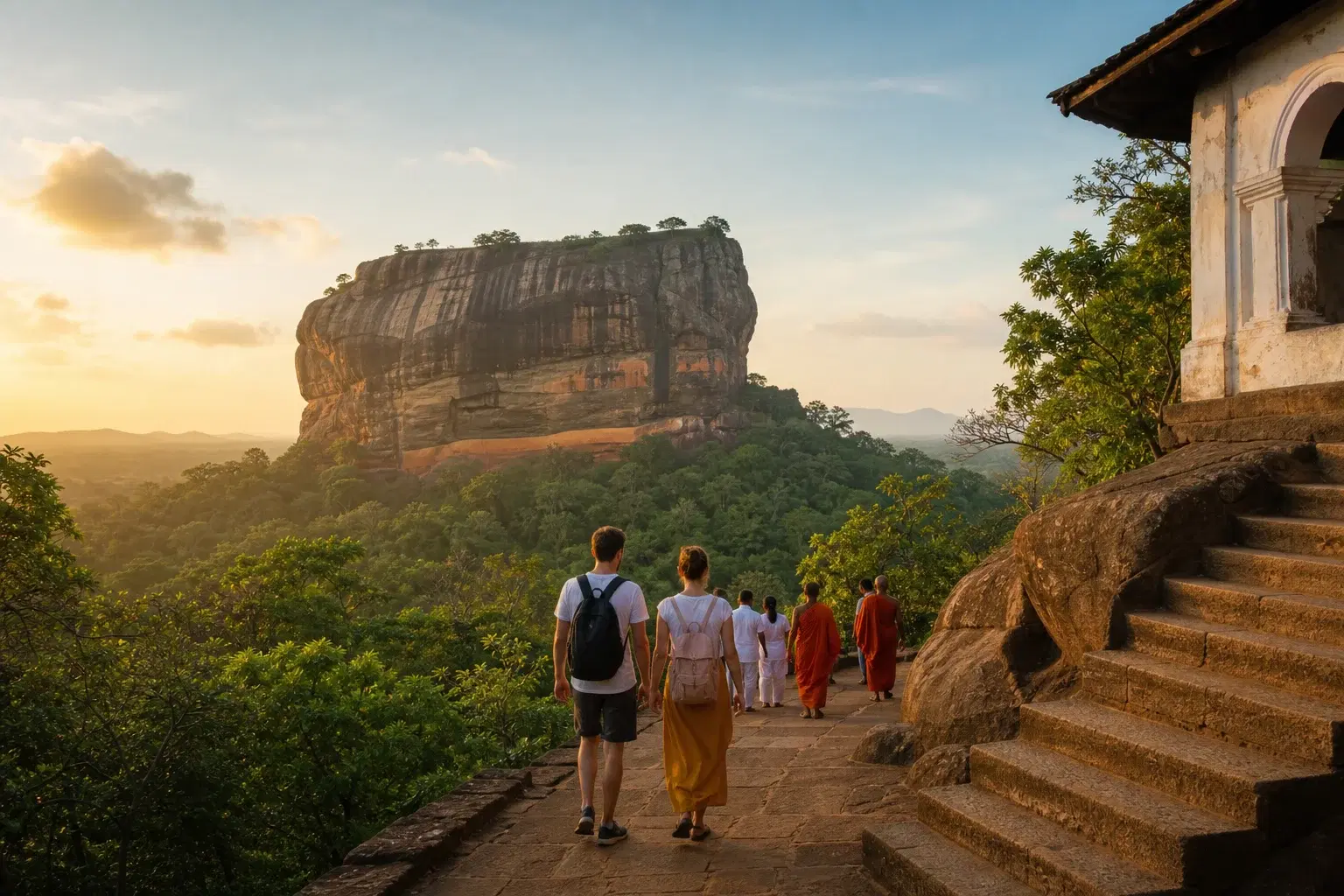
The route runs through the water gardens at the base, up through the boulder gardens, along a spiral staircase to the fresco gallery, past the mirror wall, up to the lion's paws terrace, and then up the final exposed staircases to the summit ruins.

Step counts are quoted everywhere and disagree with each other. You will see 1,200, 1,270 and various figures in between, and there is no authoritative published count that we could verify. The honest answer is around 1,200, and the number matters far less than the two things that actually determine difficulty: heat and exposure.

Fitness required is moderate. An averagely fit adult who is not in a hurry will manage it. There are landings and terraces to stop on throughout.

The final section from the lion's paws is metal staircases bolted to the rock face, open on one side. If you have a serious fear of heights, this is the part to think about honestly before paying USD 35. The lower two-thirds up to the lion's paws terrace is much less exposed and is a legitimate stopping point.

Allow two to three hours for an unhurried visit including the museum. Rushing it in ninety minutes is possible and misses the point.

The frescoes and the mirror wall are along a covered spiral staircase partway up. Photography rules are enforced at the fresco gallery; follow what the signage and the attendants say rather than what you have seen others do.

There are no drinks for sale on the rock itself. Carry water up with you.

Around 1,200 steps; published counts disagreeModerate fitness, plenty of stopping pointsFinal section is exposed metal staircasesLion's paws terrace is a reasonable turnaroundAllow two to three hours; carry your own water

Timing, Heat and the Hornets Nobody Warns You About

The single biggest determinant of whether you enjoy Sigiriya is what time you start.

The rock is exposed granite in a dry-zone climate. From late morning it radiates heat and there is almost no shade above the boulder gardens. Climbing at midday in March is genuinely unpleasant and is where most of the negative reviews come from.

Arrive at opening, or start after about 3 pm. Both windows give you cooler rock, softer light and fewer people. The late afternoon slot has the added advantage that most tour groups have cleared.

The second thing worth knowing: Sigiriya has resident hornet colonies on the rock face, and the site has been closed at short notice in the past when they have been disturbed. You will see wire-mesh shelters along the staircases for exactly this reason. If attendants tell you to stay quiet in a particular section, that is why. Do not shout, do not clap, do not play music.

Monkeys are present throughout and will take food and loose items. Keep bags closed and do not eat on the way up.

Weather closes the summit occasionally in high wind or storm. There is no refund for this.

Bring: water, a hat, sun protection, and shoes with grip. Skip: flip-flops, drones without written permission, and anything you would mind a monkey taking.

Go at opening or after 3 pmAlmost no shade above the boulder gardensResident hornets: stay quiet where instructedMonkeys take food and loose itemsNo refund if the summit closes for weather

Pidurangala: The Honest Comparison

Pidurangala is the rock about a kilometre north of Sigiriya, and the internet has decided it is the budget-savvy traveller's clever alternative. That is half right.

It is administered by the monastery at its base and costs a small rupee amount, in the order of LKR 1,000. Reported figures vary between roughly LKR 500 and LKR 1,000 depending on when the source was written, and we have not been able to verify a current published figure from the temple itself. Carry LKR 2,000 in cash and you will be fine.

The climb is shorter, around 30 to 40 minutes, and rougher. It runs up through the temple grounds, past a large reclining Buddha, and finishes with a genuine scramble over boulders where there are no steps. It is not harder in a cardiovascular sense; it is harder in a scrambling sense, and it is a poor choice in the wet or in the dark without a torch.

It is a temple site. Shoulders and knees covered, shoes off in the temple area.

Now the honest part. Pidurangala gives you the view of Sigiriya. Sigiriya gives you the view from Sigiriya, plus the water gardens, the frescoes, the mirror wall and the summit ruins. These are different products. If your interest is a photograph of the Lion Rock rising out of the plain, Pidurangala is not a cheaper version of Sigiriya, it is a better option, and it costs almost nothing. If your interest is the fifth-century site itself, Pidurangala substitutes for nothing.

The move that actually works: Pidurangala at sunrise, then Sigiriya from mid-morning or the following afternoon. You get both views and you have not saved any money, which is the correct outcome.

The move that does not work: skipping Sigiriya entirely because a blog said Pidurangala was 'just as good'. It is not the same thing and the person who told you that was optimising for a headline.

Temple-administered, small rupee fee30 to 40 minutes, ending in a boulder scrambleModest dress; it is an active temple siteGives you the view of Sigiriya, not from itBest done as well as Sigiriya, not instead

Dambulla Cave Temple: The One That Surprises People

Dambulla is a complex of five painted caves cut into an overhanging rock, containing well over a hundred Buddha images and ceilings covered continuously with murals that follow the contours of the stone.

It is a UNESCO World Heritage site and a working temple. It is also, for a lot of visitors, the more affecting of the two Dambulla-area sites, and it is consistently the one people say they had not expected to like as much as they did.

Pricing: it is set by the temple, in rupees, and is generally reported around LKR 3,000 for a foreign visitor. It is not covered by any Central Cultural Fund ticket. The Central Cultural Fund lists a 'Dambulla (Museum)' entry at USD 3, which is the museum at the base of the hill and not the caves.

There is a climb: a stepped path of roughly 15 to 20 minutes up to the cave terrace, in the open. Same advice as Sigiriya on timing.

Dress code is enforced. Shoulders and knees covered for everyone. Shoes come off before the cave terrace, and the stone gets hot in the middle of the day, which is a real consideration if you are barefoot. Socks help.

Do not turn your back on a Buddha image for a photograph. This is treated as genuinely disrespectful and has caused incidents involving visitors in Sri Lanka. Stand beside or in front, facing the same direction.

Monkeys at the base are numerous and confident.

Late afternoon light through the cave mouths is the best of the day.

Five caves, over a hundred Buddha imagesTemple-priced in rupees, around LKR 3,000Not covered by any Central Cultural Fund ticket15 to 20 minute climb, shoes off at the terraceNever pose with your back to a Buddha image

Building a Day That Is Not Exhausting

The standard tour itinerary does Sigiriya and Dambulla in one day, and it is the reason so many people describe the Cultural Triangle as gruelling. Two exposed climbs in the same day in dry-zone heat is a lot.

It is entirely doable if you sequence it properly. The mistake is doing both in the middle of the day.

The version that works: Sigiriya from opening at 7 am, finish by 10, rest through the heat, Dambulla from about 3.30 pm. Both climbs in cool light, no midday exposure.

The version that also works, if you have two mornings: Pidurangala at sunrise on day one and Dambulla in the afternoon, Sigiriya at opening on day two.

The version that does not work: arriving at Sigiriya at 11 am after a three-hour drive from Colombo, then Dambulla at 2 pm.

Base yourself in the Sigiriya, Dambulla or Habarana area rather than driving out from Kandy or Colombo. The sites are twenty minutes apart. The drive from Colombo is not.

If you can add a third element, Minneriya sits ten minutes from Habarana and its elephant gathering peaks in the August to September window. An afternoon there rather than a second climb is a considerably better use of a day.

Polonnaruwa deserves its own day and is best done by bicycle, which is genuinely one of the better half-days in Sri Lanka.

Do not do two climbs in the middle of the daySigiriya at 7 am, Dambulla at 3.30 pmBase in Sigiriya, Dambulla or HabaranaMinneriya beats a second climb as an afternoonPolonnaruwa needs its own day, ideally by bicycle

Is Sigiriya Worth USD 35?

It is a fair question and it deserves a straight answer rather than an evasion.

USD 35 is a lot of money in Sri Lankan terms. It is roughly what a night in a decent guesthouse costs. A local visitor pays a nominal rupee amount for the same site. That gap is real and it is worth understanding rather than resenting: differential pricing at heritage sites is how a middle-income country funds conservation of sites its own citizens could not otherwise afford to maintain, and Sri Lanka is far from unusual in doing it.

On the value question: Sigiriya is a fifth-century royal citadel with a hydraulic garden system that still functions, frescoes that survive on an exposed rock face, and a summit palace complex. It is not a viewpoint with a staircase. Understanding that changes the experience substantially, which is the argument for spending twenty minutes in the museum before you climb rather than treating it as a queue.

Our view: yes, once. It is the most significant single site in the country and it earns the price. What it does not earn is being done badly, at midday, in ninety minutes, alongside a second climb.

If your budget is genuinely tight, the ranking we would give is: Dambulla first on value per rupee, Pidurangala second, Sigiriya third on pure value and first on significance.

And if you are travelling as a family, note that under-6s are free and 6 to 12s pay half at Central Cultural Fund sites, which changes the arithmetic considerably.

USD 35 is roughly a guesthouse night in local termsDifferential pricing funds conservationSigiriya is a citadel, not a viewpointWorth it once, done properlyBest value order: Dambulla, Pidurangala, Sigiriya

Visiting Respectfully

Two of the three sites here are active places of worship, and one is a national symbol. A few things are not optional.

Cover shoulders and knees at Dambulla and Pidurangala. This is enforced and being turned away after a climb is nobody's idea of a good morning. Carry a sarong or scarf; they are sold everywhere and weigh nothing.

Remove shoes and hats where indicated. Socks are permitted and are a good idea on hot stone.

Never pose with your back to a Buddha image, and do not climb on statues or stupas for photographs. Visitors have been arrested in Sri Lanka over exactly this.

Buddha tattoos are a genuine legal risk in Sri Lanka and people have been refused entry to the country over them. If you have one, cover it.

Drones require written permission and are prohibited at these sites without it. Flying one because nobody stopped you is not permission.

Do not give money or sweets to children selling things at the entrances. It sustains the practice and keeps children out of school. Buy from adults running stalls instead.

At Sigiriya, stay on the marked route. The site is a fragile archaeological monument, not a rock to explore.

Shoulders and knees covered at temple sitesShoes off where indicated; socks help on hot stoneNever turn your back to a Buddha image for a photoCover Buddha tattoos; this is a real legal riskDrones need written permission

Travel Tips

  • Check the Central Cultural Fund's live price page before budgeting; it carries a timestamp and the day's exchange rate
  • Sigiriya is USD 35 full and USD 20 half; ignore articles still quoting USD 30
  • The Sigiriya ticket includes the museum, so do not buy that separately
  • Dambulla Cave Temple is priced by the temple in rupees and is not on any CCF ticket
  • Carry cash rupees for Dambulla and Pidurangala
  • SAARC nationals must show a matching passport for the half rate
  • Under 6 is free and 6 to 12 is half at CCF sites
  • E-tickets are collected at the site counter with the order receipt number
  • Tickets are single entry; do not leave and expect to return
  • Climb at opening or after 3 pm, never at midday
  • Carry water up Sigiriya; nothing is sold on the rock
  • Stay quiet where attendants indicate, because of resident hornets
  • Carry a sarong for the temple dress code at Dambulla and Pidurangala
  • Never photograph yourself with your back to a Buddha image
  • Cover any Buddha tattoo; it is a genuine legal risk in Sri Lanka

Frequently Asked Questions

How much is the Sigiriya entrance fee in 2026?

USD 35 for a non-SAARC foreign adult and USD 20 on the half ticket, according to the Central Cultural Fund's own live price page checked on 2 September 2026. At the exchange rate shown that day, 333 LKR per USD, that came to LKR 11,655 and LKR 6,660. The half ticket covers SAARC nationals and children aged 6 to 12. Children under 6 enter free.

Why do so many sites say Sigiriya costs USD 30?

Because that was the price at an earlier point and most articles are never updated. The Central Cultural Fund publishes current figures with a timestamp, and it currently shows USD 35. Treat any unsourced price in a travel article as a snapshot of when it was written.

Does the Sigiriya ticket include Dambulla Cave Temple?

No. Dambulla Cave Temple is administered by the temple, not by the Central Cultural Fund, and is priced separately in rupees, generally reported around LKR 3,000. The Central Cultural Fund lists a 'Dambulla (Museum)' entry at USD 3, which is the museum at the base of the hill, not the caves. There is no combined ticket.

How much is Pidurangala?

It is administered by the monastery at its base and costs a small rupee amount, in the order of LKR 1,000. Reported figures range from roughly LKR 500 to LKR 1,000 depending on the age of the source, and we could not verify a current published figure from the temple. Bring LKR 2,000 in cash and you will be covered.

Is Pidurangala better than Sigiriya?

They are different things. Pidurangala gives you the view of Sigiriya, which is the photograph most people actually want, for a fraction of the price. Sigiriya gives you the view from the summit plus the water gardens, frescoes, mirror wall and citadel ruins. Pidurangala is a better sunrise; it is not a substitute for the site itself. The strongest plan is both.

How many steps are there at Sigiriya?

Published figures disagree, commonly between about 1,200 and 1,270, and we could not verify an authoritative count. Around 1,200 is the honest answer. The number matters less than the heat and the exposure of the final staircases.

How hard is the Sigiriya climb?

Moderate. An averagely fit adult managing their pace will be fine, and there are landings throughout. The consideration is not fitness but the final section above the lion's paws terrace, which is open metal staircase bolted to the rock face. Anyone with a serious fear of heights should think about that before paying. The lion's paws terrace is a reasonable place to stop.

What time should I climb Sigiriya?

At opening, or after about 3 pm. The rock is exposed granite with almost no shade above the boulder gardens and it becomes genuinely unpleasant from late morning. Most negative accounts of Sigiriya are accounts of climbing it at midday.

Can I do Sigiriya and Dambulla in the same day?

Yes, if you sequence it around the heat. Sigiriya from opening, a long rest through the middle of the day, Dambulla from about 3.30 pm. They are only twenty minutes apart. Doing both between 11 am and 3 pm is what makes people describe the Cultural Triangle as exhausting.

What is the dress code?

Sigiriya has no religious dress code, though sun protection is sensible. Dambulla and Pidurangala are active temple sites: shoulders and knees covered for everyone, shoes and hats removed where indicated. Carry a sarong or scarf. Socks are useful because the stone gets hot.

Can I fly a drone at Sigiriya?

Not without written permission. Drones are prohibited at these sites otherwise, and the absence of someone stopping you is not authorisation.

Are the tickets refundable?

No. Central Cultural Fund tickets are non-refundable after payment and are valid for single entry on the relevant day. If the summit closes for weather after you have entered, there is no refund.

Is Sigiriya suitable for children?

Older children usually enjoy it. Under 6s enter free and 6 to 12s pay the half ticket. The consideration is the exposed upper staircases and the heat rather than the distance. Pidurangala's boulder scramble is less suitable for small children than Sigiriya's staircases, despite being shorter.

Reader notes

Join the conversation

Share your question, tip, or travel experience for this guide.

Comments

0 comments

Loading...

Ready to turn inspiration into a Sri Lanka trip?

Use LankaTrip to plan your journey, connect with local guides, and make this itinerary a reality.

Need help planning?

Plan your Sri Lanka adventure

Plan my trip