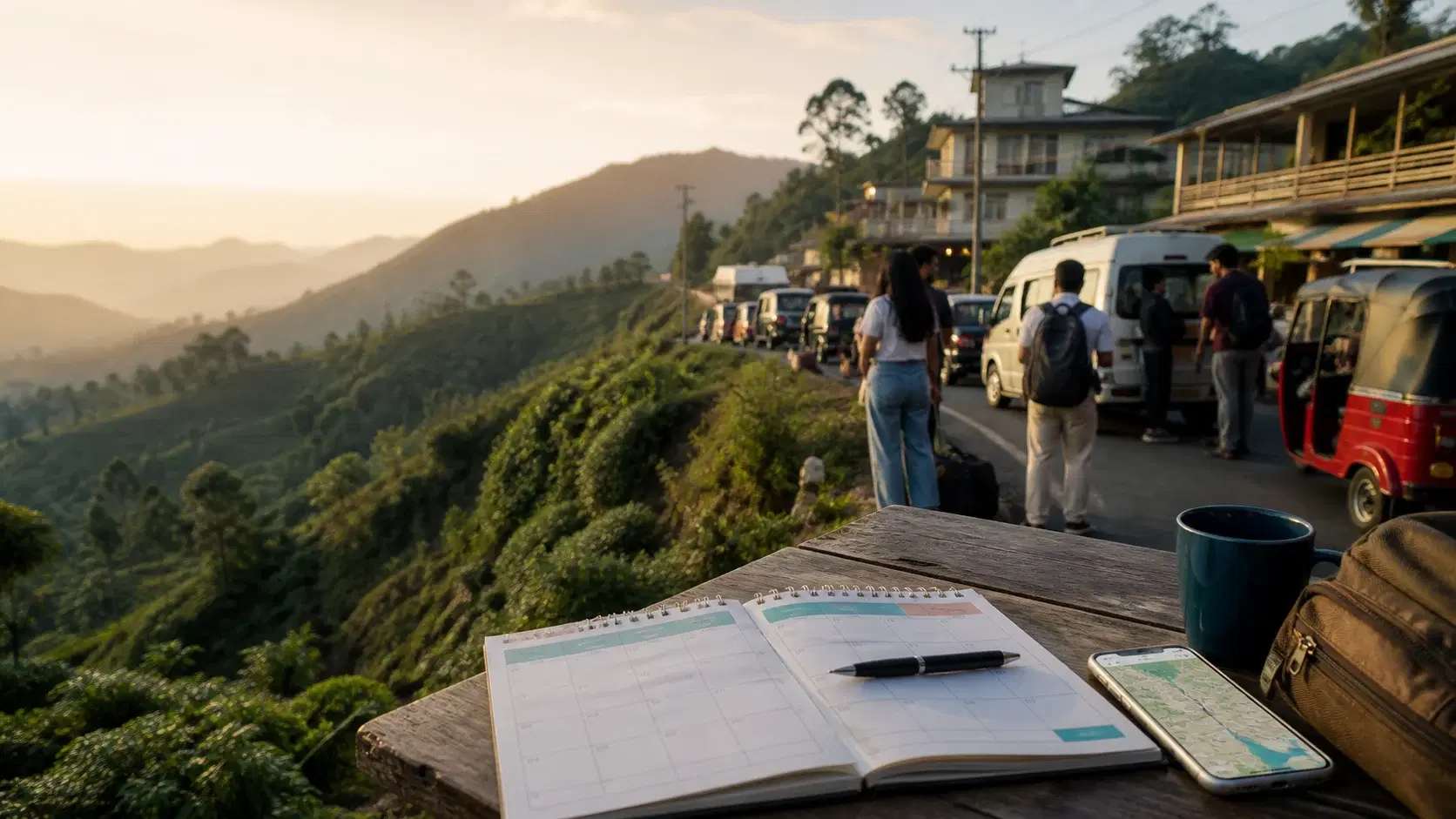
There is a particular kind of confusion that hits foreign visitors in Sri Lanka roughly twice a trip. A guesthouse that was quiet on Thursday is full on Saturday at double the rate. The road to Ella is stationary. Every reserved train seat is gone. The viewpoint that looked serene in the photograph has three hundred people on it.
The explanation is almost always the same, and it is almost never in the guidebook. It was a long weekend.
Sri Lanka has one of the highest public holiday counts in the world, at around 25 gazetted days a year. Every full moon is a national holiday, which adds twelve or thirteen dates on its own, distributed through the calendar according to a lunar cycle that has no relationship to the Gregorian months foreign visitors plan around.
Twenty-two million people share those days off. When one lands adjacent to a weekend, a very large number of them travel, and they travel to a small and predictable set of places. Those places are, with almost no exceptions, the same places foreign visitors go.
Most travel writing about Sri Lanka treats seasonality as a weather question. Monsoon here, dry season there, best months for the south coast. That is real and it matters, but it is only half the picture. A perfect-weather Saturday in April will give you a worse experience at Nuwara Eliya than a drizzly Tuesday in July.
This guide does something we have not found done anywhere else. It takes the gazetted holiday calendar, works out where the actual long weekend clusters fall through the rest of 2026 and all of 2027, and maps each one to the destinations it specifically affects. It also covers the practical consequences that catch people out, including the nationwide alcohol restriction that surprises more visitors than anything else on this list.
Quick Summary
- Sri Lanka observes around 25 public holidays a year and every full moon Poya is one of them
- The heaviest remaining 2026 window is Wednesday 23 to Sunday 27 December, a five-day cluster combining Unduvap Poya and Christmas
- That December cluster collides with the international peak season and the opening of the Adam's Peak pilgrimage season on the same day
- In 2027 the Sinhala and Tamil New Year falls on Tuesday 13 and Wednesday 14 April, the most disruptive possible weekday placement
- May 2027 contains a potential nine-day stretch from Saturday 15 to Sunday 23 May around Id-Ul-Alha and Vesak
- Vesak Poya 2027 is gazetted for Wednesday 19 May, correcting the 20 May figure circulating in unofficial calendars
- Alcohol sales are prohibited nationwide on Poya days, and also on Independence Day, New Year Day and Christmas Day
- Poson Poya sends enormous numbers to Anuradhapura and Mihintale specifically, not evenly across the island
- Ella, Nuwara Eliya, Sigiriya, Kandy and the south coast absorb the bulk of long-weekend domestic travel
- Long weekends are not simply to be avoided, since several are the most extraordinary occasions in the Sri Lankan year