
LankaTrip Insights

33 min read

Sri Lankan Street Food in 2026 and 2027: What to Eat, When It Is Actually Sold, and How to Eat It Safely

Most Sri Lankan food guides list dishes. Almost none tell you that kottu is not sold at lunchtime, that a certificate on the wall grades the kitchen A to D, or that pol sambol frequently contains dried fish. This guide covers the timing, the prices, the safety system and the calendar that decides what you can actually order.

Back to blog
Sri Lankan Street Food in 2026 and 2027: What to Eat, When It Is Actually Sold, and How to Eat It Safely

There is no shortage of articles listing Sri Lankan dishes. Type 'Sri Lankan street food' into a search bar and you will get kottu, hoppers, string hoppers, isso wade and a photograph of someone chopping roti on a griddle, repeated across a hundred near-identical pages.

What almost none of them tell you is the part that actually determines whether you eat well: the timing. Sri Lankan street food is not available all day. It is sold on a rhythm that locals internalise as children and that visitors discover by arriving at a stall at three in the afternoon and being told, politely, that there is nothing.

This guide is organised around that rhythm. It covers what each dish is, the hours it is genuinely sold, what it costs in rupees in 2026, and how to order it at the spice level you can actually tolerate.

It also covers three things that other guides skip. First, the food safety system: Sri Lanka has a national grading scheme for food premises, and knowing what the certificate on the wall means is more useful than any crowd-sourced rating. Second, the hidden ingredients that catch vegetarians, vegans and people with fish allergies. Third, the calendar, because Poya days, Ramadan and the April new year each change what is on offer.

We name no restaurants, no stalls and no chains anywhere in this article. Recommendations of that kind go stale within months and tend to funnel visitors towards whoever paid for the listing. What we give you instead are the criteria to judge a place yourself in the thirty seconds you spend standing in front of it.

Quick Summary

  • Sri Lankan street food runs on a clock: hoppers appear at breakfast and again after about 6 pm, kottu is an evening dish, rice packets sell out by early afternoon, and short eats are the only thing reliably available in the mid-afternoon gap
  • The word 'hotel' on a signboard usually means a small restaurant, not accommodation
  • Public Health Inspectors grade food premises A to D using the Health 800 form; an A or B certificate is often displayed near the counter and is more informative than any review site
  • Prices rose in April 2026 when the restaurant owners' association added Rs. 20 to kottu, fried rice and rice packets, and cut Rs. 10 off short eats
  • Small local eateries generally sit below the LKR 60 million VAT threshold, so the price on the board is the price you pay. Tourist-facing restaurants usually add 18% VAT and often a 10% service charge
  • Pol sambol, seeni sambol and many 'vegetable' curries commonly contain Maldive fish. Vegetarians and vegans must ask specifically
  • Alcohol sales are prohibited nationwide on Poya days. Meat availability drops on Poya too, though the legal basis for that is far less clear than most travel sites suggest
  • Ramadan is expected to run from around 8 February to 9 or 10 March 2027, which transforms evening street food in Muslim-majority neighbourhoods

First, the Vocabulary That Confuses Everyone

Before anything else, learn four words, because getting them wrong is the single most common reason visitors walk past good food.

A kade (Sinhala, pronounced roughly 'ka-day') is a small shop. A bath kade is a rice shop, the everyday lunch place where a plate of rice and curry costs less than a bottle of imported water. These are open-fronted, brightly lit, tiled, and usually have a glass counter at the front.

A 'hotel' on a Sri Lankan signboard almost never means accommodation. It means an eatery. A board reading 'New Star Hotel and Bakery' is a restaurant with a bakery counter. Visitors regularly walk past these looking for somewhere to eat.

A boutique, in older usage, is also a small general shop rather than a fashion store. And a 'bakery' sells far more than bread: it is the primary retail channel for short eats, the savoury pastries that fill the afternoon gap between lunch and dinner.

One more piece of practical vocabulary: 'parcel' or 'packet' means takeaway. If you ask for a rice packet, you will get a lunch wrapped in paper, historically in a banana leaf inside newspaper, now more often paper or plastic. Saying 'to sit and eat' or simply pointing at a table gets you a plate instead.

Kade means small shopBath kade means rice shop'Hotel' usually means restaurantBakery means short eats, not just bread'Parcel' means takeaway

The Sri Lankan Food Clock: When Each Dish Is Actually Sold

This is the section that will change your trip more than any dish list.

Roughly 6 am to 9.30 am is the breakfast window. Hoppers, string hoppers, pol roti, pittu, milk rice on special days, and plain tea. Bakeries put out their first tray of short eats late in this window.

Roughly 11 am to 2 pm is the rice window. Bath kades cook a fixed quantity of rice and curry for the day and sell it until it is gone. Arriving at 1.30 pm often means the good curries have been picked over. Arriving at 2.30 pm often means the shutters are half down.

Roughly 2 pm to 5.30 pm is the gap, and it is the single biggest planning trap for visitors, especially those arriving from a long drive or a train. In this window, most kades are cleaning down and most kottu griddles are cold. What is reliably available is bakery short eats, tea, fruit, king coconut and packaged snacks. Plan a proper lunch before 1 pm or accept a short eats afternoon.

From roughly 6 pm onwards the evening trade starts, and this is when Sri Lankan street food is at its best. Kottu griddles fire up. Hopper pans come back out. Fried rice, noodles and devilled dishes appear. In larger towns this runs until 10 or 11 pm, and in parts of Colombo considerably later.

The single most useful rule to memorise: kottu is an evening food. It is made from the day's roti, so it does not exist in a meaningful form at lunchtime. A place serving kottu at noon is either a tourist-facing restaurant or is reheating something. Neither is what you came for.

Breakfast: roughly 6 to 9.30 amRice and curry: roughly 11 am to 2 pmThe 2 to 5.30 pm gap: short eats and tea onlyEvening trade: from about 6 pmKottu is an evening dish, not a lunch dish

Kottu Roti: What It Is and How to Order It

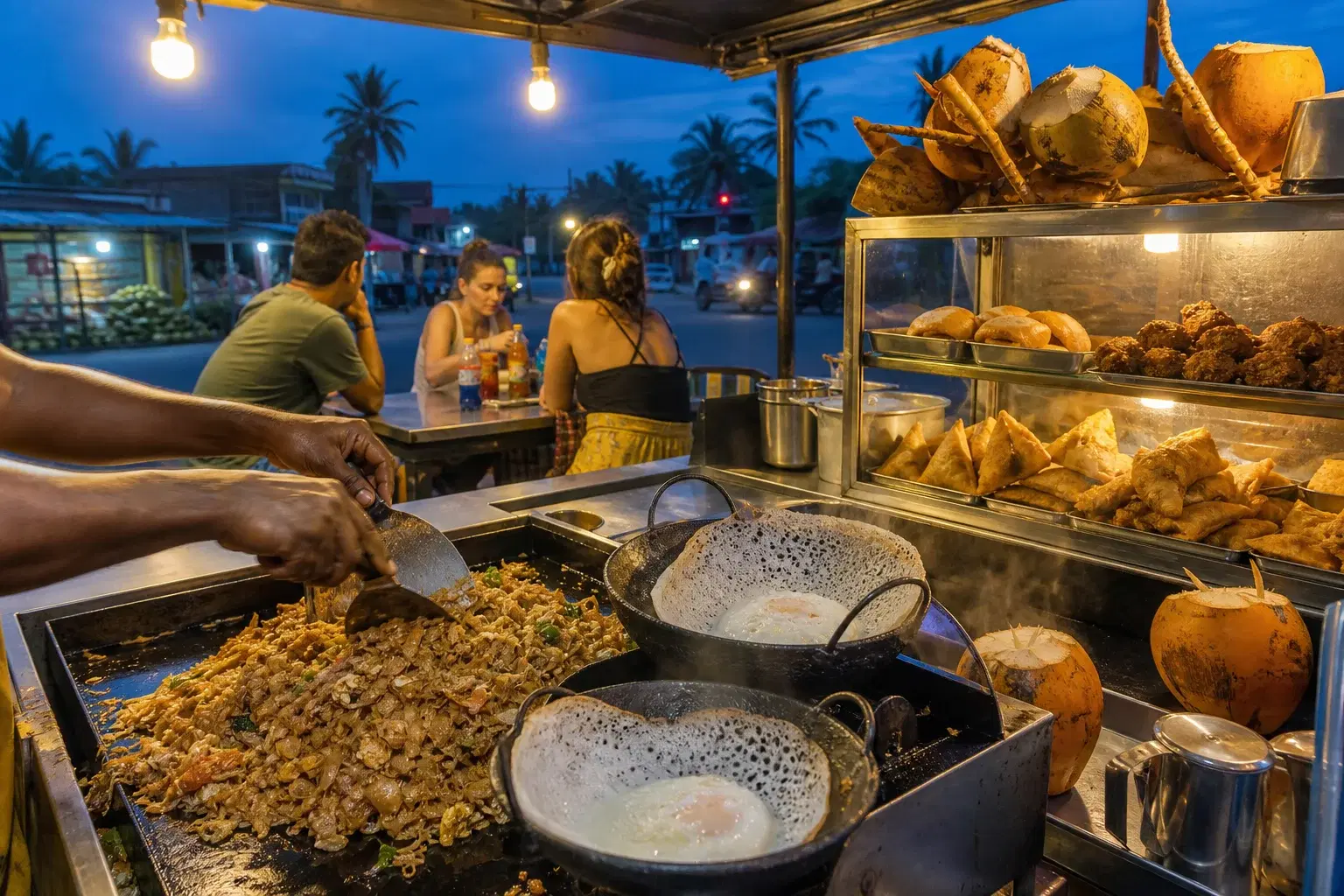
Kottu is the dish Sri Lanka is best known for abroad, and it deserves the reputation. Godamba roti, a thin elastic flatbread, is chopped on a hot flat steel griddle with two blunt blades, then combined with vegetables, egg, curry gravy and whatever protein you have ordered.

The chopping is not showmanship for tourists. It is how the dish is made. The rhythm carries a long way down a street, and following the sound is a legitimate way to find a stall after dark.

The common orders are vegetable, egg, chicken, beef, mutton and seafood. Cheese kottu, made with processed cheese, is genuinely popular locally and is not a tourist invention, though it is heavier than it sounds. Two variants worth seeking out are string hopper kottu, called indi appa kottu, where string hoppers replace the roti and the result is lighter and more fragrant, and dolphin or 'kiri' kottu, a milk-enriched version found in some areas.

What separates good kottu from bad is the curry gravy. A serious kitchen chops in a properly cooked, long-simmered curry sauce. A lazy one stirs curry powder into oil. You can usually tell before ordering by looking at whether there are pots of actual curry beside the griddle.

Portions are large. A single order is generally enough for one hungry adult and is often enough for two people who have already eaten short eats. Order one and add to it rather than ordering two and wasting one.

Kottu contains wheat flour roti, so it is not gluten free in any version. Vegetable kottu is usually cooked on the same griddle as meat kottu with the same blades, which matters for strict vegetarians and is covered further below.

Chopped godamba roti with gravy, egg and proteinEvening dish, best after 6 pmCurry gravy quality is the differentiatorString hopper kottu is the lighter alternativePortions are large; order one and share

Hoppers, String Hoppers and Pittu

Hoppers, appa in Sinhala and appam in Tamil, are bowl-shaped pancakes of fermented rice flour and coconut milk, cooked in a small curved pan so the centre stays soft and the rim goes lacy and crisp. They are a breakfast and dinner food and are almost never sold in the middle of the day.

The plain hopper is eaten with lunu miris, a fierce onion and chilli relish, or with dhal. The egg hopper has an egg cracked into the centre partway through cooking and is the version most visitors fall for. Milk hopper, kiri appa, has thick coconut milk poured in and is closer to a dessert. Honey hoppers, sweetened with treacle, appear in some areas.

String hoppers, indi appa or idiyappam, are entirely different: steamed nests of pressed rice-flour noodles, sold by the piece and eaten in groups of ten or fifteen with dhal curry, coconut sambol and a thin coconut gravy called kiri hodi. They are the most reliably vegetarian-friendly staple on the island, though the accompaniments may not be.

Pittu is steamed cylinders of coarse rice flour layered with grated coconut, traditionally pressed in a bamboo tube. Dense, mild and excellent with fish curry or kiri hodi. It is more common in the north and east and in Muslim kitchens.

A practical ordering note: hoppers are made one at a time to order. A stall with three pans produces roughly three hoppers a minute. If there is a queue of ten people at 7 pm, that is a twenty minute wait, and it is usually worth it. Do not order hoppers if you have a train to catch in fifteen minutes.

Hoppers are breakfast and dinner onlyEgg hopper is the standard first orderString hoppers are sold by the piecePittu is dense, mild and steamedHoppers are cooked to order; allow waiting time

Short Eats: The Bakery Counter System Nobody Explains

Short eats are the fried and baked savoury snacks that fill Sri Lankan bakery counters, and they are the most useful category for a traveller because they are available when nothing else is.

The system catches people out. In many bakeries you take a small plate or tray, help yourself from the covered counter, eat at a table, and pay at the end based on what you took. Staff count the wrappers or ask what you had. It works on trust and it works fine. Do not stand waiting to be served when everyone else is helping themselves.

The core items: the Chinese roll, a crepe wrapped around spiced potato or fish, crumbed and fried; the cutlet, a deep-fried ball of fish or potato; the patty, a small crimped half-moon pastry; the vegetable roti, a triangular parcel of godamba roti filled with spiced potato; malu paan, a fish bun; and vadai, a savoury lentil fritter that is more common at bus stands and street carts than in bakeries.

Freshness is the whole game. Short eats are made in batches and sit in the counter until sold. A counter refilled at 4 pm is a very different proposition from the same counter at 8 pm. Go when the tray is being refilled, look for steam or visible oil sheen rather than a dry crust, and skip any counter where the items look pale, collapsed or have been under a fan all afternoon.

Short eats got slightly cheaper in April 2026, which is unusual. The restaurant owners' association reduced short eats prices by Rs. 10 on the back of lower coconut oil costs at the same time as raising kottu and rice packet prices.

Self-service counter; pay at the endRolls, cutlets, patties, vegetable roti, malu paanAvailable through the afternoon gapJudge by freshness of the tray, not the shop frontPrices fell by Rs. 10 in April 2026

Rice and Curry: The Packet and the Plate

Rice and curry is not a dish. It is a format: a mound of rice surrounded by anywhere from three to ten separate preparations, each cooked differently. Dhal, a green leaf, a root vegetable, a gourd, a coconut sambol, a fried chilli relish, a papadam, and a protein if you order one.

There are two ways to buy it. The rice packet is the takeaway version, assembled and wrapped, and it is what most working Sri Lankans eat at lunch. The plate is the sit-down version, and at many bath kades the vegetable curries and rice are refilled without extra charge until you stop eating. This is not advertised. If a member of staff comes past with a pot and gestures, that is a refill offer, and accepting it is normal.

Ordering: 'vegetable rice and curry' gets you the base. Adding chicken, fish or egg costs more. Saying 'fish' at a coastal kade generally gets you whatever came in that morning, which is usually the right answer.

Timing again matters. The curries are cooked once, in the morning. The first hour of service is when the range is widest. By 1.30 pm you may be choosing between three remaining dishes.

This is also the meal where eating with your hand makes the most sense, because mixing the curries into the rice by hand is genuinely how the dish is designed to be eaten. More on that below.

A format, not a single dishPacket means takeaway; plate means sit-downFree refills are common and unadvertisedWidest choice in the first hour of serviceDesigned to be mixed by hand

Street Snacks and Drinks Worth Ordering

Isso wade is the one most visitors know: a lentil-flour fritter topped with whole small prawns, sold from carts along seafronts and at busy junctions. It is best when fried in front of you and noticeably less good when it has been sitting on a stacked tray in the sun.

Achcharu is pickled fruit and vegetable, sharp with chilli, salt and vinegar, sold in bags and jars. Mango achcharu is the common version. It is an acquired taste and a very good one.

Kadala, boiled and tempered chickpeas with coconut and mustard seed, is sold in paper cones and is one of the cheapest and safest street snacks going, because it is boiled and served hot.

Manioc chips, jackfruit chips and murukku are the packaged end of the market and travel well on buses and trains.

For drinks: thambili, king coconut, is the orange-shelled coconut sold from roadside piles, opened with a machete in front of you. It is sterile until opened, which makes it the single safest cold drink in the country. Plain tea, served black and heavily sweetened unless you say otherwise, costs very little and is everywhere. Faluda, a rose-syrup, milk and basil-seed drink, is a Muslim-neighbourhood speciality and is enormously popular. Wood apple juice, divul, is thick, sour and unlike anything else you have had.

One honest note on juice stalls: fresh juice is excellent, but it is frequently made with ice and sometimes topped up with tap water. If you are being careful, order thambili, bottled drinks, or hot tea instead, and see our health guide for the full picture on water.

Isso wade: best fried to orderKadala: boiled, hot and low-riskThambili is the safest cold drinkFaluda and wood apple juice are worth tryingFresh juice often involves ice and tap water

What Changes Region by Region

Sri Lanka is small enough to drive across in a day and varied enough that its food changes noticeably every couple of hours.

Colombo has the widest range and the longest hours. Pettah, the market district, and the Galle Face seafront in the evening are the two places where street food is most visible to a visitor without local guidance. Muslim-run night eateries in the city serve until very late.

The south coast leans towards seafood, devilled preparations, and increasingly towards tourist-facing menus. In beach towns you will find two parallel food economies: the seafront restaurants with English menus and 18% VAT, and the kades a street inland at a third of the price. Walking one block inland is the single most effective money-saving move on the coast.

Jaffna and the north have a distinct cuisine with heavier use of tamarind, palmyra and crab. Odiyal kool, a thick seafood and palmyra-flour broth, is the signature dish and is genuinely hard to find elsewhere on the island. Northern curries are, as a general rule, hotter.

The east coast around Batticaloa and Trincomalee has strong Muslim and Tamil food traditions, excellent fish, and its own repertoire of rice-flour breakfasts.

The hill country is where you will find the most vegetable-forward food, along with the strongest tea culture. Note for 2026: the Rambukkana to Nanu Oya section of the main railway line remains closed following cyclone damage, so Kandy, Hatton, Kotagala, Talawakele and Watagoda are reached by road at present, with reopening expected around January 2027. The Nanu Oya to Ella and Badulla section is running normally. Practically, this means the famous platform food vendors on the upper main line are not part of the journey for now.

Colombo has the longest hours and widest rangeOn the coast, walk one block inlandJaffna cuisine is distinct and hotterHill country is the most vegetable-forwardUpper main line rail closure affects platform food until around January 2027

What It Actually Costs in 2026, and Why Every Price List Disagrees

If you compare five Sri Lanka food price guides you will find kottu quoted at anywhere from LKR 400 to LKR 1,800. None of them are necessarily lying. They are describing different markets and rarely saying which.

Here is the useful framing. There are three tiers, and the same dish crosses all three.

Tier one is the local kade and canteen. This is where the association-set prices apply. In April 2026 the All-Island Canteen and Restaurant Owners' Association raised the price of rice and curry packets, fried rice and kottu by Rs. 20 in response to a rise in domestic LP gas prices, while cutting short eats by Rs. 10 because coconut oil had become cheaper. Reports differ on whether the change took effect on 6 or 7 April 2026; we have not been able to reconcile the two, and the discrepancy makes no practical difference to a visitor. At this tier, expect a rice packet or a plain kottu in the low hundreds of rupees and short eats well under LKR 200 each.

Tier two is the town restaurant with a printed menu and table service. Prices are commonly two to three times tier one. This is where a 10% service charge starts appearing on bills.

Tier three is the tourist-facing restaurant in Colombo, Galle Fort, Ella, Mirissa or a hotel. Here the same kottu may cost five to ten times the kade price. This is not necessarily a rip-off — you are paying for seating, staff, licensing and tax — but it is a different product.

The tax point matters and is widely misreported. Sri Lanka's standard VAT rate is 18%, in force since 1 January 2024. Businesses must register for VAT once taxable supplies exceed LKR 60 million in twelve months or LKR 15 million in a quarter. The 2026 Budget proposed cutting that annual threshold to LKR 36 million, and several 2026 articles reported the cut as though it had happened. It did not: the VAT (Amendment) Act No. 14 of 2026, certified at the end of June and gazetted in early July 2026, kept the threshold at LKR 60 million. The practical consequence is that most genuine street food vendors and small kades remain outside the VAT system, so the price on the board is the price you pay.

At tourist restaurants, assume the menu price is not the final price. Add 18% VAT and, frequently, 10% service charge, and budget roughly 30% above the listed figure unless the menu explicitly says taxes are included. Where a service charge has already been applied, an additional tip is not expected. At street stalls and kades, no tip is expected at all.

We are deliberately not publishing a precise rupee table. Food prices in Sri Lanka have moved repeatedly with gas and cooking-oil costs, and a table published today would mislead you within a few months. Carry small notes, expect the local tier to be genuinely cheap, and check the board.

Three price tiers for the same dishApril 2026: kottu and rice packets up Rs. 20, short eats down Rs. 10VAT is 18%; the threshold stayed at LKR 60 million in 2026Most kades are outside VAT, so the board price is finalAt tourist restaurants budget about 30% above menu price

Eating Safely: The Grading Certificate Most Visitors Walk Past

The usual advice is 'eat where the locals eat' and 'go for high turnover'. Both are sound, but Sri Lanka gives you something more concrete.

Under the Food Act No. 26 of 1980 and the Food (Registration of Premises) Regulations of 2019, every food establishment in the country, from a small wayside restaurant to a star-class hotel, must be registered with the food authority for its area. Enforcement sits with Public Health Inspectors working under Medical Officers of Health.

Public Health Inspectors inspect and grade food-handling establishments using a standard assessment form known as the Health 800. The score converts to a letter grade: 75 to 100 percent is Grade A, described as good; 50 to 74 percent is Grade B, satisfactory; 25 to 49 percent is Grade C, unsatisfactory; and 0 to 24 percent is Grade D, very unsatisfactory. To be awarded an A or B, an establishment must also reach the corresponding minimum in each relevant section rather than simply averaging out.

In practice, establishments that score well often display the certificate near the counter or the door. It is frequently in Sinhala or Tamil, but the letter grade and the date are legible to anyone. A visible, recent A or B is a considerably better signal than a star rating written by strangers on the internet. The absence of a certificate is not proof of anything, since display practice varies, but its presence is a genuine positive.

Beyond the certificate, the practical checks are the ordinary ones. Prefer food cooked to order in front of you over food that has been sitting. Hot and freshly fried beats room temperature. Boiled and steamed items are lower risk than raw ones. Be cautious with pre-cut fruit that has been standing uncovered, and with ice and fresh juice if your stomach is not settled.

Give yourself a couple of days to adjust before eating the most heavily spiced things on offer. Chilli tolerance is real and it builds.

For water, ice, and the broader health picture including the dengue situation, see our dedicated health and safety guide, which covers those questions in much more depth than a food article should.

All food premises must be registered under the Food ActPHIs grade establishments A to D using the Health 800 formA is 75 to 100 percent; B is 50 to 74 percentLook for the certificate near the counterCooked-to-order beats food that has been standing

The Spice Problem, and How to Actually Ask for Less

Sri Lankan food is, on average, hotter than Indian food that visitors have encountered abroad, and considerably hotter than most Thai restaurant food outside Thailand. This surprises people.

Saying 'not spicy' in English rarely works, for two reasons. First, it is often heard as a polite preference rather than a requirement. Second, in most kades the curries were cooked hours ago in a single pot. There is no mild version to serve you. Nothing can be adjusted at the point of ordering.

The reliable techniques are structural rather than verbal. Order dishes that are mild by construction: string hoppers with kiri hodi, pittu, dhal curry, plain hoppers, kadala, most short eats, fried rice. Ask for chilli-heavy accompaniments on the side rather than on the plate, especially lunu miris and katta sambol, which are the two hottest things on a typical table. Eat curd with treacle or plain rice alongside to buffer. And take a very small taste of any sambol before committing a spoonful of it to your rice.

Where food is genuinely cooked to order, such as kottu, fried rice, noodles and devilled dishes, asking does work. The Sinhala phrase is 'sudu' for mild in some contexts, but the more reliably understood request is simply 'miris adui' (less chilli) or 'miris naha' (no chilli). In Tamil-speaking areas, 'milagai kammi' conveys less chilli. Saying it while gesturing a small amount with your fingers works better than either phrase alone.

Do not treat a very hot dish as a challenge to be won in front of the cook. It is not a test and nobody is scoring you.

Milk, curd or a sweet drink helps far more than water, which spreads capsaicin around rather than removing it.

Sri Lankan food is hotter than most visitors expect'Not spicy' fails on pre-cooked curriesOrder structurally mild dishes insteadAsk for sambols on the side'Miris adui' means less chilli in Sinhala

Vegetarians, Vegans and Allergies: The Ingredient Nobody Mentions

Sri Lanka is one of the easier countries in Asia to eat vegetarian in. A great deal of everyday food is plant-based by default, curries are built on coconut milk rather than dairy, and rice and curry can be ordered entirely vegetable.

There is one significant catch, and it is not obvious. Maldive fish, called umbalakada in Sinhala, is a hard cured and dried tuna that is pounded or shaved into flakes and used as a seasoning. It appears routinely in pol sambol (coconut sambol), katta sambol, lunu miris and seeni sambol, and it is not uncommon in dhal and vegetable curries. It is invisible once ground in. A dish that looks and is described as vegetarian may contain it.

This is not a fringe issue. It affects strict vegetarians, all vegans, anyone keeping kosher or halal in a strict sense, and critically anyone with a fish allergy. Ask specifically about umbalakada by name rather than asking whether something is vegetarian, because the two questions get different answers.

Other things to watch: ghee is used in some breads and rice dishes; dried sprats appear in many vegetable preparations; shrimp paste turns up occasionally; some string hoppers use egg as a binder; and 'pure vegetarian', which you will see on Tamil-run establishments, is a reliable label and generally means no meat, no fish and often no egg.

Coconut is in almost everything, in three or four different forms, which makes Sri Lanka a difficult destination for anyone with a coconut allergy. Cashew is common in curries. Peanut is less prevalent than in Southeast Asia but not absent.

For anyone with a serious allergy, the honest position is this: a written card in Sinhala and Tamil naming your specific allergens improves communication substantially, but it does not guarantee a kitchen can prevent cross-contact. Street griddles, in particular, are shared surfaces. Vegetable kottu is chopped with the same blades on the same griddle as chicken kottu, minutes apart. If your allergy is severe, a small kitchen cooking to order that you can watch is safer than a busy stall, and both are safer than a buffet.

None of this should put you off. It should simply change the question you ask from 'is this vegetarian' to 'does this have umbalakada or dried fish in it'.

Maldive fish (umbalakada) hides in sambols and curriesAsk about umbalakada by name, not about vegetarianism'Pure vegetarian' is a reliable labelCoconut is unavoidable; cashew is commonShared griddles make cross-contact real

How to Eat It: Hands, Sharing and Table Manners

Sri Lankans eat most meals with the right hand, and rice and curry in particular is designed for it. Mixing the curries into the rice by hand distributes the gravies in a way a fork cannot.

The technique: use the fingertips of the right hand, not the whole palm. Mix a small amount of rice with the curries in front of you, gather it into a compact ball, and push it into your mouth with the thumb. Food should not go past the second knuckle if you can help it. Nobody will grade you on this and no one minds a beginner making a mess of it.

The left hand stays off the food. It can hold a glass or a plate. Use the right hand for passing things and for handing over money.

Cutlery is available essentially everywhere and using it causes no offence whatsoever. A spoon is normal, and a spoon and fork together, with the fork used to push food onto the spoon, is the standard local arrangement in restaurants. Knives are rarely needed.

Wash your hands before and after; most eateries have a sink in view, and there is usually a bowl or a tap at the back. Using it is expected rather than optional.

Sharing is normal. A group ordering four different curries and passing them around is the standard way to eat. Ordering one dish each and not sharing reads as slightly odd but is perfectly acceptable.

One practical note: at a busy kade at lunchtime, tables are communal. Someone sitting down opposite you is not being rude and is not trying to talk to you.

Right hand only; fingertips, not palmLeft hand does not touch foodCutlery is available and causes no offenceSpoon and fork is the standard restaurant setupTables are communal at busy times

The Calendar That Changes the Menu

Three parts of the Sri Lankan calendar materially change what you can buy and eat, and none of them are obvious from a food article.

Poya days. Every full moon is a public holiday. The nationwide prohibition on alcohol sales on Poya is real and is enforced on licensed premises, so bars and liquor shops close and restaurants do not serve alcohol. What is far less clear, and what a great many travel sites state as flat fact, is that meat sales are banned by law. In practice, many butchers close, many Buddhists eat vegetarian, and local eateries in Buddhist-majority areas often run vegetarian-only or reduced menus on Poya. Whether that is a national legal prohibition or a combination of religious observance and local authority practice is something we could not verify from a primary source, and we are not going to assert it. What we can tell you reliably is the practical effect: on Poya, expect vegetarian food to be easy and meat to be harder to find away from tourist areas, and expect no alcohol anywhere. Our long weekends guide covers which dates these fall on.

Ramadan. Ramadan 1448 is expected to begin around 8 or 9 February 2027 and to end in the first half of March, with Id-Ul-Fitr expected around 9 to 11 March 2027. Sources genuinely disagree on the exact days, and the Sri Lankan public holiday calendar and international astronomical projections do not align perfectly. All Islamic dates depend on local moon sighting and are confirmed only shortly beforehand, so treat every date here as provisional. The practical effect for a food traveller is significant and positive: in Muslim-majority neighbourhoods, daytime eateries may be closed or quiet, and then at sunset the iftar trade produces some of the best street food of the year, including faluda, samosas, watalappan and dishes that appear only in this month. It is worth planning an evening around.

Sinhala and Tamil New Year, in mid-April. This is a food festival as much as a new year. Kavum (oil cakes), kokis (a crisp fried lattice), aluwa, mung kavum, and kiribath (milk rice) appear everywhere, including in homes that will offer them to visitors. Many businesses close for several days around 13 and 14 April, so plan around reduced restaurant availability. This is also one of the busiest domestic travel periods of the year.

Vesak, in May, brings dansal: free food stalls set up by volunteers and community groups, offering rice, drinks and sweets to anyone passing, at no charge. Accepting is entirely appropriate and is the point. Do not offer money.

Poya: no alcohol nationwide; meat harder to findThe 'meat ban' is widely overstated onlineRamadan 2027: roughly 8 February to early March, moon dependentIftar street food is exceptionalApril new year brings kavum, kokis and kiribath

Eating on Trains, Buses and at Bus Stands

Some of the best incidental food in Sri Lanka is eaten sitting down on a moving vehicle.

On long-distance trains, vendors work the aisles selling vadai, wade with chilli, achcharu, corn, peanuts, sweets and tea poured from a flask into a plastic cup. Prices are low and fixed. This is generally safe, fried-hot food, and it is one of the more enjoyable parts of a Sri Lankan train journey.

Major stations have platform vendors and small canteens. The classic move is buying a paper cone of something fried through the carriage window during a stop.

One current caveat. The Rambukkana to Nanu Oya section of the main line is closed following cyclone damage, with reopening expected around January 2027. Kandy, Hatton, Kotagala, Talawakele and Watagoda are currently reached by road. If you were planning the Kandy to Ella train specifically for the platform food and the vendors, that upper section is not running at present; the Nanu Oya to Ella and Badulla stretch operates normally.

Bus stands are reliable food hubs at any hour, with bakeries, tea stalls and vadai carts clustered around them. They are noisy, they are not scenic, and the food is often very good.

Practical advice for both: carry small denomination notes. Vendors on a moving train cannot change a LKR 5,000 note, and neither can most street stalls.

Train aisle vendors sell hot fried snacks cheaplyPlatform buying through the window is standardUpper main line closed until around January 2027Bus stands are reliable food hubsCarry small notes

Eating Street Food Responsibly

Street food vendors run small businesses on thin margins, often long hours, frequently as family operations. A few things make you a better customer.

Do not haggle over street food. Prices at kades and stalls are set and are already low. Bargaining over the equivalent of a few cents with someone working a fourteen-hour day is not sharp travelling, it is unkind. Bargaining is appropriate at craft markets and for tuk-tuk fares, not for food.

Ask before photographing people. A cook working a kottu griddle is doing a job, not performing. Most will happily agree, and many enjoy it. Filming someone without asking, particularly close up, is not acceptable simply because the setting is public. If you are filming for social media, ask, and show them the result.

Take the plastic seriously. Sri Lanka has a significant waste problem and street food generates a lot of packaging. Carry a reusable water bottle, decline bags you do not need, refuse the straw, and hold onto wrappers until you find an actual bin rather than adding to a roadside pile.

Buy where you eat. If you sit at a table, order from the establishment rather than eating something carried in.

Tipping: not expected at stalls or kades. At a table-service restaurant, check whether a 10% service charge has already been added before adding more.

Finally, be honest about what street food is. It is everyday working food that exists because it is fast, filling and affordable for the people who eat it daily, not because it is picturesque. Enjoying it fully and treating the people who make it as service providers rather than scenery are not in tension.

Do not haggle over food pricesAsk before photographing or filming vendorsRefuse unnecessary plasticNo tip expected at stallsEveryday working food, not a spectacle

Travel Tips

  • Learn the clock before the dish list: kottu after 6 pm, rice before 1 pm, short eats in the afternoon gap
  • A signboard reading 'hotel' usually means a restaurant, not accommodation
  • Look for the A or B food premises grading certificate near the counter
  • Order one kottu and share it before ordering a second; portions are large
  • Ask for sambols on the side rather than mixed in
  • Say 'miris adui' for less chilli where food is cooked to order
  • Ask about umbalakada by name if you avoid fish, rather than asking if a dish is vegetarian
  • Thambili (king coconut) is the safest cold drink on the street
  • Carry small notes; vendors cannot change large denominations
  • Assume tourist restaurant menu prices exclude 18% VAT and possibly 10% service charge
  • Check whether service charge is already on the bill before tipping again
  • Expect no alcohol anywhere on Poya days, and reduced meat availability
  • Give your stomach two or three days before attempting the hottest dishes
  • Do not haggle over food prices, and ask before filming vendors

Frequently Asked Questions

Is street food safe to eat in Sri Lanka?

For most travellers, yes, with sensible choices. Sri Lanka requires all food premises to be registered under the Food Act No. 26 of 1980, and Public Health Inspectors grade establishments from A to D using a standard inspection form. Establishments scoring well often display the certificate near the counter. Beyond that, prefer food cooked to order in front of you, favour hot fried, boiled and steamed items over things that have been standing, and be cautious with ice, fresh juice and pre-cut fruit in the first few days.

What is the most famous Sri Lankan street food?

Kottu roti. Godamba roti is chopped on a hot steel griddle with two blades and combined with vegetables, egg, curry gravy and a protein. The rhythmic chopping sound is how most people locate a stall after dark.

Why can I not find kottu at lunchtime?

Kottu is an evening dish. It is made from the day's roti and griddles generally fire up from around 5 or 6 pm. Anywhere serving it at midday is either a tourist-facing restaurant or is reheating. Lunchtime in Sri Lanka is rice and curry.

How much does street food cost in Sri Lanka in 2026?

It depends entirely on which of three tiers you are in. At a local kade a rice packet or plain kottu is in the low hundreds of rupees and short eats are well under LKR 200 each. A town restaurant is typically two to three times that. A tourist-facing restaurant can be five to ten times the kade price. In April 2026 the restaurant owners' association raised kottu, fried rice and rice packet prices by Rs. 20 and cut short eats by Rs. 10. We avoid publishing a precise price table because these figures move with gas and cooking oil costs.

Do I have to pay VAT and service charge on food in Sri Lanka?

At street stalls and small kades, generally no. VAT registration is mandatory only above LKR 60 million of taxable supplies in twelve months, a threshold retained by the VAT (Amendment) Act No. 14 of 2026 despite a budget proposal to lower it, so most small eateries sit outside the system and the board price is final. At tourist-facing restaurants, expect 18% VAT and often a 10% service charge on top of menu prices.

Is Sri Lankan street food very spicy?

Generally yes, hotter than most visitors expect. Saying 'not spicy' rarely helps for curries cooked hours earlier in a single pot. Instead, order structurally mild items such as string hoppers with kiri hodi, pittu, dhal, plain hoppers and kadala, ask for sambols on the side, and use 'miris adui' where food is cooked to order.

Can vegetarians and vegans eat Sri Lankan street food?

Yes, easily, with one important caution. Maldive fish, called umbalakada, is dried cured tuna used as a seasoning and it appears frequently in pol sambol, katta sambol, lunu miris, seeni sambol and some dhal and vegetable curries. It is invisible once ground in. Ask specifically about umbalakada and dried fish rather than asking whether a dish is vegetarian, as the two questions get different answers. 'Pure vegetarian' establishments are a reliable option.

What are short eats?

Short eats are the savoury snacks sold at bakery counters: Chinese rolls, cutlets, patties, vegetable roti, fish buns and similar. In many bakeries you take a plate, serve yourself from the counter, and pay at the end based on what you took. They are the most reliably available food during the mid-afternoon gap when kitchens are closed.

What can I eat in Sri Lanka between 2 pm and 5 pm?

Bakery short eats, tea, fresh fruit, king coconut and packaged snacks. Most rice shops close after lunch and kottu griddles do not start until evening. This afternoon gap catches out many visitors arriving after a long drive or train journey.

Does anything close on Poya days?

The sale of alcohol is prohibited nationwide on Poya days and bars and liquor shops close. Many butchers also close and many local eateries in Buddhist-majority areas run vegetarian or reduced menus. Travel sites often state that meat sales are legally banned; we could not verify that as a national legal prohibition from a primary source, so we describe the practical effect rather than asserting the law. Restaurants, shops, transport and tourist sites generally operate as normal otherwise.

Is street food available during Ramadan?

Yes, and it is exceptional in the evenings. Ramadan 1448 is expected to run from around 8 or 9 February to early March 2027, with Id-Ul-Fitr expected around 9 to 11 March 2027, though sources disagree and all Islamic dates are confirmed only by local moon sighting shortly beforehand. In Muslim-majority neighbourhoods daytime eateries may be quiet, and then the iftar trade at sunset produces faluda, samosas, watalappan and dishes found only in this month.

Should I eat with my hands?

You can, and rice and curry is designed for it, but you do not have to. Use the fingertips of the right hand only, and keep the left hand off the food. Cutlery is available everywhere and causes no offence; a spoon and fork together is the standard local restaurant arrangement.

Can I still take the Kandy to Ella train for the platform food?

Not the full route at present. The Rambukkana to Nanu Oya section of the main line is closed following cyclone damage, with reopening expected around January 2027, so Kandy, Hatton, Kotagala, Talawakele and Watagoda are reached by road. The Nanu Oya to Ella and Badulla section operates normally, and aisle and platform vendors are working on that stretch.

Do I tip at street food stalls?

No. Tipping is not expected at stalls, kades or bakeries; you simply pay the price. At table-service restaurants, check the bill first because a 10% service charge is often already added, in which case nothing further is expected.

Reader notes

Join the conversation

Share your question, tip, or travel experience for this guide.

Comments

0 comments

Loading...

Ready to turn inspiration into a Sri Lanka trip?

Use LankaTrip to plan your journey, connect with local guides, and make this itinerary a reality.

Need help planning?

Plan your Sri Lanka adventure

Plan my trip