
LankaTrip Insights

24 min read

Surfing Sri Lanka in 2026 and 2027: The Two-Season Calendar Nobody Explains Properly

Sri Lanka has waves twelve months a year, but only ever on one coast at a time, and the two coasts are eight to ten hours apart. Getting the timing wrong is the single most expensive mistake surf travellers make here. This is the honest month-by-month picture, including the shoulder weeks that suit nobody.

Back to blog
Surfing Sri Lanka in 2026 and 2027: The Two-Season Calendar Nobody Explains Properly

Sri Lanka is one of the few surf destinations on earth with no off-season, and that fact is repeated so often that it has become misleading.

It is true that somewhere on this island there are rideable waves in every month of the year. It is not true that you can turn up in any month and surf. The waves move. From roughly November to April they are on the south and southwest coasts. From roughly May to September they are on the east. Those two coastlines are separated by the entire central highlands, which is an eight to ten hour drive, and when one side is working the other is usually blown out, rained on, or flat.

This is the single thing that determines whether a Sri Lankan surf trip is excellent or wasted, and it is the thing most guides cover in one sentence before moving on to a list of surf camps.

So this guide does the opposite. It spends most of its length on timing, on what each month actually produces, on the transitional weeks that nobody wants to talk about, and on the honest difference between the breaks the marketing puts in front of beginners and the breaks beginners should actually be on.

We also want to say something that surf content rarely says. The reason Sri Lanka is such a good place to learn is Weligama Bay, and Weligama Bay is no longer quiet. The bay is large enough to absorb a lot of people, but the inside section on a good January morning now holds more soft-tops than anyone would call relaxing. That is not a reason to avoid it. It is a reason to know what you are walking into, and to know that there are alternatives twenty minutes away.

Everything below assumes you want an accurate picture rather than an encouraging one.

Quick Summary

  • Sri Lanka has surf every month, but only on one coast at a time
  • South and southwest coasts work roughly November to April, peaking December to March
  • The east coast around Arugam Bay works roughly May to September, peaking July and August
  • The two coasts are eight to ten hours apart by road, so a one-week trip means choosing one
  • April and October are transition months that can disappoint on both coasts
  • Weligama is the best place in Asia to learn, and is now genuinely crowded
  • Arugam Bay Main Point is not a beginner wave, whatever a booking page tells you
  • The south coast reef breaks carry real injury risk that soft marketing language hides
  • Water sits around 27 to 29 degrees year-round and no wetsuit is ever needed

Why the Waves Move: The Monsoon Mechanic

Sri Lanka sits in the path of two monsoons that arrive from opposite directions at opposite times of year, and the surf calendar is simply a consequence of that.

From roughly May to September the southwest monsoon blows onshore across the south and west coasts. It brings rain, onshore wind and messy, blown-out water to Weligama, Mirissa, Ahangama, Midigama and Hikkaduwa. At the same time the east coast sits in the lee of the highlands, receives offshore morning winds, and picks up clean southerly swell that wraps around the island's southeastern corner into Arugam Bay.

From roughly November to April the pattern reverses. The northeast monsoon works the east coast, Arugam Bay largely shuts down and much of the town closes, while the south coast gets offshore mornings and consistent swell.

Two things follow from this that matter enormously for planning.

First, the swell and the wind are being produced by different mechanisms. The south coast in January is not flat because there is no swell; it receives swell from distant Southern Ocean storms. What changes is whether the local wind lets that swell arrive clean. This is why an offshore morning and an onshore afternoon can feel like two different beaches on the same day.

Second, monsoon onset is not a date on a calendar. It varies by weeks from year to year. A season chart that says the east coast starts in April is describing an average, and averages have never surfed anything. If your trip falls inside two weeks of a season boundary, check a live forecast before booking flights rather than trusting any chart, including this one.

The practical consequence is simple. Surf in the morning. Nearly everywhere in Sri Lanka, the wind is at its cleanest in the hours after dawn and deteriorates through the day. Travellers who sleep in and paddle out at eleven often conclude the surf is poor when what they have actually found is the wind.

Two monsoons, two coasts, opposite timingWind quality matters more than swell size hereSeason boundaries move by weeks each yearDawn sessions are consistently the bestNever book flights on a chart alone

The Honest Month-by-Month Calendar

November: The south coast wakes up. Conditions can be inconsistent early in the month and improve steadily. Fewer people, cheaper accommodation, and a real chance of both very good and very average days. A gambler's month that often pays off.

December: South coast in season. Consistent, and busy over the Christmas and New Year period, when prices rise sharply and the better guesthouses fill weeks ahead.

January: Peak south coast. Among the most consistent months of the year, with the trade-off that Weligama and Ahangama are at their busiest. Book accommodation well ahead.

February: Widely regarded as the sweet spot on the south coast. Conditions comparable to January with slightly thinner crowds once the New Year traffic clears. If we had to name one month for a first Sri Lankan surf trip, it would be this one.

March: Still strong on the south, and quieter again. A good choice for travellers who want the season without the January density.

April: The awkward month. Both coasts are in transition and neither is reliable. The south is fading and the east has not properly arrived. April can produce good days on either side and can equally produce a fortnight of frustration. It also coincides with the Sinhala and Tamil New Year holiday, which makes domestic travel and accommodation harder island-wide. We would not plan a dedicated surf trip around April.

May: The east coast begins to work. Arugam Bay is opening up, businesses are reopening after the closed season, and the crowds have not arrived. Conditions are less consistent than midsummer but the value is excellent.

June: Reliable on the east. Frequently described as the last calm month before the peak, with good waves and manageable numbers in the water. A strong choice for intermediates who want Main Point without fighting for it.

July: Peak east coast. Main Point at its best, and at its most crowded. European and Israeli summer holidays converge here and the lineup reflects that.

August: The other peak month. The biggest and most powerful swells of the east coast season commonly land in the late July to early August window, and so do the largest crowds of the Sri Lankan surf year.

September: The east coast's other sweet spot. Still working, noticeably quieter than August, and often the best quality-to-crowd ratio available on that coast.

October: The second awkward month. The east is winding down, the south has not started. Similar caveats to April. Some travellers get lucky. Many do not.

The short version: February on the south, September on the east, and treat April and October as travel months rather than surf months.

February: best south coast month overallSeptember: best east coast month overallJuly and August: biggest waves, biggest crowdsApril and October: avoid for dedicated surf tripsNovember and May: value shoulder windows

The South Coast: Where Almost Everyone Starts

The south coast surf zone runs roughly from Hikkaduwa in the west to Dikwella and Hiriketiya in the east, a stretch of about seventy kilometres containing more variety than any other part of the island.

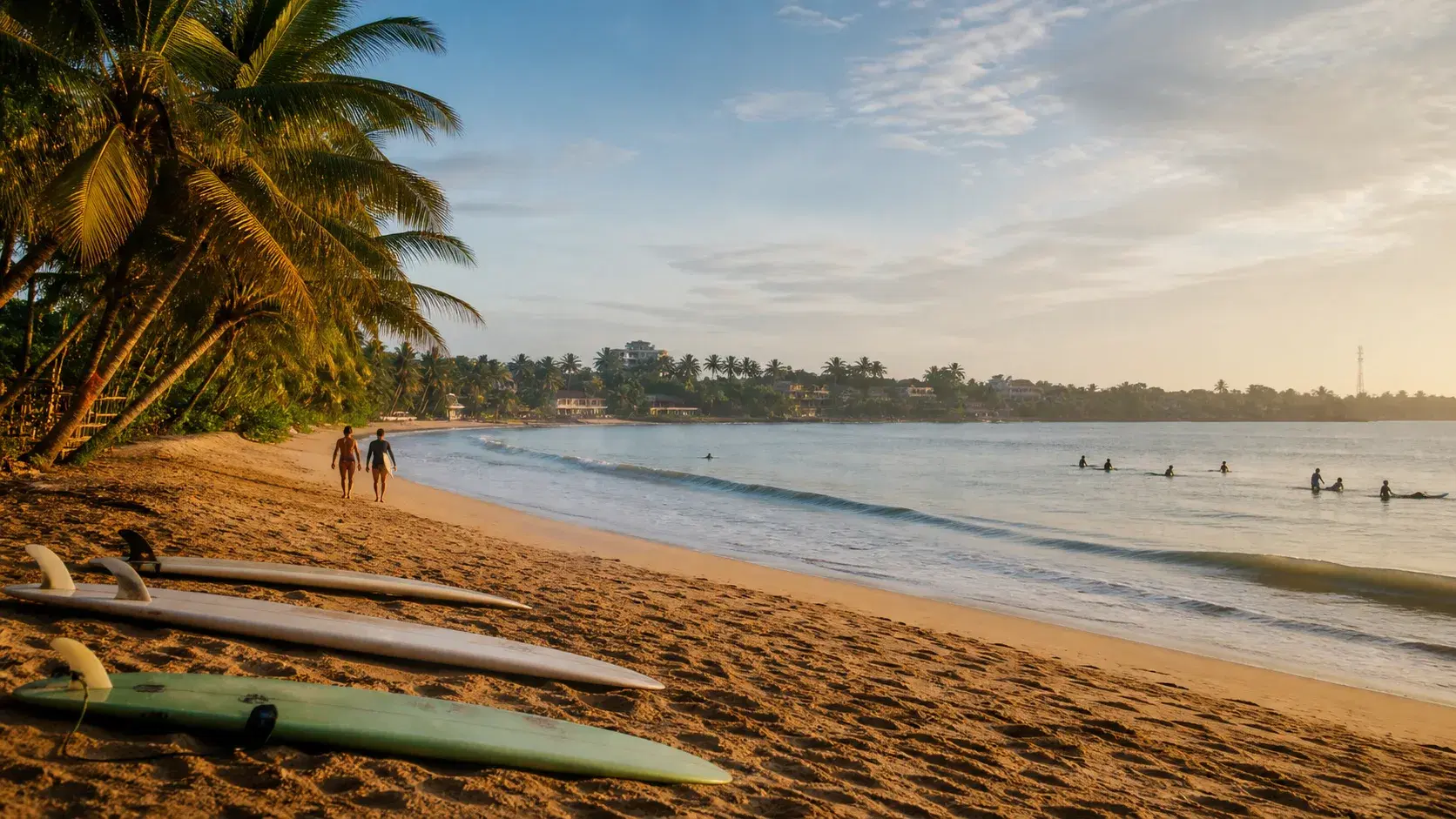
Weligama Bay is the centrepiece and the reason Sri Lanka has a reputation as a learning destination. It is a very large crescent bay with a sandy bottom, small and slow waves on the inside, and a long, forgiving whitewater section. There is no reef to hit and no significant current on ordinary days. For a first-ever surf, it is genuinely one of the best places in Asia.

It is also, now, busy. The bay's size spreads people out more than a point break ever could, but on a good morning in high season the inside section holds a substantial number of learners on soft-tops, most of whom cannot yet control their boards. The main hazard at Weligama is not the ocean. It is other people's equipment.

Ahangama and the coast immediately either side of it offer more variety and a more mixed standard of surfer, including some reef and rock bottom sections that are not beginner terrain.

Midigama is a short distance further and is a different proposition entirely. It packs several quality reef breaks into a small stretch, including fast, shallow waves that break over rock and coral. This is intermediate and advanced territory. Sea urchins are a real and frequent problem here, and booties are widely recommended rather than optional.

Mirissa balances surf with a broader beach-holiday scene and is less consistent than Ahangama, which suits travellers who want a surf that is part of a trip rather than the whole of it.

Hiriketiya, further east, is a small horseshoe bay with a left-hand point and has become extremely popular in recent years. It is beautiful and it is small, which means it fills quickly.

The practical advantage of the south is that everything is within a tuk-tuk ride. On a day when the wind ruins one spot, you can move twenty minutes and find something different. The east coast does not give you that.

Weligama: large sandy bay, best for first-timersAhangama: more variety, mixed abilityMidigama: shallow reef, intermediate and upHiriketiya: beautiful, small, crowdedMultiple spots within one tuk-tuk radius

Arugam Bay and the East: One Town, Several Waves

The east coast surf scene is concentrated around a single town in a way the south coast is not. Arugam Bay is the hub, and the breaks are spread along the coast north and south of it.

Main Point is the wave that made the island's reputation. It is a long right-hand point break wrapping around the headland at the southern end of town, capable of producing rides of several hundred metres when it is working. It has distinct sections, and the inside becomes shallower and more dangerous as the tide drops and rock and reef come into play.

Main Point is not a beginner wave. We want to state that plainly, because a number of booking pages sell beginner lessons in Arugam Bay in language that implies otherwise. Competent surf schools do not take first-timers to Main Point. They take them to Baby Point at the southern end, to sheltered bays nearby, or to flat water for a paddling session. If a school proposes putting a first-timer at Main Point on a peak-season day, that is a reason to walk away.

The lineup at Main Point in July and August is busy and has a functioning hierarchy. Local surfers take priority in the inside position, and the standard point-break etiquette applies with more consequence than it does in a beach break: do not drop in, do not paddle around people, wait your turn. Travellers who are patient and respectful report a friendly reception. Travellers who are not, do not.

Whisky Point, some distance north, is a gentler and less crowded alternative that is frequently recommended for improving surfers who are not ready for the Main Point crowd.

Peanut Farm is a semi-remote bay south of town with a sheltered end suitable for less experienced surfers and a more serious section beyond it. It requires transport to reach.

Pottuvil Point offers a long right of its own and is quieter than Main Point.

Okanda, further south toward the national park boundary, is remote, powerful and genuinely serious. It is also elephant country. This is not a spot to explore casually.

The trade-off with the east is consistency versus variety. Main Point works nearly every day in season, which the south coast cannot match. But if the wind is wrong, your options are thinner and further apart.

Main Point: long right, intermediate and aboveBaby Point and sheltered bays for beginnersWhisky Point: quieter alternativePeanut Farm and Pottuvil Point need transportOkanda is remote, powerful and near wildlife areas

What Beginners Are Not Being Told

Sri Lanka deserves its reputation as a good place to learn, and we are not going to undercut that. But there are four things the marketing consistently leaves out.

First, the biggest hazard to a beginner in Weligama is another beginner. A loose soft-top in a crowded inside section moves fast and hits hard. Wear the leash, hold your board on the ocean side when you are wading out rather than letting it sit between you and the wave, and look before you commit to a wave that someone else is already on. Most learner injuries here are collisions, not drownings.

Second, the phrase beginner-friendly is applied far too loosely on this coast. A sandy beach break with a gentle inside is beginner-friendly. A shallow reef with a fast takeoff is not, regardless of how a listing describes it. If the bottom is rock or coral and the wave breaks quickly, it is not a learning wave. Ask what the bottom is before you book anything.

Third, sea urchins are the most common injury on the south coast reefs and they are genuinely miserable. Spines break off in the foot and are difficult to remove. Booties are the single best piece of preventative equipment for anyone surfing Midigama or similar reef breaks, and they are inexpensive to buy locally.

Fourth, rip currents exist here even at friendly-looking beaches, and Sri Lankan beaches are largely unpatrolled outside a handful of hotel frontages. Drowning is a real cause of tourist death in Sri Lanka and it usually involves swimmers rather than surfers, but the same currents affect both. Learn to recognise a rip as a channel of calmer, often darker water moving seaward between breaking waves, and if caught in one, do not swim directly against it.

None of this should discourage a first-time surfer. It should shape which beach you choose. A learner who books lessons on Weligama's sandy inside, wears a leash, keeps distance from other boards and surfs in the morning has a very safe and very rewarding week ahead.

Collisions are the main beginner injury riskAsk what the bottom is before bookingBooties prevent the most common reef injuryBeaches are largely unpatrolledChoose sand, not reef, to learn on

How to Choose a Surf School Without Being Sold To

There are a great many surf schools in Sri Lanka, particularly around Weligama, and quality varies more than price does. We do not name individual businesses, but we can tell you what to check.

Ask about student-to-instructor ratio. Two or three students per instructor is meaningful teaching. Eight is crowd management. This single question separates most good operations from most poor ones.

Ask what board you will be on. A first lesson should be on a large soft-top. If a school offers to put a complete beginner on a hard board, they are prioritising their equipment over your safety.

Ask where the lesson takes place, and confirm the bottom is sand.

Ask about instructor certification. Some Sri Lankan instructors hold recognised international surf-instruction or lifesaving qualifications, and many excellent local instructors do not, having learned by growing up in the water. Certification is a useful signal but not a complete one. The more informative question is how long the instructor has been teaching and whether they hold a current first aid or water rescue qualification.

Be sceptical of a stand-up guarantee. Standing on a soft-top in whitewater on your first day is close to inevitable at Weligama and is not evidence of teaching quality. What distinguishes a good school is what happens on day three, when you should be learning to read where a wave will break rather than being pushed into whitewater repeatedly.

On price, lessons in Sri Lanka are inexpensive by international standards and rates vary widely between the south and east coasts and between group and private sessions. We are deliberately not publishing figures, because quoted rates have moved and vary hugely by operator and season. Ask two or three schools in person and you will establish the local range within an hour.

One practical note: book your first lesson in person after you arrive rather than online in advance. You can watch a lesson in progress from the beach, see the ratios with your own eyes, and pay less than the platform price.

Ask the student-to-instructor ratio firstFirst lessons belong on large soft-topsConfirm the lesson takes place over sandAsk about current first aid qualificationsBook in person after watching a lesson

Bring a Board or Rent One?

For a first or second surf trip, rent. Board rental is inexpensive and widely available on both coasts, airline board fees are not, and the boards you would want for Weligama and for Main Point are different anyway.

For an experienced surfer on a longer trip, bringing a board makes more sense. The quality of rental stock varies and the better boards go early in the day during peak season.

If you are bringing boards, a shortboard suited to the four to eight foot range covers Arugam Bay in season, and something with more volume covers the smaller south coast days. Check current airline board policies before booking flights; they differ substantially between carriers and change without much notice.

You will never need a wetsuit. Water temperatures around Sri Lanka sit roughly between 27 and 29 degrees Celsius year-round. A rash guard is worth having, and a long-sleeved one is worth more, because the sun here is severe and a morning session leaves your back exposed for two hours.

Reef booties are worth buying locally if you intend to surf the south coast reefs. They are cheap in the surf shops around Midigama and Weligama and they solve the urchin problem almost entirely.

Bring reef-safe sun protection, spare leashes, and wax suited to tropical water. Leashes degrade quickly in this sun and a snapped leash at a reef break is a genuinely bad afternoon.

A basic ding repair kit is worth carrying if you have brought your own board. Repair services exist but a small kit saves you a lost day.

Rent for short or first tripsNo wetsuit needed at any time of yearLong-sleeved rash guard for sun protectionBuy booties locally for reef breaksCheck airline board policies before booking

Can You Surf Both Coasts in One Trip?

This question comes up constantly and the honest answer is: usually not, and you should stop trying.

The drive between the south coast and Arugam Bay runs eight to ten hours through the highlands or around the southern edge of the island. It is a long day either way. On a one-week trip, spending a day and a half in vehicles to reach a coast that is out of season is a poor trade.

For a one-week trip, pick one coast based on your dates and commit to it.

For a two-week trip inside a clear season, still pick one coast. Two weeks on the south coast lets you surf Weligama, Ahangama, Midigama and Hiriketiya properly, which is more variety than most people get through in a fortnight.

The exception is a shoulder-month trip in April or October, where neither coast is reliably on and moving between them at least gives you two chances rather than one. This is a gamble rather than a strategy, but it is the one scenario where the drive is defensible.

The other exception is a genuinely long trip. Travellers spending a month or more on the island can and do follow the season from one coast to the other, and that is one of the real pleasures of surfing here.

There is a better way to think about the second week. Rather than chasing the other coast, use it. Sri Lanka is small and the non-surf attractions are close. From the south coast, Galle Fort, Yala or Udawalawe and Mirissa's whale season are all within easy reach. From Arugam Bay, Kumana National Park is nearby and quiet. A surf trip that includes two days off the board is usually a better trip than one that includes twenty hours of driving.

Eight to ten hours between the coastsOne-week trips: choose one coastTwo-week trips: still usually one coastShoulder months are the only defensible exceptionUse the second week for safaris and Galle instead

Lineup Etiquette and Sharing the Water

Sri Lankan surf communities are, by most accounts, notably welcoming compared with equivalent destinations. That reception depends on visitors behaving reasonably, and it is worth understanding what reasonable means at a point break.

The person deepest on the wave, closest to the breaking part, has priority. At a point break like Main Point that is nearly always the person on the inside, and very often a local surfer who has been reading that wave since childhood.

Do not drop in on a wave someone is already riding. This is the one rule that is not negotiable anywhere in the world.

Do not paddle around other surfers to get closer to the peak. Wait your turn in the rotation.

If you are learning, stay in the section appropriate to your ability. A beginner paddling into an advanced lineup is not just a risk to themselves; they change how everyone in the water has to behave.

Apologise if you make a mistake, because you will. Almost every problem in a lineup is resolved by acknowledging an error rather than pretending it did not happen.

Beyond the water: Arugam Bay and the south coast surf villages are working communities as well as surf destinations. Fishing operations use these beaches. Dress reasonably when you walk into town rather than through it, understand that Sri Lanka has conservative norms away from beach frontages, and spend money in local businesses rather than exclusively in expatriate-run venues where you can.

One seasonal point worth knowing: much of Arugam Bay closes during the off-season. Businesses shut, staff leave, and the town becomes very quiet. If you arrive in December expecting the July scene, you will find a different place.

Deepest surfer has priorityNever drop in on a ridden waveDo not paddle around the rotationStay in the section that matches your abilityArugam Bay largely closes out of season

What Else the Surf Coasts Offer

One of the strongest arguments for Sri Lanka over a dedicated surf destination is how little you have to travel to find something entirely different.

From the south coast, Galle Fort is close and is a genuinely interesting Dutch colonial walled town rather than a tourist reconstruction. Whale watching operates out of Mirissa during the southern season. Udawalawe and Yala national parks are reachable as day trips, though a night nearer the park makes for a far better safari.

The stilt fishermen along this coast are widely photographed and are now largely a paid performance rather than a working fishery. That is worth knowing before you decide how you feel about the photograph.

From Arugam Bay, Kumana National Park is close and receives a fraction of Yala's visitors while offering excellent birdlife. Pottuvil Lagoon offers flat-water paddling and wildlife. The cultural sites at Panama and the surrounding area are quiet and rarely visited.

Both coasts have serious food. The south coast has a substantial café culture built around the surf scene, and the east coast has a distinct culinary character shaped by Muslim and Tamil communities that is different from the south in ways most visitors never discover.

A note on combining surf with the hill country: as of 2026 the Main Line railway through the highlands remains partially closed following cyclone damage, so a surf-plus-train itinerary needs checking before it is planned. Our separate guide covers the current position.

Finally, yoga. It is offered alongside surf almost everywhere on the south coast and increasingly at Arugam Bay. Quality varies enormously and the pairing is largely a commercial one rather than a Sri Lankan tradition, which does not make it bad, only worth assessing on its own merits.

Galle Fort and whale watching from the southKumana National Park from Arugam BayDistinct east coast food cultureCheck hill-country rail status before planningYoga quality varies widely

Who Sri Lanka Suits, and Who It Does Not

Sri Lanka is close to ideal for a complete beginner in season on the south coast. Warm water, sandy bottom, cheap lessons, a large forgiving bay and a social scene that makes solo travel easy.

It is excellent for improving surfers who can already paddle and stand, and who want to progress from beach break to point break within one trip.

It is very good for advanced surfers in the east coast season, particularly outside the July and August crowd peak.

It suits travellers on a modest budget better than almost any comparable destination, and it suits people who want a surf trip that is also a country rather than only a beach.

It suits it less well if you have fixed dates that fall in April or October, if you want guaranteed large waves rather than reliable ones, or if you dislike crowds and are unwilling to surf at dawn or travel outside the peak months.

It is not the right destination if you want heavy, hollow, world-class barrels as the core of the trip. Sri Lanka has powerful waves, particularly at the east coast points and the Midigama reefs, but the island's defining quality is long, friendly, high-volume surf rather than the intensity you would travel to Indonesia for.

And it is a poor choice for a family beach holiday where one person surfs and everyone else swims, unless you research the specific beach carefully. Many of the best surf beaches are not good swimming beaches, and the absence of lifeguards makes that distinction matter.

Outstanding for beginners in seasonStrong for intermediates progressing to pointsExcellent value against comparable destinationsNot a barrel-hunting destinationSurf beaches are not always swimming beaches

Travel Tips

  • Surf at dawn because the wind almost always deteriorates through the day
  • Check a live forecast for your dates rather than trusting any season chart
  • Pick one coast per trip unless you are staying a month or more
  • Confirm the bottom is sand before booking a beginner lesson
  • Ask the student-to-instructor ratio before you pay for anything
  • Book your first lesson in person after watching one from the beach
  • Buy reef booties locally if you plan to surf the south coast reefs
  • Wear a long-sleeved rash guard because the sun here is severe
  • Never surf a reef break alone if you are unfamiliar with it
  • Learn to recognise a rip current before you get in the water
  • Carry a spare leash because tropical sun degrades them quickly
  • Avoid April and October for a dedicated surf trip
  • Expect much of Arugam Bay to be closed outside its season
  • Respect the lineup rotation and give priority to surfers on the inside
  • Never rely on lifeguards, because most Sri Lankan beaches have none

Frequently Asked Questions

When is the best time to surf in Sri Lanka?

It depends entirely on which coast. The south and southwest coasts work from roughly November to April, peaking December to March, with February often the best balance of conditions and crowds. The east coast around Arugam Bay works from roughly May to September, peaking July and August, with September offering the best quality-to-crowd ratio.

Can I surf both coasts on the same trip?

Rarely worth it. The coasts are eight to ten hours apart and only one is in season at a time. On trips of one or two weeks, choose one coast. Only shoulder-month trips in April or October, or trips of a month or more, justify moving between them.

Is Sri Lanka good for complete beginners?

Yes, particularly Weligama Bay on the south coast during its season. It has a large sandy-bottom bay, slow forgiving waves, warm water and a very large number of surf schools. The main hazard is other learners' boards rather than the ocean itself.

Can beginners surf at Arugam Bay?

Not at Main Point, which is an intermediate and advanced wave despite how some listings describe it. Competent schools take beginners to Baby Point at the southern end of the bay, to sheltered bays nearby, or to flat water. If a school proposes putting a first-timer at Main Point, look elsewhere.

Do I need a wetsuit in Sri Lanka?

No. Water temperatures sit around 27 to 29 degrees Celsius year-round. A rash guard is useful, mainly for sun protection rather than warmth, and a long-sleeved one is better.

Should I bring my own surfboard?

For a first or second trip, rent locally. Rental is inexpensive and widely available, and airline board fees are not. Experienced surfers on longer trips generally do better bringing their own, since rental quality varies and good boards go early in the day.

What are sea urchins and do I need booties?

Sea urchins are common on the south coast reef breaks around Midigama and similar spots. Their spines break off in the foot and are difficult to remove. Booties largely solve the problem and are cheap to buy locally. On sandy beach breaks like Weligama they are unnecessary.

How crowded does it actually get?

Main Point at Arugam Bay in July and August is the busiest lineup in the country and has a functioning priority hierarchy. Weligama in January is very busy but the bay's size spreads people out. Surfing at dawn and travelling in the shoulder months are the two effective ways to avoid crowds.

Are Sri Lankan beaches patrolled by lifeguards?

Most are not, outside a small number of hotel frontages. Rip currents exist even at friendly-looking beaches and drowning is a real cause of tourist death in Sri Lanka. Learn to recognise a rip, do not swim alone, and never assume someone is watching.

How much do surf lessons cost?

Lessons are inexpensive by international standards but rates vary substantially by coast, operator, season, and whether the session is group or private. We would rather you asked two or three schools in person on arrival than relied on a figure published months earlier, since quoted prices have moved.

Is April a good month to surf in Sri Lanka?

It is the least reliable month of the year alongside October. Both coasts are in transition and neither is dependable. April also coincides with the Sinhala and Tamil New Year, which makes travel and accommodation harder island-wide. We would not plan a dedicated surf trip around it.

Is Arugam Bay open all year?

No. Much of the town effectively closes outside the May to September season. Businesses shut and staff leave. Arriving in December expecting the July scene will mean finding a very quiet place.

Reader notes

Join the conversation

Share your question, tip, or travel experience for this guide.

Comments

0 comments

Loading...

Ready to turn inspiration into a Sri Lanka trip?

Use LankaTrip to plan your journey, connect with local guides, and make this itinerary a reality.

Need help planning?

Plan your Sri Lanka adventure

Plan my trip