
LankaTrip Insights

32 min read

Whale Watching in Sri Lanka 2026 and 2027: The Two-Coast Season Calendar, and Why "Swim With Whales" Tours Are Illegal

Sri Lanka is one of the few places on earth where blue whales are present year-round, but whether you see one depends almost entirely on which coast you book and which month you arrive. This guide sets out the 2026 to 2027 season calendar, names the date conflicts between sources, and explains the legal status of swim-with-whales tours.

Back to blog
Whale Watching in Sri Lanka 2026 and 2027: The Two-Coast Season Calendar, and Why "Swim With Whales" Tours Are Illegal

Whale watching is one of the three or four things most first-time visitors put on a Sri Lanka itinerary, usually somewhere between Sigiriya and a train ride. It is also the activity most often booked for the wrong month, from the wrong harbour, with the wrong operator.

The reason is structural. Sri Lanka does not have one whale watching season. It has at least two, running on opposite calendars on opposite sides of the island, and a third, dolphin-led season in the northwest. A traveller who searches for whale watching in Sri Lanka and lands on a page about Mirissa in July is reading accurate information about the wrong half of the year.

That confusion is made worse by the sources themselves. We compared season dates across government tourism material, licensed operator pages, international travel media and dive and boat listings while preparing this guide, and they do not agree. For the south coast alone we found the season variously given as November to April, December to April, November to May and September to April. These are not rounding differences. They are a six-month spread on a four-month season.

There is also a second issue that most whale watching guides simply do not raise. The single most heavily advertised premium whale experience in Sri Lanka, sold as swimming, snorkelling or freediving with blue whales at prices starting around USD 250 to USD 300 per person, is prohibited under Sri Lankan law unless a specific permission has been granted by the Department of Wildlife Conservation. Visitors are paying substantial money for an activity they are usually not told is illegal.

This guide is written for the foreign visitor planning the 2026 to 2027 season. It sets out what is known, names what is disputed, and is explicit about where the published record simply does not support a confident answer. It does not recommend individual companies, because we have no way to verify any single operator's conduct at sea on the day you sail, and telling you otherwise would be dishonest.

What we can do is give you the criteria to judge one yourself, the logistics that actually determine whether the morning works, and the legal and conservation context that the booking page will not mention.

Quick Summary

  • Blue whales are recorded in Sri Lankan waters year-round, which is unusual for the species, but the practical viewing season shifts between coasts
  • The south coast around Mirissa is generally worked from about November to April; the east coast around Trincomalee from about May to September or October
  • Published season dates contradict each other across official tourism pages, operator sites and travel media, and this guide names those conflicts rather than picking one
  • If you arrive in July and book Mirissa, you have very likely booked the wrong coast
  • Swimming, snorkelling or diving with whales is illegal without express permission from the Director General of the Department of Wildlife Conservation
  • Research published in 2024 and 2025 found the majority of operators surveyed in both Mirissa and Trincomalee were offering these prohibited in-water experiences
  • The regulated minimum approach distance is commonly cited as 100 metres for whales, and the same research recorded boats closing to within 2 to 3 metres
  • The whale grounds off the south coast sit beside the Dondra Head Traffic Separation Scheme, and ship strikes are a documented cause of blue whale deaths here
  • No operator can honestly guarantee a sighting, and the widely repeated 90 percent figure is a marketing claim rather than a verified statistic

The Two-Coast System: Why the Month You Arrive Decides the Harbour

Sri Lanka sits in the path of two monsoon systems that alternate through the year, and the whale watching calendar follows them almost exactly. When one coast is workable, the other generally is not.

From roughly November through April, the northeast monsoon dominates. The south and southwest coasts see calmer morning seas, and the whale watching fleet operates out of Mirissa and, to a lesser extent, other southern harbours. This is the period most international coverage refers to when it says whale watching season in Sri Lanka.

From roughly May through September or October, the southwest monsoon takes over. Southern seas become rough and unpredictable, southern operations wind down, and the activity shifts to the east coast around Trincomalee, where blue whales and sperm whales are recorded within a short run of the coast.

Kalpitiya, on the northwest coast, runs a third calendar and is primarily a dolphin destination rather than a reliable whale destination, with whales as a bonus rather than the headline.

The practical consequence is simple and it is the single most useful thing in this guide. Do not search for whale watching in Sri Lanka. Search for whale watching in Sri Lanka in the month you are actually travelling, and be prepared for the answer to send you to a different coast than the one your itinerary was built around.

This matters more than it sounds. Mirissa and Trincomalee are on opposite sides of the island. Rearranging an itinerary to add Trincomalee is a serious change, not a detour, and it is far easier to do at the planning stage than after flights and hotels are booked.

South coast broadly November to AprilEast coast broadly May to September or OctoberKalpitiya runs a separate dolphin-led calendarThe two main hubs are on opposite sides of the islandCheck the month before you fix the itinerary

The Season Dates Do Not Agree, and We Are Not Going to Pretend They Do

Most whale watching guides state a single confident season range. We are not able to do that honestly, because the published sources conflict, and readers deserve to know that before they book a non-refundable trip around a date.

For the south coast around Mirissa, we found the season given as November to April, as December to April with November described as the official opening, as November to May, and as September to April. Some of these are operator pages with a commercial interest in extending the advertised season. Others are established travel media. They cannot all be right.

For the east coast around Trincomalee, the range is given as May to September, as May to October, and as June to October. The shoulder months at either end are precisely the ones travellers most often want a firm answer about.

For Kalpitiya, we found November to March, December to April and October to May, depending on whether the source is describing dolphins, whales or both together, which are not the same season.

What can be said with reasonable confidence is that the core of the south coast season falls between December and March, and the core of the east coast season falls between June and September. Those central months are where the sources overlap. The edges are genuinely uncertain and are also weather-dependent in any given year.

Our practical advice is to treat the shoulder months as a gamble rather than a plan. If whale watching is the reason you are visiting a particular coast, build the trip around the core months. If it is one item among many, book the shoulder months by all means, but do not make it the anchor of a five-day detour.

Before booking, ask the operator directly whether they are running trips on your specific dates and what proportion of scheduled departures they actually sailed in that same week the previous year. An operator who can answer the second question is telling you something useful. One who cannot, or will not, is telling you something too.

South coast dates published as anywhere from September to MayEast coast dates published as May, June, September or October endpointsCore south season is broadly December to MarchCore east season is broadly June to SeptemberTreat shoulder months as a gamble, not a plan

What You Might Actually See

The headline animal is the blue whale, and Sri Lanka's claim here is genuinely unusual. Blue whales are recorded in these waters year-round rather than passing through on a seasonal migration, which is uncommon for the species and is part of why the population attracts international research attention. Animals in this population are reported at around 25 metres in length, and the species is listed as endangered on the IUCN Red List.

The reason they are here is geography. Sri Lanka's continental shelf is narrow and drops steeply, which brings deep, productive water unusually close to shore. That is also why the boat rides are relatively short compared with whale watching in many other countries.

Beyond blue whales, sperm whales are regularly recorded off both the southern and eastern coasts, and Bryde's whales and short-finned pilot whales are also reported. Sightings of orca are occasionally reported off the east coast, though these are genuinely rare and should not be part of anyone's expectations.

Dolphins are far more commonly encountered than whales on any given trip. Spinner dolphins in particular travel in very large pods, and off Kalpitiya these pods are the main attraction rather than an incidental one.

Flying fish, turtles and rays are commonly seen from the boat. Many travellers report that these smaller encounters, plus the sea and the light, end up being the memorable part of the morning regardless of what the whale count was.

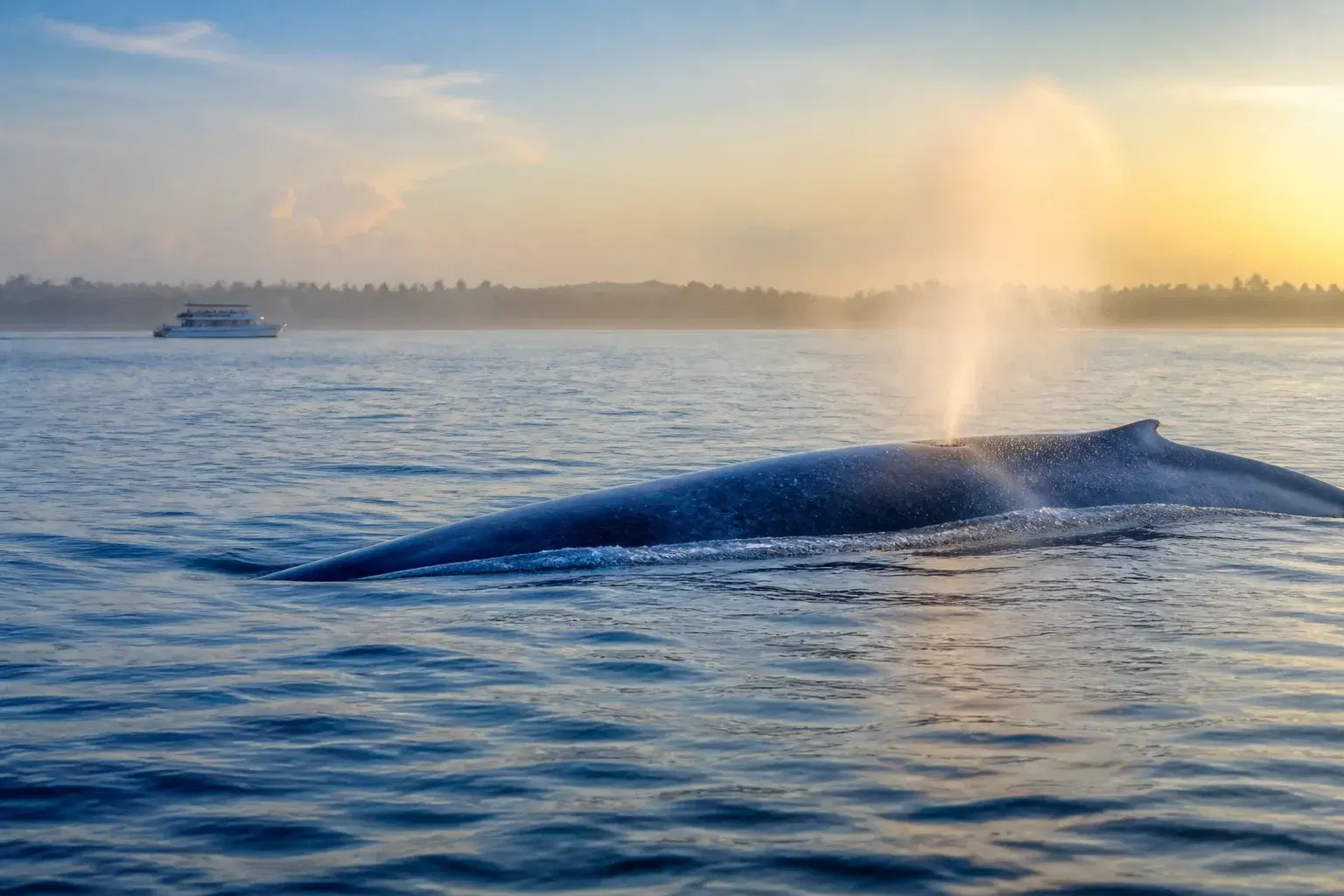
It is worth adjusting expectations about what a blue whale sighting looks like. In most cases you will see a blow, a long stretch of back, and if you are fortunate a tail fluke as the animal dives. Breaching is not what blue whales typically do. Travellers who arrive expecting the imagery from wildlife documentaries, which is filmed over months by specialist crews, frequently describe feeling let down by an encounter that was in fact perfectly good.

Blue whales recorded year-round, unusual for the speciesAround 25 metres in length, IUCN listed as endangeredSperm, Bryde's and pilot whales also recordedDolphins are seen far more often than whalesExpect a blow and a back, not a breach

Mirissa and the South Coast: The Busiest Option

Mirissa is the default answer to whale watching in Sri Lanka and has been since the industry took off after 2008. It has the largest fleet, the most developed booking infrastructure, and the shortest run out to the grounds, which sit close to Dondra Head at the island's southern tip.

It is also, by a wide margin, the most crowded. The core of the criticism levelled at Mirissa in traveller accounts is not that the whales are absent but that there are too many boats around the same animal at the same time, and that large double-decker vessels carrying substantial passenger numbers are not well suited to responsible wildlife viewing.

Departures run from the Mirissa fisheries harbour, typically in the window between about 6:00 am and 7:00 am, with passengers asked to report earlier. Trips generally run three to five hours depending on sea conditions and how long it takes to find animals.

Practically, this means staying overnight in or close to Mirissa. Travellers sometimes base themselves in Galle or Weligama and drive in early, which is workable but adds a pre-dawn transfer to an already early morning.

One point that is rarely made plainly: fleet size cuts both ways. More boats means more eyes on the water and a better chance that something is found, and it also means that once something is found, a lot of vessels converge on it. If you are choosing Mirissa, choose a smaller boat, and ask the operator directly what they do when they arrive at an animal that already has several boats on it.

An operator whose answer is that they hold back at distance and wait, or move on, is describing responsible practice. An operator who does not understand the question is answering it anyway.

Largest fleet and shortest run to the groundsDepartures roughly 6:00 to 7:00 am from the fisheries harbourTrips typically three to five hoursOvernight stay nearby is effectively requiredCrowding around individual animals is the main documented problem

Trincomalee and the East Coast: The Quieter Half of the Year

Trincomalee is the answer for anyone visiting Sri Lanka during the European summer, which is exactly when the south coast fleet is not operating. It is consistently described as quieter than Mirissa, with fewer boats and a less industrialised feel.

The grounds are reported at roughly six to eight nautical miles east of Trincomalee, which is around thirty minutes by boat, making for a shorter run than many first-time visitors expect. Departures are commonly arranged from the Nilaveli and Uppuveli beach areas north of the town.

The trade-off is infrastructure. There are fewer operators, less standardised booking, and in practice less redundancy if weather cancels your morning. If you have one shot at it, that matters.

It should be said clearly that quieter does not automatically mean better regulated. Research published in 2024 recorded a higher rate of prohibited in-water whale activity among operators surveyed in Trincomalee than in Mirissa. Fewer boats on the water is a genuine advantage for the experience; it is not a guarantee of conduct.

Trincomalee also works well as part of a wider east coast trip rather than a standalone whale trip, which softens the risk considerably. If the boat does not sail, you are still somewhere worth being.

The right choice for a European summer visitGrounds roughly six to eight nautical miles offshoreAround thirty minutes by boatFewer boats but also less redundancy if weather cancelsQuieter does not mean better regulated

Kalpitiya: Dolphins First, Whales Second

Kalpitiya on the northwest coast is frequently listed as Sri Lanka's third whale watching hub. That framing oversells it, and travellers who book it expecting blue whales are often disappointed.

What Kalpitiya is genuinely known for is very large spinner dolphin pods, sometimes described in the hundreds or over a thousand animals. That is a spectacular thing to see, and it is a more reliable proposition here than whales are.

Whales, including blue and sperm whales, are reported off Kalpitiya, but less consistently than at the two main hubs, and the published season for the area varies considerably between sources depending on whether they are describing dolphins, whales or both.

Kalpitiya suits travellers who are already heading up the northwest coast, or who are combining a boat morning with kitesurfing or the Wilpattu area. It is a weak choice for someone whose primary goal is a blue whale sighting, and we would not build an itinerary around it for that purpose.

Book it for what it reliably delivers, which is dolphins in genuinely large numbers, and treat any whale as a bonus.

Primarily a dolphin destinationVery large spinner dolphin podsWhale sightings less consistent than the main hubsSeason dates vary widely between sourcesGood as an add-on, weak as a whale-focused anchor

Swimming and Snorkelling With Whales Is Illegal in Sri Lanka

This is the section we would most like visitors to read before booking anything, because it involves a genuine legal exposure that the marketing material does not mention.

Whale watching in Sri Lanka is regulated under the Sea Mammals (Observation, Regulation and Control) Regulations No. 1 of 2012. Those regulations prohibit people from entering the water with whales. Diving and in-water interaction are permitted only under special circumstances and with the express approval of the Director General of the Department of Wildlife Conservation.

In other words, the default legal position is that swimming, snorkelling and freediving with whales is not allowed. An operator advertising these experiences openly on a public website, without reference to any permit, is advertising an activity that is prohibited unless they hold a specific permission they are not mentioning.

This is not a theoretical concern. A preliminary study by the marine research organisation Oceanswell, led by Dr Asha de Vos and funded by the Lanka Environment Fund, identified 32 swim-with-whales operators across Mirissa and Trincomalee, described as roughly a threefold increase over three years. The study reported that about half of these operations were owned by foreign nationals, and that most did not mention required permits in their advertising. Advertised prices ranged from a little under USD 300 to figures approaching USD 9,000 per person for multi-day packages.

Separate academic work published in 2024 by Berlage, Olyslaegers, de Silva and Gunawardana surveyed operators directly and reported that 73 percent of those contacted in Mirissa and 83 percent of those contacted in Trincomalee were offering illegal whale-swimming activities.

The same research recorded boats approaching whales to within two to three metres, against a regulated minimum distance commonly cited as 100 metres, and documented avoidance behaviour across four whale species, including abrupt vertical diving. The researchers were careful to note the preliminary nature of the behavioural findings, and we repeat that caveat here rather than overstating it.

There is a practical dimension for visitors as well as an ethical one. These operations bypass the permits, licences and insurance that licensed boat-based operators carry. If something goes wrong in open water several nautical miles offshore, you are in the sea with an unlicensed operator, and you should assume your travel insurance will treat that accordingly.

Our position is straightforward. Do not book swim-with-whales, snorkel-with-whales or dive-with-whales experiences in Sri Lanka. If an operator offers one, that tells you what you need to know about how they will behave around animals on a standard trip as well.

Prohibited under the 2012 Sea Mammals RegulationsPermitted only with express DWC Director General approvalResearch identified 32 operators offering it across two hubs73 percent of Mirissa and 83 percent of Trincomalee operators surveyed offered itUnlicensed operation has insurance implications for you

Approach Distances and What the Rules Actually Say

The 2012 regulations set the licensing framework for operators, covering vessel registration, safety and the conditions under which tourists may be taken out to view marine mammals.

On approach distance, the published sources are less consistent than they should be. A minimum of 100 metres from whales is the figure most commonly cited, including in the research that recorded operators breaching it. Some sources cite 50 metres for dolphins and other marine mammals. Others describe the operative rules in terms of international codes of conduct rather than the domestic regulation.

We have not been able to verify the exact wording of the current operative distances from a primary gazette text, and rather than pick the most convenient figure we are stating plainly that the published secondary sources differ. If you need the authoritative position, the Department of Wildlife Conservation is the body to ask.

Beyond distance, the principles that appear consistently across sources are these. Boats should not make sudden changes of speed or direction near animals. They should not cross in front of or behind a whale, or cut through a group. They should not block natural movement or migration routes. Passengers should not touch, feed or attempt to lure animals with food, sound or light. Nobody should enter the water.

There is also a practical rule that is not in any regulation but is worth adopting. If more than a handful of boats are already on an animal, the responsible thing is to hold off. Cumulative engine noise around a single whale is a real and measurable disturbance, not a cosmetic concern.

What can a visitor do if a captain breaches these on the day? Realistically, not much mid-trip, and confronting a skipper several miles offshore is not sensible. What you can do afterwards is leave a factual, specific account mentioning approach behaviour, and raise it with the Department of Wildlife Conservation for licensed operators. Specificity is what makes such a report useful.

Regulated under the 2012 Sea Mammals Regulations100 metres is the most commonly cited whale distanceSources differ, and we have not verified a primary gazette textNo sudden manoeuvres, no crossing, no in-water contactReport specific breaches to the DWC after the trip

The Shipping Lane Problem Off Dondra Head

This is context no booking page will give you, and it changes how you understand what you are looking at from the boat.

The whale feeding grounds off Sri Lanka's south coast overlap with the Dondra Head Traffic Separation Scheme, a shipping lane established through the International Maritime Organization in 1980 and now one of the busiest east-west trade corridors in the world. Reporting has placed the lane roughly five nautical miles off Mirissa, which is to say close to where the whale watching boats work.

Ship strikes are a documented cause of death for large whales in these waters. Marine biologist Dr Asha de Vos has argued that recorded deaths may substantially understate the true figure, on the grounds that prevailing currents and winds are more likely to carry carcasses out to sea than towards shore, where they would be found.

A proposal to move the lane roughly 15 nautical miles south has been under discussion for over a decade. OceanCare has stated that such a shift would reduce collision risk by up to 95 percent. The proposal has been backed by an unusual coalition, including the International Whaling Commission, the International Fund for Animal Welfare, the World Shipping Council and major shipping industry associations. In 2016 the IWC Scientific Committee agreed the evidence would support a proposal to the IMO if Sri Lanka chose to make one.

Sri Lanka has not done so. The government's position has been to oppose a review of the scheme, on the basis that the lane's proximity is commercially important to the ports of Colombo and Hambantota. As of the most recent reporting we have been able to verify, the lane has not been moved.

Some individual shipping companies have voluntarily shifted their own routing further south, and reporting from 2023 indicated that around a quarter of traffic was already using a southern alternative. That is a partial mitigation, not a solution.

We flag this as an unresolved and moving story. Positions at the IMO and in Colombo can change, and readers researching this closer to travel should check for developments rather than treat the position above as final.

For a visitor on a boat, the practical takeaway is this. When you look out towards the horizon and see container ships, you are looking at the reason this population is under pressure, and it is a larger factor than the boat you are sitting on. That does not excuse poor operator conduct. It does put it in proportion.

Feeding grounds overlap a major shipping laneLane reported roughly five nautical miles off MirissaA 15 nautical mile southward shift has been proposed for yearsBacked by the IWC, IFAW and shipping industry bodiesSri Lanka has opposed review; the lane has not been moved

How to Assess an Operator Without Taking Anyone's Word For It

We do not name specific companies. We have no way to verify how any given operator behaves at sea on the day you sail, and a recommendation we cannot stand behind is worse than no recommendation. What follows is a set of criteria you can apply yourself.

Ask what happens when they arrive at a whale that already has boats on it. The answer you want describes holding at distance and waiting, or moving on. Vagueness here is informative.

Ask about passenger numbers and boat size. A vessel carrying eighty or more passengers is structurally difficult to operate responsibly around wildlife, regardless of intent. Smaller boats cost more per head for a reason.

Check whether they advertise swimming, snorkelling or diving with whales anywhere on their site or social media. If they do, that is disqualifying, for the legal reasons set out above.

Treat guaranteed sighting language as a warning rather than a reassurance. No legitimate wildlife operation can guarantee a wild animal encounter, and an operator who has promised one has created a commercial incentive to chase.

Be cautious about the cheapest tier. Very low headline prices generally indicate high passenger volume, and volume is the mechanism by which the experience and the animals both degrade.

Look for whether a naturalist or trained guide is on board, and whether the operator's own materials discuss approach protocols or conservation at all. Silence on these is not proof of anything, but it is a signal.

Finally, ask what proportion of scheduled trips they cancelled for weather in your month last year, and what their refund policy is when they do. An operator who cancels appropriately in bad conditions is an operator you want.

Ask what they do at a crowded sightingPrefer smaller boats and lower passenger countsAny swim-with-whales offering is disqualifyingGuaranteed sighting language is a warning signAsk about weather cancellation rates and refunds

What the Morning Actually Involves

The logistics are the part that most often goes wrong, and they are entirely predictable.

You will be collected or asked to arrive at the harbour well before dawn, commonly between 5:30 am and 6:30 am depending on the operator and hub. Boarding at a working fisheries harbour is not a polished experience and is not meant to be.

Sailing time is typically three to five hours in total, including the run out, time on the water, and the return. Some trips run longer if animals are proving hard to find. You cannot get off partway.

Seas are calmest in the early morning, which is the entire reason for the pre-dawn start. Conditions typically deteriorate as the day warms, so a late departure is not a neutral choice.

Seasickness is the single most common complaint, and it affects people who do not normally get seasick. Take medication the night before or at least an hour before departure rather than at the harbour, because most preparations need time to work. Sit low and central in the vessel, stay outside in fresh air rather than in an enclosed cabin, and keep your eyes on the horizon rather than on a phone screen.

Most operators include a simple breakfast, water and often fruit on the return leg. Confirm this rather than assume it, and eat something light beforehand rather than nothing, since an empty stomach makes seasickness worse rather than better.

Bring a light windproof layer. It is genuinely cool at speed on open water before sunrise, which surprises visitors who packed only for a tropical beach. Add sun protection for the return leg, when you will be exposed for hours.

For cameras, optical zoom is worth far more than megapixels here, and a phone will struggle. Many travellers find they enjoy the sighting more by watching it than by filming it badly.

Finally, plan the rest of that day lightly. You will be back on land by late morning having been awake since before 5:00 am, and a long onward drive that afternoon is a poor idea.

Pre-dawn start, typically 5:30 to 6:30 amThree to five hours at sea with no early exitTake seasickness medication well in advanceBring a windproof layer and sun protectionKeep the rest of the day light

Realistic Costs and What They Include

Published prices vary by hub, boat size and season, and the figures below are drawn from secondary sources rather than a single official tariff. Treat them as indicative and confirm directly.

For shared boat trips from Mirissa, quoted prices commonly fall in the region of USD 45 to USD 50 per adult, typically including local hotel pickup, a basic breakfast and water. Some listings quote in rupees at figures in the region of LKR 12,000 to LKR 20,000 depending on inclusions.

For Trincomalee, shared trips are quoted at broadly similar levels, in the region of USD 40 to USD 50 per person, with private charters quoted considerably higher.

Kalpitiya dolphin trips are often quoted per boat rather than per person, and quoted figures vary widely depending on whether wildlife permits are included.

Private charters at any hub cost substantially more and are the honest way to get a small-boat experience. If crowding is your main concern and budget allows, this is where the money is best spent.

Be alert to what is not included. Hotel pickup radius, park or wildlife permit fees where applicable, and whether a cancelled or unsuccessful trip generates a refund, a partial refund or a second attempt are all things to establish in writing before paying.

Prices move, and this is a competitive market. Nothing above should be treated as a current quotation.

Mirissa shared trips broadly USD 45 to 50 per adultTrincomalee shared trips broadly USD 40 to 50Private charters cost substantially moreConfirm pickup radius, permits and refund terms in writingFigures are indicative, not current quotations

The 90 Percent Claim, and Managing Expectations Honestly

A sighting success rate of around 90 percent, sometimes 98 percent, is quoted almost universally in Mirissa marketing material and repeated by travel media that has not questioned it.

We have not found a verifiable, independent source for that figure. It appears to originate in operator marketing and to have been recycled outward. It may well be broadly accurate in peak season. It is not a statistic we are able to stand behind, and we are not going to present it as one.

What can be said is that sighting rates are genuinely better in the core season months than at the edges, that dolphins are seen far more reliably than whales, and that a blank morning is a real possibility that operators generally do not foreground.

There is also a longer-term question. Operators in Mirissa have reported to Sri Lankan press that blue whale sightings have become less frequent in recent years. Explanations offered have included disturbance from illegal in-water activity, and one operator has suggested a link to effects on krill populations following the 2021 X-Press Pearl disaster. We have not seen these claims independently verified and we present them as reported claims rather than established findings.

The practical implication is to book the experience for what it is, which is a morning at sea with a good chance of seeing something remarkable, rather than as a guaranteed transaction. Travellers who frame it that way come back happy far more often than those who framed it as a purchase of a blue whale.

If a sighting is essential to you, allow two mornings rather than one, in the core season, at the correct hub for your month.

The 90 percent figure is marketing, not a verified statisticCore season months genuinely perform betterDolphins are seen far more reliably than whalesReported decline in Mirissa sightings is unverifiedAllow two mornings if a sighting is essential

Getting to the Departure Harbours

Mirissa sits on the south coast between Galle and Matara, roughly a forty minute drive from Galle and generally three to four hours from Colombo by expressway, subject to traffic.

The coastal railway line running south from Colombo through Galle towards Matara is a separate line from the hill country main line section that remains closed following Cyclone Ditwah. Travellers should not assume that reports of hill country closures apply to the coastal route, and equally should not assume the coastal route is unaffected without checking. Confirm current status on the Sri Lanka Railways site before building a plan around a specific train.

From the nearest coastal station, a short tuk-tuk transfer completes the journey. Given the pre-dawn departure, arriving the previous day is effectively mandatory rather than optional.

Trincomalee is on the northeast coast and is most commonly reached by road from Colombo, Dambulla or Anuradhapura, or as part of a wider cultural triangle and east coast routing. Departures are generally arranged from the Nilaveli and Uppuveli beach areas rather than from Trincomalee town itself.

Kalpitiya is on the northwest coast and is reached by road from Colombo via Puttalam. It combines naturally with Wilpattu rather than with the southern beaches.

In all three cases, arrange your harbour transfer the night before rather than trying to find transport at 5:00 am. Many accommodation providers will organise this, and operators offering pickup usually define a radius that may or may not include where you are staying.

Mirissa is three to four hours from Colombo by expresswayThe coastal line is separate from the closed hill country sectionVerify rail status on the Sri Lanka Railways siteTrincomalee departures usually from Nilaveli or UppuveliArrange the pre-dawn transfer the night before

If You Decide Not to Take a Boat

Some travellers, having read the above, decide the crowding or the conservation picture makes a boat trip the wrong choice for them. That is a legitimate conclusion and there are alternatives.

Whales are occasionally visible from elevated points on land, particularly along the east coast where the animals come relatively close inshore. This is opportunistic rather than reliable and should not be planned around, but it costs nothing to look.

Aerial whale watching flights have operated from the south coast, offering an overhead perspective without adding a vessel to the water. Availability, operators and pricing for these change, so verify current status directly rather than relying on older listings.

Choosing a private charter with low passenger numbers, in the core season, with a naturalist aboard, is the option that most directly addresses the crowding problem while still supporting licensed local operation.

It is also entirely reasonable to skip it. Sri Lanka has a great deal to offer a wildlife-minded traveller that does not involve converging on a single animal with fifteen other boats, and there is no obligation to tick this particular box.

Whichever you choose, the money you spend on licensed local operation supports the people whose livelihoods depend on these animals remaining here, which is the strongest practical argument for the industry continuing to exist in a better form.

Occasional land-based sightings, particularly on the east coastAerial flights have operated but verify current availabilityPrivate low-capacity charters address crowding directlySkipping it entirely is a legitimate choiceLicensed local operation supports local livelihoods

Safety at Sea

Whale watching involves several hours in open water on a small vessel, and it deserves the same scrutiny as any other boat activity.

Establish that life jackets are available and sufficient for every passenger before boarding, not after leaving the harbour. Ask where they are stowed.

Do not board a visibly overloaded boat. If passengers are standing because seating has run out, that is a decision point, not an inconvenience.

Weather cancellations are a good sign, not a bad one. If an operator sails in conditions others are cancelling in, that tells you how they weigh commercial pressure against safety.

Confirm that your travel insurance covers boat excursions. Confirm separately that it would not cover an unlicensed operation or a prohibited in-water activity, which is another practical reason to avoid swim-with-whales bookings.

Travellers with mobility limitations, back or neck conditions, or who are pregnant should be aware that small boats in swell involve sustained impact and that there is no way to end the trip early. Discuss this with the operator honestly before booking rather than at the harbour.

Keep phones and cameras in a dry bag. Spray is constant and salt water damage is the most common non-medical loss on these trips.

Check life jacket availability before boardingDo not board an overloaded vesselWeather cancellations indicate a responsible operatorConfirm insurance covers boat excursionsNo early exit once the boat has sailed

Travel Tips

  • Check which coast is in season for your travel month before you fix hotels or flights
  • Treat shoulder-month season dates as uncertain because published sources contradict each other
  • Stay overnight near the departure harbour rather than driving in before dawn
  • Take seasickness medication the night before or at least an hour ahead, not at the harbour
  • Eat something light before departure rather than travelling on an empty stomach
  • Bring a windproof layer for the pre-dawn run and sun protection for the return
  • Never book swim, snorkel or dive with whales experiences, which are prohibited by default under Sri Lankan law
  • Ask the operator what they do when several boats are already on an animal
  • Prefer smaller vessels with lower passenger numbers even at higher cost
  • Treat guaranteed sighting claims as a warning sign rather than reassurance
  • Confirm what happens to your money if the trip is cancelled for weather
  • Check that life jackets are available for every passenger before boarding
  • Use a dry bag for phones and cameras because spray is constant
  • Allow a second reserve morning if a sighting is the main reason for the detour
  • Keep the rest of the day light after an early start and several hours at sea

Frequently Asked Questions

What is the best time for whale watching in Sri Lanka in 2026 and 2027?

It depends entirely on which coast you visit. The south coast around Mirissa is generally worked from about November to April, with the most consistent months falling between December and March. The east coast around Trincomalee runs from about May to September or October, with the most consistent months between June and September. Published season dates differ noticeably between sources, so confirm your specific dates with the operator before booking.

Can you see whales in Sri Lanka in July or August?

Yes, but not from Mirissa. During the southwest monsoon months the south coast fleet is generally not operating and southern seas are rough. Whale watching in those months takes place on the east coast around Trincomalee. Booking Mirissa for a July or August trip is one of the most common planning mistakes visitors make.

Is it legal to swim or snorkel with whales in Sri Lanka?

No. Entering the water with whales is prohibited under the Sea Mammals (Observation, Regulation and Control) Regulations No. 1 of 2012, except where express permission has been granted by the Director General of the Department of Wildlife Conservation. Despite this, research has documented dozens of operators openly advertising swim-with-whales experiences in Mirissa and Trincomalee. These tours are selling an activity that is illegal by default.

How much does whale watching cost in Sri Lanka?

Shared boat trips from Mirissa are commonly quoted in the region of USD 45 to USD 50 per adult, and Trincomalee at broadly similar levels. Private charters cost considerably more. These figures are indicative and drawn from secondary sources rather than an official tariff, so confirm current pricing and what is included directly with the operator.

Are you guaranteed to see a blue whale?

No. A sighting rate of around 90 percent is widely quoted in Mirissa marketing material, but we have not found a verifiable independent source for that figure and cannot present it as a statistic. Sighting rates are genuinely better in core season months. Dolphins are seen far more reliably than whales. A blank morning is a real possibility, and any operator guaranteeing a sighting has created an incentive to chase animals.

How long is a whale watching trip and how early does it start?

Most trips depart between roughly 6:00 am and 7:00 am, with passengers asked to report earlier, and run three to five hours in total. The early start exists because seas are calmest before the day warms up. You cannot leave the boat partway through, so plan the rest of the day lightly.

Will I get seasick?

Possibly, and it affects people who do not normally get seasick. Take medication the night before or at least an hour before departure, sit low and central in the boat, stay in fresh air rather than an enclosed cabin, watch the horizon rather than a screen, and eat something light beforehand rather than nothing.

Is Mirissa or Trincomalee better for whale watching?

They are in season at opposite times of year, so for most travellers the month decides it rather than personal preference. Mirissa has a larger fleet, shorter runs and better infrastructure, but is significantly more crowded. Trincomalee is quieter with fewer boats, but has less redundancy if weather cancels your morning. Quieter does not automatically mean better regulated.

Is Kalpitiya good for whale watching?

Kalpitiya is primarily a dolphin destination, known for very large spinner dolphin pods. Whales are reported there but less consistently than at the two main hubs. It is a good add-on for a northwest coast itinerary and a weak choice if a blue whale sighting is your main objective.

What is the shipping lane issue off the south coast?

The blue whale feeding grounds off southern Sri Lanka overlap the Dondra Head Traffic Separation Scheme, one of the world's busiest shipping lanes, reported at roughly five nautical miles off Mirissa. Ship strikes are a documented cause of whale deaths. A proposal to move the lane around 15 nautical miles south has been backed by the International Whaling Commission and major shipping bodies, but Sri Lanka has opposed a review and the lane has not been moved as of the most recent reporting we could verify.

How close can a boat legally get to a whale?

A minimum of 100 metres is the figure most commonly cited for whales, with some sources citing 50 metres for dolphins and other marine mammals. We have not been able to verify the exact operative wording from a primary gazette text and the published secondary sources differ, so the Department of Wildlife Conservation is the authoritative body to ask. Research published in 2024 recorded boats approaching to within two to three metres.

Can I reach Mirissa by train given the railway closures?

The coastal line running south from Colombo is a different line from the hill country main line section that remains closed following Cyclone Ditwah, so hill country closure reports do not automatically apply to the southern route. Equally, do not assume the coastal route is unaffected without checking. Confirm current status on the Sri Lanka Railways site before planning around a specific train.

Reader notes

Join the conversation

Share your question, tip, or travel experience for this guide.

Comments

0 comments

Loading...

Ready to turn inspiration into a Sri Lanka trip?

Use LankaTrip to plan your journey, connect with local guides, and make this itinerary a reality.

Need help planning?

Plan your Sri Lanka adventure

Plan my trip