
LankaTrip Insights

19 min read

Yala's 2026 Closure: The Dates Almost Every Guide Has Wrong, Which Blocks Stay Open, and Where to Go Instead

Nearly every published Yala guide states the annual closure runs from 1 September. In 2026 the Department of Wildlife Conservation set it at 14 September to 15 October, and only for Blocks 1 and 2. Blocks 3, 4, 5 and 6 stay open throughout. If you booked a safari on the strength of the wrong date, this is what to do.

Back to blog
Yala's 2026 Closure: The Dates Almost Every Guide Has Wrong, Which Blocks Stay Open, and Where to Go Instead

If you search for whether Yala is open in September, you will be told, over and over, that the park closes from 1 September to 15 October. Several of the largest safari and travel sites state it as settled fact.

For 2026 it is wrong. The Department of Wildlife Conservation announced in late August that Blocks 1 and 2 of Yala National Park would be temporarily closed to the public from 14 September to 15 October 2026, citing prevailing drought conditions in the area.

That is a thirteen-day difference, and it matters in both directions. If you have a safari booked for the first week of September and cancelled it because you read the old date, you cancelled unnecessarily. If you booked for 20 September assuming a 1 September to 15 October closure was too pessimistic, you have a problem.

There is a second error running through most coverage, and it is bigger. The closure is not the park. Yala covers roughly 979 square kilometres across six blocks. Only Blocks 1 and 2 close. Blocks 3, 4, 5 and 6 remain open, and Block 5 in particular is a genuine leopard block that most visitors have never heard of.

This guide sets out what is actually closed, what a Yala permit really costs once the charges that never appear in headline figures are added, and which parks are worth redirecting to. It names no operators and no lodges, because that kind of recommendation ages badly and tends to funnel everyone to whoever paid for the placement.

Quick Summary

  • Blocks 1 and 2 of Yala are closed to the public from 14 September to 15 October 2026, announced by the Department of Wildlife Conservation in late August
  • Most published guides state 1 September to 15 October, which is the historic pattern and is wrong for 2026
  • Blocks 3, 4, 5 and 6 remain open throughout the closure
  • The stated reason is prevailing drought; the period also coincides with development work and gives wildlife a rest from vehicle pressure
  • The Palatupana and Katagamuwa entrances serve the closed blocks; Galge serves the open ones
  • A Yala permit is not the USD 25 headline fee: a per-group service charge, a vehicle fee and 18% VAT push a solo visitor to roughly USD 45
  • Because the service charge is per group rather than per person, cost per head falls sharply with group size
  • Udawalawe, Wilpattu, Kumana, Bundala and Minneriya are all open and each does something Yala Block 1 does not
  • Reopening dates have been extended in past years when rains failed; treat 15 October as provisional

What Is Actually Closed, and When

The position for 2026, as announced by the Department of Wildlife Conservation and carried by Sri Lankan news outlets in the last week of August: Blocks 1 and 2 of Yala National Park are temporarily closed to the public from 14 September to 15 October 2026, because of drought conditions in the area.

Blocks 3, 4, 5 and 6 are not affected and remain open.

This is an annual pattern rather than an emergency. Yala's south-east dry zone reaches the end of its dry period around this time, waterholes shrink, and the department uses the window to carry out development work, build temporary water holes and truck water to animals where tanks have gone dry. Officials have also noted in past years that the closure period overlaps with leopard breeding.

What varies year to year is the exact date, and this is the part travellers get caught by. Historically the closure has often begun on 1 September. In some years it has run to 31 October rather than 15 October. In two or three recent years the drought was mild enough that no closure was declared at all. The department decides close to the time and announces at short notice.

The practical consequence: any date you read in an article written before late August 2026 is a guess about 2026, not a fact about it. Including the ones stated with total confidence.

Blocks 1 and 2 closed 14 September to 15 October 2026Blocks 3, 4, 5 and 6 remain openStated reason is prevailing droughtDates are announced at short notice and vary annuallyIn some recent years there was no closure at all

The Block System, Explained Properly

Almost nobody who says 'I went to Yala' means Yala. They mean Block 1.

Yala is divided into blocks totalling roughly 979 square kilometres. Block 1, at around 141 square kilometres, is the original and by far the most visited section. It carries the leopard density that gave Yala its reputation, and it also carries the jeep traffic that has made that reputation controversial.

Block 2 adjoins it and is quieter, with fewer established tracks.

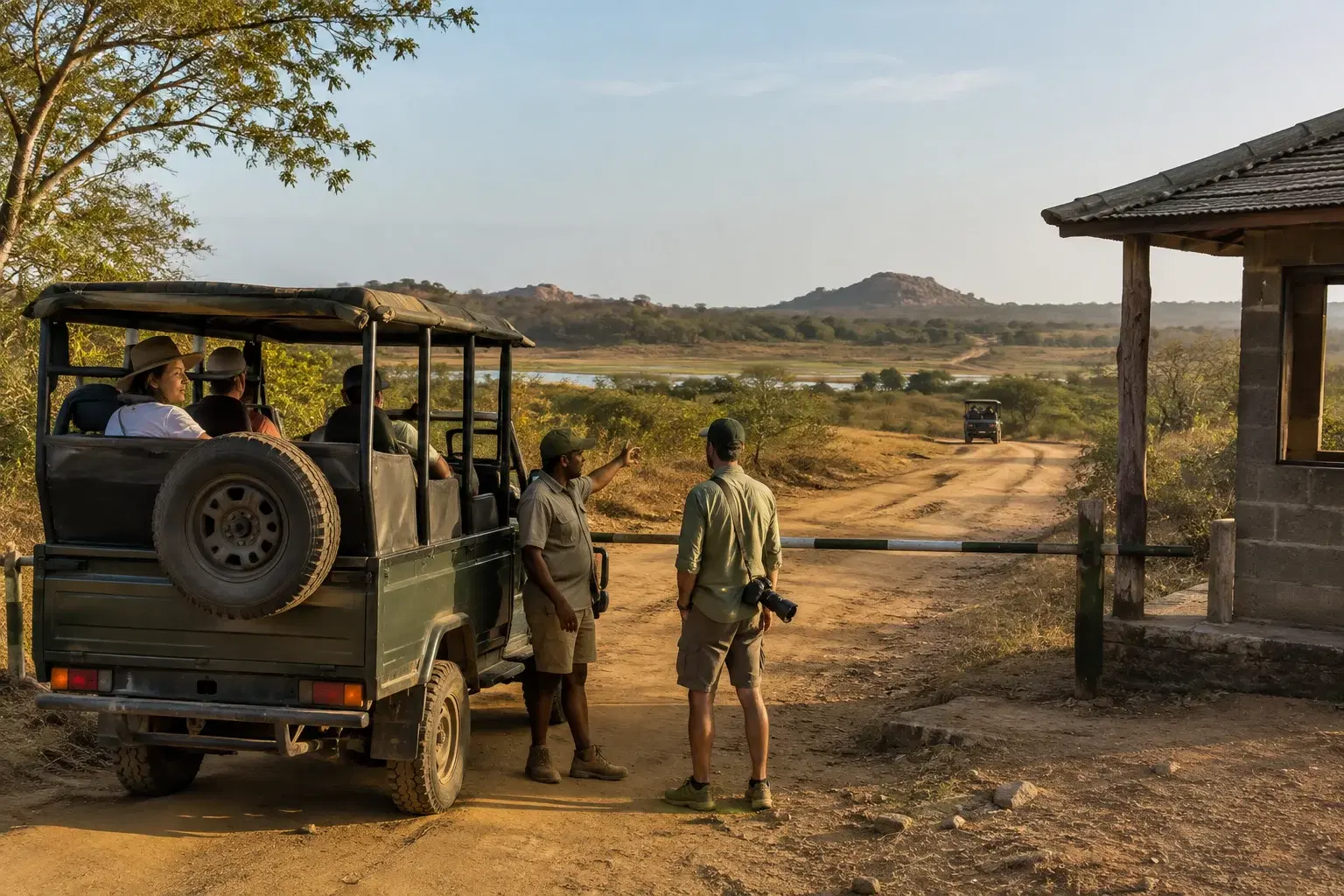
Blocks 3, 4, 5 and 6 extend north and east towards Kumana. Block 5, accessed via the Galge entrance, is the one worth knowing about. It has leopards, elephants and sloth bears, it has a fraction of the vehicles, and during the Block 1 and 2 closure it is the obvious substitute for anyone who has already travelled to Tissamaharama or Kataragama.

The main entrances map onto this. Palatupana is the principal gate for Block 1. Katagamuwa also serves the Block 1 and 2 area. Galge serves the open blocks to the north.

The honest trade-off: Block 5 has lower leopard density than Block 1 and sightings are less frequent. What you gain is that when something does appear, there may be two vehicles at the sighting rather than twenty. Whether that is a better safari is a judgement about what you actually want.

Block 1 is roughly 141 km² of a 979 km² parkBlock 1 carries the leopards and the trafficBlock 5 stays open via the Galge entrancePalatupana and Katagamuwa serve the closed blocksFewer sightings, far fewer vehicles

What a Yala Permit Actually Costs

Search for the Yala entrance fee and you will find USD 25, USD 30, USD 35, USD 42 and USD 45, all presented as the answer. All of them are describing pieces of the same structure without saying which piece.

The Department of Wildlife Conservation bills across four components.

First, the entrance fee, by age and nationality. For non-SAARC foreign visitors this is USD 25 for an adult and USD 15 for a child aged 6 to 12. SAARC nationals pay a reduced rate, around USD 20 and USD 10, on production of a matching passport at the checkpoint. Children under 6 enter free.

Second, a vehicle fee per vehicle entering the park, in the order of LKR 150 for a car or jeep and LKR 500 for a bus or lorry.

Third, a service charge applied per group rather than per person, billed at USD 10 where any foreigner is in the party.

Fourth, 18% VAT on the combined subtotal of entrance, vehicle and service charge. Booking online adds a payment gateway surcharge on top, typically around 2%.

Run that for one non-SAARC adult in a jeep and you land near USD 45 all in, which is exactly where the higher published figures come from. Run it for four adults sharing one jeep and the per-person figure drops considerably, because the USD 10 service charge and the vehicle fee are shared rather than multiplied.

That group arithmetic is the single most useful thing in this section. If you are a solo traveller or a couple, joining a shared jeep materially reduces what you pay in government charges before you have negotiated anything with an operator.

None of the above includes the jeep and driver, which is a separate commercial arrangement and is where prices vary most. Agree that figure, in writing, before the day.

One caution on currency. Fees are set in US dollars but collected in rupees at the rate applied on the day, so the rupee amount moves. Do not budget from a rupee figure quoted in an article written months ago.

Base entrance USD 25 adult, USD 15 child (non-SAARC)Plus vehicle fee, plus USD 10 service charge per groupPlus 18% VAT on the subtotalRoughly USD 45 all in for a solo visitorPer-head cost falls sharply in a shared jeep

Gate Times and How a Yala Day Actually Runs

Gates open at 6 am. The morning session runs until roughly 10 am, when vehicles exit for the middle of the day. The afternoon session begins around 2 to 2.30 pm and vehicles must be out by around 6 to 6.30 pm.

To make a 6 am gate you are typically being collected between 4.30 and 5 am, which is a genuine consideration if you are travelling with children or have just come off a long drive.

The morning session is generally the stronger of the two for wildlife activity, and it is also the busier. The afternoon session has fewer vehicles and, in the dry season, animals moving towards water late in the day.

Full-day options exist but involve a long, hot, largely inactive middle period. Most wildlife does very little between 10 am and 2 pm and neither will you.

Book the permit and the jeep in advance during December to April. In the shoulder months it is usually possible to arrange the day before.

One thing worth knowing before you go: Yala Block 1 in high season can put a large number of vehicles at a single leopard sighting. Radio coordination between drivers is standard practice. If a crowded, competitive sighting would spoil the experience for you, that is an argument for an open block or a different park rather than an argument you can win on the day.

Gates open 6 am; morning session to about 10 amAfternoon session from about 2 pm to 6 pmPickup is typically 4.30 to 5 amFull-day options include a dead middle periodVehicle crowding at sightings is real in Block 1

Alternative One: Udawalawe, for Elephants

If elephants rather than leopards are the point, Udawalawe is arguably the better park regardless of whether Yala is open.

It is open throughout the Yala closure. It is smaller and more open in character, with grassland and a large reservoir, which means sightings are less about luck and more about arriving.

Elephant sightings are close to reliable, which is unusual and is why the park suits families and anyone with one shot at a safari. There are no leopards in practical terms.

It is roughly two hours from the Tissamaharama and Kataragama area, so a trip planned around Yala can be redirected without unpicking the whole itinerary.

Fee structure follows the same DWC pattern as Yala, so apply the same arithmetic: base fee plus vehicle plus a per-group service charge plus 18% VAT.

Open throughout the Yala closureNear-reliable elephant sightingsOpen terrain, easier viewingSuits families and first-time safari-goersAbout two hours from Tissamaharama

Alternative Two: Wilpattu, for Leopards Without the Convoy

Wilpattu is Sri Lanka's largest national park and, on any measure of atmosphere, the most rewarding for people who dislike crowds.

Its defining feature is the villus, natural sand-rimmed lakes scattered through dense dry forest. The forest is thicker than Yala's scrub, which cuts sighting frequency but makes the sightings you do get feel earned rather than queued for.

Leopards are present and regularly seen. So are sloth bears, particularly when palu fruit is in season.

The catch is location. Wilpattu is in the north-west, roughly three to four hours from Colombo and a long way from the southern circuit. It is not a same-week substitute for a Yala booking unless your itinerary has slack in it. It fits naturally with Anuradhapura and the Cultural Triangle.

For anyone whose trip has not been finalised, this is the redirection we would argue for most strongly.

Sri Lanka's largest national parkVillus: natural lakes in dry forestLeopards and sloth bears, far fewer vehiclesNorth-west location, pairs with AnuradhapuraDenser forest means fewer but quieter sightings

Alternatives Three and Four: Kumana and Bundala, for Birds

Kumana adjoins Yala on its eastern side and is reached from the Arugam Bay direction rather than the Tissamaharama one. It is a serious birding park built around a large mangrove swamp lagoon, with elephants, crocodiles and occasional leopards alongside.

Because jeep distances are longer, the all-in cost per person often works out higher than Yala despite the same base fee. Budget accordingly.

It is at its best when the migratory season builds from around April onwards, and it fits naturally into an east coast itinerary rather than a southern one.

Bundala is the other direction: a coastal wetland complex near Hambantota, internationally recognised for its waterbird populations. Flamingos are the headline in season. It is small, cheap by comparison, and it can be done as a half-day from the same base as Yala.

Neither park will produce a leopard photograph to replace the one you had planned. Both will produce a considerably better morning than sitting in a hotel because Block 1 is shut.

Kumana: lagoon birding, reached via Arugam BayKumana jeep distances raise the all-in costBundala: coastal wetland near HambantotaFlamingos and migratory waterbirds in seasonBundala works as a half-day from the Yala base

Alternative Five: Minneriya and Kaudulla, at Their Annual Peak

If your itinerary can move north, this is the strongest argument of all for treating the Yala closure as an opportunity rather than a loss.

The elephant gathering at the Minneriya reservoir peaks in the August to September window. Counts in the low hundreds have been recorded in single afternoons. It is one of the largest concentrations of Asian elephants anywhere and it is happening right now, in the same weeks Block 1 is shut.

Kaudulla and Hurulu Eco Park are adjacent and are used interchangeably depending on where the herd has moved. A good driver will know which is producing on the day; that flexibility is worth more than a fixed booking.

It sits directly alongside Sigiriya, Dambulla and Polonnaruwa, so it slots into a Cultural Triangle leg without additional travel days.

One honest note on framing. The gathering happens because the reservoir shrinks in drought and the surrounding grassland concentrates the herds. It is a response to water stress, not a festival, and it draws a large number of vehicles. Keep distance, do not let a driver push in for a photograph, and treat the spectacle as something you are permitted to observe rather than entitled to.

Gathering peaks in the August to September windowHundreds of elephants recorded in single afternoonsKaudulla and Hurulu are interchangeable alternativesFits alongside Sigiriya and PolonnaruwaDriven by water stress; keep distance

If You Have Already Booked

Work through it in this order.

Check your date against the actual closure window, not the one in the article that worried you. Anything before 14 September or after 15 October 2026 is currently unaffected for Blocks 1 and 2.

If your date falls inside the window, ask your operator specifically whether they can run the day in Block 5 via the Galge entrance. Many can. Some will not offer it unless asked, because it is a longer drive from the usual bases.

If Block 5 does not work, ask about Udawalawe. It is the least disruptive substitution from a southern base.

Check what you actually paid for. A permit is issued for a date and is not refundable once purchased. A jeep and driver arrangement is a private contract and is usually more flexible. These are separate things and operators sometimes present them as one.

Do not book anything non-refundable for the days immediately after 15 October on the assumption the park will reopen on schedule. Reopening has been extended in past years when the rains did not arrive. The reopening is conditional on conditions improving, and the department has said as much in previous seasons.

The upside, if your dates are flexible: the period just after reopening consistently has the lowest jeep volumes of the year, before the December to April season builds.

Confirm your date against 14 September to 15 OctoberAsk specifically about Block 5 via GalgeUdawalawe is the easiest southern substitutionPermits are non-refundable; jeep hire usually is notDo not assume a punctual 15 October reopening

Why the Closure Exists, and Why It Should

It is worth saying plainly that the closure is a good thing, and that a traveller inconvenienced by it is not the injured party.

Yala Block 1 absorbs a very large volume of vehicles for its size. There is no cap on jeep numbers on a given day. In peak season a single leopard sighting can attract a queue of vehicles, and drivers coordinate by radio to converge on them.

A closure period allows vegetation to recover, gives animals space to move through the block without vehicles tracking them, and lets park staff carry out maintenance and provide water where natural sources have failed.

The Department of Wildlife Conservation is working with limited resources across 21 national parks. A six-week rest for the country's most heavily visited block is a modest intervention.

The version of this article that would get more clicks would frame the closure as a problem to be worked around. It is more accurately a constraint that exists for a reason, and the reasonable response is to go somewhere else for six weeks.

No cap on daily jeep numbers in YalaVehicle convergence at sightings is standardClosure allows vegetation and wildlife to recoverStaff use the window for water provision and maintenanceA six-week rest is a modest intervention

Doing a Sri Lankan Safari Well

Whichever park you end up in, a few things separate a good day from a bad one, and most of them are within your control.

Set expectations with your driver at the start, out loud. Say that you do not want the vehicle to chase, block, or crowd an animal, and that you would rather miss a sighting than pressure one. Most drivers will respect this. Some will not offer it unless asked, because most customers ask for the opposite.

Do not ask for off-track driving. It is prohibited and it damages habitat.

Keep noise down, stay seated, and do not stand on the vehicle to get a better angle.

Never feed anything. Roadside feeding of elephants outside parks is a serious problem in Sri Lanka and is directly implicated in human-elephant conflict.

Bring more water than you think and a hat. Dry-zone parks are hot and there is no shade in an open jeep.

Accept that you may not see a leopard. Yala's density is exceptional by world standards and it still does not guarantee anything. A safari sold on a guaranteed sighting is being sold dishonestly.

Tip the driver and tracker directly, in cash, at the end. This is customary and it is separate from whatever the operator charged.

Tell the driver you do not want animals crowdedOff-track driving is prohibitedNever feed wildlife, in or out of parksNo sighting is ever guaranteedTip driver and tracker directly in cash

Travel Tips

  • Verify closure status with the Department of Wildlife Conservation before booking anything non-refundable
  • Blocks 1 and 2 are closed 14 September to 15 October 2026; Blocks 3 to 6 are open
  • Ask your operator specifically about Block 5 via the Galge entrance
  • Budget roughly USD 45 per person in government charges for a solo Yala visit, less in a shared jeep
  • Fees are set in dollars but collected in rupees at the day's rate
  • Children under 6 enter free; ages 6 to 12 pay a reduced rate
  • SAARC nationals must present a matching passport at the checkpoint for the discount
  • Gates open at 6 am, which means a 4.30 to 5 am pickup
  • Agree the jeep and driver price in writing before the day
  • Permits are not refundable once purchased; jeep hire usually is more flexible
  • Do not book tightly around 15 October; reopening has slipped in past years
  • Tell your driver at the start that you do not want animals crowded or chased
  • Carry more water than you think you need and a hat
  • Tip the driver and tracker directly in cash at the end

Frequently Asked Questions

Is Yala National Park open in September 2026?

Partly. Blocks 1 and 2 are closed from 14 September to 15 October 2026 following a Department of Wildlife Conservation announcement in late August, citing drought conditions. Blocks 3, 4, 5 and 6 remain open throughout. The park was fully open in the first two weeks of September 2026.

Why do most websites say Yala closes on 1 September?

Because that has often been the date historically, and most articles are written well in advance and never updated. The department sets and announces the dates close to the time, and they vary: some years have started on 1 September, some have run to 31 October, and in two or three recent years no closure was declared at all. For 2026 the announced window is 14 September to 15 October.

Which Yala blocks stay open during the closure?

Blocks 3, 4, 5 and 6. Block 5, reached through the Galge entrance, is the most practical substitute and holds leopards, elephants and sloth bears with far fewer vehicles than Block 1. Palatupana and Katagamuwa serve the closed Block 1 and 2 area.

How much does a Yala safari cost in 2026?

The government charges break into four parts: entrance fee (USD 25 for a non-SAARC adult, USD 15 for a child 6 to 12, reduced for SAARC nationals, free under 6), a vehicle fee of roughly LKR 150 for a jeep, a service charge of USD 10 per group where a foreigner is present, and 18% VAT on that subtotal. Online booking adds a gateway surcharge of about 2%. A solo visitor lands near USD 45; a shared jeep reduces the per-head figure considerably because the service charge and vehicle fee are shared. Jeep and driver hire is separate and negotiated.

Will Yala definitely reopen on 15 October 2026?

Treat it as provisional. Reopening is conditional on conditions improving, and in past seasons the department has extended closures when rains failed to arrive. Do not book non-refundable arrangements for the days immediately after the stated reopening date.

What is the best alternative to Yala for leopards?

Wilpattu, in the north-west. It is Sri Lanka's largest national park, has resident leopards and sloth bears, and carries a fraction of the vehicle traffic. The trade-off is denser forest, so fewer sightings, and a location that fits the Cultural Triangle rather than the southern coast.

What is the best alternative for elephants?

Udawalawe, about two hours from Tissamaharama and open throughout the closure. Sightings are close to reliable because the terrain is open grassland around a reservoir. There are no leopards in practical terms. For sheer numbers, the Minneriya gathering peaks in the August to September window and can put hundreds of elephants in one place.

Can I visit Yala without a jeep?

No. Access is by permitted vehicle with a driver, and off-track driving is prohibited. The vehicle fee is part of the permit structure.

Is the morning or afternoon safari better?

Mornings generally have more wildlife activity and more vehicles. Afternoons are quieter and, in dry conditions, animals move towards water late in the day. Gates open at 6 am with the morning session running to about 10 am; the afternoon session runs from around 2 pm to 6 pm.

Am I guaranteed to see a leopard at Yala?

No, and any operator suggesting otherwise is being dishonest. Yala Block 1 has an exceptional leopard density by world standards, which improves the odds substantially and guarantees nothing.

Why does Yala close at all?

The stated reason is drought: waterholes shrink at the end of the dry period and animals come under stress. The department also uses the window for development work, building temporary water holes and trucking water where tanks have gone dry. The closure additionally gives the most heavily visited block a rest from vehicle pressure, and officials have noted it overlaps with leopard breeding.

Do children pay to enter Yala?

Children aged 6 to 12 pay a reduced entrance fee, around USD 15 for non-SAARC nationals. Children under 6 enter free. The per-group service charge and the vehicle fee still apply to the party as a whole.

Reader notes

Join the conversation

Share your question, tip, or travel experience for this guide.

Comments

0 comments

Loading...

Ready to turn inspiration into a Sri Lanka trip?

Use LankaTrip to plan your journey, connect with local guides, and make this itinerary a reality.

Need help planning?

Plan your Sri Lanka adventure

Plan my trip