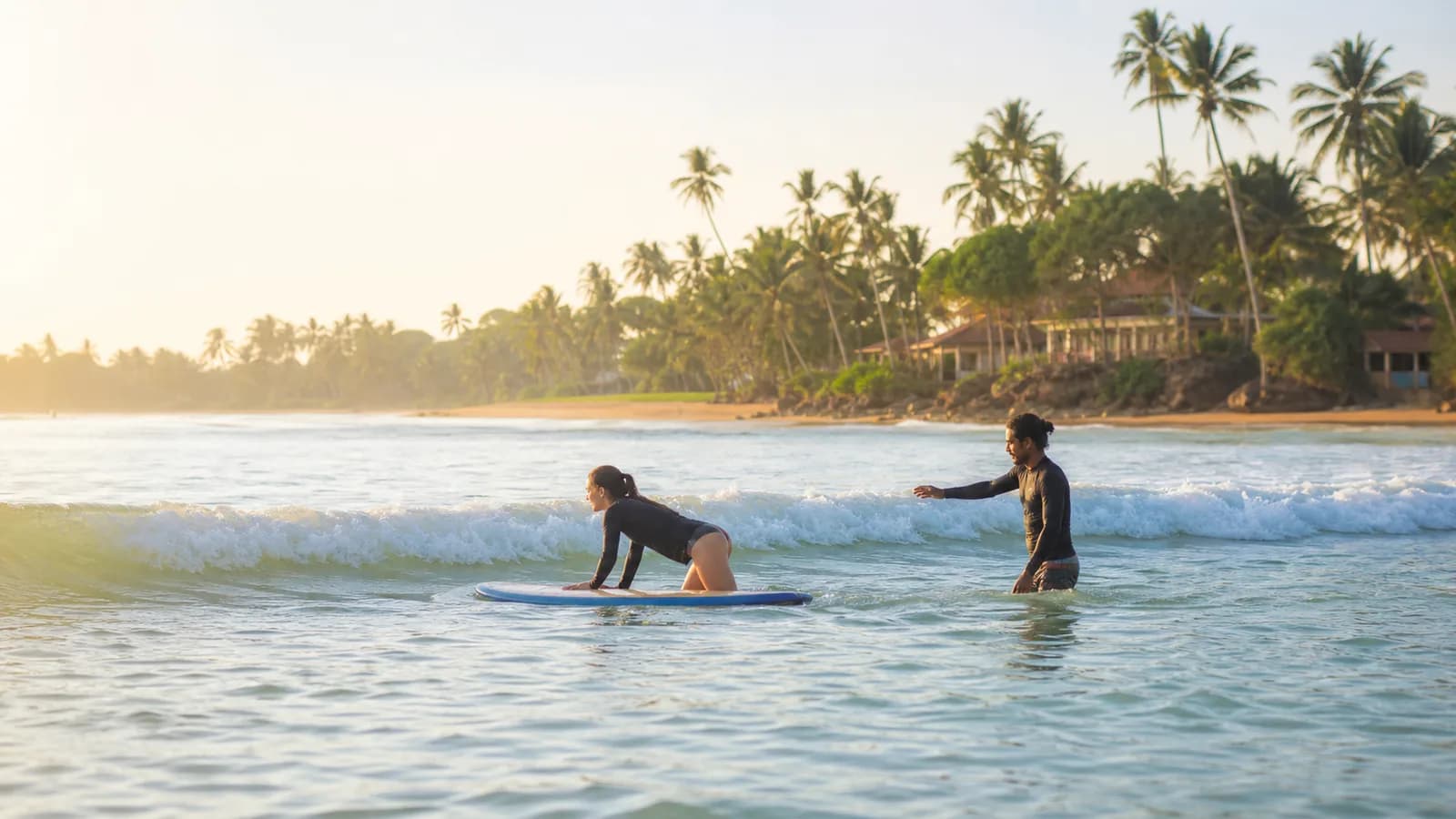
Most people who dream of learning to surf imagine two obstacles: cold water and expensive lessons. Sri Lanka removes both.
The sea here stays around 27 to 29 degrees Celsius all year, warm enough that a wetsuit is never part of the conversation. A 90-minute group lesson with a board, rash guard, and instructor costs about what a single coffee-shop breakfast does in Sydney or London. And the island's signature learning wave, the long, soft, sandy-bottom roller of Weligama Bay, is about as gentle an introduction to the sport as the ocean offers anywhere.
That combination is why Sri Lanka has quietly become one of the world's great learn-to-surf destinations, drawing complete beginners from Europe, Australia, and increasingly North America to a string of laid-back coastal villages where the daily rhythm is surf, eat, nap, repeat.
This guide is written for the traveler who has never stood on a surfboard, or who has had one wobbly lesson on holiday and wants to actually learn. It covers where to go in 2026 depending on your dates, what lessons and camps genuinely cost, how to choose a school you can trust, what your first week in the water will really feel like, and the safety and etiquette basics that keep the experience fun.
If you are already an intermediate or advanced surfer researching reef breaks and swell windows, our general Sri Lanka surfing guide covers the full spot map. This one is for first waves.
L'essentiel
- Sri Lanka is one of the cheapest and most forgiving places in the world to learn to surf, with group lessons from roughly 18 to 25 US dollars
- Total beginners learn fastest on the south coast from November to April, and at the east coast's gentler bays from May to September
- Weligama is the island's beginner nursery: a huge sandy-bottom bay where almost everyone stands up in their first lesson
- Surf camps bundle accommodation, daily lessons, and breakfast from roughly 300 to 700 euros per week; individual lessons suit shorter trips
- Five to seven days of daily surfing is the realistic minimum to go from never-surfed to catching small green waves
- Choose schools with certified instructors, small student ratios, soft beginner boards, and clear safety briefings