
LankaTrip Insights

25 min de lecture

Sri Lankan Cooking Classes and Food Experiences in 2026 and 2027: What You Actually Learn, and the One Ingredient Vegetarians Need to Know About

Maldive fish — dried, cured tuna — is invisible once mixed into pol sambol, seeni sambol and many vegetable curries. It is the single most important thing a vegetarian traveller can learn here, and almost no cooking class mentions it unasked. This guide covers that, what a class genuinely teaches, and why the roadside spice garden your driver suggests is not a food experience.

Retour au blog
Sri Lankan Cooking Classes and Food Experiences in 2026 and 2027: What You Actually Learn, and the One Ingredient Vegetarians Need to Know About

Sri Lankan food is the thing visitors most consistently underestimate before arriving and most consistently rave about afterwards. It is not Indian food with different branding. It is its own cuisine, built on coconut in three forms, a distinctive spice register, sour notes from goraka and tamarind, and a meal structure that puts five to a dozen separate dishes on the table at once.

A cooking class is the fastest way to understand it, and it is one of the best-value experiences available here. Three or four hours gets you a market walk, a kitchen full of unfamiliar technique, a meal you made yourself, and usually a recipe sheet you will actually use at home. It also works on a rainy afternoon, which in a country with as much rain as this one is a practical advantage rather than a footnote.

But the experiences on offer vary enormously in what they actually deliver, and the word 'class' covers everything from a genuine hands-on session in a family kitchen to a chef demonstrating in front of you at a hotel while you drink a welcome juice.

There is also a specific piece of knowledge that belongs at the front of any article about Sri Lankan food, because it affects a large number of travellers and almost nobody volunteers it. Maldive fish — umbalakada, dried and cured tuna — is used as a background savoury seasoning across the cuisine. It goes into pol sambol, the coconut relish that accompanies almost every meal. It goes into seeni sambol, into kiri hodi, into a good number of vegetable curries. Once mixed in it is entirely invisible. A vegetarian traveller can eat it for two weeks without knowing.

And there is a related experience that gets sold as food tourism and is not: the roadside spice gardens along the Kandy to Matale to Dambulla corridor, which a large number of drivers will suggest, and which are retail operations with a botanical preamble.

This guide covers what a good class teaches, how to choose one, the ingredient knowledge that makes eating here easier, how the regional cuisines differ, and which food experiences are worth your money.

L'essentiel

  • A good class is hands-on: you scrape coconut, extract milk, grind spices and cook six to ten dishes
  • A weak class is a demonstration you watch, often at a hotel, with little technique transferred
  • Market visits genuinely add value and are worth paying more for
  • Maldive fish appears invisibly in pol sambol, seeni sambol, kiri hodi and many vegetable curries
  • The phrase to learn is umbalakada epa — no dried fish
  • Rice and curry is a template rather than a recipe; the combination changes daily with what is fresh
  • Sri Lanka is excellent for vegetarians and slightly harder for strict vegans, for one specific reason
  • The roadside spice gardens on the Kandy to Matale to Dambulla corridor are retail operations, not cooking experiences
  • Drivers commonly receive commission for delivering you to those gardens
  • Regional cuisines differ substantially — Jaffna, the coast, the hill country and the Burgher and Malay traditions are not interchangeable

What a Good Cooking Class Actually Teaches

The distinction that matters is between learning technique and watching food being made. A good Sri Lankan cooking class transfers about five specific skills, and if the session you book does not include them, you have booked a meal rather than a class.

Scraping coconut. Fresh coconut is the foundation of the cuisine and it is scraped by hand, traditionally on a hiramanaya, a bench-mounted serrated blade. Almost nobody outside the region has done this, and it is genuinely satisfying.

Extracting coconut milk. First and second extractions behave differently in a curry — the thick first milk goes in late so it does not split, the thinner second milk goes in early. This single piece of knowledge fixes most home attempts at Sri Lankan food.

Tempering. Whole spices, curry leaves, pandan and shallots are bloomed in hot oil to build the base layer of flavour. The sequence and timing matter and are hard to learn from a written recipe.

Balancing a curry. Sri Lankan cooking relies on sour elements — goraka in fish curries, tamarind, lime — alongside heat and coconut richness. Understanding how those three are balanced is what separates a competent home cook from someone following instructions.

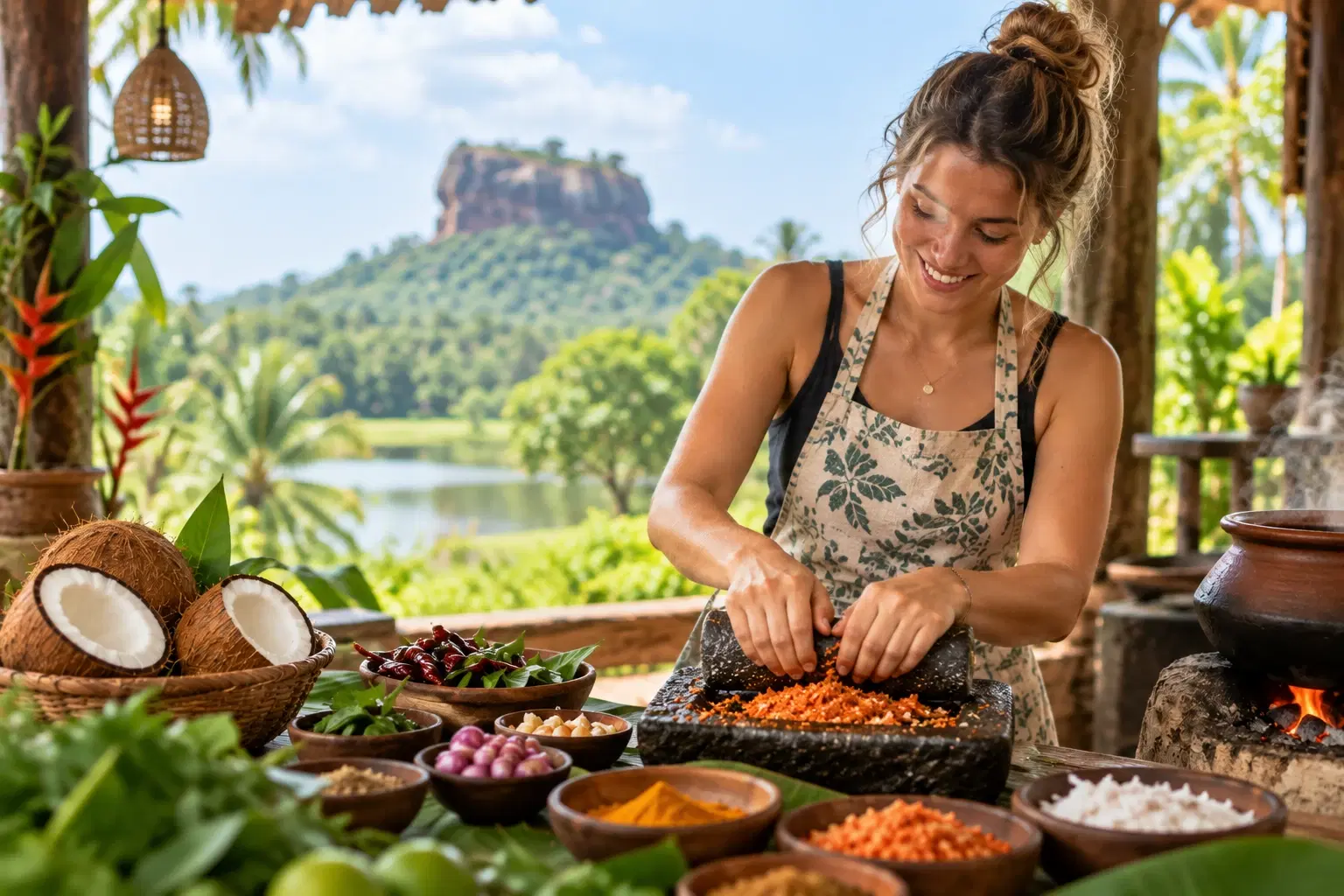
Grinding pol sambol. Traditionally made on a miris gala, a flat grinding stone, with coconut, chilli, shallots, lime and salt. Doing it by hand versus using a food processor produces genuinely different results, and a good class will let you feel the difference.

On the menu, a typical class covers a rice and curry spread — several vegetable curries, a dhal, a meat or fish curry, a mallung of chopped greens with coconut, a sambol, and papadam — often plus hoppers or string hoppers, and sometimes a dessert such as watalappam.

Six to ten dishes is normal and the volume is deliberate, because a rice and curry is defined by having many things on the plate at once rather than by any single dish being the centrepiece.

What you should leave with: a recipe sheet you can follow at home, an understanding of which spices are non-negotiable and which can be substituted outside Sri Lanka, and advice on where to source curry leaves, pandan and goraka in your own country. A class that does not address the substitution problem has not really taught you to cook this food where you live.

Coconut scraping and milk extraction, first versus secondTempering whole spices — sequence and timingBalancing sour, heat and coconut richnessGrinding pol sambol on a stoneSubstitution advice for cooking at home afterwards

How to Choose, and What to Ask Before You Book

There are roughly three formats on offer and they suit different people.

The home or family class. Held in a private home or guesthouse kitchen, usually small, often taught by the person who cooks that family's meals every day. This is generally the best experience: the technique is authentic, the group is small enough to do everything yourself, and the conversation around the food is half the value. Colombo, Galle and the south coast, Ella, Kandy and the villages around Sigiriya and Dambulla all have strong options.

The cooking school. More structured, larger groups, usually a fixed menu and a proper teaching kitchen. Good for people who want organisation and a reliable syllabus, slightly less intimate.

The hotel demonstration. A chef cooks in front of you. This can be enjoyable and the food is usually excellent, but the skill transfer is limited. Know which one you are buying.

The questions worth asking before you pay: Is it hands-on or a demonstration? How many people are in the group? Is a market visit included? How many dishes will we cook? Do we eat what we make? Will I get written recipes? Can you accommodate my dietary requirements, and specifically, do you use Maldive fish?

Group size is the variable that most affects the experience. Four to eight people is a class. Sixteen is a show.

The market visit is worth paying extra for. Walking a Sri Lankan market with someone who can name the vegetables, explain what goraka is, point out the difference between the rice varieties and show you what a good coconut looks like is genuinely educational, and it is the part most people remember. It also reframes every meal you eat for the rest of the trip.

A note on timing: classes typically run either morning into lunch or afternoon into dinner. The morning option usually includes the market, since that is when markets are at their best. If you have a choice, take the morning.

On price, we are not publishing figures. The range across formats, cities and group sizes is very wide and we could not verify a reliable current range. Confirm the price, what is included, and whether it covers the meal before booking rather than afterwards.

Home classes generally beat schools and hotel demonstrationsAsk directly: hands-on or demonstration?Group size is the biggest variable — four to eight is idealPay extra for the market visit; it is the memorable partTake the morning session if you have the choice

Umbalakada: The Ingredient Vegetarians Need to Know About

This is the most practically useful thing in this article, and it deserves its own section.

Maldive fish, called umbalakada in Sinhala, is tuna that has been boiled, smoked and sun-dried until it is hard enough to resemble wood. It is then broken into chips or pounded into flakes and used across Sri Lankan cooking as a savoury background note — the thing that gives a dish depth you can taste without being able to identify.

Where it turns up: pol sambol, which accompanies almost every meal and looks like nothing but coconut, chilli, shallot and lime. Seeni sambol, the sweet caramelised onion relish. Kiri hodi, the mild coconut gravy. A considerable number of vegetable curries. And some dhal preparations.

The problem for a visitor is that it is invisible. Once pounded and mixed into grated coconut it cannot be seen, and the dish presents as entirely plant-based. Many restaurant staff do not think to mention it, because to a Sri Lankan cook it is a seasoning in the way that fish sauce is a seasoning in Thai cooking, rather than an ingredient that makes a dish non-vegetarian.

The solution is one phrase: umbalakada epa, meaning no dried fish. Said when ordering sambols and curries, it will usually get you a version made without it. Vegan Sri Lankan households make pol sambol without umbalakada every day, so this is a normal request rather than an awkward one.

A wider set of useful phrases: mas epa for no meat, malu epa for no fish, kiri epa for no dairy or milk, bittara epa for no eggs. Learning these five will do more for a plant-based traveller here than any restaurant list.

Shrimp paste is a less common but real second issue, particularly in coastal areas and in cooking that blends Tamil and Sinhalese traditions. Worth asking about if you are strict.

The broader picture is genuinely positive. Sri Lanka is excellent territory for vegetarians. Most everyday curries are plant-based — jackfruit, breadfruit, green banana, drumstick, ash plantain, beetroot, cashew and a wide range of leafy vegetables are all treated as main-course ingredients in their own right rather than as side dishes. A lunchtime rice and curry buffet will typically set out eight to twelve options, several of which are always suitable. The country is not a difficult place to eat plant-based; it is a place with one specific invisible ingredient you need to know the name of.

In a cooking class, ask about this at booking rather than on the day. A good instructor will simply make the vegan version, and will often explain the difference, which is itself interesting.

Umbalakada is dried, cured tuna used as a background seasoningIt appears in pol sambol, seeni sambol, kiri hodi and many vegetable curriesIt is invisible once mixed inSay 'umbalakada epa' — no dried fishAlso learn: mas epa, malu epa, kiri epa, bittara epa

The Spice Garden Problem

If you travel the Kandy to Matale to Dambulla road, there is a good chance your driver will suggest stopping at a spice garden. It is worth understanding what this is before you agree.

The pattern is consistent enough across many separate establishments and many years of visitor accounts to describe as a model rather than as isolated bad experiences. Entry is free. You receive a short guided walk through a garden of spice and medicinal plants, which is usually genuinely interesting. You are then seated, given a spice tea, and talked through a range of Ayurvedic preparations. Frequently a massage is provided without being requested, after which a tip is expected. Someone presenting as an Ayurvedic doctor may take your pulse and identify ailments — often ones you mentioned in conversation earlier in the visit. You are then taken to a shop, handed a basket, and sold products at prices that visitors consistently report as many multiples of what comparable items cost in ordinary shops and markets.

Visitor accounts repeatedly describe two further elements: products that do not resemble what was demonstrated, and drivers and guides receiving commission for the delivery.

We are describing a widespread pattern rather than accusing any particular business, and some visitors report perfectly pleasant experiences with no pressure at all. But the volume and consistency of complaints across many establishments makes this worth knowing about in advance.

How to handle it, without making anyone an enemy. You are entitled to decline the stop entirely — tell your driver in advance that you do not want to visit a spice garden, and do it politely at the start of the day rather than at the gate. If you do go, treat the walk as the experience and the shop as optional. Do not discuss your health complaints with anyone on the premises. Decline the massage if you do not want it, before it starts. Do not let items be placed in a basket on your behalf. Ask the price of each item individually, in rupees, before it goes in. And check your card receipt against the agreed amount before leaving, as currency confusion is a recurring theme in complaints.

If you want genuine Ayurvedic products, buy them from established retailers or pharmacies rather than roadside operations, and be aware that the Department of Ayurveda registers qualified practitioners — someone described as a doctor at a roadside garden may or may not be one.

If you want to learn about spices, a cooking class market visit does the job far better and costs a fraction as much. You will handle cinnamon, cardamom, goraka, pandan and curry leaf, learn what they do in a dish, and buy them at market prices if you want to take some home.

None of this means every spice garden is dishonest. It means the format is built around retail, that the incentives run against you, and that calling it a food experience is generous.

Free tour, then a structured sales processDrivers commonly receive commission for bringing youDo not discuss your health complaints on the premisesAsk the price of each item before it enters the basketA cooking class market visit teaches spices far better

The Regional Cuisines Are Not Interchangeable

Travellers often talk about Sri Lankan food as a single thing. It is not, and knowing the differences makes the whole trip eat better.

The coastal south and west. Fish-dominated, with ambul thiyal — a dry, intensely sour fish curry preserved with goraka — as the signature dish. Coconut in everything. This is the cuisine most visitors encounter first, since it covers Colombo, Negombo, Galle and the south coast beaches.

Jaffna and the north. A Tamil cuisine with its own identity, notably more chilli-forward, with distinctive use of tamarind and a different spice register. Jaffna crab curry is the dish it is famous for and it deserves the reputation. Odiyal kool, a seafood and palmyra soup, is the regional speciality that visitors rarely encounter. If you go north, eat accordingly rather than ordering the same things you ate in Galle.

The hill country. Vegetable-led, with hearty curries, earthy dhal and creative use of wild greens in mallungs — gotukola sambol, made with pennywort, is the one to try. The cool climate also produces vegetables you will not see in the lowlands, and strawberries around Nuwara Eliya.

The dry zone and the Cultural Triangle. Freshwater fish, and a strong tradition of village cooking using produce grown in home gardens. Village cooking experiences around Sigiriya, Dambulla and Habarana are among the best food experiences in the country, often including a bullock cart ride, a lake crossing and a meal cooked over a wood fire in clay pots. These are properly worth doing.

Burgher and Malay traditions. The product of centuries of Portuguese, Dutch and Malay settlement, concentrated in Colombo and Kandy. Lamprais — rice, curries, frikkadel meatballs and sambol baked together in a banana leaf — is a Dutch Burgher dish and a genuinely distinct thing. Watalappam, a spiced coconut and jaggery custard, comes from the Malay community and is the country's best dessert.

Muslim Sri Lankan cooking is a further tradition, with its own biryanis and the ubiquitous short eats found in every bakery.

The practical takeaway: if you are doing a cooking class in the hill country, ask for hill country dishes. If you are in Jaffna, do not eat southern food. The regional variation is one of the more rewarding things about eating here and it is easy to miss by ordering the same rice and curry everywhere.

Coastal: fish-led, ambul thiyal, heavy coconutJaffna: Tamil, chilli-forward, crab curry, odiyal koolHill country: vegetable-led, gotukola, wild greensCultural Triangle: village cooking over wood firesBurgher and Malay: lamprais and watalappam

Food Experiences Beyond the Cooking Class

A cooking class is the obvious option but it is not the only one, and some of the others are better value.

Market tours on their own. Pettah in Colombo, the markets in Kandy, Galle and Negombo, and the fish market at Negombo in the early morning are all worth an hour or two with someone who can explain what you are looking at. The Negombo fish market, in particular, is at its most extraordinary very early.

Village cooking experiences in the Cultural Triangle. Typically a half-day: transport by bullock cart or tractor, a lake crossing, and a meal cooked over a wood fire in clay pots and eaten sitting on the floor of a village house. The food is simple and excellent and the format supports rural households directly.

Street food walks in Colombo. Kottu, short eats, hoppers in the evening, and the specific pleasure of watching a kottu cook work a hot plate with two metal blades, which is as much percussion as cooking.

Tea experiences in the hill country. A factory tour explains the manufacturing process and a proper tasting will teach you more about grading than any amount of reading. This is also entirely weather-proof, which matters in the hills.

Toddy and arrack. Palm toddy tapping is a traditional occupation on the coast and arrack is the national spirit. Some coastal areas offer explanations of the tapping process, which is genuinely interesting.

Eating at a lunch buffet. Not an experience you book, but worth stating plainly: a local rice and curry lunch at an ordinary restaurant, where eight to twelve curries are set out and you take what you want, is the single best introduction to the cuisine and costs very little. Do this on your first day, before booking anything.

One thing to be careful about: dinners at your accommodation are often excellent and are usually the easiest option, but they tend to be toned down for foreign palates. If everything tastes mild, ask for it the way the family eats it. The answer is frequently a completely different meal.

Standalone market tours, especially Negombo fish market earlyVillage cooking experiences in the Cultural TriangleStreet food walks and evening hoppers in ColomboTea factory tours are entirely weather-proofEat a local rice and curry buffet on day one

Chilli Levels, Stomach Upsets and Practical Realities

A few practicalities that come up constantly and are rarely addressed directly.

On heat: Sri Lankan food is genuinely spicy, and considerably more so than most visitors expect. Food served to tourists is routinely reduced, sometimes drastically. If you want the real version, say so — the phrase is simple and staff will usually be delighted. If you want it milder, that is equally fine and nobody will judge you. Coconut milk, rice and curd cut heat far better than water does.

Curd and treacle, incidentally, is the traditional dessert and the standard remedy after a meal that was hotter than intended. Buffalo curd with kithul treacle is worth ordering on its own merits.

On stomach upsets: the usual sensible practice applies. Drink bottled or properly treated water. Eat at places that are busy, since turnover means fresh food. Be more cautious with pre-cut fruit and with anything that has been sitting at ambient temperature. Freshly cooked, hot food from a busy street stall is generally safer than lukewarm food from a quiet restaurant.

Hand washing matters more than usual, because a substantial amount of Sri Lankan food is traditionally eaten with the right hand. Eating with your hand is worth trying and is genuinely a different sensory experience — but wash properly first and use your right hand only, as the left is considered unclean.

On allergies: Sri Lankan cooking uses coconut in almost everything, cashew in a number of curries, and mustard and sesame in tempering. A serious nut allergy needs to be communicated clearly and repeatedly, and written down in Sinhala is far better than spoken in English. Cross-contamination in small kitchens is a real risk and should be discussed frankly rather than hopefully.

On dietary requirements at classes: tell the instructor at the time of booking, not on arrival. Ingredients are bought fresh that morning, often at the market you are about to visit, so late notice genuinely limits what they can do.

And on portions: a Sri Lankan rice and curry lunch is substantial. A cooking class that produces eight dishes will produce more food than a group can eat. Come hungry and do not book dinner afterwards.

Food served to tourists is routinely toned down — ask for the real versionCurd and treacle is both dessert and heat remedyBusy places mean high turnover and fresher foodEat with your right hand only, and wash properly firstDeclare allergies at booking, in writing, ideally in Sinhala

Taking the Food Home

Most people leave a cooking class intending to cook this food at home and most never do, usually because of an ingredient problem that could have been solved before they left.

What to buy here: Ceylon cinnamon, which is genuinely different from the cassia sold as cinnamon in most countries and is one of the few things that is both better and cheaper in Sri Lanka. Curry powder, both raw and roasted, which are different products used for different dishes. Goraka, the sour dried fruit used in fish curries, which is almost impossible to find abroad. Pandan leaf, which dries acceptably. Whole cardamom, cloves and pepper.

Where to buy it: ordinary markets and supermarkets, or established spice retailers in the cities. Prices at a market are a fraction of what a roadside garden charges and the product is generally the same or better. If your cooking class includes a market visit, buy then, with your instructor to advise you.

What not to bother with: curry leaves, which do not dry well and lose most of what makes them worth having. Fresh coconut, obviously. And anything in decorative tourist packaging, which costs a multiple of the same product in a plain bag.

Check your own country's import rules before buying quantities of plant material. Fresh produce is restricted almost everywhere and dried spices are generally fine, but the responsibility is yours.

On substitution, which is the thing that actually determines whether you cook this at home: desiccated coconut can stand in for fresh at a pinch but needs rehydrating and is not the same. Tinned coconut milk works, and the thick top layer approximates first extraction. Tamarind substitutes for goraka imperfectly. Curry leaves are available frozen in most South Asian grocers and freeze far better than they dry.

Ask your instructor these questions directly. A good one will have answered them many times and will tell you honestly which dishes travel and which do not.

Ceylon cinnamon is genuinely better and cheaper hereBuy goraka — it is very hard to find abroadBuy at markets, not roadside gardensSkip dried curry leaves; buy them frozen at home insteadCheck your own country's import rules before buying in quantity

Eating Considerately

A few things worth holding onto, because food tourism touches people's homes and livelihoods more directly than most activities.

A home cooking class means you are in somebody's house. Remove your shoes, dress modestly, ask before photographing family members or the interior, and treat it as a visit rather than a venue.

Book small local operators directly where you can. A family running classes from their kitchen keeps almost all of what you pay; the same class booked through several layers of intermediary does not.

Do not haggle hard over a cooking class or a home meal. Negotiating over a tuk-tuk fare is normal; negotiating over the price of a meal someone has cooked for you in their home is not.

Eat what you are served, or at least try it. Declining food in a Sri Lankan home is more loaded than in many cultures, and genuine dietary requirements should be raised at booking specifically so this situation does not arise.

Be careful with photography in markets. Traders are working, and a camera in someone's face while they are trying to sell fish is an imposition. Ask, buy something, and the dynamic changes entirely.

Support the places that feed locals. Ordinary rice and curry restaurants, bakeries and street stalls operate on thin margins and rarely see foreign customers. Eating at them spreads money more widely than eating at the places set up for visitors, and the food is usually better.

Finally, be honest in your reviews. The food tourism sector here is full of small family operations for whom a fair review matters enormously — and the persistence of the spice garden model described above is partly a function of visitors who felt awkward and said nothing.

A home class is a home — behave accordinglyBook small operators directly where possibleDo not haggle over a home-cooked mealAsk before photographing market tradersEat where locals eat; the money spreads further

Conseils de voyage

  • Ask whether a class is hands-on or a demonstration before booking
  • Choose a class with a market visit, and take the morning session
  • Keep group size small — four to eight is a class, sixteen is a show
  • Declare dietary requirements and allergies at booking, not on arrival
  • Learn 'umbalakada epa' — no dried fish — if you are vegetarian or vegan
  • Also learn mas epa, malu epa, kiri epa and bittara epa
  • Tell your driver in advance if you do not want a spice garden stop
  • Never discuss your health complaints at a roadside spice garden
  • Ask the price of each item individually before it goes in a basket
  • Buy spices at ordinary markets, not at tourist gardens
  • Ask for food the way the family eats it if everything tastes mild
  • Order curd and treacle — dessert and heat remedy in one
  • Eat with your right hand only, and wash properly first
  • Eat at busy places; turnover means fresher food
  • Ask your instructor about ingredient substitutions for cooking at home
  • Do not book dinner after a cooking class — there will be far too much food

Questions fréquentes

What do you actually cook in a Sri Lankan cooking class?

Typically a full rice and curry spread — several vegetable curries, a dhal, a meat or fish curry, a mallung of chopped greens with coconut, a sambol and papadam — often plus hoppers or string hoppers and sometimes a dessert such as watalappam. Six to ten dishes is normal, because a rice and curry is defined by having many things on the table at once.

Where are the best cooking classes in Sri Lanka?

Colombo, Galle and the south coast, Ella, Kandy, Negombo and the villages around Sigiriya and Dambulla all have strong options. The format matters more than the location: a small hands-on class in a family kitchen generally beats a large demonstration anywhere.

What is Maldive fish and why does it matter?

Maldive fish, or umbalakada, is tuna that has been boiled, smoked and dried until hard, then flaked or pounded and used as a background savoury seasoning. It appears in pol sambol, seeni sambol, kiri hodi and many vegetable curries, and it is invisible once mixed in — so a dish can look entirely plant-based and not be.

How do I ask for food without dried fish?

The phrase is 'umbalakada epa'. It is a completely normal request — vegan Sri Lankan households make pol sambol without it every day. Also useful: mas epa for no meat, malu epa for no fish, kiri epa for no dairy, bittara epa for no eggs.

Is Sri Lanka good for vegetarians and vegans?

Very good for vegetarians and manageable for vegans once you know about Maldive fish. Most everyday curries are plant-based, and a lunchtime rice and curry buffet typically offers eight to twelve dishes with several always suitable. Jackfruit, breadfruit, green banana, drumstick and a wide range of leafy vegetables are treated as main-course ingredients here rather than side dishes.

Are the spice gardens worth visiting?

As a food experience, generally not. The consistent pattern across many establishments is a free garden walk followed by a structured sales process — often including an unrequested massage, someone presenting as an Ayurvedic doctor identifying ailments, and products priced at many multiples of ordinary retail. Drivers commonly receive commission for bringing you. A cooking class market visit teaches you far more about spices for far less.

Can I refuse a spice garden stop?

Yes, and it is easier if you say so at the start of the day rather than at the gate. Tell your driver politely that you do not want to visit one. If you do go, treat the walk as the experience, decline the massage before it starts, do not discuss your health, and ask the price of each item individually before it goes into a basket.

Is Sri Lankan food very spicy?

Genuinely, yes — and food served to visitors is routinely toned down, sometimes drastically. If you want the real version, ask for it. If you want it milder, that is equally fine. Coconut milk, rice and curd cut heat far better than water.

How long does a cooking class take?

Three to five hours with a market visit, two to three without. Morning sessions usually include the market, since that is when markets are at their best.

What spices should I buy to take home?

Ceylon cinnamon, which is genuinely different from the cassia sold as cinnamon elsewhere and is both better and cheaper here. Goraka, the sour dried fruit used in fish curries, which is very hard to find abroad. Raw and roasted curry powders, which are different products. Buy at ordinary markets rather than tourist gardens, and check your own country's import rules first.

Do the regional cuisines really differ?

Substantially. Jaffna's Tamil cooking is more chilli-forward with distinctive tamarind use and its own dishes such as crab curry and odiyal kool. The coastal south is fish-led with ambul thiyal. The hill country is vegetable-led. And the Burgher and Malay traditions produced lamprais and watalappam, which belong to neither. Ordering the same rice and curry everywhere means missing most of this.

Can classes accommodate allergies?

Usually, but tell them at booking rather than on arrival, because ingredients are bought fresh that morning. Note that coconut is in almost everything, cashew appears in a number of curries, and mustard and sesame are used in tempering. For a serious allergy, have it written down in Sinhala and discuss cross-contamination frankly.

Is a cooking class good for children?

Generally yes, particularly the hands-on family classes and the village cooking experiences, where there is plenty to do — coconut scraping is a reliable hit. Check the group format and tell the instructor children are coming, and be aware that the food will be spicy unless you ask otherwise.

Notes des lecteurs

Rejoignez la conversation

Partagez votre question, astuce ou expérience de voyage pour ce guide.

Commentaires

0 commentaires

Chargement...

Prêt à transformer l'inspiration en voyage au Sri Lanka ?

Utilisez LankaTrip pour planifier votre voyage, contacter des guides locaux et concrétiser cet itinéraire.

Besoin d'aide pour planifier ?

Planifiez votre aventure au Sri Lanka

Planifier mon voyage