
Инсайты LankaTrip

17 мин чтения

The 10 Best Waterfalls in Sri Lanka for 2026 and 2027: Heights, Seasons, and the Safety Rule Nobody Prints

Bambarakanda is listed at 263 metres by some sources and 241 by others, and ranked both 299th and 461st in the world. Diyaluma is widely called the second-highest and at least one detailed index disagrees. Here is an honest ranking, when each one actually runs, and the upstream-rain rule that matters more than any of it.

Назад в блог
The 10 Best Waterfalls in Sri Lanka for 2026 and 2027: Heights, Seasons, and the Safety Rule Nobody Prints

Sri Lanka is one of the most waterfall-dense countries on earth. The island's central massif catches both monsoons, and the water comes off the escarpments in more than three hundred named falls — some roadside, some requiring a serious walk, a handful genuinely world-class.

It is also a subject where published information is unusually unreliable, and in a way that matters.

Take Bambarakanda, the tallest. Most sources give it 263 metres; a detailed Sri Lankan waterfall index gives 241. Its world ranking appears as 299th on one page and 461st on another. Diyaluma is described almost everywhere as the second-highest in the country, and at least one careful index places a different cascade above it. These are not trivial differences, and nobody reconciles them because repeating a number is easier than measuring one.

Then there is the seasonality problem. A large number of guides recommend visiting waterfalls in the dry season, which is when they are easiest to reach and weakest. Others recommend the wet season, which is when they are spectacular and most dangerous. Both pieces of advice are given confidently and neither explains the trade-off.

And underneath all of it sits the thing that actually causes harm, which almost no waterfall article states plainly. People are not usually hurt at Sri Lankan waterfalls by the height of the drop. They are hurt because water level rises suddenly from rain that fell upstream, in a catchment they cannot see, often while the sun is out where they are standing. Pools that were calm become torrents. This has killed people.

What follows is an honest ranking of ten falls worth travelling for, with where they are, when they actually run, how hard they are to reach, and what to watch for.

Кратко

  • Sri Lanka has well over 300 named waterfalls; this is a ranking of the ten most worth your time
  • Published heights disagree substantially — Bambarakanda appears as both 263 m and 241 m across credible sources
  • Its world ranking is given as both 299th and 461st depending on the database used
  • Diyaluma is widely described as second-highest, though at least one detailed index ranks it third
  • The strongest flow follows the wet months; the safest access is in drier periods
  • Upstream rain is the real hazard — water levels rise with no warning at the fall itself
  • Ravana Falls is the most accessible and the most crowded
  • Bambarakanda is the tallest and among the least visited
  • Several falls require steep, unmarked or slippery descents and are not the casual stops guides imply
  • Leeches are common on wet-zone and highland approach trails

The Upstream Rain Rule

This belongs before the list rather than after it, because it is the single most useful thing in this article.

A waterfall's flow is determined by rainfall across its entire catchment, which may extend many kilometres into hills you cannot see from where you are standing. Rain falling up there arrives at the fall some time later, as a surge. The sky above you can be completely clear when it happens.

The practical consequences: a pool at the base of a fall can go from calm to dangerous in minutes. Rocks that were exposed become submerged. Water that was ankle-deep at a crossing becomes chest-deep and fast. And the debris that comes down with a surge — branches, rock — does the real damage.

So: do not swim below a waterfall if it has rained anywhere in the hills that day, or the night before. Do not cross streams above a fall in wet conditions. If the water is brown or carrying debris, that is a surge already in progress and you should be well clear of it.

The second hazard is much simpler and more common: wet rock. Sri Lankan waterfall rock is frequently smooth, often covered in algae, and consistently more slippery than it looks. Most waterfall injuries here are falls on rock rather than drownings. Do not climb beside a fall for a better angle. Do not walk to the lip of a drop. The upper pools at Diyaluma in particular have a long record of people scrambling around on wet rock above a 220-metre fall, and the outcome when that goes wrong is not survivable.

Third: many of these falls are unsupervised, unfenced and unpatrolled. There is no lifeguard, no barrier and frequently no phone signal. Rescue is slow.

Practical rules that cover almost everything. Go with someone. Ask locally about that fall on that day — people living nearby know the catchment and will tell you honestly. Wear footwear with grip, not flip-flops. Do not swim alone. Do not drink and then swim. And treat any local warning as information rather than as an attempt to sell you a guide.

None of this is a reason to skip the waterfalls. It is a reason to enjoy them from where the ground is dry and stable, which is also, incidentally, where the better photographs are taken.

Upstream rain raises water levels with no warning at the fallBrown water carrying debris means a surge is already happeningWet rock causes more injuries than the water doesNever climb beside or above a fall for a photographMost falls are unfenced, unpatrolled and out of phone signal

Why the Numbers in This Article Are Ranges

Before the list, a note on the figures, because we are going to give some of them as ranges and it is worth explaining why.

Sri Lanka has no single authoritative published register of waterfall heights that we could find. The figures in circulation come from a mix of older survey work, enthusiast databases, and tourism material copying each other.

Bambarakanda is the clearest example. The most widely cited figure is 263 metres, which appears on Wikipedia and most travel sources. A detailed Sri Lankan waterfall index that catalogues several hundred falls gives 241 metres. Its world ranking is given as 461st by one database and 299th by another source citing a different one.

Diyaluma is consistently given as 220 metres, but its rank is contested: almost every travel source calls it the second-highest in Sri Lanka, while the detailed index places a cascade at Kalugala at around 240 metres above it, which would make Diyaluma third.

Part of this is genuine methodological disagreement. Whether a multi-tier cascade counts as one waterfall or several changes the ranking dramatically, and whether you measure the single free drop or the total descent changes the number.

We are therefore giving heights as approximate, flagging where sources conflict, and not presenting a definitive national ranking by height. What we can rank with confidence is which are worth visiting, which is what this list is.

No single authoritative published height register existsBambarakanda: 263 m or 241 m depending on sourceWorld ranking given as both 299th and 461stDiyaluma is either second or third highest, depending on how cascades are countedHeights here are approximate by design

The Ten Worth Travelling For

Ranked by whether they justify the journey, not by height.

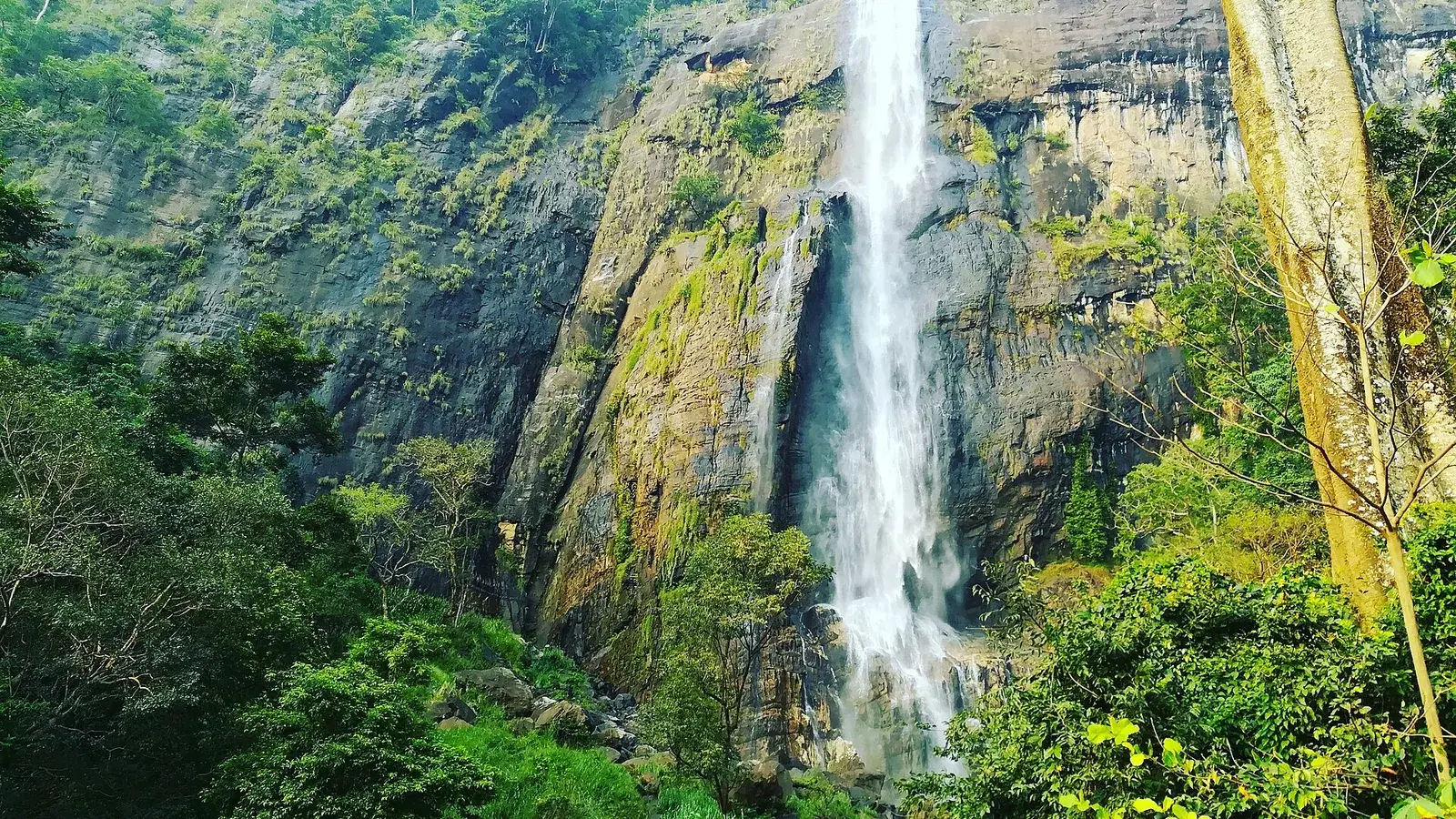
1. Diyaluma, near Koslanda, Badulla District. Around 220 metres in a single dramatic free fall beside the Beragala to Wellawaya road. The lower fall is visible from the roadside with almost no effort, which makes it the best effort-to-spectacle ratio on the island. The upper pools, reached by a steep climb of around an hour, are the famous infinity-pool photograph — and are also where the serious accidents happen. Go for the view from below; treat the upper pools as a decision requiring care, a guide and dry conditions.

2. Bambarakanda, near Kalupahana, Badulla District. The tallest in the country at around 263 metres, set in a pine forest about five kilometres off the A4. Slender rather than thunderous, and often quiet — it receives a fraction of Ravana's visitors despite being the national record holder. Strongest roughly between October and March. A rough trail leads toward the base.

3. Dunhinda, near Badulla. Around 63 metres, reached by a walking trail of roughly a kilometre and a half from the road. The name refers to the smoky spray it throws up, and that spray is the point — it is a broad, powerful fall rather than a tall one. Good in the northeast monsoon and after.

4. Ravana Falls, near Ella. The most accessible major fall in Sri Lanka, cascading directly beside the main road south from Ella toward Wellawaya. You can see it from the vehicle. That accessibility makes it the busiest and most commercial of the ten, with vendors and crowds, but it is genuinely impressive when running and it costs you nothing but a stop.

5. St Clair's, near Talawakele. Known as the broadest in Sri Lanka and often called the Little Niagara of the East, viewed from a roadside platform across a tea valley. Flow varies considerably with upstream water management and season, so it can be magnificent or modest depending on when you arrive — check before making a detour for it.

6. Devon Falls, near Talawakele. Around 97 metres, a short distance from St Clair's and usually visited in the same stop, viewed from a roadside vantage point across tea country. The pairing makes for an easy half-hour on the Nuwara Eliya to Hatton road.

7. Baker's Falls, in Horton Plains National Park. Around 20 metres, and the reason it is on this list is context rather than scale: it sits on the Horton Plains circular walk at over 2,000 metres, in montane cloud forest, and it is the one part of that walk that does not depend on the weather cooperating. If World's End gives you cloud, Baker's Falls still delivers.

8. Sera Ella, near Laggala in the Knuckles foothills. A two-tier fall in genuinely rural surroundings that most visitors never reach. Worth it specifically if you are already in the Knuckles area, and a good example of what the island offers once you leave the standard route.

9. Bopath Ella, near Ratnapura. Around 30 metres, named for its shape, which resembles a bo leaf. It is the most visited waterfall in the country by local standards because of its convenient location off the A4, which means it is busy at weekends and holidays and quiet midweek.

10. Laxapana, near Maskeliya. Around 129 metres in the Central Highlands. Its flow is closely tied to hydroelectric operations in the area, which means it varies substantially and can be reduced at times. When it is running it is among the more dramatic in the country.

Honourable mentions worth adding if you are in the area: Aberdeen Falls near Ginigathena at around 98 metres, Bomburu Ella near Welimada as a broad multi-strand cascade, and Ramboda Falls on the Nuwara Eliya road.

Diyaluma: the best effort-to-spectacle ratio on the islandBambarakanda: the tallest, and surprisingly quietRavana: the most accessible and the most crowdedSt Clair's and Devon: an easy pair on the Talawakele roadBaker's Falls: weather-proof insurance on the Horton Plains walk

When They Actually Run

This is where most waterfall guides quietly mislead, by recommending a season without explaining what you gain and lose.

Waterfalls in Sri Lanka are at their most powerful during and immediately after the wet periods. For the hill country's southwestern escarpment — which includes most of this list — that means the southwest monsoon from May to September, and the second inter-monsoon in October and November. For the eastern side, including Dunhinda near Badulla, the northeast monsoon from December to February.

Bambarakanda is generally described as strongest from around October to March.

What you gain in the wet: volume, spray, noise, and the sense of why these were considered sacred. Photographs in the dry season of a fall you have seen in the wet are genuinely disappointing.

What you lose: safe access. Trails become slippery, upstream surges become likely, pools become unswimmable, leeches proliferate on approach trails, and mountain roads can close entirely during sustained rain or after a landslide.

The dry-season trade is the reverse. Access is easy, rock is dry, swimming is realistic where it is permitted at all, and the drive is straightforward — but several falls reduce to a fraction of their flow, and a few become thin ribbons.

Our honest recommendation: the shoulders are the answer. The weeks immediately after a wet period, when the catchments are still full but the daily rain has eased, give you strong flow with manageable conditions. In practice that often means late in the second inter-monsoon or the early part of the following dry period, depending on which side of the island the fall sits.

One further consideration for the coming period: a strong El Niño is currently in place, with a wetter signal for October and November 2026 and a drier one for January to April 2027. That points to a strong waterfall season late this year and a weaker one in early 2027, which is worth knowing if you are planning specifically for waterfalls.

Wet season: maximum volume, worst access and highest riskDry season: easy access, much weaker flowThe shoulder weeks after a wet period are the best compromiseEastern falls like Dunhinda peak in the northeast monsoonA wetter late 2026 and drier early 2027 is the current outlook

Building a Waterfall Route

The falls on this list are not evenly distributed, which makes some efficient groupings possible.

The Ella and Badulla cluster: Ravana, Diyaluma and Dunhinda sit within reasonable reach of each other in the Uva region. Ravana is a roadside stop from Ella, Diyaluma is on the road south toward Wellawaya, and Dunhinda is near Badulla. This is the strongest single-day waterfall route in the country.

The Talawakele cluster: St Clair's and Devon are minutes apart on the Nuwara Eliya to Hatton road and can be seen in half an hour combined. Laxapana and Aberdeen are in the broader area for anyone wanting to go deeper.

The Horton Plains inclusion: Baker's Falls is not a separate trip — it is part of the park's circular walk, which is around nine kilometres and takes three to four hours.

The Ratnapura and wet-zone side: Bopath Ella is close to the A4 and works as a stop between Colombo and the hill country, particularly if you are heading toward Sinharaja.

The Knuckles side: Sera Ella belongs with a Knuckles trip rather than a hill country one.

Practicalities. Most of these involve a stop from a vehicle rather than an expedition, so a driver for the day is the efficient way to cover a cluster. Where there is an entry fee it is usually small and collected locally; carry cash in rupees.

Bring footwear with grip, a dry bag for cameras, a warm layer if you are at altitude, and leech protection for any wet-zone or highland trail. Do not bring the expectation of a quiet moment at Ravana.

And build in flexibility. A fall that is spectacular one week can be modest the next, and local advice on the day is worth more than any published recommendation including this one.

Ella and Badulla: Ravana, Diyaluma and Dunhinda in one dayTalawakele: St Clair's and Devon in half an hourBaker's Falls comes with the Horton Plains walkBopath Ella suits a Colombo to hill country transferCarry cash, grip footwear and leech protection

Visiting Waterfalls Responsibly

Waterfalls are among the most heavily littered places in Sri Lanka, and they are often sacred, working or both.

Take everything out with you, including organic waste. Many of these sites have no collection at all, and plastic accumulating in a plunge pool ends up in a river system.

Do not use soap, shampoo or detergent in a waterfall pool. This still happens and it is genuinely damaging in a watercourse that supplies communities downstream.

Several falls are associated with religious sites or local legend — Ravana Falls has a place in the Ramayana tradition, and shrines and temples sit near a number of others. Dress and behave accordingly near them.

Respect the people who live around these places. Many falls are reached through private land, tea estates or small villages, and the access you are enjoying is often informal goodwill rather than a right. Ask before crossing land, and do not damage crops or fences.

Buy from local stalls rather than treating vendors as an annoyance. At the busier falls, small traders are earning a living from a short season.

Do not encourage or participate in wildlife handling — some vendors at waterfall sites offer photographs with snakes, monkeys or other animals. This is harmful to the animals and should not be rewarded with money.

And do not take rocks, plants or anything else. It sounds trivial at the level of one visitor and is not at the level of the numbers these sites receive.

Take all waste out; many sites have no collectionNever use soap or shampoo in a plunge poolMany falls sit near shrines — dress and behave accordinglyAccess is often informal goodwill across private landDo not pay for photographs with handled wildlife

Советы путешественникам

  • Never swim below a fall if it has rained upstream that day or the night before
  • Brown water carrying debris means a surge is already in progress — get clear
  • Wet rock causes more injuries than the water; wear footwear with grip
  • Never climb beside or above a fall for a photograph
  • Ask locally about that specific fall on that day
  • Do not swim alone, and never after drinking
  • Carry cash in rupees for small local entry fees
  • Bring leech protection for wet-zone and highland approach trails
  • Carry a dry bag for cameras and phones — spray travels further than you think
  • Expect no phone signal at many falls; tell someone where you are going
  • Visit in the weeks after a wet period for the best flow-to-safety balance
  • Check Disaster Management Centre advisories in sustained wet weather
  • Never use soap or shampoo in a plunge pool
  • Take all your waste out; most sites have no collection
  • Do not pay for photographs with handled snakes or monkeys
  • Treat local warnings as information, not as a sales pitch

Частые вопросы

What is the tallest waterfall in Sri Lanka?

Bambarakanda, near Kalupahana in Badulla District. Most sources give its height as around 263 metres, though a detailed Sri Lankan waterfall index gives 241, and its world ranking appears as both 299th and 461st depending on which database is cited. It is the tallest on any of these measures.

Which is the second-highest waterfall in Sri Lanka?

Almost every source says Diyaluma at around 220 metres, and at least one detailed index disagrees, placing a cascade at Kalugala of around 240 metres above it. The difference comes down to whether multi-tier cascades are counted as a single fall, which is a genuine methodological question rather than an error.

When is the best time to see waterfalls in Sri Lanka?

It depends on what you want. Wet periods give maximum volume and the worst access and highest risk. Dry periods give easy access and much weaker flow. The best compromise is the shoulder weeks just after a wet period, when catchments are still full but daily rain has eased.

Is it safe to swim at Sri Lankan waterfalls?

Sometimes, with real caution. The main hazard is water level rising suddenly from rain that fell upstream in a catchment you cannot see — often while the sky above you is clear. Never swim below a fall if it has rained in the hills that day, never swim alone, and get clear immediately if the water turns brown or starts carrying debris.

Which waterfall is easiest to visit?

Ravana Falls near Ella, which cascades directly beside the main road south toward Wellawaya — you can see it from the vehicle. St Clair's and Devon near Talawakele are similarly roadside. The trade-off at Ravana is crowds and vendors.

Are the Diyaluma upper pools worth the climb?

They are the source of the famous infinity-pool photographs, and they are also where the serious accidents happen — people scrambling on wet rock above a 220-metre drop. The climb takes around an hour and is steep. Go only in dry conditions, with a guide, and if you are unsure, the roadside view of the lower fall is genuinely spectacular on its own.

Do I need to pay to see waterfalls in Sri Lanka?

Most are free or charge a small locally collected fee. Baker's Falls is the exception on this list, since it sits inside Horton Plains National Park and comes with the park entry fee. Carry cash in rupees.

Are there leeches at waterfalls?

On wet-zone and highland approach trails, frequently — particularly in wet conditions. They are harmless but abundant. Leech socks, tucked trousers and a repellent handle it. Roadside falls like Ravana and St Clair's are not a problem.

How many waterfalls does Sri Lanka have?

Well over 300 named falls of ten metres or more, with detailed indexes cataloguing several hundred. The concentration is along the hill country escarpments where both monsoons deliver rain to steep terrain.

Can I see waterfalls from the train?

Some, in passing, on the hill country line. Bear in mind the current rail position: the Kandy to Nanu Oya section remains closed following Cyclone Ditwah damage, so the accessible stretch runs from Nanu Oya to Ella and Badulla. Most of the falls on this list are road stops rather than rail views.

Which waterfalls suit families with children?

The roadside ones — Ravana, St Clair's and Devon — where viewing requires no walking and no scrambling. Dunhinda's trail is manageable for older children. Avoid anything involving a steep descent, and keep children well back from wet rock at every site.

Does hydroelectric generation affect the waterfalls?

It can. Flow at some falls in the Central Highlands, Laxapana among them, is tied to upstream water management and generation schedules, which means volume varies beyond what rainfall alone would suggest. If a particular fall is the reason for a detour, it is worth asking locally what it is doing that week.

Заметки читателей

Присоединяйтесь к обсуждению

Поделитесь вопросом, советом или опытом поездки по этому гиду.

Комментарии

0 комментариев

Загрузка...

Готовы превратить вдохновение в поездку на Шри-Ланку?

Используйте LankaTrip, чтобы спланировать путешествие, связаться с местными гидами и воплотить этот маршрут в реальность.

Нужна помощь с планированием?

Спланируйте приключение на Шри-Ланке

Спланировать поездку