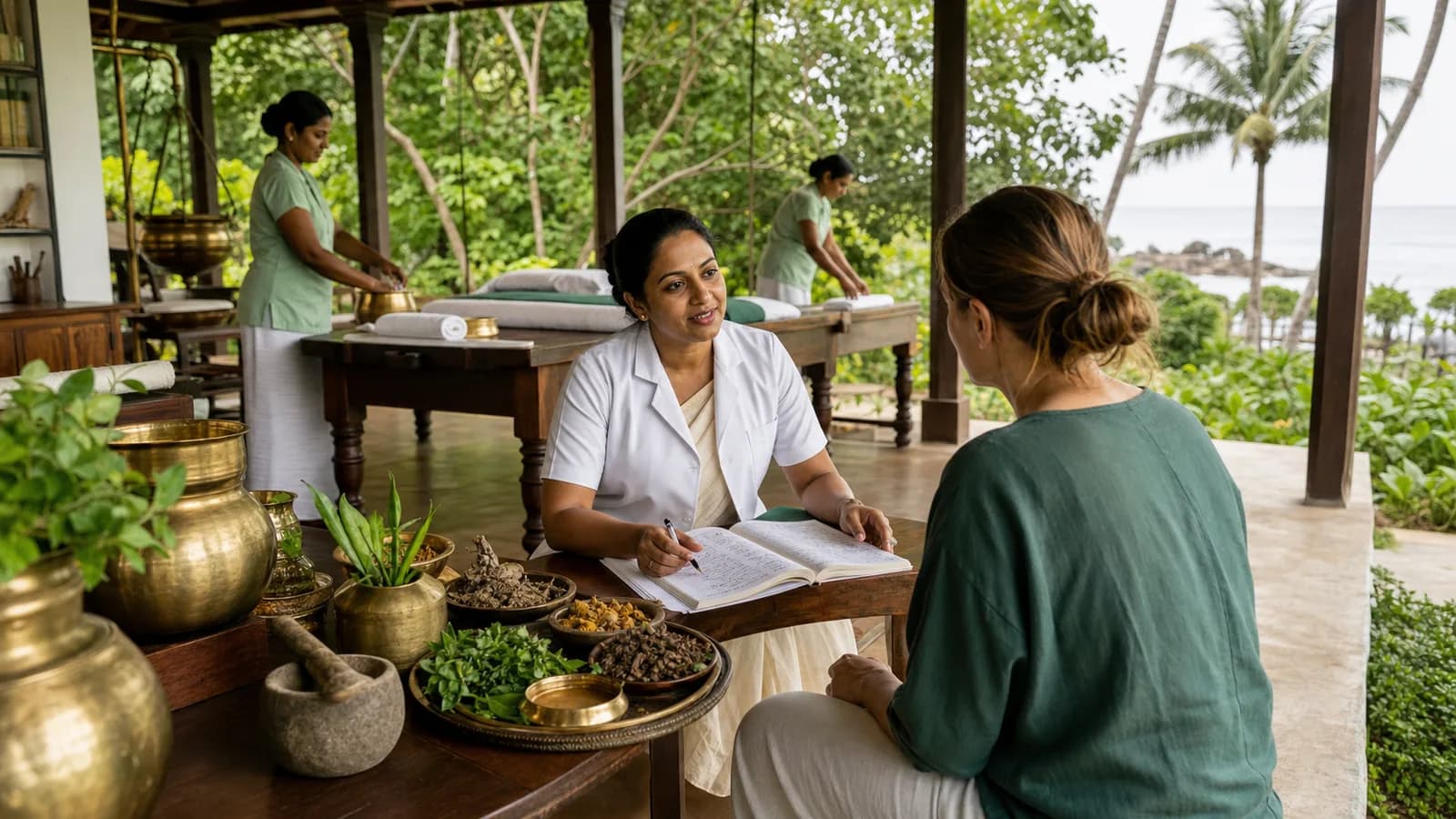
Most travelers arrive in Sri Lanka with a beach, a train ride and a rock fortress on the list. A surprising number leave having also booked something they never planned: two or three weeks lying on a wooden treatment table while a physician adjusts their diet, their sleep and their herbal prescriptions day by day.
Ayurveda is one of the strongest reasons repeat visitors return to the island, and one of the least well understood. Search results are dominated either by resort marketing or by wellness writing that treats the whole thing as an aesthetic — oil, flowers, a copper bowl, a beach.
The reality is more interesting and more practical. Sri Lanka is one of a small number of countries where traditional medicine is not a parallel tourist industry but an arm of the state health service, with its own government department, its own registered physicians, its own hospitals and its own pharmacopoeia drawn substantially from plants that grow nowhere else.
It is also a country where anyone can paint the word 'Ayurveda' on a wall. Sri Lankan newspapers, the Department of Ayurveda and the tourism authority have all publicly raised concerns about venues trading on the name without qualified staff or proper registration. Some of these are simply low-quality massage shops. Some are considerably worse.
This guide is written to close that gap. It covers what a genuine programme actually involves day to day, what it honestly costs, how long you really need, where the main Ayurveda regions are, and the specific questions that will tell you within two minutes whether you are talking to a clinic or a shopfront.
Quick Summary
- Ayurveda is part of Sri Lanka's official healthcare system, with a dedicated government department and degree-level medical training
- A genuine programme starts with a physician consultation and a written, individual treatment plan, not a menu of massages
- Full panchakarma normally needs 14 to 21 days; anything advertised as 'panchakarma' in three days is a marketing label
- Realistic pricing runs from roughly USD 150 to 400 for a short introductory stay, USD 400 to 800 for a week, and USD 800 to 2,500 or more for 14 to 21 days
- Sri Lankan authorities have repeatedly flagged unregulated venues using the Ayurveda name; registration checks matter
- Ayurveda is complementary to, not a replacement for, conventional medical care — bring your prescriptions and your diagnoses