
LankaTrip Insights

16 min read

Money, SIM Cards, and Staying Connected in Sri Lanka in 2026: The Arrival Essentials Guide

Can you rely on cards in Sri Lanka? How much cash should you carry? Is an eSIM better than an airport SIM? This 2026 guide answers the practical money and connectivity questions every foreign traveler asks before landing, with current tourist SIM prices, ATM fees, and the mistakes that cost real money.

Back to blog
Money, SIM Cards, and Staying Connected in Sri Lanka in 2026: The Arrival Essentials Guide

Every Sri Lanka trip begins with the same two practical questions, usually asked somewhere over the Indian Ocean: how will I pay for things, and how will I get online?

They matter more than they sound. Your ride-hailing app, offline maps, train timetable checks, accommodation messages, and translation tools all depend on data, while the tuk-tuk driver waiting outside arrivals and the roadside kottu shop three hours later both expect cash.

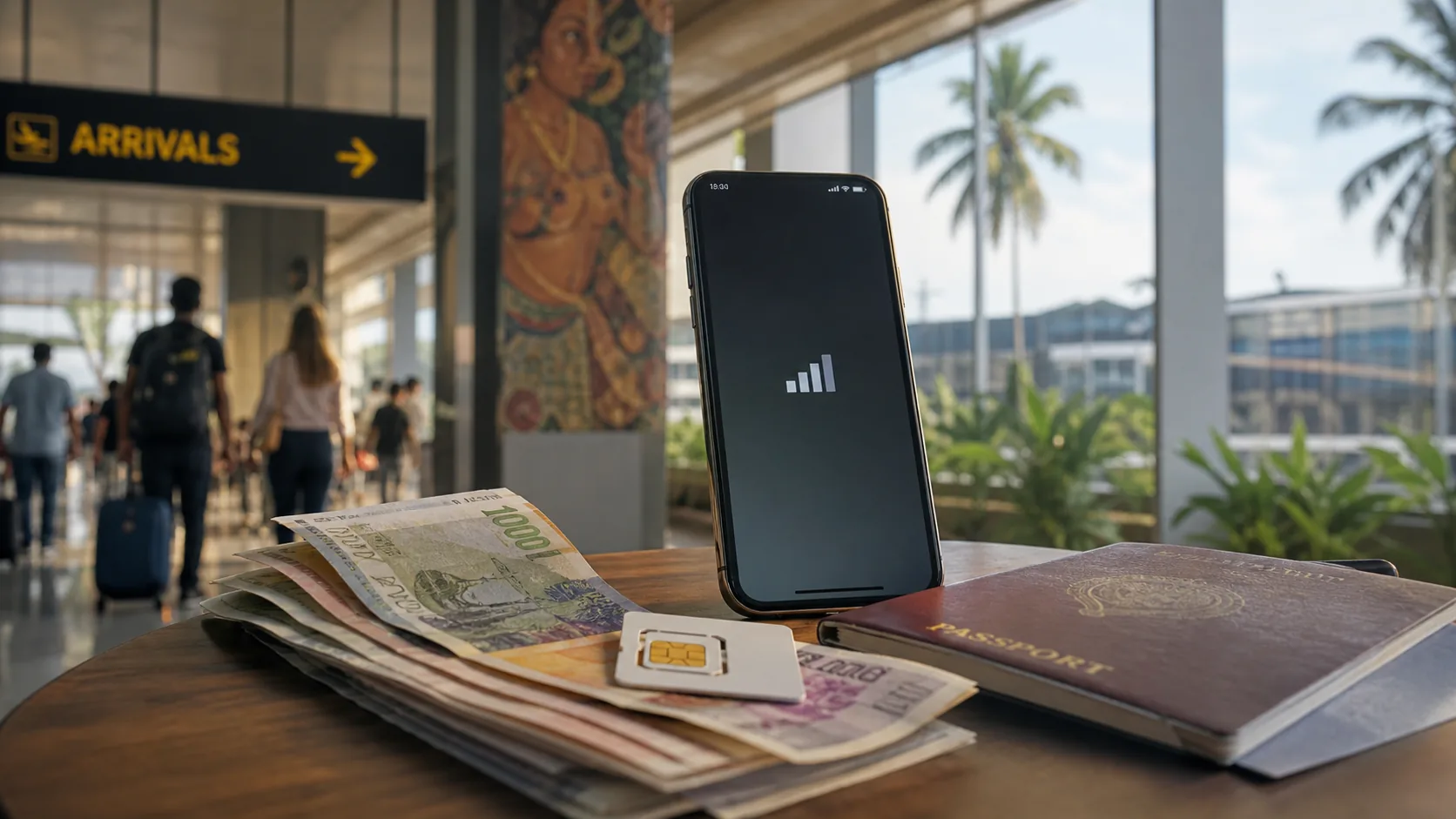
The good news is that Sri Lanka makes both easy and remarkably cheap. Tourist SIM packages with 20 to 50 gigabytes of data cost less than a beachside lunch, ATMs accepting foreign cards are everywhere on the tourist trail, and the whole setup can be completed in the airport arrivals hall before you even meet your driver.

The catch is a handful of small traps that quietly cost travelers money: dynamic currency conversion at ATMs, inflated SIM prices from unofficial resellers, assuming cards work everywhere, and running out of cash in regions where the nearest ATM is an hour away.

This guide covers the full arrival checklist — currency, cash, cards, ATMs, exchange rules, SIMs, eSIMs, coverage, and Wi-Fi — with current 2026 figures, so you land knowing exactly what to do in your first hour on the island.

Quick Summary

  • Sri Lanka runs on the Sri Lankan Rupee (LKR), and everyday spending — tuk-tuks, markets, small eateries, guesthouses — is still largely cash
  • Visa and Mastercard are widely accepted at hotels, supermarkets, and larger restaurants; American Express acceptance is limited
  • ATMs are widespread and accept foreign cards, with local fees typically around LKR 300 to 500 per withdrawal and per-transaction limits that vary by bank
  • Always choose to be charged in Sri Lankan Rupees at ATMs and card machines — declining dynamic currency conversion saves real money
  • Tourist SIM packages from local operators cost roughly USD 4 to 8 for 20 to 50 GB with 30-day validity, sold at airport arrival counters with passport registration
  • eSIMs installed before you fly cost more per gigabyte but activate the moment you land, with no queue or paperwork
  • Mobile coverage is strong across the main tourist circuit; download offline maps before heading into the deep hill country
  • You can bring up to USD 10,000 in cash without declaring it, and re-exchanging leftover rupees at departure is easiest with your original exchange receipts

Understanding the Sri Lankan Rupee

Sri Lanka's currency is the Sri Lankan Rupee (LKR), and it is what virtually every business on the island expects. While a few upscale hotels and tour operators may quote in US dollars or euros, the vast majority of transactions happen in rupees, and paying in local currency almost always gets you a better effective rate.

Notes circulate in denominations from 20 up to 5,000 rupees, and the everyday reality is that small notes are gold. Tuk-tuk drivers, market vendors, and small shops frequently cannot break a 5,000 note, so break large notes at supermarkets and hotels whenever you can.

A useful trick when withdrawing cash: instead of a round figure like 100,000 rupees, withdraw an odd amount such as 99,800, which forces the machine to dispense some smaller notes for tips, tuk-tuks, and change-making.

Get comfortable with the rough conversion early — thinking in thousands of rupees quickly becomes second nature, and knowing instantly what 1,500 rupees means in your home currency is your best defence against tourist-price quotes.

Officially, large retail purchases cannot be made in foreign cash, so do not plan to spend dollars or euros directly; convert to rupees and spend like a local.

The rupee (LKR) is the working currency everywhereSmall notes are essential for daily spendingWithdraw odd amounts to force smaller notesBreak big notes at supermarkets and hotelsForeign cash is not accepted for retail purchases

Cash Versus Card: What Actually Works Where

The honest rule of thumb for Sri Lanka in 2026: cards work in the formal economy, cash runs everything else.

Visa and Mastercard are widely accepted at hotels, upscale and mid-range restaurants, supermarket chains, larger shops, and tourist-oriented businesses in cities and main tourist areas, and contactless payment is increasingly common in Colombo and larger towns.

American Express acceptance is limited, and mobile wallets like Apple Pay and Google Pay have only patchy support, so do not build your payment plan around either.

Cash remains essential for tuk-tuks, local restaurants and street food, markets, entrance donations, small guesthouses, and most businesses in rural areas — and notably, many guesthouses and small restaurants even in tourist hubs like Ella and Mirissa are cash-only.

The practical approach is a split: carry enough rupees for two to three days of everyday spending, keep a card for hotels and bigger bills, and top up cash at ATMs as you go rather than carrying your whole budget at once.

Carry both a Visa and a Mastercard if you can, since occasional machines accept only one network, and keep a backup card stored separately from your wallet in case of loss.

Cards: hotels, supermarkets, larger restaurantsCash: tuk-tuks, markets, guesthouses, rural areasAmex and mobile wallets are unreliableMany Ella and Mirissa spots are cash-onlyCarry one Visa and one Mastercard if possible

ATMs: Availability, Fees, and the Conversion Trap

ATMs are widely available in cities, towns, and tourist areas across Sri Lanka, operate around the clock, work in English, and dispense rupees to foreign Visa and Mastercard holders — the arrivals hall at Bandaranaike International Airport has machines from several major banks, so you can get cash before leaving the terminal.

Local ATM fees for international cards typically run around 300 to 500 rupees per withdrawal — roughly one to one and a half US dollars — on top of whatever your home bank charges, though fees vary by bank and a few local banks have been known to waive them entirely. Your home bank's foreign transaction fees are often the bigger cost, so check those before you travel.

Per-transaction withdrawal limits vary considerably by bank, commonly somewhere between 40,000 and 100,000 rupees and sometimes higher, so if you need a larger amount you may need consecutive withdrawals — which makes minimising per-withdrawal fees worthwhile by taking out larger sums less often.

The single most expensive mistake at Sri Lankan ATMs is accepting dynamic currency conversion. When the machine offers to charge you in your home currency instead of rupees, it is applying its own marked-up exchange rate. Always select to be charged in Sri Lankan Rupees and let your own card provider handle the conversion.

The same rule applies at card terminals in shops and hotels: if offered a choice, pay in rupees, not your home currency.

For safety, prefer ATMs attached to bank branches during daytime, shield your PIN, and be aware that machines in remote areas occasionally run out of cash — another reason to top up before heading into the deep hill country or along quieter coastlines.

ATMs widespread and open 24/7 on the tourist trailLocal fees typically LKR 300-500 per withdrawalWithdrawal limits vary by bankAlways decline dynamic currency conversionUse bank-attached ATMs during the day

Exchanging Money: Airport, Banks, and Departure Rules

If you prefer arriving with cash to exchange, the arrivals area at Bandaranaike International Airport has several licensed exchange counters operating around the clock, with rates that are usually only slightly below what you would get at banks in the city — a fair trade for immediate convenience.

Beyond the airport, money can be exchanged at banks and licensed exchange offices in cities and tourist towns, with official rates anchored by the Central Bank of Sri Lanka. Avoid unlicensed street changers entirely.

Keep your exchange receipts. They matter at the end of the trip: re-converting leftover rupees to foreign currency at departure is easiest when you can show proof of your original exchange, and the airport is the most convenient place to do it before you fly out.

On arrival rules, you can bring up to USD 10,000 or equivalent in cash into Sri Lanka without declaration; larger amounts must be declared at customs.

US dollars, euros, and British pounds are the easiest currencies to exchange, and clean, undamaged notes get the best reception.

In practice, most travelers find the simplest system is a modest cash exchange or ATM withdrawal at the airport for the first days, then ATM top-ups as the trip progresses — no need to carry weeks of budget in cash from day one.

Airport exchange counters operate 24/7Use banks and licensed offices, never street changersKeep receipts for re-exchanging leftover rupeesUp to USD 10,000 can be brought in undeclaredUSD, EUR, and GBP exchange most easily

Tourist SIM Cards: Prices, Packages, and How to Buy

Sri Lanka's mobile data is among the cheapest a traveler will find anywhere, and the tourist packages sold on arrival are genuinely good value rather than a tourist tax.

The main operators are Dialog, Mobitel (SLT-Mobitel), Hutch, and Airtel. Dialog holds the largest network with the widest coverage — including remoter areas and the hill country — and was first to launch 5G, while Mobitel runs a very close second with particularly strong coverage through the Cultural Triangle and along the southern coast. Hutch offers some of the cheapest data with a more urban-focused network.

As of mid-2026, Dialog's tourist plans, all with 30-day validity, run approximately 1,399 rupees for 20 GB (around USD 4), 1,799 rupees for 30 GB (around USD 5 to 6), and 2,450 rupees for 50 GB (around USD 7 to 8), each with a small call allowance included. Mobitel's tourist offers are similarly priced, including a cheaper roughly 800-rupee seven-day option that suits short stays.

Buying is straightforward: official operator counters sit in the arrivals area at Bandaranaike International Airport, registration requires your passport, and the process typically takes 15 to 30 minutes depending on queues. Insert the SIM, confirm data works before walking away, and you are set for the month.

If airport queues are long or you arrive at an odd hour, official operator stores in Colombo, Negombo, and every major town sell the same packages — sometimes at marginally better prices than airport counters — and staff at official stores are used to setting up travelers' phones.

For a two-week trip, the 20 GB plan comfortably covers maps, messaging, ride-hailing, and social sharing; heavy video users and remote workers should take the 50 GB option or plan around accommodation Wi-Fi for streaming.

Tourist SIMs cost roughly USD 4-8 for 20-50 GB30-day validity on standard tourist plansPassport required for registrationBuy at official airport counters or operator stores20 GB covers a typical two-week trip

eSIM Versus Physical SIM: Which Should You Choose?

If your phone supports eSIM, you have a genuine choice to make, and it comes down to convenience versus cost.

Travel eSIMs from international providers are purchased and installed before you fly, then activate the moment you land — meaning you can book a ride-hailing car and message your accommodation from the arrivals hall with zero queuing, no passport registration, and no paperwork.

The trade-off is price: typical Sri Lanka eSIM plans run somewhere between USD 7 and 15 or more depending on data and duration, which is noticeably more per gigabyte than the local tourist SIMs, and data-only eSIMs usually lack a local phone number, which occasionally matters for booking confirmations and local calls.

The physical tourist SIM wins on pure value and gives you a local number, at the cost of 15 to 30 minutes at a counter with your passport.

Plenty of travelers split the difference: a small eSIM package for instant connectivity on landing, then a cheap local SIM bought calmly in town the next day for the bulk of the trip.

Whichever route you choose, check before departure that your phone is carrier-unlocked, and if you rely on an eSIM, confirm which local network it uses — coverage in the deep tea country is strongest on the biggest local networks.

eSIM: instant activation, no queue, higher costLocal SIM: best value plus a local numbereSIMs typically USD 7-15 for tourist-length plansHybrid approach works well for late-night arrivalsConfirm your phone is carrier-unlocked before flying

Coverage, Wi-Fi, and Staying Connected on the Move

Mobile coverage across Sri Lanka's main tourist circuit is genuinely good, with 4G reaching most towns, coastlines, and even many rural areas, and 5G expanding in Colombo and larger centres.

The gaps are where you would expect them: deep hill-country valleys, stretches of the highland train line, the interior of national parks, and remote corners of the north and east can drop to weak signal or nothing.

The fix is simple preparation — download offline maps for your whole route before leaving good coverage, save your accommodation contacts and booking confirmations offline, and never rely on live navigation alone in the highlands.

Wi-Fi is close to universal at tourist accommodation, from beach hostels to boutique tea bungalows, and reasonably common in cafés and restaurants in tourist towns. Speeds are usually fine for messaging and browsing, less reliably so for heavy streaming or video calls.

Treat most guesthouse and café Wi-Fi as unsecured, because much of it is: avoid logging into banking over open networks, or use a VPN if you need to handle anything sensitive on shared Wi-Fi.

On trains and long bus rides, expect intermittent signal and treat any connectivity as a bonus — which, on the tea-country train, is arguably the point.

Strong 4G across the main tourist circuitDead zones in deep hill country and national parksDownload offline maps before the highlandsAccommodation Wi-Fi is near-universal but often unsecuredUse a VPN for banking on shared networks

How Much Cash to Carry Day to Day

The right amount of walking-around cash depends on travel style, but useful 2026 ballparks make planning easy.

Budget travelers relying on local buses, street food, and guesthouses typically spend somewhere around 8,000 to 13,000 rupees per day — roughly 25 to 40 US dollars — and can carry two or three days of that comfortably.

Mid-range travelers mixing nicer restaurants, drivers, and activities move through more like 16,000 to 32,000 rupees per day, though a larger share of that goes on cards at hotels and restaurants.

Whatever the style, add a cash buffer before heading anywhere remote — safari mornings, highland hikes, and quieter coastal stretches can all put you an hour or more from a working ATM.

Keep your cash sensibly split: a day's spending money accessible, the rest tucked separately in your bag or the hotel safe alongside your backup card, so a lost wallet is an annoyance rather than a crisis.

Tipping is appreciated rather than rigidly expected — small notes for drivers, porters, and guides go a long way, which is one more reason to hoard 100 and 500 rupee notes.

Budget style: roughly LKR 8,000-13,000 per dayMid-range: roughly LKR 16,000-32,000 per dayCarry a buffer before remote areasSplit cash between wallet, bag, and safeKeep small notes for tips and tuk-tuks

The First-Hour Arrival Checklist

Everything in this guide compresses into a simple sequence for your first hour after clearing immigration at Bandaranaike International Airport.

First, connectivity: activate your pre-installed eSIM, or join the queue at an official operator counter with your passport for a tourist SIM, and confirm data works before moving on.

Second, money: withdraw rupees from a bank ATM in the arrivals hall — declining any offer to charge in your home currency — or exchange a modest amount of cash at a licensed counter, keeping the receipt.

Third, break a big note: buy a bottle of water or snacks at an arrivals shop so you are not offering a 5,000-rupee note for a 700-rupee tuk-tuk ride.

Fourth, transport: with data live, book a ride through the ride-hailing app or meet your pre-arranged pickup, with fare benchmarks now at your fingertips.

Do these four things and every practical friction of the first days disappears — the rest of the trip is just topping up data and rupees as you go, which by then will feel entirely routine.

1. SIM or eSIM live before leaving the terminal2. Rupees from a bank ATM, charged in LKR3. Break a large note at an arrivals shop4. Book transport with data workingTotal time: 30 to 60 minutes

Travel Tips

  • Always choose to be charged in Sri Lankan Rupees at ATMs and card machines — decline dynamic currency conversion every time
  • Buy SIMs only at official operator counters or stores and bring your passport
  • Check your phone is carrier-unlocked before leaving home
  • Withdraw odd amounts like 99,800 rupees to force smaller notes
  • Carry one Visa and one Mastercard, stored separately
  • Keep two to three days of cash and top up as you travel
  • Download offline maps before entering the hill country
  • Keep currency exchange receipts for re-conversion at departure
  • Use bank-attached ATMs during daytime where possible
  • Add a cash buffer before safaris, highland hikes, and remote coasts
  • Avoid banking over open guesthouse Wi-Fi, or use a VPN
  • Hoard 100 and 500 rupee notes for tips and tuk-tuks

Frequently Asked Questions

Can I use my credit card in Sri Lanka?

Yes, in the formal economy. Visa and Mastercard are widely accepted at hotels, supermarkets, larger restaurants, and tourist businesses in cities and main tourist areas. American Express acceptance is limited, and tuk-tuks, markets, street food, and many guesthouses remain cash-only, so carry rupees for everyday spending.

How much does a tourist SIM card cost in Sri Lanka in 2026?

Roughly USD 4 to 8. Dialog's 30-day tourist plans run about 1,399 rupees for 20 GB, 1,799 for 30 GB, and 2,450 for 50 GB, with Mobitel similarly priced including a cheaper seven-day option. Buy at official operator counters in the airport arrivals hall or at stores in town, with your passport for registration.

Is an eSIM or a local SIM better for Sri Lanka?

eSIMs win on convenience — installed before you fly and active on landing with no queue — but cost more per gigabyte, typically USD 7 to 15 for tourist-length plans, and usually lack a local number. Local tourist SIMs are the best value. Many travelers use a small eSIM for arrival and switch to a local SIM in town.

Do ATMs in Sri Lanka accept foreign cards?

Yes. ATMs are widespread in cities and tourist areas, operate 24/7 in English, and accept foreign Visa and Mastercard. Local fees are typically around 300 to 500 rupees per withdrawal on top of your home bank's charges, and per-transaction limits vary by bank.

What is dynamic currency conversion and should I accept it?

It is when an ATM or card machine offers to charge you in your home currency instead of rupees, using its own marked-up exchange rate. Always decline it and choose to be charged in Sri Lankan Rupees — your own card provider will almost always give you a better rate.

How much cash should I carry in Sri Lanka?

Two to three days of spending money is a sensible amount to carry, topping up at ATMs as you go. Budget travelers typically spend around 8,000 to 13,000 rupees a day, mid-range travelers roughly 16,000 to 32,000, with more of the mid-range spend going on cards. Add a buffer before remote areas.

How much cash can I bring into Sri Lanka?

Up to USD 10,000 or equivalent without declaration; larger amounts must be declared at customs. US dollars, euros, and pounds are the easiest currencies to exchange at licensed counters and banks.

Is there good mobile coverage in Sri Lanka?

Yes across the main tourist circuit, with solid 4G in most towns and coastal areas and 5G growing in Colombo. Coverage weakens in deep hill-country valleys, national parks, and remote parts of the north and east, so download offline maps before those stretches.

Is hotel and café Wi-Fi safe to use in Sri Lanka?

Wi-Fi is nearly universal at tourist accommodation and common in cafés, but much of it is unsecured. It is fine for browsing and messaging; avoid logging into banking over open networks or use a VPN for anything sensitive.

Can I exchange leftover rupees when I leave?

Yes, most easily at the airport before departure, and smoothest when you can show receipts from your original exchange. Alternatively, spend down your rupees and keep a small note or two as a souvenir.

Reader notes

Join the conversation

Share your question, tip, or travel experience for this guide.

Comments

0 comments

Loading...

Ready to turn inspiration into a Sri Lanka trip?

Use LankaTrip to plan your journey, connect with local guides, and make this itinerary a reality.

Need help planning?

Plan your Sri Lanka adventure

Plan my trip