
LankaTrip Einblicke

24 Min. Lesezeit

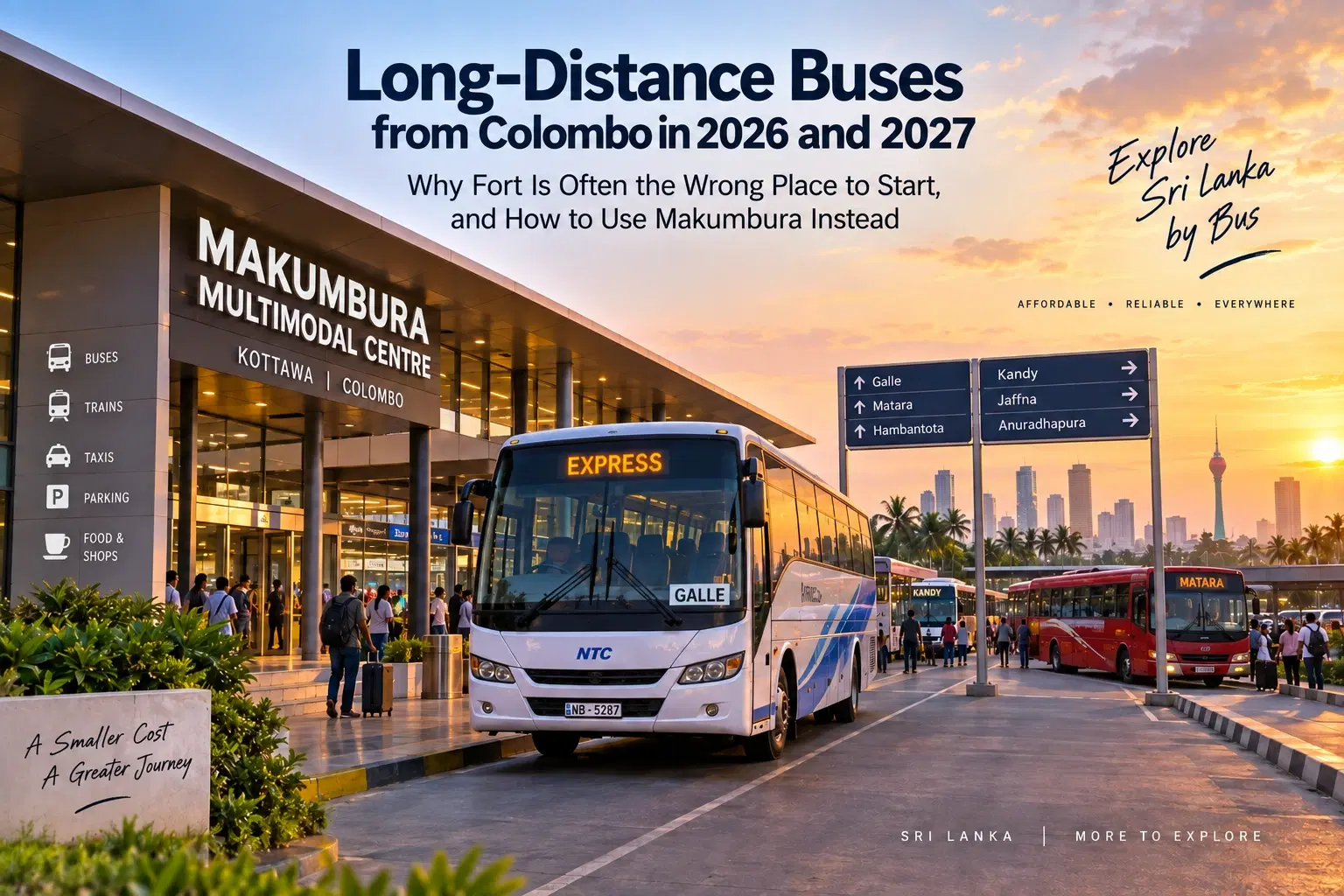
Long-Distance Buses from Colombo in 2026 and 2027: Why Fort Is Often the Wrong Place to Start, and How to Use Makumbura Instead

Makumbura Multimodal Centre runs a live departure board with bay numbers and the exact fare printed before you board. Galle is Rs 930 and ninety minutes. Almost no guide mentions it exists, and travellers keep queuing at Pettah for buses that now leave from Kottawa.

Zurück zum Blog
Long-Distance Buses from Colombo in 2026 and 2027: Why Fort Is Often the Wrong Place to Start, and How to Use Makumbura Instead

Sri Lanka has one of the densest and cheapest bus networks in South Asia. It reaches essentially every town on the island, it runs from before dawn until late at night, and it costs a small fraction of what a car and driver costs for the same journey.

It is also close to impenetrable on a first encounter, and the reason is not the buses. It is that Colombo has no single bus station, and nothing tells you this. Fort and Pettah contain several distinct terminals within a few hundred metres of each other, divided partly by operator and partly by destination, with almost no English signage explaining which is which.

And the most useful change of the last few years has gone largely unrecorded in travel writing. The expressway services that most visitors actually want — the fast, air-conditioned buses that reach Galle in about ninety minutes — no longer start in central Colombo at all. They start at the Makumbura Multimodal Centre in Kottawa, about 18 km southeast of Fort, which is a modern facility with numbered bays, a live electronic departure board, and the exact fare published before you board.

That last detail is worth pausing on. In a country where travellers worry constantly about being overcharged, there is a government terminal displaying the gazetted fare for every departure on a public screen. Almost nobody tells visitors it exists.

This guide covers which terminal serves what, how to use Makumbura, verified fares and journey times taken from the live board, what the different bus classes actually mean, and the practical constraints — luggage above all — that determine whether a bus is the right choice for a particular leg of your trip.

Kurzüberblick

  • Colombo has no single bus station — Fort and Pettah hold several separate terminals, and the main expressway hub is elsewhere entirely
  • Makumbura Multimodal Centre at Kottawa is the departure point for expressway services to the south, southeast and beyond
  • Makumbura runs a live public departure board showing bay, destination, time, operator and the exact fare
  • Colombo area to Galle is about 90 minutes; to Matara about 1 hour 45 minutes
  • Bastian Mawatha is the main private long-distance stand for Kandy, Jaffna, Anuradhapura, Kurunegala and the coastal routes
  • The Colombo Central stand on Olcott Mawatha serves SLTB red buses, including Kandy, Anuradhapura and Jaffna
  • Route 138 links Pettah and Fort to Kottawa and Makumbura, and runs in both directions
  • All fares are gazetted by the National Transport Commission and were last revised on 6 July 2026
  • Fares are set by stage, not by kilometre, and the chart displayed inside the bus is the legally binding figure
  • Buses have almost no luggage storage, which is the single biggest practical constraint for travellers

The Thing Nobody Tells You: There Is No Central Bus Station

Travellers arrive at Colombo Fort railway station, look for the bus station, and find several.

Bastian Mawatha is the principal private long-distance stand. It sits roughly 400 to 500 metres east of Fort station, on the south side of Olcott Mawatha, behind the shopfronts. This is the main hub for long-distance private buses, with services toward Kandy, Jaffna, Anuradhapura, Kurunegala, Kataragama, Badulla, Ampara, Negombo, Katunayake and the coastal route south.

The Colombo Central stand on Olcott Mawatha is the Sri Lanka Transport Board terminal — the state operator, running the red buses. Long-established route numbers depart from here: route 01 toward Kandy, route 04 toward Anuradhapura, route 87 toward Jaffna.

Gunasinghepura and Saunders Place are further terminals in the same cluster, historically used for Negombo and airport highway services among others.

The Pettah stands surrounding these serve mostly local and suburban routes across the Colombo district — Moratuwa, Maharagama, Negombo on the ordinary road, and the connections into the suburbs.

In practice the allocation shifts. Terminal assignments change, routes move between stands, and there is no reliably current published map. This is why every experienced traveller gives the same advice: arrive, say your destination clearly to anyone in uniform or behind a counter, and follow the pointing. Conductors call out destinations continuously and are generally helpful. The system works on asking, not on reading.

One thing that makes this much easier: learn the route number for your destination rather than only the place name. Route numbers are painted on the front of every bus and are the single most reliable identifier in the whole system.

And the most important navigational fact of all: if you are heading south or southeast on an expressway service, none of these terminals is where you want to be.

Bastian Mawatha: main private long-distance standColombo Central on Olcott Mawatha: SLTB red busesGunasinghepura and Saunders Place: further terminals in the clusterTerminal assignments shift — ask rather than rely on mapsLearn your route number; it is painted on every bus

Makumbura Multimodal Centre: The Terminal Most Travellers Should Be Using

Makumbura Multimodal Centre, usually shortened to MMC, sits at Kottawa on the southeastern edge of Colombo, immediately beside the Southern Expressway entrance. It opened to concentrate expressway bus services at the point where the expressway actually begins, rather than having them fight through Colombo traffic first.

The effect for a traveller is substantial. A bus leaving Makumbura for Galle is on the expressway within minutes. A bus leaving central Colombo for the same destination spends the first hour of the journey getting out of the city.

It is also, by some distance, the most legible transport facility in the country for a first-time visitor. Departures are organised into numbered bays. There is a live electronic departure board, published in English and Sinhala, showing the bay number, route, destination, departure time, status, operating agency and the fare for every service. The same board is available online, which means you can check real departures and real prices before you leave your hotel.

The bay allocation is broadly by destination. As a working guide: Galle, Matara, Tangalle, Hambantota, Embilipitiya, Elpitiya, Ambalangoda, Baddegama, Kataragama, Monaragala, Badulla, Ampara, Pottuvil and Kandy each have their own bay, alongside bays for Panadura, Kalutara, Matugama, Kaduwela, Kadawatha, Gampaha and Negombo. Treat published bay numbers as indicative and confirm on the board when you arrive.

Services are operated by a mix of the state-owned SLTB, National Transport Commission licensed operators, and the Western Province Road Passenger Transport Authority. From a passenger's point of view the distinction rarely matters — the fare is the same regardless, because it is gazetted rather than set by the operator.

Frequency is high on the main corridors. The Makumbura to Matara service runs dozens of departures across the day, and Galle is similar, with services from before five in the morning. On these routes you do not need to plan around a timetable; you turn up and take the next one.

How to reach Makumbura from central Colombo: route 138 runs between Pettah and Kottawa in both directions and terminates at the centre itself — the return service to Pettah is shown on the departure board like any other route. A tuk-tuk or ride-hailing car from Fort takes roughly thirty to forty-five minutes depending on traffic. If you are already staying in the southern suburbs, you may be closer to Makumbura than to Fort.

There is one genuine trade-off. Getting to Kottawa from central Colombo takes time, and for a short journey that overhead can cancel the expressway saving. Makumbura makes sense for anything from Galle southward and for the southeast. For Negombo or the airport, central terminals remain more sensible.

Located at Kottawa, directly at the Southern Expressway entranceNumbered bays and a live departure board in EnglishThe board shows the exact fare before you boardRoute 138 connects Pettah and Fort to KottawaBest for Galle southward and the southeast; not for the airport

Verified Fares and Journey Times from Makumbura

The figures below were taken directly from the Makumbura departure board on 16 September 2026. They are gazetted fares, not estimates, and they are what the operator is legally permitted to charge.

To Galle: Rs 930, around 1 hour 30 minutes, roughly 112 km. To Matara: Rs 1,170, around 1 hour 45 minutes, roughly 138 km. To Tangalle: Rs 1,410. To Embilipitiya: Rs 1,670, around 2 hours 30 minutes. To Kataragama: Rs 2,180, around 3 hours 30 minutes. To Monaragala: Rs 2,510, around 4 hours 30 minutes. To Elpitiya: Rs 830.

Shorter and suburban services from the same terminal: Negombo Rs 610 and around an hour; Kalutara Rs 560; Matugama Rs 540; Gampaha Rs 480; Panadura Rs 370; Kadawatha Rs 340; Kaduwela Rs 280.

Longer routes departing from or passing through Makumbura include Badulla at around 4 hours 30 minutes, Ampara at around 6 hours, and Kandy at around 3 hours.

For comparison, a private car and driver from Colombo to Galle typically costs many times the bus fare, and reaches the same place at the same time, since both use the same expressway and the same speed limit.

Two important caveats. First, these fares change. The National Transport Commission last revised fares on 6 July 2026, and revisions follow fuel price movements, so treat any published figure — including these — as a snapshot. Check the live board or the Commission's fare page before budgeting precisely. Second, journey times assume clear expressway conditions. Heavy rain, an incident on the E01, or a holiday weekend can extend them considerably.

What the figures do establish reliably is the order of magnitude. Reaching Galle from Colombo for under a thousand rupees in ninety minutes, on an air-conditioned bus, is a genuinely good deal by any standard, and it is available to any visitor who knows where the terminal is.

Galle Rs 930, about 90 minutesMatara Rs 1,170, about 1 hour 45Kataragama Rs 2,180, about 3.5 hoursNegombo Rs 610, about an hourFares last revised 6 July 2026 — always check current figures

How Sri Lankan Bus Fares Work, and Why You Are Harder to Overcharge Than You Think

This is the section that saves travellers both money and anxiety, because the fare system is far more protective than most visitors realise.

Bus fares in Sri Lanka are not set by the operator. They are gazetted by the National Transport Commission under the National Transport Commission Act No. 37 of 1991, and the same gazette governs both the state-owned SLTB and every licensed private operator. An operator charging above the approved rate is committing an offence, and the Commission has stated publicly that it will take legal action against those who do.

Ordinary bus fares are calculated by stage rather than by kilometre. The Commission publishes a table dividing journey distances into bands, with a rupee fare printed for each stage and each class of service. This is why two journeys of similar length can cost the same, and why fares do not scale smoothly with distance.

Expressway services work differently. Highway express fares are gazetted as a single flat figure per origin and destination pair, which is why the Makumbura board can display one number per route.

The single most useful thing to know: the fare chart displayed inside the bus is the legally binding figure. Where anything else disagrees with it — an article, an app, a conductor's first quote — the chart in the bus is what counts. It is usually near the front, often in Sinhala, and the numbers are legible regardless of script.

The most recent revision took effect at one minute past midnight on 6 July 2026. It was an interim revision reflecting updated cost factors and a reduction in the diesel price, and it raised fares on shorter normal-service routes by around 12 per cent.

Practical guidance follows directly. Carry small notes, because conductors on ordinary services rarely have change for large ones. Accept the ticket you are given and keep it, since inspectors do board. If a quoted fare feels wrong, ask to see the chart, politely — the request is entirely normal and is usually enough on its own.

It is worth saying plainly that overcharging on scheduled buses is not a widespread problem. The fare is fixed, the ticket is printed, other passengers are watching, and the conductor has no discretion. Buses are among the least scam-prone forms of transport available to a visitor in Sri Lanka, which is a point in their favour beyond price.

Fares are gazetted by the NTC, not set by operatorsOrdinary fares are by stage, not by kilometreExpressway fares are flat per routeThe chart inside the bus is the legally binding figureOvercharging on scheduled buses is rare

Understanding the Bus Classes

Sri Lankan buses are graded into classes, the fare differs accordingly, and the difference in comfort over a five-hour journey is considerable.

Normal service is the cheapest and the most numerous. No air conditioning, windows open, seats often full, passengers standing, frequent stops. It is an entirely reasonable way to travel short distances and an authentic experience, but it is hard work with luggage or over long distances in heat.

Semi-luxury sits a step above, generally with better seating and fewer passengers standing, at a modest premium.

Luxury and super-luxury services are air-conditioned with assigned seating and significantly fewer stops. On long routes the price difference is small relative to the comfort gained, and for most visitors it is straightforwardly worth paying.

Highway express air-conditioned services are the expressway buses — the ones departing from Makumbura on the E01 and from other multimodal centres on the E03 and E04. These are the fastest and most comfortable public option in the country, and the ones that compete directly with hiring a car.

You may also see Sisu Seriya services. These are dedicated school transport and are not a service travellers should attempt to use.

One category worth knowing about for long overnight journeys: services to distant destinations such as Jaffna, Batticaloa and Ampara often run late-evening and overnight departures. These cover ground while you sleep and save a hotel night, but expect cold air conditioning, loud entertainment systems on some services, and comfort levels that fall short of a train sleeper. Bring a warm layer — this surprises people repeatedly, because air conditioning on Sri Lankan long-distance buses is frequently set very low.

If you have a choice on any journey over about three hours, take the air-conditioned option. The saving on the cheaper ticket is small in absolute terms and the difference in how you arrive is not.

Normal: cheapest, no air conditioning, frequent stopsLuxury and super-luxury: air-conditioned, assigned seats, fewer stopsHighway express AC: the expressway services, fastest public optionOvernight services run to Jaffna, Batticaloa and AmparaCarry a warm layer — air conditioning is often set very cold

The Luggage Problem, Which Decides Everything

This is the constraint that determines whether a bus is realistic for a given leg of your trip, and it is consistently understated.

Sri Lankan buses have essentially no luggage compartment. There is no hold beneath the vehicle as on a European coach. There are overhead racks suitable for a daypack, there is the space between your feet, and on some expressway services there is a small area near the door. A large wheeled suitcase has nowhere to go and becomes an obstruction in the aisle that other passengers must climb over.

The practical consequences: if you are travelling with a backpack you can hold on your lap or wedge at your feet, buses work for any journey on the island. If you are travelling with two large suitcases, buses are not a realistic option for intercity travel and you should budget for a car or take the train, which does have luggage space.

On crowded normal services you may also be standing. Standing for two hours holding luggage in tropical heat is genuinely unpleasant, and this is where most travellers' bad bus experiences come from.

Expressway services from Makumbura are considerably better on this front. They have assigned seating, nobody stands, and the passenger profile is different. If you are going to try Sri Lankan buses with luggage, an expressway service from Makumbura is the right place to start.

Keep valuables on your person rather than in an overhead rack, particularly on crowded services and overnight journeys. This is ordinary travel practice rather than a warning specific to Sri Lanka, but crowded buses anywhere are where opportunistic theft happens.

One further consideration: buses do not wait. They pull away promptly and boarding can be brisk. If you are travelling with children, elderly relatives or significant luggage, board early rather than at the last moment, and be at the bay before the departure time rather than at it.

There is no luggage hold on Sri Lankan busesBackpacks work; large suitcases do notStanding for hours with luggage is the main source of bad experiencesExpressway services from Makumbura are much better for luggageBoard early; buses do not wait

Bus or Train? An Honest Comparison by Route

The two systems serve different routes with different strengths, and the right answer varies considerably by destination.

To Galle and the south coast: the bus wins on speed by a wide margin. The expressway service reaches Galle in about ninety minutes against roughly two and a half to three hours on the coastal train. The train, however, runs along the shoreline and is one of the more scenic journeys in the country. Take the bus when you want to arrive; take the train when the journey is part of the point.

To Anuradhapura: the train is both faster and more comfortable, at roughly three and three quarter hours against around five and three quarter hours by bus. The northern line has been restored and is operating. Take the train.

To Kandy: the bus is generally faster than the train, though the train journey is more pleasant. Note that rail services on this corridor have been disrupted, so check the current position before assuming either option.

To Ella and the hill country: the train is the entire point and no bus competes on experience. But the hill-country line remains partially disrupted following Cyclone Ditwah, with the Kandy to Nanu Oya section not running at the time of writing. Buses currently fill that gap, which makes them more useful on this corridor than they would normally be.

To Jaffna and the far north: both work. The train is more comfortable; overnight buses save a hotel night.

To Batticaloa, Ampara and the east: buses generally have better coverage and frequency than the limited rail service.

To Kataragama, Tissamaharama and the southeast: there is no useful rail service, and the expressway bus from Makumbura is comfortably the best public option.

The general principle: trains win on comfort, scenery and luggage; buses win on speed, frequency and coverage. Sri Lanka's rail network reaches a minority of the island, and once you leave the lines, buses are how the country actually moves.

Galle: bus is much faster; train is more scenicAnuradhapura: take the trainHill country: train where running, bus where it is notSoutheast: bus, with no real rail alternativeTrains win on comfort; buses win on coverage

Using the System Without Stress

A handful of habits make the difference between finding Sri Lankan buses easy and finding them bewildering.

Travel early. The widest choice of departures on every route is in the morning, traffic is lighter, and you arrive with the day intact. On many long routes services thin out considerably by mid-afternoon.

Ask, repeatedly and without embarrassment. Terminal staff, conductors and other passengers are generally willing to help, and the system is genuinely designed around verbal information rather than signage. Saying your destination clearly and looking expectant works remarkably well.

Learn to recognise your destination written in Sinhala, or at minimum have it saved on your phone in both scripts. Many buses display destinations in Sinhala only.

Sit near the front on a route where you are unsure of your stop, and tell the conductor where you are going when you board. They will almost always let you know when to get off, and this removes most of the anxiety of using an unfamiliar route.

Carry small notes. Conductors on ordinary services collect fares in cash as the bus moves and rarely carry change for large denominations.

Download offline maps before travelling. Mobile coverage is generally decent but patchy in the hills, and being able to track your position removes the fear of missing a stop entirely.

Do not expect to reserve a seat on most services. Expressway and some long-distance luxury services operate with assigned seating at the terminal; ordinary services do not, and seats go to whoever boards first. On a busy route, board at the origin terminal rather than at an intermediate stop.

Build in buffer time. Buses are frequent rather than punctual, and while this rarely matters for ordinary travel, it matters a great deal if you are connecting to a flight. Do not schedule a bus as the final leg before an international departure without generous margin.

Travel in the morning for the widest choiceAsk staff and conductors — the system runs on speechSave your destination in Sinhala script on your phoneTell the conductor where you are going when you boardNever make a bus the last leg before a flight

Who Should Use Buses, and Who Should Not

Buses suit you well if you are travelling with a backpack rather than suitcases, if you are comfortable asking strangers for directions, if your budget matters, and if you have some flexibility in your schedule. They are also, for many travellers, among the more memorable parts of a trip — you travel alongside Sri Lankans going about ordinary business rather than in a bubble.

Expressway services from Makumbura suit almost everybody, including families and older travellers. Assigned seats, air conditioning, no standing, a clear departure board, a published fare and a ninety-minute run to Galle is not a compromise by any reasonable standard.

Buses suit you poorly if you are travelling with large suitcases, if you have significant mobility limitations, if you are on a tight fixed schedule, or if you are travelling with very young children who need space. There is no shame in hiring a driver for legs that would be genuinely difficult; many travellers sensibly mix the two, taking buses on the easy corridors and cars where the bus would be a struggle.

A reasonable hybrid approach that works well: use expressway buses for the main intercity corridors where they are fast and comfortable, use trains for the scenic lines where they are running, and hire a driver for the days involving multiple dispersed stops, such as touring the Cultural Triangle or reaching a national park at dawn.

That combination generally costs far less than hiring a car and driver for a whole trip, while avoiding the legs where public transport genuinely does not work well.

Buses suit backpack travellers with flexible schedulesExpressway services suit almost everybody, families includedPoor fit for large suitcases or tight fixed schedulesMixing buses, trains and hired drivers is usually optimalA hybrid approach costs far less than a driver throughout

Travelling Considerately on Public Transport

Buses are working transport carrying people to jobs, schools and hospitals, and a few conventions are worth observing.

Front seats on many buses are reserved for clergy, pregnant women, elderly passengers and passengers with disabilities. Give them up without being asked.

Do not occupy a second seat with luggage on a crowded service. If your bag needs a seat, an expressway service with assigned seating is the right choice instead.

Dress as you would for any public place in Sri Lanka — covered shoulders and knees are appropriate, and especially so on routes to religious destinations such as Kataragama or Anuradhapura.

Keep your voice and your music down. Sri Lankan buses are often loud with the operator's own entertainment, but that is not an invitation for passengers to add to it.

Be patient with the conductor rather than demanding. They are managing fares, tickets and boarding across a moving vehicle, and they will get to you.

If a bus is very crowded and you have the flexibility to wait fifteen minutes for the next one, doing so leaves space for someone who does not have that luxury. On busy commuter corridors at peak hours, this is a small kindness that costs a tourist almost nothing.

Finally, use the system rather than avoiding it. Public transport fares support drivers, conductors and operators across the country, and a visitor riding a scheduled bus at the gazetted fare is contributing to exactly the kind of tourism that spreads money widely rather than concentrating it.

Give up reserved front seats without being askedDo not use a second seat for luggage on crowded servicesDress as for any public place, especially on pilgrimage routesBe patient with conductorsRiding scheduled buses spreads tourism money widely

Reisetipps

  • Confirm which terminal your route uses before setting out — Colombo has several
  • For anything from Galle southward, start at Makumbura rather than Fort
  • Check the Makumbura live departure board online before leaving your accommodation
  • Learn your route number; it is painted on the front of every bus
  • Save your destination in Sinhala script on your phone
  • Carry small notes for conductors on ordinary services
  • Keep your ticket — inspectors do board
  • The fare chart inside the bus is the legally binding figure
  • Travel with a backpack rather than suitcases; there is no luggage hold
  • Carry a warm layer — long-distance air conditioning runs very cold
  • Tell the conductor your destination when boarding and sit near the front
  • Board at the origin terminal on busy routes to secure a seat
  • Travel in the morning for the widest choice of departures
  • Download offline maps before any unfamiliar route
  • Never schedule a bus as the final leg before an international flight
  • Give up reserved front seats to clergy, elderly and pregnant passengers

Häufige Fragen

Where do long-distance buses leave from in Colombo?

It depends on the destination. Bastian Mawatha is the main private long-distance stand, around 400 to 500 metres east of Fort station. The Colombo Central stand on Olcott Mawatha serves SLTB red buses. Gunasinghepura and Saunders Place serve further routes. Expressway services to the south and southeast depart from Makumbura Multimodal Centre at Kottawa, not from central Colombo at all.

What is Makumbura Multimodal Centre?

A modern bus terminal at Kottawa on Colombo's southeastern edge, built beside the Southern Expressway entrance so that expressway services start where the expressway begins. It has numbered bays, a live departure board showing bay, destination, time, operator and fare, and high-frequency services to the south and southeast.

How do I get to Makumbura from Colombo Fort?

Route 138 runs between Pettah and Kottawa in both directions and terminates at the centre. A tuk-tuk or ride-hailing car from Fort takes roughly 30 to 45 minutes depending on traffic. If you are staying in the southern suburbs you may already be closer to Makumbura than to Fort.

How much is the bus from Colombo to Galle?

Rs 930 on the expressway service from Makumbura, as displayed on the terminal board in September 2026, taking around 1 hour 30 minutes. Fares are gazetted and revised periodically — the last revision took effect on 6 July 2026 — so check the live board or the National Transport Commission's fare page for the current figure.

How long does the bus take from Colombo to Matara?

About 1 hour 45 minutes on the expressway service from Makumbura, at a fare of Rs 1,170 as displayed in September 2026. The route runs via the Kottawa and Godagama interchanges.

Can I be overcharged on a Sri Lankan bus?

It is uncommon. Fares are gazetted by the National Transport Commission and apply equally to state and private operators, the conductor has no discretion, and the fare chart displayed inside the bus is the legally binding figure. The Commission has stated it will take legal action against operators charging above approved rates.

Do Sri Lankan buses have luggage storage?

Essentially none. There is no hold beneath the vehicle. Overhead racks take a daypack, and larger bags go between your feet or, on some expressway services, in a small area near the door. Backpacks are fine; large wheeled suitcases are not realistic for intercity bus travel.

What do the bus classes mean?

Normal is cheapest with no air conditioning and frequent stops. Semi-luxury is a modest step up. Luxury and super-luxury are air-conditioned with assigned seats and fewer stops. Highway express air-conditioned services are the expressway buses. On any journey over about three hours the air-conditioned option is worth the small extra cost.

Can I book a bus seat in advance?

Generally no. Expressway and some long-distance luxury services operate with assigned seating allocated at the terminal, but ordinary services do not reserve seats — they go to whoever boards first. On busy routes, board at the origin terminal rather than an intermediate stop.

Is the bus or the train better in Sri Lanka?

It varies by route. Buses win to Galle on speed, and to the southeast where there is no useful rail service. Trains win to Anuradhapura on both speed and comfort, and win on scenery almost everywhere. Trains also have luggage space, which buses do not.

Are overnight buses safe and comfortable?

They are widely used and generally safe, and services run to distant destinations including Jaffna, Batticaloa and Ampara. Comfort is another matter: expect very cold air conditioning, sometimes loud entertainment, and less space than a train sleeper. Bring a warm layer and keep valuables on your person.

What if I do not speak Sinhala or Tamil?

The system runs on asking rather than reading, and saying your destination clearly works well. Terminal staff, conductors and fellow passengers are generally helpful. Save your destination in Sinhala script on your phone, since many buses display destinations in Sinhala only, and learn your route number — it is painted on the front of every bus.

Are buses suitable for families with children?

Expressway services from Makumbura are, with assigned seating, air conditioning and nobody standing. Crowded ordinary services are harder work with young children, particularly with luggage. Board early rather than at the last moment, as buses pull away promptly.

Leser-Notizen

Mach mit beim Gespräch

Teile deine Frage, deinen Tipp oder deine Reiseerfahrung zu diesem Guide.

Kommentare

0 Kommentare

Wird geladen...

Bereit, Inspiration in eine Sri-Lanka-Reise zu verwandeln?

Nutze LankaTrip, um deine Reise zu planen, lokale Guides zu finden und diese Route Wirklichkeit werden zu lassen.

Hilfe bei der Planung?

Plane dein Sri-Lanka-Abenteuer

Reise planen