
LankaTrip Einblicke

23 Min. Lesezeit

West, South and East Coast in 2026 and 2027: Which Sri Lankan Beach Coast to Choose, When, and Which Ones Are Safe to Swim

Sri Lanka's Coast Guard has rescued 2,629 people since 2010, including 1,221 foreign nationals. In April 2026 alone its lifesavers pulled nineteen people from the water, fourteen of them foreigners, aged between five and sixty-two. That is the context missing from every beach round-up, and it should shape which beach you pick.

Zurück zum Blog
West, South and East Coast in 2026 and 2027: Which Sri Lankan Beach Coast to Choose, When, and Which Ones Are Safe to Swim

Sri Lanka has more than a thousand kilometres of coastline and a monsoon system that keeps at least one stretch of it in season for most of the year. That is the island's great advantage as a beach destination, and it is also the source of the single most common planning error visitors make: arriving on the wrong coast in the wrong month.

The rule is simple enough to state. The west and south coasts are in season roughly from November to April. The east coast is in season roughly from May to September or October. They are opposites, they are several hundred kilometres apart, and you cannot sensibly do both on one trip.

The part that gets far less attention, and matters more, is which beaches are actually safe to swim at.

Sri Lanka's Coast Guard operates around sixteen lifesaving posts at key tourist beaches. Since its lifesaving service was established in 2010 it has rescued 2,629 people, including 1,221 foreign nationals. In April 2026 alone its lifesavers rescued nineteen people from drowning — fourteen of them foreign nationals, from Australia, France, Germany, India, Russia and Switzerland, aged between five and sixty-two.

Sixteen posts on more than a thousand kilometres of coast means the overwhelming majority of Sri Lankan beaches have no rescue service at all. Rip currents are the leading cause of drowning here, they occur at beaches that look entirely benign, and Sri Lanka Life Saving reports alcohol as a contributing factor in around 40% of incidents.

None of that is a reason to avoid the coast — it is one of the best beach destinations in Asia and the great majority of visitors have a wonderful and entirely uneventful time. It is a reason to choose your beach deliberately rather than by photograph, which is what this guide is for.

Kurzüberblick

  • West and south coasts run roughly November to April; the east coast runs roughly May to September or October
  • April and October are the transition months when neither coast is reliably good
  • The Sri Lanka Coast Guard operates around sixteen lifesaving posts island-wide and has rescued 2,629 people since 2010, including 1,221 foreign nationals
  • In April 2026 alone, Coast Guard lifesavers rescued nineteen people, fourteen of them foreign nationals, aged five to sixty-two
  • Red and yellow flags mean lifeguards are present; swim between them and nowhere else
  • Alcohol is reported as a contributing factor in around 40% of drowning incidents
  • The east coast has the calmest, clearest water in its season — Nilaveli, Pasikudah and Pigeon Island
  • The south coast has the best infrastructure, food and variety, and the most crowding
  • The west coast is the most overlooked, and Kalpitiya is its strongest argument
  • Whales: Mirissa November to April, Trincomalee roughly May to September, Kalpitiya dolphins November to April

The Two-Season System and the Two Months It Fails

Sri Lanka has two monsoons that hit opposite coasts, and the beach calendar follows them directly.

The southwest monsoon runs roughly May to September, bringing rain and rough seas to the west and south coasts while leaving the east comparatively dry. The northeast monsoon runs roughly December to February, reversing it.

So: west and south coasts from around November to April, peaking December to March. East coast from around May to September, with some sources extending it to October, peaking around June to August.

The system breaks down twice a year, during the inter-monsoons in April and October. These are transition months in which the departing season has not quite ended and the arriving one has not quite begun. Both coasts are marginal rather than one being good. If beaches are the purpose of your trip, these are the two months to avoid — and October in particular is the rainiest period of the year island-wide.

This also means something practical about itinerary design: a Sri Lankan beach trip should pick one coast and commit to it. Travellers regularly plan a week on the south coast followed by a week in Trincomalee, and in almost every month of the year one of those halves is out of season.

One caveat for the coming period. A strong El Niño is currently in place, which shifts the odds in ways relevant to coastal travel: a wetter than usual October and November, and a drier January to April 2027. A drier early 2027 would generally favour the south and west coast season. The December to February northeast monsoon is more contested, and the disagreement among Sri Lankan forecasters lands specifically on the north and east — which is an argument for a south or west coast itinerary in that particular window this year.

And a note that applies in every season: in-season does not mean flat. In-season means the prevailing swell and wind are coming from a favourable direction. Individual days still vary, and the sea safety guidance below applies year-round on every coast.

West and south: November to April, peak December to MarchEast: roughly May to September or October, peak June to AugustApril and October are transition months to avoidPick one coast per trip; do not splitIn-season means favourable, not flat

Sea Safety: The Section That Should Come First

Most beach guides put safety at the bottom as a disclaimer. Given the numbers, it belongs at the top.

The Sri Lanka Coast Guard operates around sixteen lifesaving posts along key tourist beaches. Since the service was established in 2010 its lifesavers have rescued 2,629 people, including 1,221 foreign nationals, as of 30 April 2026. Separately, the World Health Organization has described lifeguards deployed at seventeen popular beaches as contributing to more than 1,800 lives saved over the past decade.

Those figures are a success story — the service works, and the national drowning toll has fallen from more than 850 a year in 2014 to around 610 more recently, according to government and police figures. But read them the other way and they tell you how routine this risk is. Fourteen foreign nationals rescued in a single month, aged five to sixty-two, from six different countries.

The flag system is the most useful thing a visitor can learn and almost nobody explains it. Red and yellow flags indicate that lifeguards are in the vicinity and mark where it is safe to enter the water. Swim between them. On beaches with no flags, there is no patrol and no one is watching.

Rip currents are the primary mechanism. They are channels of fast-moving water flowing seaward through gaps in a sandbar or reef, and they are often visible as a stretch of choppier, discoloured, or deceptively calm-looking water between areas of breaking waves. They occur at beaches that look perfectly benign.

If you are caught in one: do not swim directly back toward the beach against the pull, which is what exhausts people. Swim parallel to the shore until you are out of the channel, then come in at an angle. If you have a board or anything that floats, stay with it — it keeps you up and makes you visible.

Sri Lanka Life Saving reports alcohol as a contributing factor in around 40% of drowning incidents. This is the single most actionable statistic in this article. Do not swim after drinking, and be particularly careful about the late-afternoon beach-bar-then-swim sequence that feels entirely natural on holiday.

A pattern worth knowing, described by Sri Lanka Life Saving's chief executive: drownings here frequently involve groups rather than individuals. One person gets into difficulty in a dangerous spot, others go in to help, and multiple people are lost. If someone is in trouble, raise the alarm and throw something that floats rather than swimming out yourself unless you are trained.

Practical rules that cover almost everything: swim where local people are swimming, ask your accommodation about that specific beach on that specific day rather than about swimming generally, stay within your depth, never swim alone, and never at night. A beach that was safe in February is not necessarily safe in June.

Around sixteen Coast Guard lifesaving posts island-wide2,629 rescues since 2010, including 1,221 foreign nationalsRed and yellow flags mean lifeguards present — swim between themAlcohol is a factor in around 40% of drowningsIf caught in a rip, swim parallel to shore, never against it

The South Coast: The Default, and Usually the Right One

The stretch from Bentota round to Tangalle is where most first-time visitors go and where most should. It has the best infrastructure, the widest range of accommodation, the strongest food scene outside Colombo, and a beach for most purposes.

Season: November to April, peak December to March.

Hikkaduwa is the long-established northern anchor, with a coral sanctuary, a beach break, and a nightlife scene. The reef shelters parts of the bay; outside it the water is considerably more serious.

Unawatuna is a reef-protected horseshoe bay and one of the more reliably swimmable beaches on this coast, which is a large part of its popularity. It is also busy, developed and not a quiet choice.

Galle is not a beach but it anchors this coast — the Dutch fort is a genuine highlight and a good rainy-afternoon option, and it works as a base with beaches either side.

Dalawella and Thalpe sit east of Unawatuna with sheltered sections and calmer swimming, and a quieter feel.

Weligama is the wide sandy bay that has become the island's beginner surf capital. Mellow, sandy-bottomed, and busy with learners. Not a quiet beach, but a forgiving one.

Midigama is a short stretch of serious reef breaks and is the surf destination rather than the swimming one.

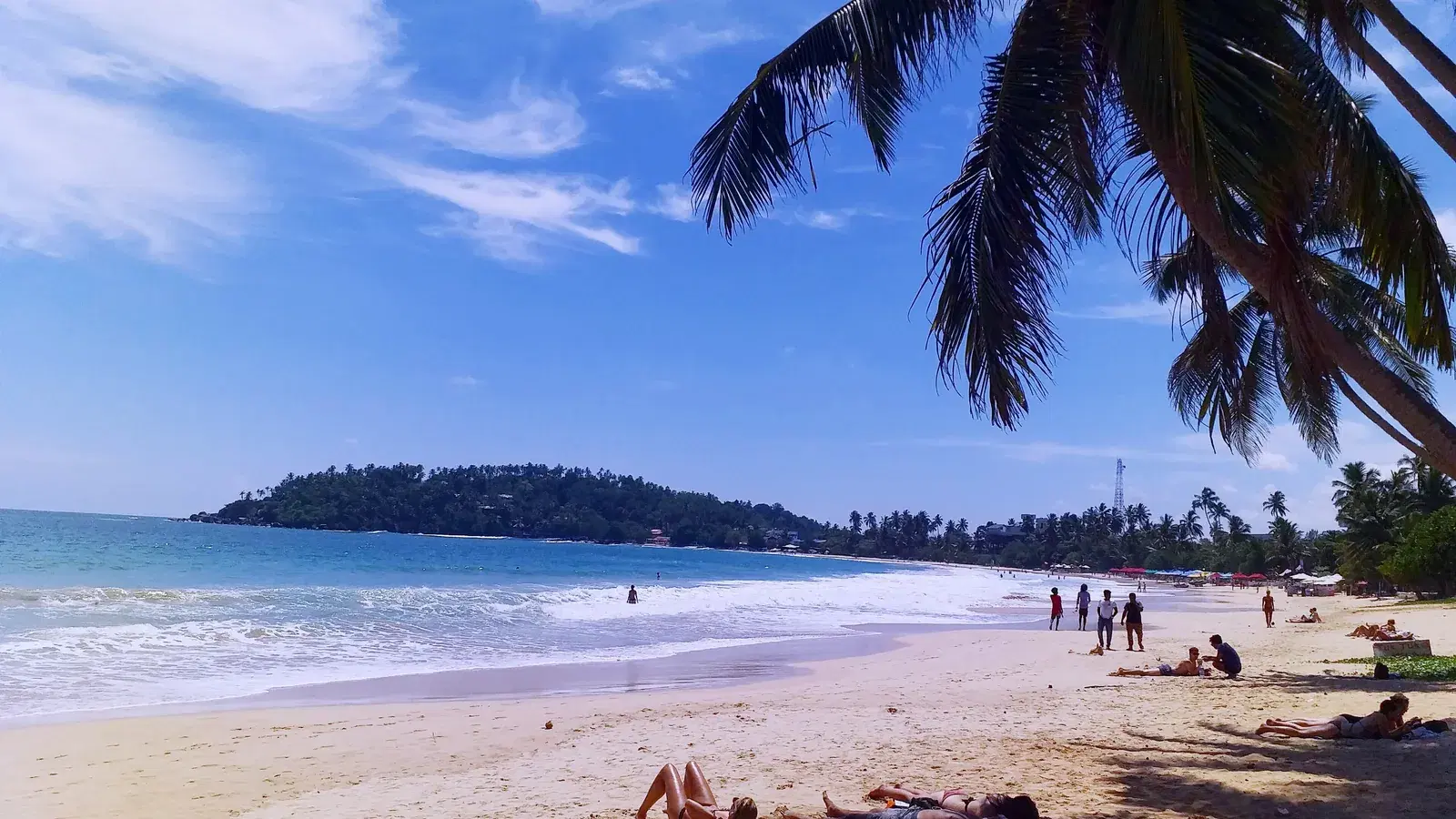
Mirissa is the whale-watching hub for this coast in season, with a main bay that is generally calm from November to April and a well-known palm-covered headland.

Hiriketiya is a small sheltered horseshoe that has gone from unknown to extremely popular in a few years. Beginner-friendly, compact, crowded, and genuinely lovely.

Tangalle has some of the most beautiful long beaches on the island and a reputation for dangerous water on the exposed main strip. Several sheltered coves nearby are much better for swimming. This is the clearest example on the coast of a beach where beauty and safety diverge — take local advice specifically.

Who it suits: first-timers, couples, food travellers, surfers, families wanting infrastructure, and anyone who wants the option of doing something other than lying on sand. Who it suits less: anyone seeking solitude in peak season.

Season November to April, peak December to MarchBest infrastructure, food and variety of the three coastsUnawatuna, Dalawella and Hiriketiya are the sheltered swimming picksWeligama for learning to surf; Midigama for experienced surfersTangalle is beautiful and its main strip is widely reported as hazardous

The East Coast: The Calmest and Clearest Water on the Island

In its season the east coast has water the south coast simply cannot match — flat, clear and warm, over white sand, with the best snorkelling in the country.

Season: roughly May to September, with some sources extending to October. Peak around June to August.

Trincomalee is the hub, with one of the deepest natural harbours in the world, the Koneswaram temple on Swami Rock, and a genuine town rather than a resort strip.

Uppuveli and Nilaveli are the beaches north of Trincomalee. Nilaveli in particular has very wide sand and notably gentle water in season, which makes it one of the better family options in the country.

Pigeon Island marine national park, reached by a short boat ride from Nilaveli, is the country's best snorkelling — coral gardens and frequent turtle encounters. Go on the earliest boat: the water is clearer and there are fewer boats. It is a protected marine park, which means reef etiquette matters and is enforced.

Pasikudah is the family beach of the east — a shallow bay where the water stays at knee depth a long way out, which is precisely what people with small children are looking for and rarely find. Kalkudah next door is longer and quieter.

Arugam Bay in the far southeast is the surf destination, running roughly May to October with most camps closing by the end of October. Outside surf season it largely shuts down.

Whale watching from Trincomalee runs in the opposite season to Mirissa. Sources give the window variously as May to September, May to October and March to September, with peak generally around June to August. Boats leave early, around six, and the deep water close to shore means a relatively short run out.

Who it suits: families with young children, snorkellers and divers, anyone who prioritises calm clear water over restaurants and nightlife, and travellers visiting between May and September. Who it suits less: anyone visiting between November and March, and anyone who wants a dense food and bar scene.

One practical note: the east is less developed than the south, which is the appeal and also means fewer options for food, medical care and transport. Plan accordingly rather than assuming south-coast levels of convenience.

Season roughly May to September, peak June to AugustNilaveli and Pasikudah are the calmest family water on the islandPigeon Island is the country's best snorkelling — take the first boatTrincomalee whale season runs opposite to Mirissa'sLess developed: fewer food, medical and transport options

The West Coast: The One Everybody Skips

The west coast gets dismissed as the bit you pass through between the airport and somewhere better. That is partly fair and partly a mistake.

Season: broadly the same as the south — November to April.

Negombo sits fifteen minutes from the international airport and is the standard first or last night. The beach is not the island's finest, but the lagoon, the fish market at dawn and the Dutch canal are genuinely worth a morning, and arriving on a long-haul flight and driving four hours to the south coast is a poor way to start a trip. Give it the first night.

Kalpitiya, on the northwest peninsula, is the west coast's real argument and one of the more under-documented destinations in Sri Lanka. It is the country's kitesurfing centre, with a large shallow lagoon that is close to ideal for learning and a season running roughly May to September — which, unusually for the west, is the southwest monsoon period. It is also the best place in Sri Lanka for spinner dolphins, with super-pods numbering in the hundreds from around November to April, plus sperm whale sightings in that window.

That gives Kalpitiya an unusual profile: a kiting season in the middle of the year and a marine wildlife season at the opposite end.

Bentota, Beruwala and Wadduwa form the established resort strip south of Colombo — larger hotels, watersports, river trips on the Bentota Ganga, and a turtle hatchery scene of very variable quality. Convenient and comfortable rather than characterful.

Mount Lavinia is Colombo's beach, useful if you are based in the city and want sand without leaving, though not a destination in itself.

The Bar Reef marine sanctuary off Kalpitiya is the largest reef system in Sri Lanka and has suffered significant bleaching; it remains of real ecological interest and conditions vary.

Who it suits: arriving and departing travellers, kitesurfers, dolphin watchers, and anyone who wants resort comfort close to the airport. Who it suits less: anyone looking for the classic Sri Lankan beach experience, which is further south.

Negombo is the sensible first and last night — fifteen minutes from the airportKalpitiya is the west's genuine destination and badly under-documentedKitesurfing season roughly May to September on the lagoonSpinner dolphin super-pods November to AprilBentota and Beruwala: comfortable resort strip, limited character

Choosing by What You Actually Want

The useful question is not which coast is best but which beach suits your purpose. Here is the honest sorting.

For swimming with small children: Pasikudah on the east in season, where the water stays knee-deep a long way out. Nilaveli is the other strong option. On the south coast, the reef-sheltered bays — Unawatuna, Dalawella, Hiriketiya — are the calmer choices, but none matches Pasikudah for genuinely shallow water.

For snorkelling: Pigeon Island off Nilaveli, comfortably. Hikkaduwa's coral sanctuary on the south coast is the alternative in the opposite season and is not in the same class.

For learning to surf: Weligama on the south coast from November to April. Arugam Bay's gentler points on the east from May to October.

For whales: Mirissa from November to April, Trincomalee from around May to September. For dolphins specifically, Kalpitiya from November to April, where the spinner pods number in the hundreds.

For food and things to do: the south coast, and it is not close. Galle Fort, a dense restaurant scene, Mirissa, and easy access to Yala and the hill country.

For quiet: Kalkudah on the east, the less-developed stretches around Tangalle, and Kalpitiya outside kite season. Anywhere described in a guide as up-and-coming five years ago is now busy.

For nightlife: Hikkaduwa, Unawatuna, Mirissa and Arugam Bay in its season. Sri Lanka's beach nightlife is modest by regional standards, which some people consider a feature.

For a first or last night near the airport: Negombo. This is not a compromise — it is the correct call.

For photography: the east coast in season for clear water and white sand; the south coast for palms, stilt fishermen and Galle Fort.

And for anyone whose core requirement is simply reliable safe swimming: the east coast in season, at a flagged beach, is the most dependable answer on the island.

Small children: Pasikudah, then NilaveliSnorkelling: Pigeon Island, by a distanceWhales: Mirissa Nov–Apr, Trincomalee May–Sep, Kalpitiya dolphins Nov–AprFood and variety: south coast, not closeReliable safe swimming: east coast in season, at a flagged beach

The Marine Wildlife Calendar

Because the seasons are opposite, Sri Lanka offers marine wildlife nearly year-round — provided you are on the right coast.

Blue whales off Mirissa and Dondra Head: November to April, generally peaking around December to March. Boats leave early and the run out is a few miles.

Blue and sperm whales off Trincomalee: sources give May to September, May to October and March to September, with peak generally reported around June to August. Trincomalee's deep water close to shore means a shorter run out than Mirissa, typically around thirty minutes, and whales are sometimes visible from Swami Rock.

Spinner dolphins off Kalpitiya: November to April, in pods that can number in the hundreds. Common, bottlenose, Risso's and humpback dolphins also occur, with sperm whales as a less reliable bonus.

Turtles: five species nest on Sri Lankan beaches, with nesting concentrated on the southwest and south coasts. Rekawa near Tangalle is the best-known site for observing nesting, which is a genuinely different and better experience than a hatchery. Turtle hatcheries along the southwest coast vary enormously in standard and some practices are questionable; we would rather you see nesting turtles in the wild with a guide than pay to hold a hatchling.

Reef life: Pigeon Island in the eastern season and Hikkaduwa's sanctuary in the southern one. Both have suffered bleaching events and neither is what it was twenty years ago, which is worth knowing before you set expectations.

A general point about booking marine wildlife trips: earlier boats mean calmer seas, better light and fewer vessels. On every one of these, take the first departure.

And a note we will expand elsewhere: whale watching in Sri Lanka has a documented problem with boats crowding and pursuing animals, particularly at the busiest hub in peak season. Operator conduct varies enormously. Ask about approach distances and how many boats the operator runs before booking, and treat an operator who promises guaranteed close encounters as a warning sign rather than a selling point.

Mirissa blue whales: November to April, peak December to MarchTrincomalee: roughly May to September, shorter run outKalpitiya spinner dolphins: November to April, pods in the hundredsRekawa for wild turtle nesting, rather than a hatcheryAlways take the first boat of the day

Getting There and Moving Between Coasts

The south coast is the easiest to reach and the east is the hardest, which is part of why the east stays quieter.

To the south coast: expressway buses from the Makumbura terminal at Kottawa in Colombo reach Galle in around ninety minutes and Matara in under two hours, at fares well under a thousand rupees. This is comfortably the best-value transport in the country and considerably faster than the train, though the coastal railway is more scenic. From Galle or Matara, local buses and tuk-tuks cover the surf towns.

To the west coast: Negombo is close to the airport and straightforward. Kalpitiya is a longer haul up the northwest coast, generally three to four hours from Colombo by road.

To the east coast: Trincomalee and Pasikudah are long journeys from Colombo — typically six hours or more by road. From the Cultural Triangle the east is much closer, which is why the sensible itinerary pairs Sigiriya or Habarana with Trincomalee rather than approaching from Colombo. Arugam Bay in the far southeast is a long journey from almost everywhere and should be treated as a dedicated leg.

Between coasts: this is the journey to avoid. Mirissa to Trincomalee is most of a day. Since the two are in opposite seasons, there is rarely a good reason to do it — if you find yourself planning it, the itinerary probably needs rethinking rather than optimising.

Note that rail services on some corridors remain affected following Cyclone Ditwah, so confirm the current position rather than assuming a connection exists.

Within a beach area, tuk-tuks handle everything. Agree the fare before setting off, or use a metered or app-based option where available.

South coast: expressway bus from Makumbura, Galle in ~90 minutesEast coast: six hours or more from Colombo; much closer from the Cultural TriangleKalpitiya: three to four hours from ColomboAvoid coast-to-coast transfers; they signal an itinerary problemConfirm current rail services before planning around them

Using the Coast Considerately

Sri Lanka's coast supports fishing communities, nesting turtles and reef systems that are already under pressure, and a few things matter more here than inland.

Reef-safe sunscreen, genuinely. Oxybenzone and octinoxate contribute to coral bleaching, and you will be swimming over reef at Pigeon Island and Hikkaduwa specifically. A rash vest does more than sunscreen and washes nothing into the water.

Never stand on, touch or collect coral. At Pigeon Island this is a protected marine park and it is taken seriously. Coral takes decades to recover from a moment of carelessness.

Do not buy coral, shells, turtle products or anything made from marine wildlife. There is a market because tourists buy.

On turtles: do not use flash photography near nesting turtles or hatchlings, do not handle them, and do not pay to hold a hatchling. Hatchery standards vary widely, and long-term tank retention of hatchlings is poor practice. Wild nesting observation with a licensed guide, at Rekawa for instance, is both a better experience and better for the turtles.

Respect fishing operations. Nets, lines, stilts and anchored boats are people's livelihoods. Do not swim or surf through them, and do not move gear for a photograph.

On the stilt fishermen: some are working fishermen and some now pose primarily for tourists and expect payment. Either is fine — but agree the arrangement before photographing rather than afterwards.

Dress with some awareness. Beachwear is fine on the beach and in beach restaurants; walking through a village or town in swimwear is not, and topless sunbathing is not culturally acceptable in Sri Lanka.

Take your rubbish with you, and be aware that plastic on Sri Lankan beaches is a visible and worsening problem. Several coastal towns run regular beach cleanups that welcome visitors.

And spend locally. Small guesthouses, family restaurants and local boat operators keep far more of what you pay in the community than the alternative, and the coastal economy is seasonal and thin.

Use reef-safe sunscreen, or better, a rash vestNever touch or stand on coralDo not pay to hold a hatchling; see wild nesting insteadNever swim or surf through fishing gearNo swimwear away from the beach; no topless sunbathing

Reisetipps

  • Pick one coast per trip; the seasons are opposite
  • Avoid April and October if beaches are the point of the trip
  • Swim between red and yellow flags — they mean lifeguards are present
  • Assume no lifeguard unless you can see one; most beaches are unpatrolled
  • Never swim after drinking; alcohol features in around 40% of drownings
  • If caught in a rip, swim parallel to shore, never against the pull
  • Ask your accommodation about that specific beach on that specific day
  • Swim where local people are swimming, and never alone or at night
  • If someone is in trouble, raise the alarm and throw something buoyant rather than swimming out
  • Take the first boat for whales, dolphins and Pigeon Island
  • Use reef-safe sunscreen, or a rash vest instead
  • Never touch or stand on coral, and do not buy marine souvenirs
  • See wild turtle nesting rather than paying to hold a hatchling
  • Do not walk through towns or villages in swimwear
  • Approach the east coast from the Cultural Triangle, not from Colombo
  • Confirm current rail services before planning a coastal train journey

Häufige Fragen

Which Sri Lankan coast should I visit?

It depends entirely on when you are travelling. West and south coasts from roughly November to April; east coast from roughly May to September or October. They are in opposite seasons, so the month decides the coast rather than the other way round.

Can I visit the south and east coasts on the same trip?

Not sensibly. They are in opposite seasons and most of a day apart by road, so in nearly every month one of them will be out of season. If your itinerary includes both, it probably needs rethinking rather than optimising.

Which beaches in Sri Lanka are safe to swim at?

The most reliable answer is a flagged beach on the east coast in season — Nilaveli and Pasikudah in particular, where Pasikudah stays knee-deep a long way out. On the south coast, the reef-sheltered bays such as Unawatuna, Dalawella and Hiriketiya are the calmer options. Always check locally on the day, because conditions change with season and swell.

Are Sri Lankan beaches patrolled by lifeguards?

A small number are. The Sri Lanka Coast Guard operates around sixteen lifesaving posts at key tourist beaches, and red and yellow flags mark where lifeguards are present and where it is safe to enter. On an island with more than a thousand kilometres of coast, that means the overwhelming majority of beaches have no rescue service at all.

How dangerous is swimming in Sri Lanka really?

Real enough to plan around. Coast Guard lifesavers have rescued 2,629 people since 2010, including 1,221 foreign nationals, and in April 2026 alone they rescued nineteen people — fourteen of them foreigners, aged five to sixty-two. Rip currents are the leading cause, they occur at beaches that look benign, and alcohol is reported as a factor in around 40% of incidents.

What should I do if I am caught in a rip current?

Do not swim directly back toward the beach against the pull — that is what exhausts people. Swim parallel to the shore until you are out of the channel, then come in at an angle. If you have a board or anything buoyant, stay with it: it keeps you afloat and makes you visible.

Where is the best snorkelling in Sri Lanka?

Pigeon Island marine national park off Nilaveli, by a clear margin, in the east coast season. Take the earliest boat — the water is clearer and there are fewer vessels. Hikkaduwa's coral sanctuary is the south coast alternative in the opposite season but is not in the same class.

When and where can I see whales?

Mirissa on the south coast from November to April, peaking around December to March. Trincomalee on the east from roughly May to September, with a shorter run out because the water is deep close to shore. For dolphins, Kalpitiya from November to April, where spinner pods can number in the hundreds.

Is the west coast worth visiting at all?

Negombo yes, as your first or last night — it is fifteen minutes from the airport and driving four hours south after a long-haul flight is a poor start. And Kalpitiya genuinely yes: it is the country's kitesurfing centre, with a season running roughly May to September, and the best place for spinner dolphins from November to April.

Which beach is best for young children?

Pasikudah on the east coast in season, where the water stays at knee depth a long way out, which is exactly what parents look for and rarely find. Nilaveli is the next best. On the south coast, the reef-sheltered bays are calmer but none is as shallow.

Are the turtle hatcheries worth visiting?

Standards vary enormously and some practices are poor, including long-term tank retention of hatchlings. We would rather you watch wild nesting with a licensed guide — Rekawa near Tangalle is the best-known site — than pay to hold a hatchling. It is a better experience and better for the turtles.

Can I wear swimwear away from the beach?

Beachwear is fine on the beach and in beach restaurants, but walking through a town or village in swimwear is not appropriate, and topless sunbathing is not culturally acceptable in Sri Lanka. Carry a cover-up.

How do I get to the east coast?

Approach it from the Cultural Triangle rather than Colombo. Trincomalee is six hours or more from Colombo by road but much closer from Sigiriya or Habarana, which is why the sensible itinerary pairs the two. Arugam Bay in the far southeast is a long journey from almost anywhere and works best as a dedicated leg.

Leser-Notizen

Mach mit beim Gespräch

Teile deine Frage, deinen Tipp oder deine Reiseerfahrung zu diesem Guide.

Kommentare

0 Kommentare

Wird geladen...

Bereit, Inspiration in eine Sri-Lanka-Reise zu verwandeln?

Nutze LankaTrip, um deine Reise zu planen, lokale Guides zu finden und diese Route Wirklichkeit werden zu lassen.

Hilfe bei der Planung?

Plane dein Sri-Lanka-Abenteuer

Reise planen