LankaTrip Einblicke

21 Min. Lesezeit

Temple Etiquette and Cultural Rules in Sri Lanka in 2026: What Foreign Visitors Must Know Before Arriving

Sri Lankans are famously forgiving of honest mistakes — but a small number of cultural lines are backed by law, and foreign visitors have been fined, refused entry and deported for crossing them. This 2026 guide separates the rules that carry legal risk from the customs that simply mark you as a considerate guest.

Zurück zum Blog
Temple Etiquette and Cultural Rules in Sri Lanka in 2026: What Foreign Visitors Must Know Before Arriving

Almost every first-time visitor to Sri Lanka arrives with a version of the same question, usually phrased apologetically: what am I going to accidentally get wrong?

The reassuring answer is that Sri Lanka is one of the more forgiving countries in Asia for a visitor who is visibly trying. People are patient, hospitable and generally delighted that you came. A tourist who fumbles a greeting or gets a temple dress code slightly wrong will be corrected kindly and then offered tea.

The less reassuring answer is that there is a narrow category of behaviour where the tolerance stops completely, and it is not obvious from the outside which behaviours those are. Buddhism holds the foremost place in Sri Lanka's constitution, and around seventy percent of the population is Buddhist. Disrespecting Buddhist images and artefacts, or making offensive remarks about religion, is treated as a serious offence and has led to arrests.

This is not theoretical. Foreign nationals have been detained at the airport, brought before a magistrate and deported over a tattoo. Others have received suspended prison sentences over a photograph. Several national governments explicitly warn their citizens about it in official travel advice.

This guide is organised around that distinction. First the rules that carry legal risk, stated plainly. Then the temple protocols that will get you turned away at a gate rather than arrested. Then the everyday customs that simply make you a better guest. Read the first section carefully and skim the rest — but read the first section.

Kurzüberblick

  • Cover shoulders and knees and remove shoes and hats before entering any Buddhist temple
  • Visible Buddha tattoos have led to foreign visitors being refused entry and deported; keep them fully covered
  • Never pose with your back to a Buddha statue for a photograph
  • Alcohol and fresh meat sales are restricted nationally on monthly Poya full-moon days
  • Hindu temples in the north enforce their own stricter rules, including shirt removal for men at some kovils
  • Sri Lankans are genuinely patient with honest errors, so a visible effort to get it right matters more than perfection

The Rules That Carry Legal Risk

Start here. Everything in this section has resulted in real consequences for real foreign visitors.

Visible Buddha tattoos. This is the single most serious risk for travelers and the one most often discovered too late. British nationals have been refused entry to Sri Lanka or deported for having visible tattoos of the Buddha, and the UK government states this directly in its travel advice. In one widely reported 2014 case, a British woman arriving from India was detained at Colombo airport after a tattoo of the Buddha seated on a lotus was noticed, held before a magistrate, and deported. She was a practising Buddhist. That made no difference. An earlier case in 2013 saw a British man refused entry over the same issue. There is no statute specifically banning Buddha tattoos, which is precisely why the outcome is unpredictable. If you have one, cover it completely for the entire duration of your stay — long sleeves, a bandage, whatever works — including at immigration and in taxis.

Photographs that disrespect Buddha images. Posing with your back to a Buddha statue for a selfie is treated as disrespectful because you are turning your back on the most sacred object in the space. Official advice from several governments explicitly warns against it. In 2012, three French tourists received six-month suspended prison sentences for kissing a Buddha statue. A visitor was deported for a photograph pretending to kiss a statue. The safe alternative is simple: stand beside the statue facing the same direction, or face it directly.

Australian government advice goes further, noting that it is illegal to mistreat Buddhist images and that this extends to posing for photos with Buddha statues and to wearing tattoos, clothing or jewellery associated with Buddhism.

Clothing and merchandise depicting the Buddha or any deity. That temple-print vest or Buddha-head necklace sold in Bangkok is a poor choice here. Leave it out of your luggage.

Offensive remarks about religion. Making disrespectful public comments about Buddhism is a serious offence and could lead to arrest. This includes joking about it loudly in bars and on social media while in the country.

Photography of government and military installations. This is strictly forbidden and should simply never be attempted, particularly in the north and east.

Antiquities. Exporting certain items, including antiquities, requires legal authorisation from the Department of Archaeology. Do not buy old religious statuary or artefacts without documentation.

Cover Buddha tattoos completely for your entire stayNever turn your back on a Buddha statue for a photoAvoid clothing or jewellery depicting the BuddhaOffensive remarks about religion can lead to arrestNever photograph military or government installations

What to Wear at a Buddhist Temple

The dress code is consistent across the island and easy to satisfy once you know it.

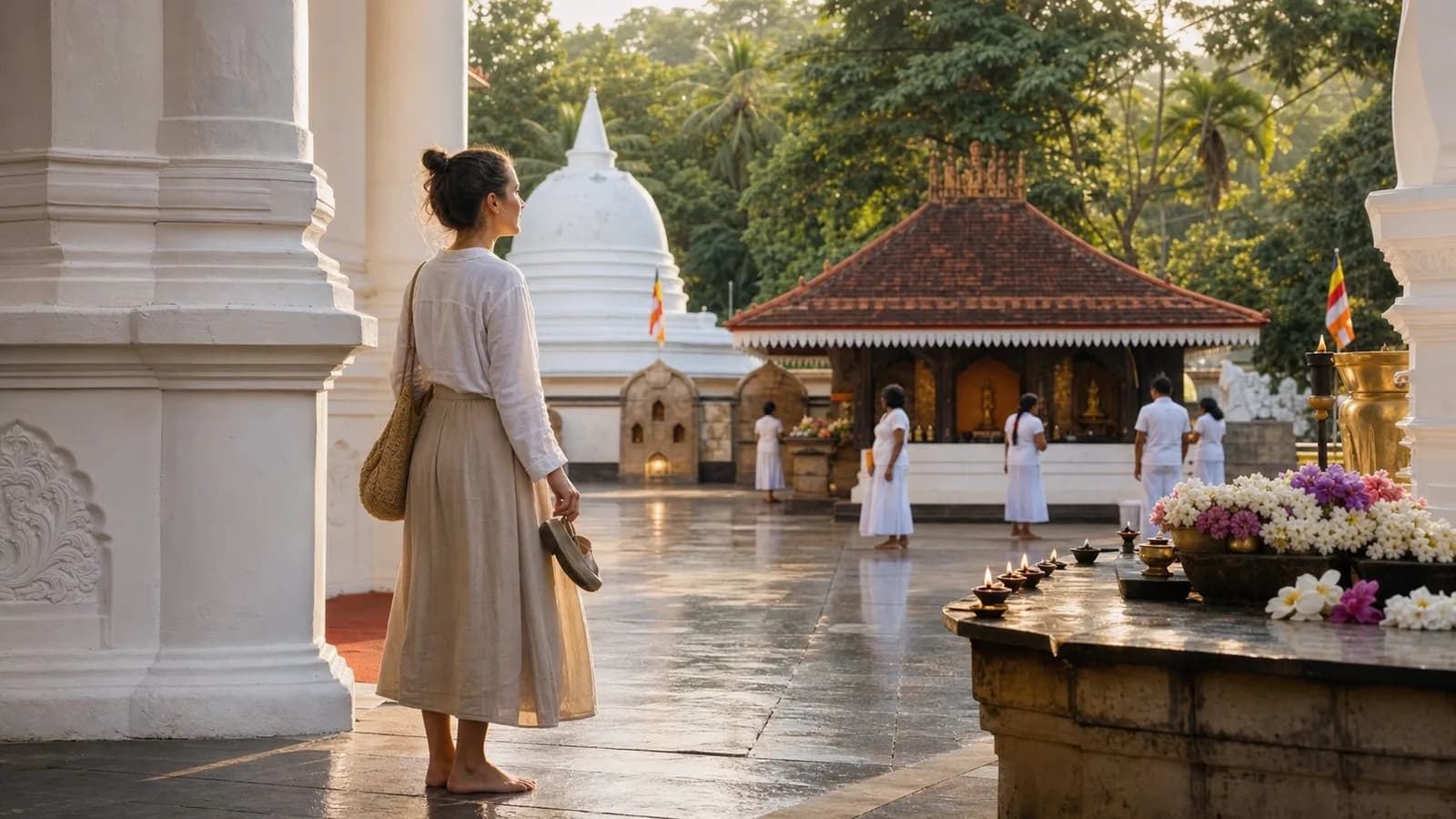
Cover your shoulders and your legs. Knees should be covered as a minimum, and longer is better. This applies equally to men and women, and it applies at every Buddhist temple in the country regardless of how touristed it is.

Remove shoes and hats before entering. Socks usually come off too, and at many sites you will be walking on stone that has been in full sun all day, which is a strong argument for early morning or late afternoon visits. Carrying a spare pair of clean socks is a common trick, though check whether the specific site permits them.

White is traditional. Sri Lankan worshippers often wear white to temples, particularly on Poya days. You are not required to, but wearing plain, modest, light-coloured clothing fits in well.

Practical advice that solves almost every situation: keep a large sarong or scarf in your day bag from the moment you land. It covers shoulders, wraps as a skirt, doubles as a sun cover and weighs nothing. Many major sites have sarongs available at the entrance, sometimes for a small fee, but relying on that is a gamble at smaller temples.

Shorts are the most common failure point. Above-knee shorts will not get you into most temples, and swimwear or vest tops certainly will not. If your itinerary includes a temple stop, dress for the temple and be warm for the rest of the day rather than the reverse.

Enforcement varies by site. Major destinations like the Temple of the Sacred Tooth Relic in Kandy are firm and well signposted. Smaller village temples may say nothing at all — which is not permission, simply politeness.

Shoulders and knees covered, men and women alikeShoes and hats removed before enteringWhite or plain light clothing fits local practiceAlways carry a sarong or large scarfShorts are the most common reason visitors are refused

How to Behave Inside a Buddhist Temple

Once you are past the gate, a handful of behaviours separate a respectful visitor from an awkward one.

Never point your feet at a Buddha image, a monk or a shrine. Feet are considered the least clean part of the body. When sitting in a shrine room, tuck your feet behind you or sit cross-legged rather than stretching your legs forward. This one rule catches more visitors than any other.

Do not sit or climb on any part of a shrine, stupa or statue, and never touch a Buddha image unless you are specifically invited to.

Walk clockwise around a stupa or dagoba, keeping it on your right. This is the traditional direction of circumambulation and following it marks you immediately as someone who has paid attention.

Keep your head lower than Buddha images where the layout makes that possible, and never stand on a raised surface to photograph one from above.

Do not eat, drink or smoke within temple premises. Keep your voice low. Phones on silent.

Photography rules differ by site. Some heavily visited temples permit respectful photography; others prohibit it entirely in shrine rooms. Look for signage, and when in doubt ask. Never photograph a worshipper mid-prayer, and never use flash near ancient murals — Sri Lanka has irreplaceable painted interiors that have already suffered from visitor flash.

If you want to make an offering, flowers, incense and oil lamps are commonly offered and are usually available near the entrance. Doing so is welcomed but never expected of visitors.

Never point your feet at images, monks or shrinesWalk clockwise around stupasNo eating, drinking or smoking on temple premisesCheck photography rules and never use flash on muralsOfferings are welcomed but never required

Interacting With Monks

Buddhist monks occupy a position of high respect in Sri Lankan society, and the conventions around them are stricter than most visitors expect.

Do not touch a monk. This applies generally and applies absolutely to women, for whom physical contact with a monk breaches monastic rules rather than mere etiquette. Do not offer a handshake; a slight bow with palms together is the correct greeting.

Women should not hand objects directly to a monk. If you need to pass something, place it down for the monk to pick up, or pass it through a male intermediary. This is not a slight — it is a requirement of the monastic code, and monks will appreciate a visitor who already knows it.

On public transport, seats are commonly given up for monks, and there are often designated seats at the front of buses. Follow local practice.

Do not sit at a level higher than a senior monk where seating allows a choice, and do not turn your back to a monk while seated in a shrine room.

Ask before photographing monks. Many are entirely happy to be photographed, particularly in temple settings, but the question matters.

If you are invited to observe or join an almsgiving, particularly around Kandy where morning offerings to monks remain part of daily life for some families, treat it as a genuine privilege. Dress conservatively, follow instructions, and do not treat the ritual as a photo opportunity.

Never touch a monk, especially if you are a womanWomen should not hand items directly to a monkGreet with palms together rather than a handshakeGive up your seat on buses and trainsAsk before photographing

Hindu Kovils: Different Rules, Stricter Enforcement

Sri Lanka's Hindu temples, particularly in the north and east and in Tamil communities elsewhere, operate under a distinct set of conventions. Visitors who assume Buddhist temple rules will carry over frequently get this wrong.

Footwear is removed, as at Buddhist sites, but at many kovils this extends to the surrounding sand or courtyard area rather than just the building.

At several important kovils, including Nallur Kandaswamy in Jaffna, men are required to remove their shirt entirely before entering the complex. It must be carried or tied at the waist rather than draped over a shoulder. A verti or dhoti is preferred but trousers are accepted. This is enforced at the gate without exception.

Women must cover shoulders and legs, and at stricter temples hair should be tied rather than worn loose. Enforcement at northern kovils is noticeably firmer than at tourist-oriented southern sites.

Leather items are prohibited inside many Hindu temples. Leave leather belts, bags and watch straps in your vehicle or accommodation.

Do not enter the inner sanctum, and do not photograph inside sanctums or during ceremonies. Restrictions are often unsigned and simply assumed.

Some Hindu temples observe traditional restrictions on entry for menstruating women. Visitors will not usually be questioned, but it is worth knowing that these conventions exist and are taken seriously by the communities concerned.

One general principle applies at every kovil: these are working places of worship serving daily ritual, not heritage attractions with a religious theme. Move quietly and stay out of processional paths.

Men remove shirts at some major kovils, including NallurWomen cover shoulders and legs, hair tied at stricter sitesLeather items are prohibited at many Hindu templesFootwear removed well before the building itselfNorthern enforcement is stricter than southern

Poya Days and What They Mean for Your Trip

Every full moon is a Buddhist religious holiday called Poya, and it has direct, practical consequences for travelers that catch out an enormous number of visitors.

Alcohol sales are prohibited nationally. This is not a matter of individual venue policy. Bars, restaurants, bottle shops and hotel bars will not sell alcohol on Poya day. Some international hotels operate in a grey area with minibar service, but publicly available alcohol simply is not.

Fresh meat is also restricted, and in practice becomes difficult to find in many areas. Restaurants in strongly Buddhist communities often run vegetarian-only menus on the day.

You may drink alcohol purchased beforehand in a private space such as your own hotel room. Buying in advance is the standard workaround, and locals will tell you to do exactly that.

Many shops and businesses close, entertainment can be restricted, and public transport is often busier as people travel to temples.

The other side of Poya is that it is one of the best days of the month to visit a temple. Sites fill with white-clad worshippers, ceremonies run through the day, and the atmosphere is entirely different from an ordinary afternoon. If you want to see living Buddhist practice rather than an empty archaeological site, plan a temple visit for a Poya day.

There are twelve or thirteen Poya days per year, since lunar and solar calendars do not align. Check the dates against your itinerary before booking, particularly if a special dinner or celebration is planned. Vesak in May and Poson in June are the most significant and the most spectacular, with lantern displays and public food offerings across whole neighbourhoods.

National alcohol sales ban on every Poya dayFresh meat restricted and often unavailableBuy in advance and drink privately if you wish toBest day of the month to see living temple practiceVesak in May and Poson in June are the highlights

Everyday Customs Outside the Temple

The rules that govern ordinary interaction are softer, but observing them changes how you are treated across an entire trip.

Greeting. Ayubowan, spoken with palms pressed together, is the traditional Sinhala greeting and translates roughly as a wish for long life. In the Tamil-speaking north and east, vanakkam serves the same purpose. Using the right one in the right region is noticed and appreciated.

Eating. Sri Lankans traditionally eat with the right hand, and the technique — mixing rice and curry with the fingers and using the thumb to push it in — is worth attempting at least once. The left hand is considered unclean and should not be used for eating or for passing food. Cutlery is universally available if you prefer it.

The head and the feet. Do not touch anyone's head, including a child's, as the head is considered the most sacred part of the body. Correspondingly, avoid pointing your feet at people, showing the soles of your feet, or stepping over someone seated on the floor.

Hospitality. If tea is offered, accept it. Refusing hospitality outright is more awkward here than it would be at home, and the offer is usually sincere rather than formal. Removing shoes when entering a private home is standard.

Public affection. Sri Lanka is socially conservative in public. Holding hands is unremarkable; kissing and prolonged embraces in public are not. Nude and topless sunbathing is not permitted anywhere.

Dress outside temples. Beach and resort areas are relaxed, but in towns, villages, markets and on public transport, modest dress is the norm. Women travelling alone in particular may find that dressing modestly reduces unwanted attention considerably.

The right-hand rule extends beyond food. Give and receive items, particularly money and gifts, with the right hand or with both hands.

Head wobble. The side-to-side head movement is not a no. It generally means yes, understood, or agreement. It takes about three days to stop misreading it.

Ayubowan in the south, vanakkam in the northEat with the right hand; never use the left for foodNever touch anyone's head, including children'sAccept tea when offeredModest dress in towns, villages and on transport

Photography: Where the Line Sits

Photography causes more accidental offence in Sri Lanka than any other visitor behaviour, partly because the rules vary so much by context.

The absolute prohibitions: no photographs of military installations, checkpoints, personnel or government institutions. No photographs that place you in a disrespectful position relative to a Buddha image. No flash near ancient murals.

The permission-based situations: photographing individual people, worshippers, monks, tea pluckers, farmers, market vendors and children. Ask first, every time. A gesture towards the camera and a raised eyebrow is universally understood, and the answer is usually yes.

There is a specific problem with photographing workers. Tea estate pluckers and farm labourers are among the most photographed people in the country and among the least consulted about it. Ask, and consider buying something from them.

Children require particular care. Do not photograph children without a parent's clear consent, and do not post identifiable images of other people's children online.

At religious sites, look for signage first and ask second. Some temples permit photography in outer areas but not in shrine rooms. Some permit it entirely. Some prohibit it entirely. Ceremonies are generally off-limits regardless of the site's general policy.

Drones deserve their own warning. Drone use is subject to regulation and is restricted or prohibited over many archaeological sites, religious sites and anywhere near military installations. Check current requirements before travelling with one, and never fly over a temple, a village or a private property without permission.

A useful general test: if the person in your frame would be uncomfortable knowing the photograph existed, do not take it.

Never photograph military or government installationsAlways ask before photographing peopleTea pluckers and workers deserve the same courtesyCheck signage at every religious siteDrone use is restricted, especially over heritage sites

Other Legal and Practical Notes for Foreign Visitors

A few remaining points fall outside temple etiquette but belong in any honest briefing.

Public drinking and smoking. Drinking alcohol in public places such as streets, parks and buses is prohibited and can be fined. The same applies to smoking in designated non-smoking public areas. Bars, restaurants and licensed premises are entirely fine.

Drug laws are severe. Sri Lanka enforces strict legislation covering possession, use and trafficking of controlled substances, with long prison terms and heavy fines. Cannabis is illegal for recreational use, despite a narrow licensed exception for traditional Ayurvedic medicine dispensed through regulated channels. Do not accept anything offered on a beach.

The legal drinking age is 21.

Same-sex relations remain illegal under colonial-era legislation. The UK Foreign Office notes it is not aware of prosecutions, and enforcement against tourists is not typical, but LGBTQ+ travelers should be aware of the legal position and exercise discretion in public.

Removing natural material is an offence. Taking coral, shells, sand or wildlife from beaches and national parks is illegal and can attract substantial fines. This is enforced.

Fuel and vehicle registration systems have applied to private vehicles in recent years. If hiring a private vehicle rather than travelling with an operator, confirm the arrangements with the hire company beforehand.

Finally, a note on proportion. The purpose of this list is not to make Sri Lanka sound intimidating. Millions of visitors travel here every year without incident, and the overwhelming majority of interactions with Sri Lankans are warm, generous and entirely unbothered by minor errors. The rules that carry real consequence are few and specific, and knowing them frees you to relax about everything else.

Public drinking and smoking can attract finesDrug penalties are severe and strictly enforcedSame-sex relations remain technically illegalRemoving coral, shells or sand is an offenceThe genuinely risky rules are few and specific

Practical Preparation Before You Fly

Turning all of the above into action takes about ten minutes of packing decisions.

Pack a large sarong or lightweight scarf and keep it in your day bag from arrival. It is the single most useful cultural item you can carry.

Pack at least one set of temple-appropriate clothing: long trousers or a long skirt and a top covering the shoulders, in a light fabric that survives heat.

Pack slip-on footwear. You will remove your shoes several times a day at religious sites, and laced boots become tedious quickly.

Pack clean socks for hot stone surfaces at archaeological and temple sites, checking site rules on whether they are permitted.

Leave behind anything depicting the Buddha or any deity — clothing, jewellery, bags, phone cases.

If you have a Buddha tattoo, plan the cover from the airport onwards, not from the first temple. The reported cases involve arrival at immigration and the airport taxi rank, not temple gates.

Check the Poya calendar against your itinerary and note the dates, particularly if you have planned a celebration or a specific dining experience.

Learn four words: ayubowan, vanakkam, istuti and nandri. Hello and thank you in both languages. It takes five minutes and changes hundreds of small interactions across a trip.

And keep the underlying principle in mind, because it covers every situation this guide has not anticipated: in Sri Lanka, visible effort counts for more than perfect knowledge. People notice when you are trying.

A sarong is the most useful cultural item you can packSlip-on shoes save time at every religious siteLeave Buddha-imagery clothing and jewellery at homePlan tattoo coverage from the airport onwardsLearn hello and thank you in both languages

Reisetipps

  • Keep a sarong or large scarf in your day bag from the moment you land
  • Cover any Buddha tattoo completely from arrival at immigration onwards
  • Never pose with your back to a Buddha statue for a photograph
  • Wear slip-on shoes, since you will remove them several times a day
  • Buy alcohol the day before a Poya day if you want it
  • Carry clean socks for hot stone at temple and archaeological sites
  • Leave clothing and jewellery depicting the Buddha or any deity at home
  • Ask before photographing any person, including tea pluckers and vendors
  • Do not touch monks, and women should not hand items to them directly
  • Remove leather items before entering Hindu temples
  • Learn ayubowan and vanakkam for the south and north respectively
  • Eat with your right hand and never pass food with your left

Häufige Fragen

What should I wear to a temple in Sri Lanka?

Cover your shoulders and at least your knees, in light modest clothing, and remove shoes and hats before entering. This applies equally to men and women at every Buddhist temple. White or plain light colours align with local practice. Carrying a large sarong solves almost every situation, since shorts and vest tops will see you refused entry.

Can I visit Sri Lanka with a Buddha tattoo?

Only if you can keep it completely covered for your entire stay. Foreign nationals have been refused entry, detained and deported over visible Buddha tattoos, and several governments warn about this in official travel advice. There is no specific statute banning them, which makes outcomes unpredictable. Plan the cover from the airport onwards, not just for temple visits, since reported cases involved immigration and the airport taxi rank.

Why can't I take a selfie with a Buddha statue?

Posing with your back to a Buddha image is considered disrespectful because you are turning your back on the most sacred object in the space, and disrespecting Buddhist images is treated as a serious offence. Visitors have faced legal consequences including suspended sentences and deportation for photographs involving Buddha statues. Stand beside the statue facing the same direction, or face it directly.

What happens on a Poya day?

Poya is the monthly Buddhist full moon and a public holiday. Alcohol sales are prohibited nationally across bars, restaurants and shops, fresh meat is restricted and often unavailable, many businesses close and entertainment can be restricted. You may drink alcohol bought beforehand in a private space. It is also the best day of the month to visit a temple and see living Buddhist practice.

Are the rules different at Hindu temples?

Yes, and they are often stricter. Leather items are prohibited at many kovils. At several major temples in the north, including Nallur Kandaswamy in Jaffna, men must remove their shirt entirely before entering the complex. Women cover shoulders and legs and may be expected to tie their hair. Footwear comes off well before the building itself, and enforcement at northern kovils is firmer than at tourist-oriented southern sites.

Can I photograph inside temples in Sri Lanka?

It depends entirely on the site. Some heavily visited temples permit respectful photography, others prohibit it in shrine rooms, and some prohibit it entirely. Look for signage and ask when unsure. Never use flash near ancient murals, never photograph worshippers mid-prayer, and never photograph during a ceremony regardless of the site's general policy.

How should I behave around Buddhist monks?

Do not touch a monk, and this applies absolutely to women, for whom contact breaches monastic rules. Greet with palms together rather than a handshake. Women should not hand items directly to a monk but should place them down or pass them through a male intermediary. Give up seats on public transport, and ask before taking photographs.

Is Sri Lanka strict about how tourists dress generally?

Outside temples, beach and resort areas are relaxed, but towns, villages, markets and public transport are socially conservative and modest dress is the norm. Nude and topless sunbathing is not permitted. Women travelling alone often find that dressing modestly noticeably reduces unwanted attention.

What are the most common mistakes foreign visitors make?

Wearing shorts to a temple, pointing feet towards a Buddha image while sitting, taking a selfie with their back to a statue, arriving on a Poya day expecting to buy alcohol, touching a child's head affectionately, and photographing people without asking. Most cost nothing more than embarrassment, but the statue photograph and any visible Buddha tattoo carry genuine legal risk.

Will Sri Lankans be offended if I get something wrong?

Rarely, and this is worth emphasising. Sri Lankans are widely regarded as patient and generous with honest mistakes, and a visitor who is visibly making an effort will be corrected kindly rather than criticised. The exceptions are the specific rules around Buddha images and religious respect, where the response is legal rather than social.

Leser-Notizen

Mach mit beim Gespräch

Teile deine Frage, deinen Tipp oder deine Reiseerfahrung zu diesem Guide.

Kommentare

0 Kommentare

Wird geladen...

Bereit, Inspiration in eine Sri-Lanka-Reise zu verwandeln?

Nutze LankaTrip, um deine Reise zu planen, lokale Guides zu finden und diese Route Wirklichkeit werden zu lassen.

Hilfe bei der Planung?

Plane dein Sri-Lanka-Abenteuer

Reise planen